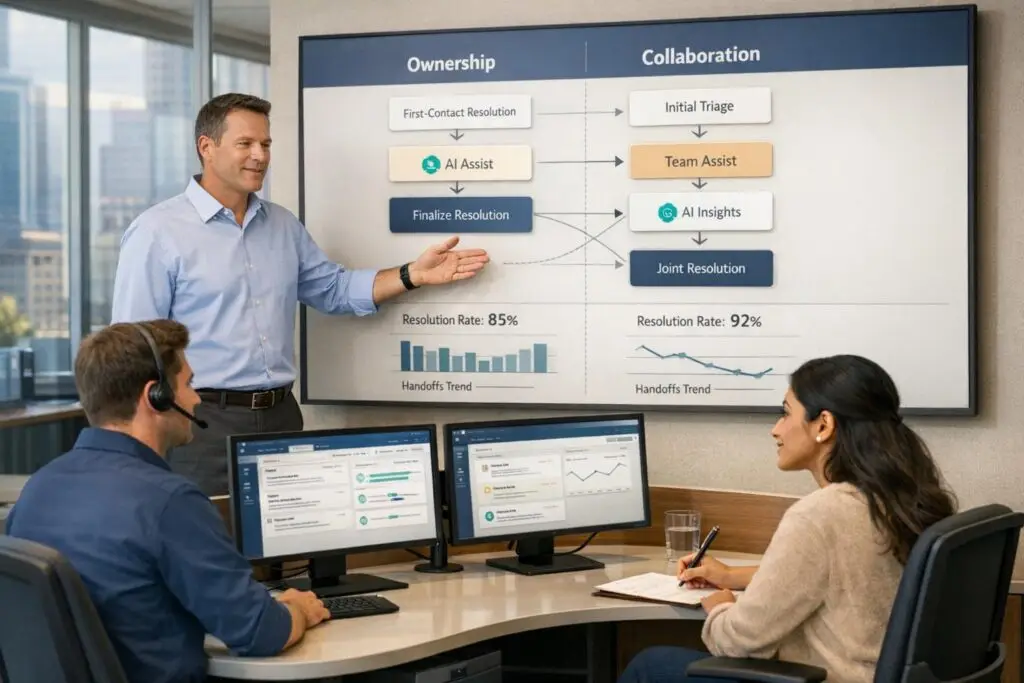
B2B customer support today demands a balance between ownership and collaboration. Here’s what that means:
- Ownership: Agents take full responsibility for issues until they’re resolved.
- Collaboration: Agents involve the right teammates while keeping all case details clear and accessible.
When these expectations aren’t clear, problems like over-escalation, context loss, and knowledge silos arise. AI tools can help by improving workflows, flagging issues early, and ensuring seamless handoffs.
Key Steps to Train Agents:
- Define Expectations: Clarify what ownership and collaboration look like in practice.
- Identify Gaps: Use data to spot where agents fall short, like unresolved tickets or poor handoffs.
- Targeted Training: Use real scenarios and role-playing to improve agent behavior.
- Monitor Results: Track metrics like resolution rates and customer satisfaction to measure progress.
Takeaway: Combining clear standards, effective training, and AI-powered workflows helps agents resolve issues faster and build customer trust.
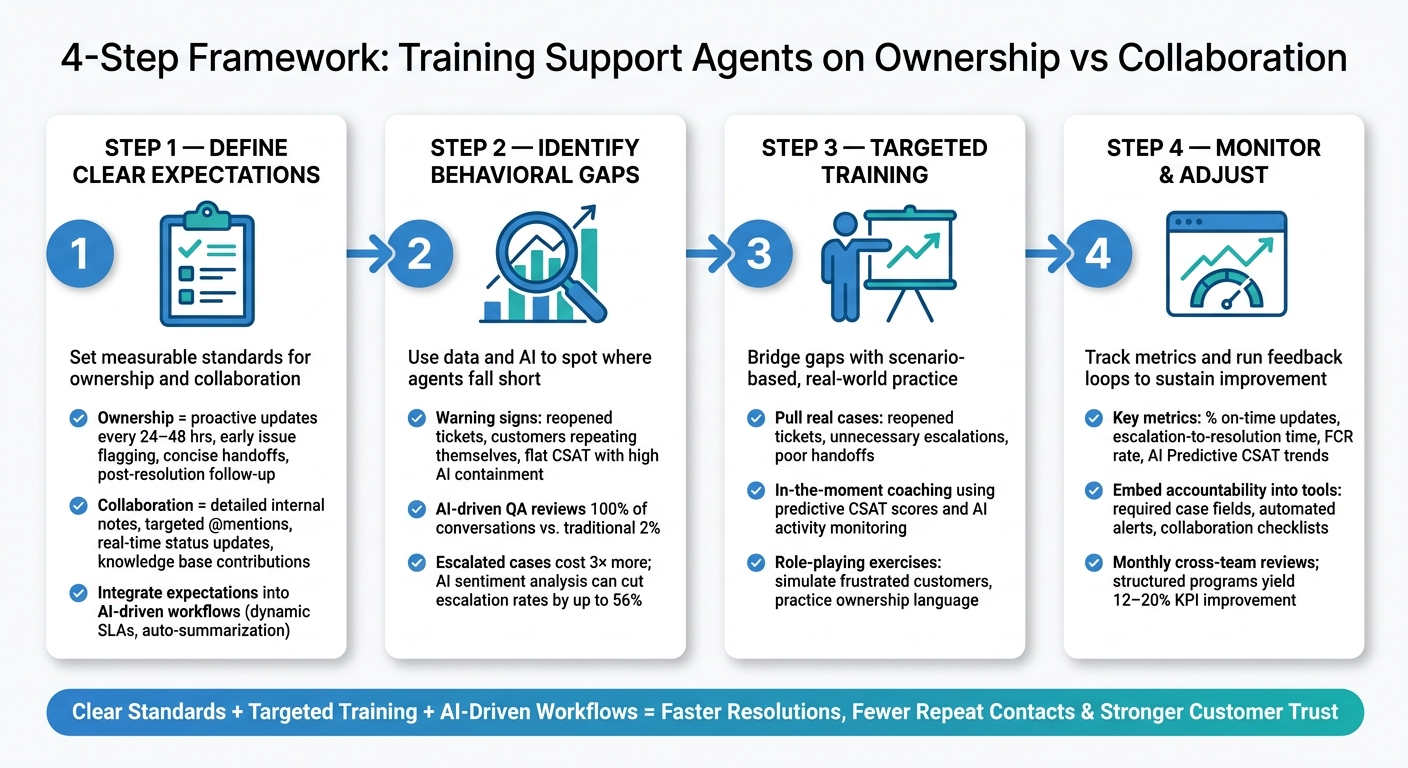
4-Step Framework: Training Support Agents on Ownership vs Collaboration
Step 1: Define Clear Expectations for Ownership and Collaboration
Before training agents on specific behaviors, it’s important to define what those behaviors look like in clear, measurable terms.
What Ownership Looks Like in Practice
Ownership in customer support boils down to four key actions:
- Proactively updating status: Provide updates every 24–48 hours, even when there’s no new progress.
- Flagging issues early: Notify a manager about a ticket before an SLA breach instead of explaining it afterward.
- Delivering concise handoffs: When escalating, include a TL;DR summary that highlights the core issue, troubleshooting steps already taken, any blockers, and the business impact on the customer.
- Following up post-resolution: Check back three days after deploying a fix to ensure it works in the customer’s environment.
This last point reflects a growing trend in B2B support: account-based ownership. It’s not just about resolving individual tickets but keeping an eye on the overall health of the client relationship.
What Collaboration Looks Like in Observable Actions
Collaboration is about making work transparent and accessible to the team. Effective collaboration involves:
- Writing detailed internal notes about troubleshooting steps already tried.
- Using targeted @mentions to involve the right subject matter expert (SME) instead of assigning the ticket to a general queue.
- Keeping ticket statuses, such as "Waiting for Dev", updated in real time on shared dashboards.
- Adding to the knowledge base when a case reveals missing or unclear documentation.
Training should emphasize that group success matters more than individual metrics [3]. With these behaviors defined, the next step is to see how AI-driven workflows can help reinforce them.
Connecting Expectations to AI-Driven Workflows
Once expectations are clear, integrate them into support tools to automate and reinforce these behaviors in an AI-powered support environment.
For example, Supportbench’s dynamic SLAs can adjust "Time to Next Response" targets based on factors like customer sentiment or account tier. This ensures agents take proactive ownership without requiring managers to manually flag every high-risk ticket. Similarly, auto-summarization features provide collaborators with instant case context, removing the need for manual briefings and reducing the friction often associated with teamwork.
| AI Feature | Drives Ownership | Fosters Collaboration |
|---|---|---|
| Sentiment Analysis | Alerts agents to high-stakes cases needing personal accountability | Signals when a specialist should be involved |
| Escalation Prediction | Encourages early resolution to avoid SLA breaches | Highlights when cross-functional help is needed |
| Auto-Summarization | Ensures owners provide clear handoff histories | Gives collaborators immediate context |
| Intelligent Routing and Prioritization | Assigns ownership based on agent expertise | Connects cross-department teams to a single ticket |
Before automating workflows, take time to map out and refine your support process. Automating a flawed system only speeds up the problems [4].
sbb-itb-e60d259
Step 2: Identify Gaps in Current Agent Behavior
Once you’ve set clear expectations in Step 1, the next step is pinpointing where agents fall short. Addressing these gaps early can help you avoid escalations, customer churn, or losing clients altogether.
Spotting Warning Signs in Interaction Patterns
Ownership issues usually show up as patterns across multiple tickets. For instance, if a customer reaches out again within a few days of a case being marked "resolved", it’s a red flag. It likely means the agent closed the ticket without fully addressing the root problem. Another warning sign? High AI containment rates paired with flat or declining CSAT scores[1].
Collaboration breakdowns are another common issue. If customers have to repeat themselves when transferred to another agent, it’s a sign of poor handoff practices. AI tools can help by flagging instances where conversation context gets lost during these transitions. Additionally, if a customer expresses frustration multiple times in a single interaction, it’s a clear signal of low ownership that warrants further review[5].
Leveraging QA Scoring for Better Coaching
Traditional QA methods, where only 2% of conversations are reviewed, often miss critical coaching opportunities. AI-driven QA, on the other hand, can analyze 100% of conversations daily, applying a consistent rubric to highlight patterns in agent behavior over time[2].
The key to effective QA is using a rubric designed to measure ownership and collaboration – not just tone or adherence to policies. For example, did the agent gather all necessary context within 30 seconds of a handoff? Did they clearly outline the next steps instead of leaving the customer with vague assurances like "we’ll look into it"? Tools like Supportbench’s QA insights can automatically flag cases that need attention, giving managers a prioritized list of coaching opportunities rather than overwhelming them with transcripts to sift through.
"Tier-1 deflection without an archetype-level CSAT breakdown is a vanity number waiting to be exposed at the next quarterly review." – Digital Applied Field Note[2]
For this process to succeed, agents need to trust it. Transparent rubrics – where agents can see exactly how and why they were scored – help ensure the feedback feels fair and constructive[2].
Beyond improving individual performance, these gaps also have a direct impact on business outcomes.
Understanding the Business Impact of Behavioral Gaps
Behavioral gaps can be costly. Escalated cases, for example, cost three times more than standard ones. By using AI-driven sentiment analysis to catch these issues early, businesses can cut escalation rates by as much as 56%[6].
To measure these gaps effectively, focus on metrics that go beyond simple ticket volume. For instance:
- Resolution rate: Was the problem genuinely solved, or just deferred?
- Delayed CSAT: Survey customers 48–72 hours after their interaction to identify cases where tickets were closed prematurely.
- Transfer and repeat contact rates: These metrics highlight where ownership and collaboration are breaking down and the costs associated with them.
Step 3: Train Agents Using Targeted Methods
Once you’ve pinpointed the gaps, the next step is bridging them with training that hits the mark. Generic training won’t cut it here – agents need to practice handling the exact scenarios they’ll encounter. From high-pressure ownership challenges to tricky handoffs with unhappy customers, the training must directly address the behaviors identified in Step 2 and turn those insights into actionable skills.
Scenario-Based Training Built from Real Cases
Your case history holds the best training material. Pull examples where things went wrong – tickets that were reopened, escalated unnecessarily, or required customers to repeat themselves – and use them to create realistic training scenarios. These examples show agents what effective problem-solving looks like. Tools like Supportbench’s AI case summaries can speed up the process by identifying cases that highlight ownership or collaboration issues. By tying these scenarios to the specific gaps identified earlier, you’re ensuring the training is grounded in real-world challenges.
"Great agents take ownership. They do not just close tickets. They solve problems fully." – SupportZebra [7]
In-the-Moment Coaching with AI Support
Live feedback beats delayed reviews every time. With tools like Supportbench’s predictive CSAT scores and AI activity monitoring, managers get a real-time view of how cases are unfolding. If a case’s predictive CSAT score starts to dip during an interaction, managers can step in right away, rather than waiting for a negative survey response. This kind of immediate coaching helps agents see the bigger picture:
"When agents understand the bigger picture, they make better choices. They stop acting like task workers. They start acting like team members." – SupportZebra [7]
To reinforce these lessons, you can also incorporate interactive role-playing that mirrors real-time challenges.
Role-Playing to Practice Conflict and Collaboration
Role-playing is most effective when it’s based on actual problem areas, not generic scripts. Using insights from QA scoring and case analysis (Step 2), create exercises that focus on recurring communication issues. For example, simulate a situation where one agent plays a frustrated customer – someone who’s been transferred multiple times and forced to repeat their issue – while another agent practices taking ownership by acknowledging the problem, taking responsibility, and outlining a clear resolution plan.
During these exercises, watch for unhelpful phrases like "I’ll look into it" or "that’s not my department." These vague responses can escalate frustration. Instead, coach agents to use clear, approved alternatives. Pair these role-playing sessions with regular skill refreshers to keep agents up-to-date on new products, policies, and escalation paths. This ensures they’re always ready to handle evolving challenges with confidence.
Step 4: Monitor Results and Adjust Expectations Over Time
After targeted training, it’s important to keep an eye on agent behavior to ensure ownership and collaboration become second nature. Training is only effective if it leads to measurable changes in behavior. To achieve this, integrate your expectations into tools, focus on the right metrics, and establish feedback loops to keep standards relevant.
Building Expectations into Tools and Workflows
One way to reinforce ownership and collaboration is by embedding these principles directly into your systems. This ensures that agents naturally follow the desired processes. For example, in Supportbench, you can configure required case fields such as Case Owner, Next Customer Touch Date, and Internal Stakeholders Involved. Making these fields mandatory ensures accountability is both visible and trackable.
To take it further, pair these fields with automations. For instance, if the Next Customer Touch Date is missed, the system can send an immediate alert to both the agent and their manager while flagging the case as "At Risk." For high-priority cases – like platform bugs or enterprise accounts – you can auto-generate a collaboration checklist. This checklist prompts agents to involve Product or Engineering teams and includes structured details such as steps to reproduce the issue, customer impact, and the expected timeline. By automating these processes, you make the desired behaviors the easiest path to follow, which also allows for more precise behavioral tracking.
Tracking Agent Behavior and Customer Outcomes
Once workflows are set up, the next step is using metrics to measure their effectiveness. Tools like AI Predictive CSAT in Supportbench provide early indicators of customer satisfaction. For instance, if scores start to dip on cases where agents demonstrate strong ownership, it might signal a need to review the quality of updates rather than just their frequency. Combine this with metrics like escalation-to-resolution time and First Contact Resolution (FCR) rate, comparing cases with early versus late collaboration. Studies on service organizations have shown that structured improvement programs can lead to a 12–20% boost in key performance indicators compared to teams without them [8].
Key metrics to monitor include:
| Metric | Insight Provided |
|---|---|
| % Cases with on-time customer updates | Shows if agents are proactively managing cases |
| Escalation-to-resolution time | Indicates whether collaboration speeds up complex resolutions |
| FCR rate (early vs. late collaboration) | Highlights if involving stakeholders early reduces repeat issues |
| Trends in AI Predictive CSAT | Reflects whether ownership quality is improving beyond just frequency |
Running Feedback Loops Across Teams
Metrics alone are not enough; regular reviews are essential for continuous improvement. Monthly discussions with Support, Product, and Customer Success teams can help refine standards. During these reviews, go over three to five real cases that highlight strong or weak ownership and collaboration. Identify any systemic issues – such as unclear procedures, slow handoffs, or conflicting priorities – and assign clear responsibilities for resolving them.
Don’t ignore qualitative feedback. Agent pulse surveys can reveal hidden challenges, like balancing the pressure to close tickets quickly with the expectation to fully own an issue. Similarly, customer comments from surveys can validate whether the metrics align with actual experiences. Research from Google’s Project Aristotle shows that teams perform better when members feel safe raising concerns and providing feedback. Creating a space where agents can voice uncertainties or contradictions in expectations is worth the effort.
After making changes to workflows or expectations, revisit the same metrics to measure impact. Keep an eye out for unintended consequences, such as excessive collaboration causing bottlenecks or unnecessary noise. This iterative approach ensures that your processes remain effective and aligned with both agent and customer needs.
Conclusion: Getting the Balance Right for Better Support Outcomes
Training agents to embrace both ownership and collaboration takes ongoing effort. To make it work, stick to four key steps: define clear expectations, identify gaps, use targeted training, and monitor results. Skipping even one of these steps can lead to common problems, like unresolved issues being passed around without resolution.
When these steps are followed, the payoff is clear. Agents who truly understand and apply ownership and collaboration can resolve complex problems faster, leaving customers with a sense that someone is genuinely committed to helping them.
AI tools play a big role in maintaining this balance. They automate processes like smooth handoffs and timely notifications, ensuring nothing falls through the cracks. As the Human-AI Collaboration Playbook for Support Ops explains:
"The winning pattern is not ‘let the AI handle everything,’ but ‘let the AI handle what it can safely own, let humans own what requires judgment, and make the handoff between them unmistakable.’" [9]
This principle doesn’t just apply to AI – it’s just as relevant for human agents. The focus isn’t about scripting every interaction but about building accountability into workflows. Features like required case fields, automated alerts, and QA scoring help identify coaching opportunities early, preventing small missteps from becoming major issues.
When clear standards are combined with AI-driven workflows, the results are hard to ignore. These strategies consistently lead to faster resolutions, fewer repeat contacts, and stronger customer trust – because customers know their concerns are in capable hands from start to finish.
FAQs
How do I prevent over-escalation without slowing down resolutions?
To handle escalations efficiently without letting them spiral out of control, it’s crucial to have clear policies in place. Start by focusing on early containment and ensuring accountability at every step. This helps prevent issues from escalating unnecessarily.
Using automation tools can also make a big difference. For example, automated systems can predict and address potential SLA breaches before they become a problem. Additionally, ensuring escalations are resolved only after accountability has been clearly assigned keeps the process on track.
AI tools, such as sentiment analysis, can help prioritize cases that need urgent attention. This ensures that critical issues are addressed promptly and effectively.
Finally, keep an eye on performance by regularly monitoring metrics and conducting QA reviews. This helps identify outdated workflows that might be causing delays, allowing you to fine-tune processes and maintain accuracy over time.
Which metrics best show ownership is improving (not just ticket speed)?
Metrics such as time to first meaningful response and customer satisfaction scores (CSAT) go beyond just measuring ticket resolution speed. They highlight how quickly agents take actionable steps and how customers feel about the overall resolution experience.
What AI workflows most reduce context loss during handoffs?
AI workflows designed to minimize context loss during handoffs focus on maintaining the full conversation history, organizing data transfer, and ensuring smart routing. These workflows often include AI-generated summaries that highlight key details like issue history, customer sentiment, and any prior resolution efforts.
Effective systems also transfer structured conversation data, customer profiles, and reasons for escalation, while providing agents with proactive briefings to maintain a smooth flow. Additionally, using trigger logic based on factors like sentiment, urgency, and intent helps ensure transitions are seamless, reducing the need for customers to repeat themselves.