Quick answer
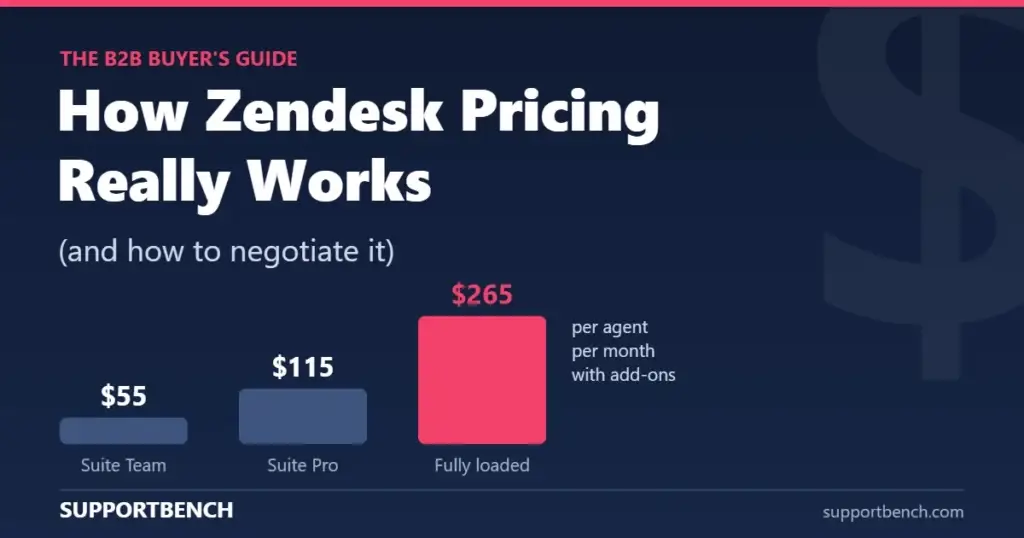
How Zendesk pricing works in 2026: Support Team starts at $19 per agent per month on annual billing; Zendesk Suite lists at roughly $55 (Team), $89 (Growth) and $115 (Professional) per agent per month, with Suite Enterprise quote-only. Monthly billing runs 15–25% higher, and add-ons such as Copilot cost $50 per agent per month each, so a fully equipped agent can reach $200–265 per month. Supportbench’s all-inclusive alternative starts at $32 per agent with AI included.
Nobody leaves Zendesk because the software stopped working. They leave because the third renewal quote arrived and someone in finance asked why the “per agent” price on the invoice looks nothing like the price on the website. After a decade of watching B2B support teams work through exactly that conversation, we can tell you: Zendesk pricing isn’t complicated by accident. It’s a quoting system, and quoting systems reward the people who understand them.
And if the math stops working for you, here are the 8 best Zendesk alternatives for B2B support teams, compared honestly.
This guide explains how Zendesk actually determines what you pay, where the real costs hide, and how to negotiate — whether you plan to stay or you’re pricing the exit.
How Zendesk pricing is structured
Zendesk sells two product lines, both priced per agent, per month:
- Support-only plans — ticketing without the full platform. Support Team starts at $19/agent/month (annual billing).
- Zendesk Suite — the bundle most B2B teams end up on: ticketing, messaging, help center, voice, and basic AI. As of mid-2026, list pricing is roughly $55/agent/month (Suite Team), $89 (Suite Growth), and $115 (Suite Professional) on annual billing. Suite Enterprise is quote-only.
Three structural facts explain most billing surprises:
- Annual vs. monthly billing is a different price list. Month-to-month billing typically runs 15–25% higher than the advertised annual rates. The website price assumes you commit for a year.
- The list price is a starting point, not the price. Above roughly 10–15 seats, almost everything is negotiable — which also means almost nothing is standard.
- The platform is priced to upsell. The capabilities B2B teams actually buy Zendesk for — real AI assistance, workforce management, advanced privacy controls — mostly live in paid add-ons, not in the base plan.
Why your price per user isn’t what the website says
“Why is Zendesk charging different pricing per user?” is one of the most common questions we hear from teams auditing their bill. The usual causes:
- Mixed seat types. Full agents, light agents, and contributor roles carry different costs and different limits per plan. A “40-seat” account is rarely 40 identical seats.
- Add-ons applied per agent. Copilot, the Workforce Engagement bundle, and Contact Center are each listed at $50/agent/month. Apply two of those to half your team and your blended per-seat cost stops matching any published number.
- Grandfathered legacy plans. Long-time customers often carry retired SKUs (Support Professional, legacy Guide tiers) at old rates that merge awkwardly with new purchases.
- Negotiated discounts with expiry dates. First-term discounts frequently step back up at renewal — that’s the renewal shock, working as designed.
The add-on economy: where the real money goes
Here’s the arithmetic that matters. Suite Professional at $115/agent/month sounds knowable. But add Copilot ($50), the Workforce Engagement bundle ($50), and Advanced Data Privacy and Protection, and a fully-equipped agent can cost $200–265/month before anyone has answered a ticket. For a 25-agent B2B team, the delta between “base plan” and “the plan you actually run” is often $30,000–45,000 a year.
And the newest layer doesn’t bill per seat at all: Zendesk’s AI agents are priced per automated resolution — third-party analyses report roughly $1.50 per resolution on committed volume and around $2.00 pay-as-you-go. That’s a metered utility bolted onto a seat-based contract. If your deflection volume grows, so does the bill — success is billable.
We’ve written before about hidden costs and TCO in help desk pricing; Zendesk is the genre’s defining example.
What about knowledge base (Guide) pricing?
If you’re searching for “Zendesk knowledge base pricing” separately: Guide is no longer sold as a standalone product. Help center functionality is bundled into Suite plans, with the useful controls tiered — multiple help centers, advanced customization, and content blocks arrive at Professional and Enterprise levels. Legacy Guide Professional customers still carry it as a line item, which is another reason two companies’ invoices never look alike. Practically: if the knowledge base is the thing you need, you’re buying the Suite tier that unlocks it, not a $15 add-on.
Custom setup and implementation costs
Zendesk’s own professional services and its partner network price implementation separately — data migration, workflow build-out, integrations, and training are commonly quoted in the $5,000–$25,000+ range for mid-market deployments, depending on complexity. Budget for it, or budget for the internal admin time that replaces it. A platform whose setup requires a services engagement is telling you something about its ongoing admin load, too.
How Zendesk determines your actual quote
When you go quote-only (Enterprise, or any deal with volume), the price is built from: seat count and mix, term length, billing frequency, add-on attach, competitive pressure, and — more than anything — timing. Like every large SaaS vendor, Zendesk runs on a quarterly sales calendar. The same deal priced in the middle of a quarter and in the last two weeks of one can come back meaningfully different.
The negotiation playbook
Seven tactics that consistently work for B2B teams with 10+ seats:
- Time it to quarter-end. Start conversations 6–8 weeks before your renewal, but let final pricing land in the vendor’s end-of-quarter window.
- Bring a real competing quote. Not a rumor of one. A written alternative quote is the single strongest lever in any SaaS negotiation — reps discount against paper, not against feelings.
- Negotiate the add-ons, not just the platform. Base-plan discounts are commoditized; add-on pricing has more room. Ask for Copilot or WEM bundled at a flat rate, or free for a term.
- Cap the renewal uplift in writing. First-term discounts that silently expire are the mechanism behind most renewal shock. A 3–5% annual cap clause is routinely granted when asked for — and never volunteered.
- Right-size the seat mix. Audit for agents who only need read access or occasional collaboration; light agent and contributor roles exist precisely so you don’t pay full freight for them.
- Trade term for price carefully. Multi-year deals earn real discounts, but only sign one with a price cap and, ideally, a seat-flex clause. A discount you can’t shrink out of isn’t a discount.
- Scrutinize per-resolution AI pricing before committing volume. Committed-volume rates look cheaper per unit, but overcommitting to automated resolutions you don’t yet generate is prepaying for deflection you haven’t proven.
When negotiating isn’t the answer
Honest caveat from people who compete with Zendesk: sometimes staying and negotiating is the right call. If you’re deeply invested in the ecosystem, at Enterprise scale, with admin expertise in-house, a well-negotiated Zendesk contract is defensible.
But if you’re a B2B support team — where the unit of work is an account relationship, not an anonymous ticket — you should ask what you’re actually buying. Most of the add-on economy exists to backfill capabilities that account-centric platforms treat as core: SLA management, customer health scoring, AI summarization, workforce scheduling. That’s the trap of per-agent-plus-add-ons pricing: you’re not paying for what the software does, you’re paying for how many doors your team opens.
Supportbench takes the opposite approach: all-inclusive pricing — every capability, including AI, in the plan, priced for B2B teams that have outgrown their help desk without wanting enterprise bloat. If you want the line-by-line, see our Supportbench vs. Zendesk comparison, browse the wider help desk alternatives research, or — if you’re further along — the help desk migration guide covers how teams move without losing ticket history.
Frequently asked questions
How much does Zendesk cost per agent per month?
On annual billing, Support Team starts at $19/agent/month; Zendesk Suite runs roughly $55 (Team), $89 (Growth), and $115 (Professional), with Enterprise quote-only. Monthly billing typically adds 15–25%. Add-ons like Copilot are $50/agent/month each on top.
How does Zendesk determine pricing for a specific company?
Quotes are built from seat count and mix, plan tier, contract length, billing frequency, add-on attach, competitive pressure, and where the deal lands in the sales quarter. Above ~10–15 seats, list price is a starting point.
Why does Zendesk charge different pricing per user?
Because accounts mix full agents, light agents, and contributors; add-ons apply per agent; legacy SKUs persist at old rates; and negotiated discounts expire on different schedules. Blended per-seat cost rarely matches any published price.
Is Zendesk’s knowledge base priced separately?
No — Guide is bundled into Suite plans, with advanced help center features gated to Professional and Enterprise tiers. Only legacy customers still carry standalone Guide line items.
How much should I budget for Zendesk setup?
Mid-market implementations commonly run $5,000–$25,000+ through Zendesk professional services or partners, plus ongoing admin time. Simple deployments can self-serve, but B2B workflow builds rarely stay simple.
Can you negotiate Zendesk pricing?
Yes — term length, billing frequency, add-on bundling, renewal caps, and competing quotes all move the number. The most valuable clause is a written cap on renewal uplift; the strongest lever is a real alternative quote.
Related: we ran the same pricing teardown on Salesforce — how Salesforce Service Cloud pricing really works in 2026.
Evaluating help desks for a B2B team?
Supportbench is all-inclusive from $32 per agent per month, with migration and onboarding included. See pricing or book a 20-minute demo.