Quick answer: Hypercare is a defined period of elevated support that immediately follows a go-live — a new customer onboarding, a help desk migration cutover, or a major release — during which the support team runs tighter SLAs, wider coverage, and daily monitoring until the account or system is stable enough for business-as-usual (BAU) support. A typical run lasts 2–6 weeks and ends when a named set of exit criteria is met, not when the calendar says so.
The term came out of ERP and IT implementations, but in B2B support it has a sharper meaning: hypercare is how you protect revenue during the riskiest window of the customer relationship. The weeks right after go-live are when accounts form their lasting opinion of your team — and when churn risk quietly gets baked in. This guide gives you the full playbook: when it applies, the four-phase timeline, the staffing math, an SLA posture table, and the exit criteria most teams never define.
The three situations that demand hypercare
This is not a courtesy tier you offer everyone forever. It applies in three specific situations, each with a different risk profile:
- New-customer go-live. The implementation team hands off, real users hit the product, and every gap in configuration or training surfaces at once. This is the version most B2B SaaS support teams run, and the one with the highest revenue stakes — onboarding impressions harden fast.
- Platform or help desk migration cutover. Whether you ran a big-bang or phased migration, the weeks after cutover are when data gaps, broken automations, and workflow surprises appear. Here the elevated coverage is internal-facing as much as customer-facing: your own agents are the users under stress.
- Major release or incident recovery. After a serious outage or a high-risk release, a short window of elevated support — closer monitoring, faster acknowledgment, proactive check-ins on affected accounts — rebuilds confidence faster than any apology email.
Hypercare vs. go-live vs. business-as-usual
Go-live is a moment; hypercare is the period that follows it; BAU is the steady state it hands off to. Teams that blur these phases either exit too early (and burn the account) or never exit (and burn the team).
| Phase | Timing | Goal | SLA posture | Ends when |
|---|---|---|---|---|
| Go-live | A single cutover event | System live, users in | War-room: minutes, not hours | Cutover checklist complete |
| Hypercare | 2–6 weeks after go-live | Stabilize, catch defects, build trust | Elevated: tightened targets, wider hours, named owners | Exit criteria met (see below) |
| Business as usual | Ongoing | Sustainable service to contract | Contractual SLAs by severity level | — |
The four-phase hypercare timeline
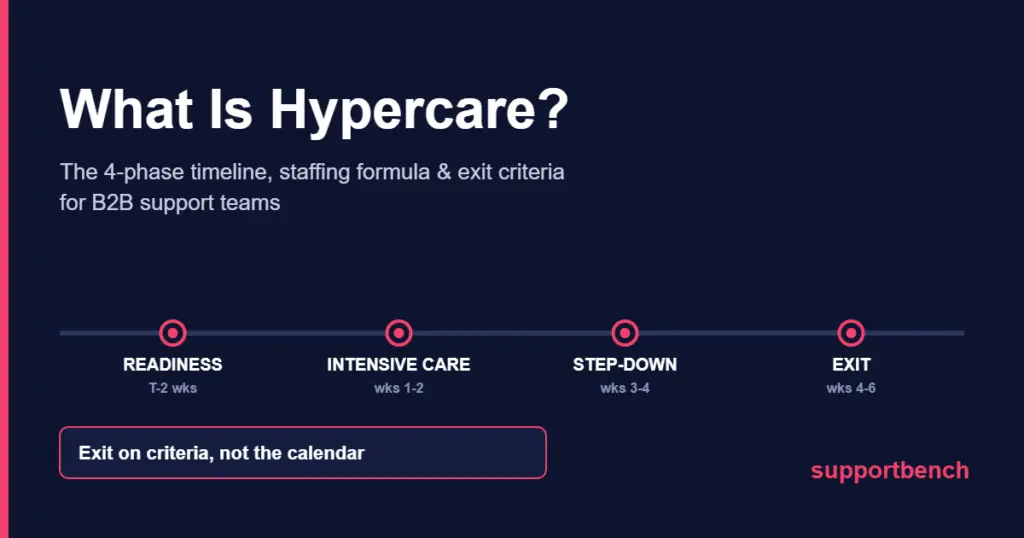
Run the period as a plan with phases and owners, not a vibe. The structure below fits a 4-week window; stretch or compress by risk, not by hope.
- Readiness (T‑minus 2 weeks). Before go-live, the support team gets what the project team has: known issues, configuration decisions, training gaps, and a list of the accounts or users most at risk. Define the SLA posture, the escalation path, and the exit criteria now — exit criteria written after go-live are negotiated under pressure. If this is a migration, run sampling validation before cutover so the first weeks aren’t spent discovering data problems one ticket at a time.
- Intensive care (weeks 1–2). Daily standup on the dedicated queue, a tag so the volume is visible, tightened response targets, and proactive outreach — you contact the customer before they contact you. Every defect gets a theme label so recurring issues surface as patterns, not anecdotes. This is also when your escalation paths get their real-world test; treat every escalation in this window as free intelligence.
- Step-down (weeks 3–4). As volume and severity fall, taper deliberately: standups go to three times a week, proactive check-ins go weekly, staffing returns toward baseline. Publish the taper schedule to the customer — a silent step-down feels like abandonment, an announced one feels like progress.
- Exit and handover (week 4–6). Measure against the exit criteria, hold a closeout review with the customer, and hand the account to the BAU team with a written summary: open items, defect themes, workarounds in place, and the account’s temperature. Then actually exit. Hypercare that never ends is just understaffed BAU with better branding.
Staffing and SLAs during hypercare
The most common failure is running the period with BAU staffing. Ticket volume after a go-live doesn’t rise politely — for the first two weeks, plan on a multiple of baseline, then a taper.
HYPERCARE STAFFING FORMULA
Agent-hours needed per week =
(baseline weekly tickets × surge multiplier × avg handle time in hours)
÷ agent utilization rate
Surge multiplier: 2.0–3.0 for weeks 1–2 · 1.3–1.5 for weeks 3–4 · plan utilization at 0.7, not 1.0
Worked example — a 12-agent team takes a 400-seat account live:
- Baseline forecast for the account: 90 tickets/week at 0.5 hours average handle time = 45 agent-hours/week in BAU.
- Weeks 1–2 at a 2.5× surge: 90 × 2.5 × 0.5 = 112.5 agent-hours ÷ 0.7 utilization ≈ 161 agent-hours/week — roughly 4 dedicated agents, not the 1.5 the BAU math suggests.
- Weeks 3–4 at 1.4×: 90 × 1.4 × 0.5 = 63 ÷ 0.7 = 90 agent-hours/week — taper to ~2.5 agents.
- If you can’t dedicate headcount, dedicate hours: named agents own the queue for defined blocks, and their other queues get covered. Splitting attention 20 ways is how SLAs fail at capacity.
SLA posture during the window should be explicitly tighter than contract, and explicitly temporary:
| Severity | BAU first response | Hypercare first response | Extras |
|---|---|---|---|
| Sev 1 | 1 hour | 15–30 min | Named owner, status updates every 2 hours |
| Sev 2 | 4 hours | 1–2 hours | Daily review in standup |
| Sev 3 | 1 business day | 4 hours | Theme-tagged for defect patterns |
| Sev 4 | 2 business days | 1 business day | Batched into weekly summary |
These are elevated internal targets layered on top of the contract — the same mechanism as an internal SLA, pointed at one account for a defined window. Track them separately from BAU metrics or your monthly SLA numbers will look worse than they are.
Hypercare exit criteria: the part most teams skip
“We’ll run hypercare for four weeks” is a schedule, not an exit. A time-boxed period either ends while the account is still wobbly or drags on because nobody can prove it’s safe to stop. Define exit as a set of conditions, all of which must hold for five consecutive business days:
HYPERCARE EXIT CRITERIA — ALL TRUE FOR 5 CONSECUTIVE BUSINESS DAYS
1. Ticket volume ≤ 120% of projected BAU baseline
2. Zero open Sev-1s; Sev-2 backlog trending down
3. No new recurring defect themes in the last 5 days
4. First-contact resolution within 10% of BAU norm
5. All critical workarounds documented and owned
6. Customer stakeholder signs off on the handover summary
Criterion 6 matters more than it looks. An exit the customer agrees to is a milestone; an exit they discover is a downgrade. If this was a migration, pair the sign-off with a migration validation review that goes beyond ticket counts.
Five hypercare mistakes that create escalations
- Running the period with BAU staffing. The surge is predictable; absorbing it with the same headcount just converts it into missed SLAs and ticket escalations.
- No dedicated queue or tag. If these tickets are mixed into the general queue, you can’t see the surge, staff it, or prove it ended.
- Exit by calendar instead of criteria. Four weeks is a default, not evidence. Exit on data.
- Silent step-down. Tapering without telling the customer converts a well-run process into a perceived abandonment — and abandoned accounts escalate to executives, not to your queue.
- Losing the defect intelligence. The launch window surfaces every weak point in your product, configuration, and docs in one compressed burst. Teams that don’t theme-tag and hand that intelligence to product and onboarding rerun the same fire drill on every account.
What about hypercare in agile and project management?
In project management, hypercare (sometimes called the warranty or stabilization period) is the phase between go-live and formal project closure, when the project team stays engaged to resolve post-launch defects before handing the system to operations. In agile delivery there is rarely a formal phase for it — continuous delivery spreads the risk across many small releases — but teams still run hypercare-style windows after major launches. The support-team version in this guide is the same discipline pointed at customers instead of internal users: elevated coverage, defect capture, explicit exit.
Hypercare FAQ
What is the meaning of hypercare?
Hypercare means a temporary period of intensified support immediately after a go-live, migration, or major release — faster response targets, closer monitoring, and proactive communication until the system or account is stable.
What is the difference between go-live and hypercare?
Go-live is the cutover event itself: the moment users start working in the new system. Hypercare is the support period that follows go-live, typically 2–6 weeks, designed to stabilize the launch. Go-live ends when the cutover checklist is complete; the stabilization period ends when the exit criteria are met.
How long should hypercare last?
Two to six weeks in most B2B contexts — two weeks of intensive care, then a taper. But duration should be governed by exit criteria (stable volume, no critical defects, customer sign-off), not by the calendar. Complex ERP-style implementations can justify 8–12 weeks; a routine feature launch may need only days.
What is hypercare in agile?
Agile teams rarely schedule a formal stabilization phase, because frequent small releases spread launch risk. In practice, agile organizations run short versions after major releases or migrations: elevated monitoring, a defect triage cadence, and a defined return to normal operations.
Who owns hypercare — support, customer success, or the project team?
Jointly, with one named lead. The project or implementation team owns defect resolution; support owns the ticket surge and SLA posture; customer success owns the relationship and the exit sign-off. What fails is unnamed ownership — a launch window without a single accountable lead becomes everyone’s second priority.
What KPIs should you track during hypercare?
Daily ticket volume against projected baseline, first-response and resolution times against the elevated targets, open counts by severity, first-contact resolution, recurring defect themes, and escalation count. Track them on a dedicated dashboard, separated from BAU reporting.
Running hypercare in a tool that can’t see accounts?
Supportbench gives B2B teams account-level health, severity-based SLAs, and escalation paths in one platform — so the launch window runs on data, not heroics.
For the wider operating system this plugs into, start with the support operations playbook — and if your hypercare is the aftermath of a platform switch, the migration project guide and migration checklist cover the weeks before this one.
Evaluating help desks for a B2B team?
Supportbench is all-inclusive from $32 per agent per month, with migration and onboarding included. See pricing or book a 20-minute demo.