Quick answer: SaaS customer support is the practice of supporting business customers of a software-as-a-service product across the full account lifecycle — not just answering tickets. It differs from B2C support in four structural ways: the unit of work is the account (not the ticket), response commitments are contractual SLAs (not goodwill targets), a single conversation can put six or seven figures of ARR at risk, and support data feeds renewal decisions. Get those four right and tooling, staffing, and metrics all follow.
After a decade running support for B2B SaaS companies, we have watched teams copy B2C playbooks — deflect fast, close fast, survey everyone — and quietly bleed accounts while their dashboards glowed green. This guide covers what SaaS customer support actually is, how it differs from consumer support, how to structure tiers, which metrics matter, and how to build a SaaS support strategy that survives contact with your biggest customer having their worst week.
What Is SaaS Customer Support?
SaaS customer support is the function that resolves product questions, technical issues, and account problems for customers of a subscription software product. Because revenue arrives monthly or annually rather than at purchase, support is not a cost center bolted onto sales — it is one of the main reasons a customer renews or churns. In practice, SaaS support spans reactive ticket resolution, tiered technical escalation, proactive outreach on at-risk accounts, and the knowledge systems that let customers help themselves.
In B2B SaaS specifically, support, account management, and customer success run as one motion: the same account surface serves all three. That is the core argument of our B2B customer service guide, and it is the lens for everything below.
SaaS Support vs B2C Support: The 4 Structural Differences
- The unit of work is the account. A B2C queue handles anonymous one-off contacts. A SaaS queue handles the fifth ticket this month from a customer paying $80K/year — and your agents need to see the other four.
- SLAs are contractual. Enterprise deals ship with negotiated response and resolution times, often different per tier and per severity. Missing them is a breach, not a bad day. See our internal SLA guide and severity level definitions.
- Ticket value is wildly asymmetric. One conversation can carry the renewal of your largest account. Averages lie; segment everything by account value.
- Support data feeds revenue decisions. Sentiment trends, escalation frequency, and SLA performance are churn signals. If they live only in the help desk, the renewal team is flying blind.
The Real Cost Metric: Cost per Resolution, Weighted by ARR at Risk
Most teams track cost per ticket. For SaaS customer support the more honest number weighs what a failure would cost:
SUPPORT ECONOMICS, THE SAAS WAY
Cost per resolution = (loaded team cost + tooling) / resolutions
ARR-weighted exposure = sum of (open escalations x account ARR x churn risk)
Run both. The first sizes the team; the second sets its priorities.
Worked example: a 10-agent team costing $75K loaded each plus $20K tooling resolves 3,000 tickets/month. Cost per resolution = ($770,000 / 12) / 3,000 = ~$21. Meanwhile two open Sev-1 escalations sit on accounts worth $120K and $60K ARR with an estimated 25% churn risk each: ARR-weighted exposure = $45,000 — more than a month of the entire team. That is why the next hire is rarely “more Tier 1” and often “faster escalation handling.”
Structuring SaaS Technical Support: Tiers That Match Reality
The classic Tier 1/2/3 model still works for SaaS technical support if you define it by capability, not seniority: Tier 1 owns product questions and known issues with a target of first-contact resolution; Tier 2 owns configuration, integrations, and data problems; Tier 3 is engineering time with an explicit budget, not an open door. We cover the mechanics — routing rules, handoff criteria, and the swarming alternative — in our guides to tiered support workflows and L1/L2/L3 handoffs. Two SaaS-specific rules: severity definitions must be customer-visible (or every issue becomes a Sev-1), and staffing should follow your ticket volume forecast, not last quarter’s panic.
A 5-Part SaaS Support Strategy
- Segment support by account, not by volume. Your top 20 accounts deserve named ownership, tighter SLAs, and proactive review. Everyone gets good support; not everyone gets the same support.
- Put contractual SLAs in the tooling, not a spreadsheet. Per-account, per-severity timers with escalation triggers. If your help desk cannot express your contracts, the help desk is the problem.
- Make self-service earn its keep. A knowledge base pays off only when it deflects the tickets you want deflected. Track deflection honestly — our deflection-rate benchmarks for B2B show what realistic looks like.
- Instrument sentiment and health, not just CSAT. Survey response rates in B2B are too low to steer by; predicting satisfaction from ticket signals covers every conversation, not the 15% who answer.
- Close the loop with revenue. A weekly at-risk-account review with CS and sales, driven by support data, is the single highest-leverage meeting a Head of Support can run.
Metrics That Matter (and Two That Lie)
Track: first response time and resolution time against SLA by severity, escalation rate, cost per resolution, deflection rate, and account-level sentiment trend. Treat with suspicion: raw ticket volume (it rewards deflecting your best feedback channel) and average CSAT (a 4.8 average hides the two furious enterprise accounts who stopped responding). Our support metrics guide goes deeper on each.
The SaaS Support Maturity Model: Which Stage Are You In?
Every SaaS customer support org we have worked with sits somewhere on a four-stage curve. Knowing your stage tells you what to fix next — and what to skip until later.
- Stage 1 — Reactive inbox. Support lives in a shared email inbox or a basic queue. No severity definitions, no SLAs, no account view. Every day is triage. The fix at this stage is not AI or analytics; it is a real ticketing structure with severity levels and ownership.
- Stage 2 — Managed queue. You have a help desk, response targets, and basic reporting, but everything is ticket-shaped: agents cannot see account history, SLAs are one-size-fits-all, and escalations are informal Slack pings. Most B2B teams stall here for years because the queue looks under control while accounts quietly degrade.
- Stage 3 — Account-based support. Cases roll up to accounts, SLAs are contractual and per-tier, escalation paths are trigger-based, and support reviews at-risk accounts with CS weekly. This is the minimum bar for supporting enterprise customers credibly.
- Stage 4 — Predictive operations. Sentiment and health scoring run on every conversation, staffing follows a forecast model, AI handles routing and drafting, and support data directly informs renewal strategy. Few teams live fully at Stage 4 — but every practice in this guide moves you toward it.
Designing Support Plans and Tiers Customers Actually Pay For
Mature SaaS companies productize support itself: a standard plan included with every subscription, plus one or two paid tiers for customers whose businesses depend on yours. The mistake is gating the wrong things. Never gate competence — every customer gets accurate answers and honest communication. Gate speed, access, and proactivity:
| Element | Standard | Premium | Enterprise / Strategic |
| Channels | Email, portal | + Live chat | + Phone, dedicated Slack/Teams channel |
| First response (Sev-1) | 4 business hours | 1 hour | 30 min, 24×7 |
| Coverage | Business hours | Extended hours | Follow-the-sun |
| Named contacts | — | Named senior agent | Technical Account Manager |
| Proactive reviews | — | Quarterly | Monthly ops review + roadmap input |
Two rules from a decade of watching these programs succeed and fail: price premium support against the customer’s cost of downtime (not your cost of delivery), and staff the named-contact promise before you sell it — an unstaffed TAM promise is the fastest way to turn your best accounts into your angriest. Our guide to the TAM role in modern help desks covers how to structure that layer.
SLA Benchmarks by Severity (Typical Mid-Market B2B SaaS)
Contracts vary, but after reviewing hundreds of B2B SaaS SLA schedules these are the commitments that keep showing up. Use them as a sanity check, not a template — your product’s blast radius should set the numbers.
| Severity | Definition (customer-visible) | First response | Update cadence | Resolution target |
| Sev-1 | Production down or unusable for all users; no workaround | 15–60 min | Hourly | 4–24 hours (workaround), fix ASAP |
| Sev-2 | Major function impaired; workaround exists but painful | 1–4 hours | Daily | 3–5 business days |
| Sev-3 | Minor function impaired; normal work continues | 4–8 business hours | On change | Next maintenance cycle |
| Sev-4 | Question, cosmetic issue, or feature request | 1 business day | — | Backlog, communicated honestly |
The definitions matter more than the numbers: publish them where customers can see them, with examples, or every urgent-sounding ticket becomes a Sev-1 negotiation. Full treatment in our severity levels guide.
Staffing: How Many Agents Does SaaS Customer Support Need?
The honest sizing math is simple arithmetic most teams never run:
THE STAFFING FORMULA
Agents needed = (monthly tickets × avg handle time in hours)
÷ (productive hours per agent × occupancy)
Worked example — 2,400 tickets/month:
- 2,400 tickets × 0.5 hours average handle time = 1,200 handling hours needed
- Each agent gives ~140 productive hours/month × 80% occupancy (nobody handles tickets 100% of the day) = 112 usable hours per agent
- 1,200 ÷ 112 ≈ 11 agents — before coverage windows, specialization, and escalation load
Two adjustments B2B teams forget:
- Reserve 15–20% of capacity for escalations and proactive work. A fully-loaded queue has no surge room for your biggest account’s worst day.
- Staff to the forecast, not the trailing average. The full model with seasonality and hiring lead time is in our ticket volume forecasting guide.
Onboarding and Hypercare: The First 90 Days of an Account
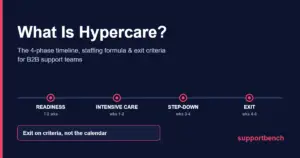
Churn is usually decided in the first 90 days, and support sees the evidence first: confused tickets, integration failures, silence. Well-run SaaS support teams treat new accounts as a distinct operating mode — often called hypercare:
- A defined window — typically 2–6 weeks post go-live, with an explicit end date
- Tightened response targets — treat every hypercare ticket one severity higher than it reads
- A named owner for the account’s tickets, not queue roulette
- Proactive check-ins at day 7, 30, and 60 — before problems get reported, not after
- A weekly watch list reviewed with Customer Success
The operational trick is tagging: mark every ticket from an account in its first 90 days, route them to senior agents, and read their sentiment trend as an early-warning system. A new account that files three confused tickets in week two is not annoying — it is telling you the onboarding failed, while there is still time to fix it.
Where AI Actually Helps SaaS Support (and Where It Doesn’t Yet)
AI is now table stakes in SaaS customer support tooling, but the wins are uneven.
Working in production today:
- Routing and prioritization — intent + sentiment beats keyword rules; see our AI routing guide
- Agent-assist drafting on known issues
- Sentiment scoring across every conversation, not just surveyed ones
- Predicting satisfaction without surveys — coverage of 100% of conversations vs the ~15% who answer
Oversold: full-resolution chatbots for complex B2B products. Realistic deflection for technical B2B support runs far below vendor marketing, and deflecting your best customers’ signal into a bot loop costs more than the tickets saved — our deflection benchmarks put real numbers on this.
The test for any AI feature: does it shorten time-to-resolution on your twenty hardest real tickets, or does it just shrink the queue metric while accounts fume? One more honest caveat: bolted-on AI that reads only the current ticket cannot do account-level reasoning — native AI with account context is a structural advantage, not a feature checkbox.
Tooling: What SaaS Customer Support Actually Needs
The tooling requirement follows directly from the four differences. What SaaS customer support actually needs:
- Account-level context in every ticket — the other four tickets from this customer, visible without hunting
- Contractual SLA management with per-account, per-severity policies
- Tiered escalation workflows with trigger-based routing
- Native sentiment and health signals, not add-on surveys
- Reporting that speaks revenue — by account and ARR, not just by agent and queue
Consumer-grade help desks retrofit some of this with add-ons and admin work; platforms built for B2B carry it natively. We compare the field honestly — including where we fall short — in our SaaS help desk roundup and the broader B2B ticketing systems comparison. Supportbench is built for exactly this account-based motion — book a demo and bring your three ugliest real tickets, not our demo data.
Building the SaaS Support Team: Roles That Scale
Titles vary, but scaling SaaS customer support reliably produces five roles:
- Support agents own the queue and first-contact resolution. Hire for written clarity and curiosity, not just experience.
- Technical support engineers handle Tier 2/3 — API questions, integration failures, log-reading. They are the difference between “escalated to engineering” and “resolved without engineering.”
- Team leads (one per 6–10 agents) own quality, coaching, and the escalation path — using a real rubric like our QA scorecard framework, not vibes.
- Support operations (usually your first hire after eight agents) owns tooling, automation, reporting, and the forecast. One good ops person routinely frees 15–20% of team capacity.
- Technical Account Managers carry the named-contact promise for strategic accounts.
The career-ladder point most teams miss: agents need a path that is not “become a manager.” Senior IC tracks through TSE and ops are how you keep your best people answering your hardest tickets.
Five Common SaaS Support Mistakes (and What They Cost)
- Optimizing average handle time on B2B tickets. AHT pressure teaches agents to close fast rather than resolve fully — and reopened tickets on enterprise accounts cost more than slow ones. Measure resolution quality and SLA attainment instead.
- Deflecting before understanding. Aggressive chatbot gating on a complex product deflects your highest-signal feedback along with the password resets. Deflect known-answer volume; never deflect confusion.
- One SLA policy for every customer. If your $200K accounts get the same commitments as your $200 accounts, one of the two prices is wrong. Contractual tiers exist because value tiers exist.
- Treating support as a cost center in planning. Teams budgeted purely on cost-per-ticket end up staffed for the average day and destroyed by the bad week — which is always the week your biggest customer is watching.
- Letting support data die in the help desk. If sentiment trends and escalation history never reach CS and sales, your company is renewing accounts blind. The weekly at-risk review fixes this for the price of thirty minutes.
A 90-Day Plan to Upgrade Your SaaS Customer Support Operation
- Days 1–30 — instrument reality. Baseline every metric above, publish severity definitions, and audit your top 20 accounts’ ticket history for silent decay. No process changes yet; you cannot fix what you have not measured.
- Days 31–60 — fix the structure. Implement per-account SLAs, trigger-based escalation paths, and the new-account hypercare tag. Start the weekly at-risk review with CS.
- Days 61–90 — compound. Turn recurring ticket patterns into KB articles and automation, run the staffing formula against your forecast, and present the ARR-protected number to leadership.
This arc mirrors the fuller program in our Head of Support 90-day plan — the difference between a support team that reports ticket counts and one that reports revenue protected is usually one disciplined quarter.
FAQ
What is SaaS customer support?
SaaS customer support is the function that resolves product, technical, and account issues for customers of subscription software. Because revenue depends on renewal, it spans reactive tickets, tiered technical escalation, proactive account care, and self-service — not just a help desk queue.
How is SaaS support different from B2C customer service?
Four ways: the unit of work is the account rather than the ticket, response times are contractual SLAs, individual conversations can carry six-figure renewal risk, and support data feeds revenue decisions. B2C playbooks optimized for volume and speed miss all four.
What is a good cost per resolution for SaaS support?
Most B2B SaaS teams land between $15 and $40 per resolved ticket depending on product complexity and tier mix. The number matters less than the trend and the pairing: always read it next to ARR-weighted escalation exposure so cheap support never becomes expensive churn.
Should SaaS support teams use tiers or swarming?
Tiers win when volume is high and issues cluster into known patterns; swarming wins when issues are novel and cross-functional. Many B2B teams run tiers for the queue plus a swarm protocol for Sev-1s — the models are complements, not rivals.
What tools do SaaS customer support teams use?
A B2B-capable help desk or support platform (account context, SLA management, escalation workflows), a knowledge base, and increasingly AI for routing, sentiment, and drafting. The deciding question is whether the platform models accounts and contractual SLAs natively or bolts them on.
Evaluating help desks for a B2B team?
Supportbench is all-inclusive from $32 per agent per month, with migration and onboarding included. See pricing or book a 20-minute demo.