Salesforce Service Cloud list pricing in 2026 runs from $25 to $550 per user, per month across five editions — but after a decade of watching B2B support teams buy it, we can tell you the sticker price is the least interesting number on the invoice. The real cost is seats, plus AI consumption, plus add-ons, plus the implementation and admin overhead nobody quotes you up front. Here is how the pricing actually works, what it hides, and how to know whether you should be paying it at all.
Salesforce Service Cloud pricing at a glance (2026)
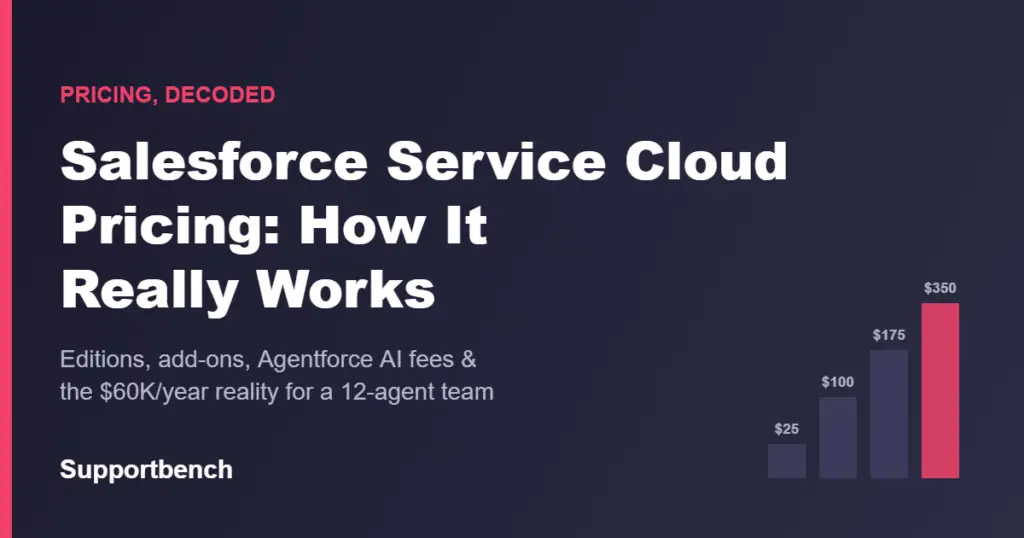
| Edition | List price (per user/month) | What you actually get |
|---|---|---|
| Starter Suite | $25 | Basic case management inside a lightweight CRM bundle. Not a full service desk. |
| Pro Suite | $100 | Adds omni-channel routing and case swarming. Still a bundle, still capped. |
| Enterprise | $175 | The first real service desk tier: AI for service, self-service help center, workflow automation, incident management. |
| Unlimited | $350 | Adds chat and bots, Salesforce Knowledge, premier support. |
| Agentforce 1 Service | $550 | The full AI suite with unmetered internal Agentforce use and 2.5M Flex Credits per org per year. |
Two things the pricing page does not make obvious. First, everything from Enterprise up is billed annually — that $175 seat is a $2,100-per-agent annual commitment. Second, the capabilities most support leaders are actually shopping for (AI, help center, real automation) do not unlock until the $175 Enterprise tier. The two cheaper Suites exist to get small teams into the ecosystem, not to run a support operation.
The add-on layer: where the quote grows
Service Cloud’s edition price is a floor, not a ceiling. The common add-ons each land between $50 and $200 per user, per month at list:
- Digital Engagement — $75/user/month on top of Enterprise or Unlimited. This is what turns on WhatsApp, SMS, and messaging channels. If your customers expect to reach you anywhere other than email and phone, budget for it.
- Service Cloud Voice — an add-on seat fee, plus telephony usage billed separately through Amazon Connect. Voice is the add-on teams most often underestimate, because the consumption line grows with call volume.
- Knowledge, Field Service, and friends — each its own SKU below Unlimited. The pattern is consistent: capabilities that ship natively in purpose-built help desks are separately priced modules here.
Agentforce: how Salesforce charges for AI
Salesforce bills AI on consumption, on top of your seats, under one of two models — and you cannot mix them in the same org:
- Per conversation: a flat $2 per AI-handled session. Predictable, and expensive at scale: 1,000 AI conversations a month is $24,000 a year.
- Flex Credits: $500 per block of 100,000 credits, where a standard action burns 20 credits (about $0.10) and a voice action burns 30 (about $0.15). Cost per conversation depends entirely on how many steps the agent takes — a complex resolution can quietly cost multiples of a simple one.
The strategic point: with consumption-billed AI, your bill grows with your ticket volume. Deflection success does not make the line item smaller; it makes it bigger.
What a real team actually pays
Here is the arithmetic for a 12-agent B2B support team on the tier most of them need:
- 12 × Enterprise at $175 = $25,200/year
- 12 × Digital Engagement at $75 = $10,800/year
- Agentforce at ~1,000 conversations/month = $24,000/year
Roughly $60,000 a year at list — before implementation (typically $10,000–$50,000+ with a partner), before the admin time (Salesforce orgs realistically consume a half-time to full-time admin), and before renewal uplift. That is the number to compare against alternatives, not the $175 on the pricing page. We wrote the same breakdown for Zendesk in how Zendesk pricing really works — the pattern of seat price versus real price is an industry habit, not a Salesforce quirk.
Can you negotiate Salesforce Service Cloud pricing?
Yes — list price is the opening position, not the final one. The levers that consistently work:
- Time the deal to Salesforce’s fiscal year end (January 31). Q4 discounting is real, and reps have quota pressure in the back half of January.
- Multi-year terms trade flexibility for percentage points. Do the math on whether you will actually keep the seat count.
- Bundle at signature. Add-ons negotiated at initial signing discount far better than add-ons bought mid-term, when they know you are committed.
- Cap the renewal uplift in writing. The first-term discount is often recovered at renewal; a 5–7% cap clause is a standard ask.
When Service Cloud makes sense — and when it does not
If your company already runs Sales Cloud, your support volume is enterprise-scale, and you have the admin capacity to maintain the org, Service Cloud is a defensible choice — the CRM adjacency is genuinely valuable.
The mismatch shows up in B2B support teams that bought it for the brand. B2B support does not run on anonymous tickets; it runs on accounts — ongoing relationships where history, health, and SLAs compound over time. Service Cloud can model that, but every layer of it is a configuration project or a paid module, and the total cost above is what that flexibility bills out at. Teams that have outgrown their help desk usually do not need more platform; they need account-centric support without the enterprise bloat. That comparison — what ships natively versus what you assemble — is the honest way to evaluate Service Cloud alternatives, and it is why we publish all-inclusive pricing with every capability in one number: support, account health, SLAs, AI, and analytics, without the SKU maze.
Already on Salesforce and weighing a move? Your case history is portable — here is the step-by-step on exporting Salesforce cases, emails, and attachments.
Frequently asked questions
How much does Salesforce customer service software cost?
List pricing runs $25–$550 per user, per month across five editions. Most support teams need the Enterprise edition at $175/user/month, and a realistic 12-agent deployment with messaging and AI lands around $60,000 a year before implementation costs.
How much does Salesforce customer service incident management cost?
Incident management ships in the Enterprise edition at $175 per user, per month. It is not available in the Starter or Pro Suites, so incident-centric teams should price from Enterprise up.
How much does Salesforce Service Cloud Enterprise cost?
$175 per user, per month, billed annually — a $2,100-per-agent annual commitment. It is the first tier with AI for service, a self-service help center, workflow automation and incident management. Unlimited is $350 and Agentforce 1 Service is $550 per user, per month.
How much does Salesforce Digital Engagement cost?
$75 per user, per month on top of an Enterprise or Unlimited seat. It is the add-on that turns on WhatsApp, SMS and messaging channels; for a 12-agent team that is $10,800 a year at list.
What does Service Cloud Voice cost?
Voice is an add-on with a per-user fee plus usage-based telephony billed through Amazon Connect. Total cost scales with call minutes, so heavy phone teams should model it on real volume, not the seat price.
How much does Salesforce contact center software cost?
Budget for three lines: the seat (Enterprise at $175 per user, per month), the Service Cloud Voice add-on (a per-user fee), and telephony usage billed separately through Amazon Connect. The usage line grows with call volume, so model it on real minutes rather than the seat price.
Does Service Cloud pricing include AI?
No. Agentforce is billed on consumption on top of seats: either $2 per AI conversation or Flex Credits at roughly $0.10 per action. Only the $550 Agentforce 1 Service edition bundles meaningful AI capacity (2.5M Flex Credits per org per year).
Can you negotiate Salesforce Service Cloud pricing?
Yes. Discounts are most available at Salesforce’s January 31 fiscal year end, on multi-year terms, and on add-ons bundled at initial signature. Always negotiate a renewal-uplift cap.
Is there a cheaper alternative for B2B support teams?
Purpose-built B2B support platforms deliver account-centric support, SLAs, and AI natively at a fraction of an assembled Service Cloud stack. See our guide to help desk alternatives or book a demo to compare against your current quote.
Numbers reflect published list pricing as of July 2026; confirm current figures with your Salesforce quote, since list prices and packaging change.
Evaluating help desks for a B2B team?
Supportbench is all-inclusive from $32 per agent per month, with migration and onboarding included. See pricing or book a 20-minute demo.