
Legacy helpdesk systems are draining resources, costing up to $4,500 per agent monthly, and adding hidden fees that inflate budgets by 30–40%. Modern AI-powered platforms offer a cost-effective alternative, reducing per-interaction costs from $3–$6 to just $0.25–$0.50. Shifting to these systems can save companies up to $225,000 monthly for teams managing 50,000 interactions.
Key Takeaways:
- Legacy Costs: $8,000/channel setup fees, $60,000–$100,000 migration costs, and $4,940/month per agent.
- AI Advantage: Automates 50–70% of inquiries, cutting costs by 85–90%. This is achieved through real-time analytics and insights that identify inefficiencies.
- Savings Example: Companies like Obzervr reduced costs by 78% in one year.
- Modern Pricing: Platforms like Supportbench start at $32/agent/month with no setup fees and built-in AI tools.
The choice is clear: move away from legacy systems like Zendesk to save money, improve efficiency, and stay competitive.
1. Legacy Helpdesk Tools
Upfront Costs
Legacy helpdesk platforms come with hefty upfront expenses that extend well beyond their initial price tags. For starters, there are hardware costs – like servers and cooling systems – that cloud-native solutions completely bypass. A prime example of this is the Royal Navy, which in 2015 shelled out $9 million in licensing fees just to keep using Windows XP because their legacy programs couldn’t operate without it.
Then there’s implementation and customization, which can quickly balloon into significant expenses. Aaron Johnson, IT Support Leader at Lids.com, encountered migration quotes ranging from $60,000 to $100,000 just to transfer 370,000 tickets. On top of that, launching or customizing support channels often starts at $8,000 per channel. And don’t forget the cost of training staff or hiring specialists to manage outdated systems – an often-overlooked expense that adds up fast.
But it doesn’t stop there. Hidden fees are another financial pitfall of legacy systems.
Hidden Fees
The real financial strain comes from costs that aren’t obvious at first glance. Legacy systems can consume a staggering 80% of an IT budget, with the average cost to keep a single legacy system running reaching around $30 million. On an annual basis, IT maintenance for these systems averages nearly $40,000 per system.
"The direct subscription or license cost of software is only a small fraction of the total cost of the software. This is usually called the TCO or total cost of ownership." – Brightwork Research
Personnel costs also pile on. Benefits and overhead for support agents can tack on an additional 40-60% to their base salary. Complex legacy platforms often require full-time administrators, who typically earn between $75,000 and $132,000 annually. On top of that, IT staff lose an average of 17 hours per week – nearly half of their workweek – just maintaining these outdated systems. All these factors push the actual monthly cost per agent to a staggering $4,940.
And the challenges don’t end with maintenance. Legacy systems also struggle when it comes to adopting AI, compounding their financial burden.
AI Integration Impact
One of the biggest drawbacks of legacy platforms is their inability to integrate AI seamlessly. Instead of offering built-in AI capabilities, these systems rely on expensive add-ons or third-party middleware, which only drives costs higher. In contrast, cloud-based systems are far more efficient, using 77% fewer servers and consuming 84% less power compared to on-premise legacy hardware. This efficiency gap only widens as AI becomes more indispensable.
The financial contrast is striking. Traditional human-only support costs between $3.00 and $6.00 per interaction, while AI-powered support slashes that to just $0.25–$0.50 per interaction – an 85-90% savings. For a team handling 50,000 interactions each month, that’s $225,000 in operational costs with legacy systems, compared to a fraction of that with AI-native platforms. By 2025, it’s estimated that companies will allocate 40% of their IT budgets just to manage the technical debt of outdated systems. That’s money that could instead fuel innovation rather than keeping obsolete technology afloat.
The mounting costs make it clear: transitioning to modern, AI-ready platforms isn’t just a smart move – it’s becoming a necessity.
sbb-itb-e60d259
2. Supportbench – Cost-Efficient AI B2B Customer Support & Success Platform
Upfront Costs
Supportbench takes a fresh approach to helpdesk pricing, focusing on transparency and long-term savings. Pricing starts at $32 per agent per month with annual billing or $40 per agent per month for monthly billing. There are no setup fees, and the Professional plan includes free onboarding and training. Compare this to older platforms that can charge upwards of $8,000 per channel just for setup services.
For data migration, automated tools range from $39 to $100, depending on the volume of data – far more affordable than manual migration services, which often cost $60,000 to $100,000. For example, moving 10,000 records costs about $514. Features like sentiment analysis and customer health scoring are also included in the base $40 per agent plan.
Hidden Fees
Supportbench prides itself on a straightforward pricing model, avoiding the hidden fees that can inflate costs by up to 25% with other platforms. After 15 agents, the price increases by $2.50 per additional agent, capped at $150 per agent. For teams with 60+ agents, the platform automatically transitions to an Enterprise plan.
"Supportbench was refreshingly transparent… we were overpaying for unused features." – Thinh T., Information Technology and Services
In April 2025, Thinh T., a verified reviewer from an Information Technology and Services company (51–200 employees), shared their experience of switching to Supportbench. They had been frustrated by paying for unused features and struggling with limited reporting options on their previous platform. Supportbench’s transparent pricing and advanced tools, like predictive CSAT scoring, provided much-needed clarity and operational improvements.
Unlike older systems that charge extra for essential tools, Supportbench includes AI features, reporting engines, and health scoring in its standard plans.
AI Integration Impact
Supportbench’s AI-native design delivers major cost savings. While traditional human-only support costs between $3.00 and $6.00 per interaction, AI-powered support reduces that to just $0.25–$0.50 per interaction, cutting costs by 85–90%. This translates into noticeable monthly savings compared to legacy systems.
AI-integrated agents also boost efficiency, handling 13.8% more inquiries per hour than traditional methods. Additionally, 57% of companies using AI support report measurable cost savings within six months, with most breaking even in just 3 to 4 months. Supportbench’s built-in AI tools, like predictive CSAT, automated triage, and case summaries, are ready to use from day one – eliminating the $25,000 to $60,000+ integration costs often associated with older platforms.
The platform also ensures 24/7 support availability (168 hours per week), far exceeding the standard 40-hour workweek offered by traditional systems. This around-the-clock coverage comes without the added expense of overtime or extra staffing.
Pros and Cons
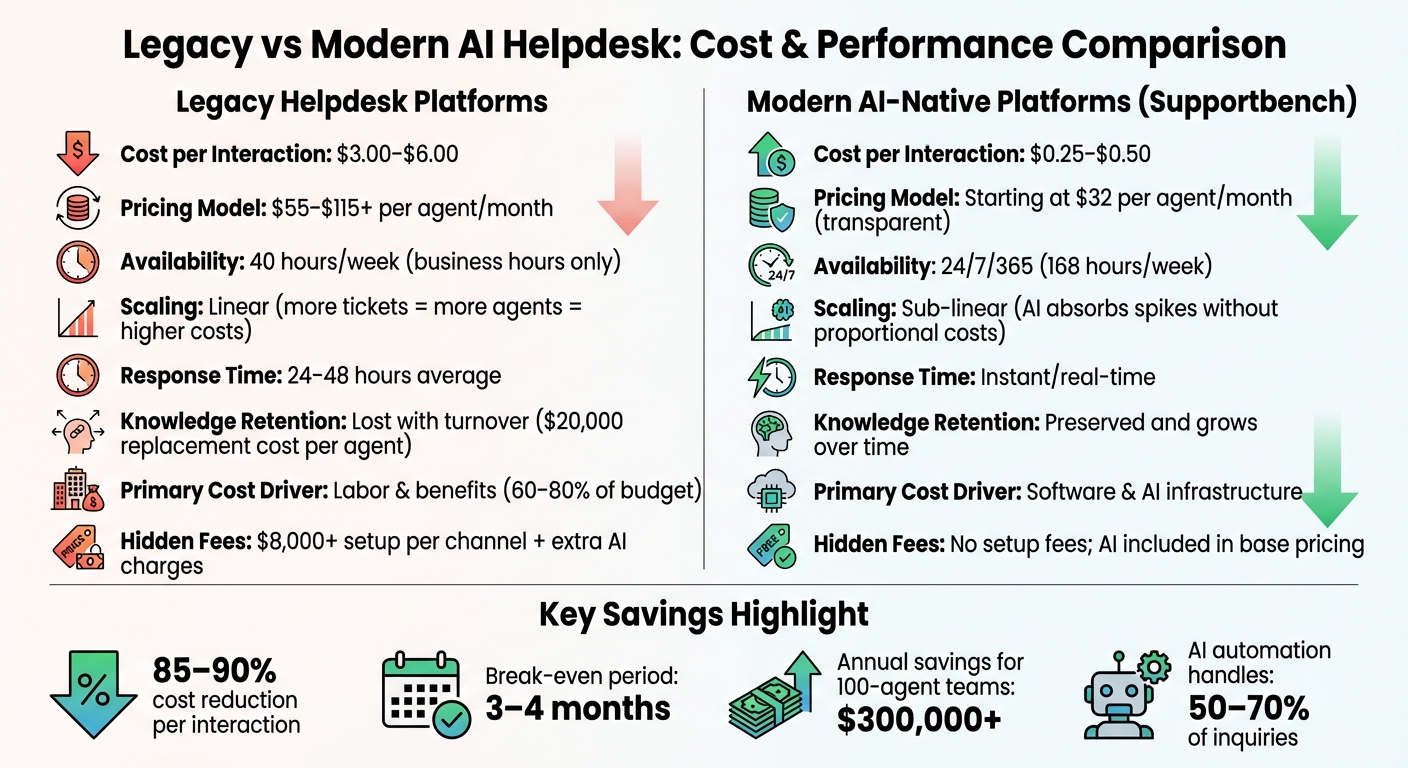
Legacy vs Modern AI Helpdesk Cost Comparison
When weighing migration costs, it’s essential to understand the trade-offs between legacy systems and modern AI-native platforms. This comparison sheds light on where your budget is allocated and why shifting to modern platforms can reshape cost efficiency. The table below outlines the key operational and financial differences:
| Feature | Legacy Helpdesk Platforms | Modern AI-Native Platforms (Supportbench) |
|---|---|---|
| Cost per Interaction | $3.00–$6.00 | $0.25–$0.50 |
| Pricing Model | Per-agent monthly fees ($55–$115+) | Transparent scaled pricing starting at $32/agent/month |
| Availability | Limited to business hours (~40 hours/week) | 24/7/365 coverage (168 hours/week) |
| Scaling Economics | Linear (more tickets mean more agents, increasing costs) | Sub-linear (AI absorbs spikes without proportional cost increases) |
| Response Time | Average of 24–48 hours | Instant or real-time responses |
| Knowledge Retention | Lost with agent turnover (replacement costs around $20,000 per agent) | Retained and grows over time |
| Primary Cost Driver | Labor and benefits (60–80% of the total support budget) | Software and AI infrastructure |
| Hidden Fees | Setup costs (often $8,000+ per channel) and extra charges for AI features | No setup fees; AI features included in base pricing |
Legacy platforms rely heavily on human labor, making their costs rise proportionally with ticket volume. As more tickets come in, more agents are needed, which drives up expenses for training, salaries, and overhead.
Modern AI-native platforms, like Supportbench, change the game. By automating 50–70% of inquiries, they eliminate the need for constant headcount increases. This automation not only reduces ticket volumes and speeds up resolution times but also ensures institutional knowledge is preserved, even as team members come and go.
For teams with around 100 agents, these platforms typically pay for themselves within 3–4 months, leading to annual savings of over $300,000.
Conclusion
Legacy platforms often trap businesses in a linear cost model where expenses surge with every additional ticket. These traditional systems rely on per-agent pricing, meaning that as ticket volumes grow, so does the need for more staff. This setup drives per-interaction costs to a hefty $3.00–$6.00, with monthly agent expenses exceeding $4,500 once you factor in platform fees, salaries, and benefits. Beyond these direct costs, these systems come with steep implementation fees, consume around 40% of IT resources, and pile on technical debt.
In contrast, modern AI platforms are rewriting the rules of customer support economics. AI-native solutions like Supportbench slash costs by automating inquiries, bringing per-interaction expenses down to just $0.25–$0.50. This eliminates the need for linear scaling. Businesses can typically break even within 3–4 months, and automated migration tools streamline the transition at a fraction of the cost – about $10,000 compared to the $60,000–$100,000 required for manual migrations.
"Legacy systems aren’t just technical debt. They’re business debt that accumulates interest every quarter you delay action."
- William Flaiz, Digital Transformation Executive
For B2B teams handling complex customer relationships and long-term cases, the real question isn’t whether to migrate, but how quickly it can be done. Delaying this move only increases maintenance expenses, drains productivity, and forfeits opportunities to leverage AI for better efficiency. Companies that adopt AI-native platforms not only cut costs but also enhance service quality, ensuring stronger customer retention and safeguarding revenue streams.
The financial benefits are clear and urgent. Evaluate your total cost of ownership, calculate the three-year cost difference between staying with your legacy system versus migrating, and prioritize automated migration solutions. The math consistently leads to one outcome – AI-native platforms provide measurable returns on investment that legacy systems simply cannot compete with.
FAQs
What hidden costs should I expect with a legacy helpdesk system?
When you first look at the license fee for a legacy helpdesk system, it might seem simple enough. But dig a little deeper, and you’ll find a range of hidden costs lurking beneath the surface. For starters, labor expenses can skyrocket because outdated systems often lead to clunky, inefficient workflows. Then there are the integration and maintenance fees – keeping the system running smoothly or connecting it with other tools can quickly add up. And don’t forget the extra charges for must-have features like AI capabilities or advanced analytics.
On top of that, there are costs that often fly under the radar, such as data storage and compliance fees, which can grow as your needs expand. Add to this the toll of lost productivity – whether it’s from system downtime or using tools that just can’t keep up with modern demands. Over time, these hidden costs can quietly pile up, far outweighing any initial savings you might think you’re getting by sticking with an older system.
How does an AI-native platform like Supportbench help reduce customer support costs?
AI-native platforms like Supportbench weave artificial intelligence into every step of the support process. Tasks like ticket routing, prioritization, and resolution are automated, which means less manual work for your team. This not only shortens the average handling time per case but also trims labor costs. With routine tasks taken care of, support teams can manage a higher ticket volume without needing to hire more staff.
What sets Supportbench apart from older, legacy systems is its all-in-one approach. While traditional platforms often require expensive add-ons for features like chat, analytics, or knowledge management, Supportbench includes these advanced AI tools right out of the box. This eliminates surprise fees and lowers the overall cost of ownership. To put it into perspective, automating just 20% of tickets can save around $15,400 per year for each U.S. support rep. Multiply that by a larger team, and the savings quickly add up.
By streamlining operations, automating repetitive tasks, and allowing agents to focus on more complex issues, Supportbench helps B2B teams deliver superior support experiences. At the same time, it reduces the cost per interaction and safeguards revenue.
What is the ROI of switching from a legacy helpdesk to an AI-powered platform?
Switching to an AI-powered customer support platform can lead to impressive cost savings and efficiency gains. For example, a recent study found that a support team with 100 agents saved around $300,000 per year by adopting AI-driven tools – easily offsetting the upfront migration costs.
AI platforms streamline processes by automating tasks like ticket prioritization, SLA management, and analyzing customer insights. This not only cuts operational costs but also boosts efficiency and enhances customer satisfaction, allowing teams to accomplish more with fewer resources.