Choosing the right support platform in 2026 depends on your team’s size, budget, and complexity of workflows. Here’s a quick breakdown:
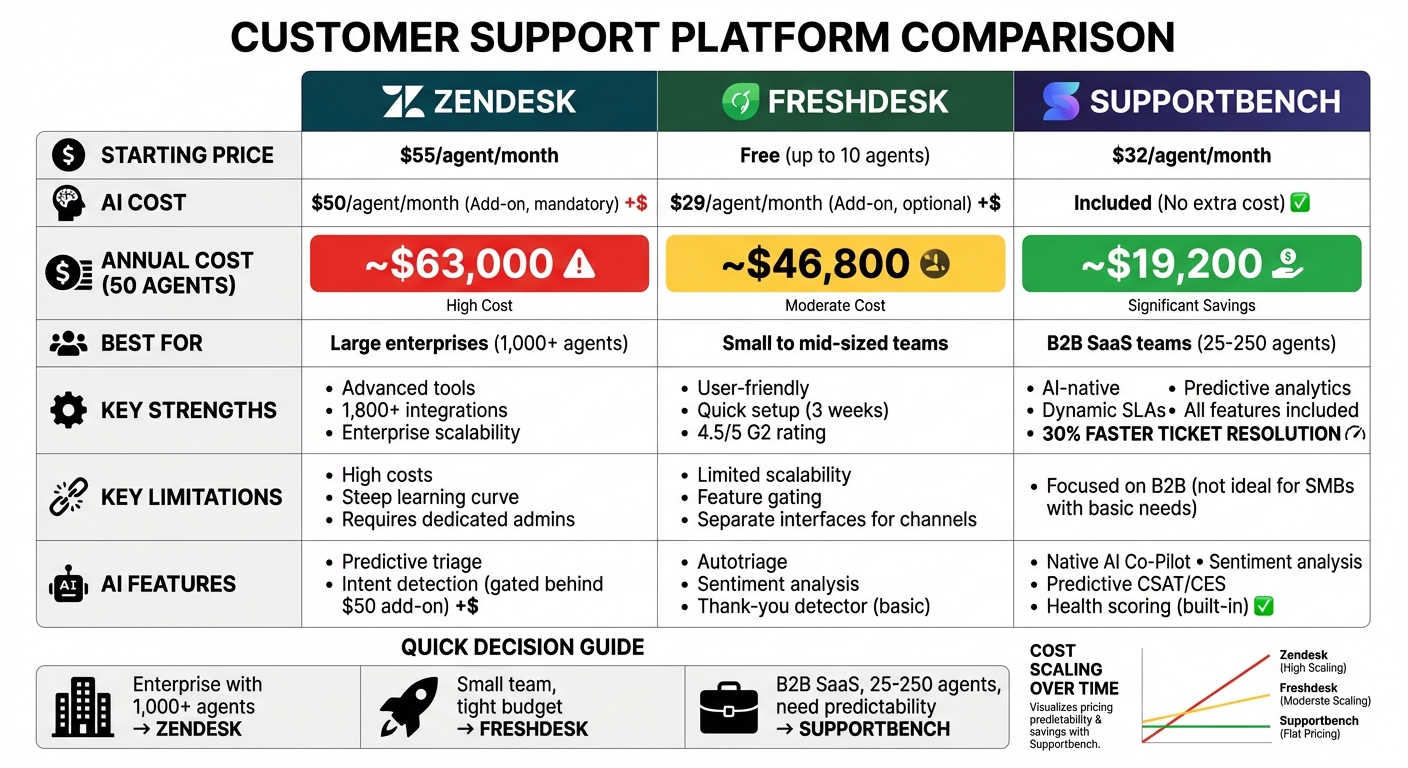
- Zendesk: Best for large enterprises with 1,000+ agents. Offers advanced tools but comes with high costs and complexity. AI features are add-ons starting at $50/agent/month.
- Freshdesk: Ideal for small to mid-sized teams. Affordable entry-level plans (free for up to 10 agents), but scalability and advanced features are limited. AI (Freddy) costs $29/agent/month.
- Supportbench: Tailored for B2B teams (25–250 agents). Flat pricing at $32/agent/month includes all features like AI, predictive analytics, and SLA-driven workflows. No hidden fees or add-ons.
Quick Comparison:
| Platform | Starting Price | AI Cost | Best For | Key Limitation |
|---|---|---|---|---|
| Zendesk | $55/agent/month | $50/agent/month | Large enterprises | High costs, steep learning curve, B2C focused |
| Freshdesk | Free (up to 10 agents) | $29/agent/month | Small to mid-sized teams | Limited scalability |
| Supportbench | $32/agent/month | Included | B2B SaaS teams (25–250 agents) | Focused on B2B, not SMBs |
If you’re scaling a B2B operation, Supportbench offers the best value with all features included at a predictable cost, making it a strong choice for growing teams.
Zendesk vs Freshdesk vs Supportbench: Pricing, Features & AI Comparison 2026
Zendesk: Features, Costs, and Limitations
Features and Pricing Structure
Zendesk provides an all-in-one workspace that unifies email, chat, phone, and social media channels. It also includes tools for internal collaboration, detailed reporting, and access to over 1,800 integrations.
The platform offers seven pricing tiers, starting at $55 per agent per month. Higher-tier plans and optional add-ons – like advanced AI features, which cost around $50 extra per agent per month – unlock additional capabilities. However, as you scale, costs can rise significantly. Key features such as advanced AI, custom objects, and in-depth analytics are either locked behind premium plans or sold as separate add-ons. While these higher tiers provide powerful tools, fully utilizing AI capabilities requires purchasing these extras.
AI Features and Scaling Challenges
Zendesk’s AI tools bring advanced functionality, but they also add complexity. Pre-trained on more than 18 billion support interactions, these tools include features like intelligent triage, generative search, and proactive agent support. However, these AI-powered features are not included in standard plans and must be purchased as add-ons. AI agent usage is billed per resolution, costing between $1.00 and $1.50 per interaction.
The platform’s automation relies heavily on keyword-based rules, which can miss subtle nuances in customer sentiment. Additionally, testing complex workflows in a safe environment requires the Sandbox feature, which is only available with Enterprise-level plans. Smaller teams often face the challenge of testing changes directly in live environments.
Best Fit and Limitations
Zendesk’s pricing and technical setup make it a better fit for mid-sized to large organizations with straightforward support needs and the resources to handle its complexity. Companies using Zendesk have reported benefits like a 42% reduction in time to first response and a 15% boost in admin productivity.
However, the platform struggles with more intricate B2B workflows, such as those requiring seamless management of renewals, entitlements, and asset tracking. Teams often deal with data silos, forcing them to toggle between multiple browser tabs or invest in additional integrations to link external tools like Confluence or Google Docs. Furthermore, the steep learning curve frequently necessitates hiring dedicated administrators or consultants, adding hidden operational costs to Zendesk’s already high licensing fees.
Freshdesk: SMB Platform with Growth Constraints
Features and Pricing Tiers
Freshdesk simplifies customer support for small and mid-sized businesses by consolidating inquiries from email, chat, phone, social media, and messaging apps into one inbox. Starting in 2026, admins will also be able to set SLA targets as low as 5 minutes, with automated adjustments to align with business hours.
The platform offers a free plan for up to 10 agents, making it an attractive option for startups dipping their toes into helpdesk systems. Paid plans begin at $29 per agent per month for the Growth tier, $69 per agent per month for Pro, and $109 per agent per month for Enterprise, with all plans billed annually. While these tiers are reasonably priced for basic needs, costs rise quickly as teams require more advanced features. Freddy AI, Freshdesk’s AI Copilot, is available for an additional $29 per agent per month and can be purchased selectively for specific team members rather than for the entire team.
Key tools for boosting agent productivity include canned responses, collision detection to avoid duplicate replies, internal notes for collaboration, automated ticket categorization, a customer portal, and a knowledge base for self-service. With over 3,500 reviews, Freshdesk has earned a G2 score of 4.4 out of 5.
AI Capabilities and Enterprise Limitations
Freddy AI, Freshdesk’s AI system, is trained on more than 18 billion real-world support interactions. While it handles basic automation and ticket routing effectively, it lacks the sophistication needed for more advanced tasks like predictive intelligence or nuanced sentiment analysis – features often essential for complex B2B operations.
The platform’s user interface can feel clunky when managing multiple channels. Agents often need to switch between separate screens for chat, phone, and ticketing, which can disrupt their workflow and make it harder to maintain a clear view of customer interactions. This fragmentation can slow response times, especially for teams juggling multiple touchpoints.
Freshdesk also falls short in areas like Workforce Management (WFM) and Quality Assurance (QA). It lacks native tools for resource planning and quality monitoring, requiring managers to handle these tasks manually. During periods of high ticket volume, performance can lag, and the platform does not offer advanced collaboration tools, such as internal discussions within tickets, which enterprise teams often rely on for handling complex escalations.
Ideal Use Cases and Constraints
Freshdesk is a great fit for small teams with straightforward ticketing needs and limited budgets. Its quick setup – usually around three weeks – and user-friendly design make it easy to get up and running with minimal training. Matt Phelps, Director of Global Customer Support, highlighted its versatility:
"While using Zendesk, we were fragmented and inefficient. After moving to Freshdesk, we had the capability to do live chat, voice, and ticketing all in one platform."
However, Freshdesk’s limitations become apparent as businesses grow. Critical features are often locked behind higher-priced plans, a practice known as "feature gating". Matt Gordon, VP of Global Customer Support at a Freshdesk customer, expressed frustration with this approach:
"The gating system, you know, charging for new features, significantly increased costs."
For companies managing complex B2B workflows – like renewals, asset tracking, or multi-step customer journeys – Freshdesk’s capabilities may fall short. These businesses often face challenges integrating multiple systems or achieving advanced automation. To bridge these gaps, some organizations find themselves needing to purchase additional Freshworks products, such as Freshchat for live chat, which can add up to $83 per month, or pivot to enterprise customer support platforms designed for complexity.
Supportbench: AI-Native Platform for B2B Support
Features and Pricing Model
Supportbench offers an all-inclusive package at $32 per agent per month, covering case management, knowledge bases, predictive analytics, AI automation, and live human support. This flat-rate pricing ensures that every customer, regardless of team size, benefits from enterprise-level functionality. Nooshin Alibhai, Founder and CEO of Supportbench, emphasizes:
Supportbench’s pricing is transparent and includes automation, analytics, and reporting from day one.
This straightforward pricing model eliminates hidden fees and supports teams as they grow, ensuring predictable costs.
Built-In AI and Operational Impact
Supportbench integrates AI across its workflows to enhance efficiency. The AI Co-Pilot allows agents to interact with the system conversationally, accessing the knowledge base, past tickets, and customer histories. Meanwhile, AI Automation handles tasks like ticket prioritization, issue classification, case summaries, and even creating knowledge base articles from resolved cases – cutting down on manual work and reducing the need for external tools.
The platform also features AI CX Intelligence, which automates the collection of CSAT and CES scores, performs agent quality checks, and analyzes customer sentiment to identify potential risks. This proactive system flags at-risk customers before problems escalate. On average, users report 30% faster ticket resolution thanks to these AI-driven tools. Additionally, companies using AI in customer service have seen a 15% to 30% drop in call, chat, and email inquiries. These capabilities not only streamline operations but also improve support quality.
Built for Complex B2B Workflows
Supportbench is designed to handle the intricate needs of B2B support. Its dynamic SLAs adjust automatically based on key customer milestones, such as tightening response times 30 days before a contract renewal. This ensures priority clients receive timely attention without requiring manual adjustments.
Agents benefit from a comprehensive, 360-degree view of each customer, including health scores, contract details, usage history, and renewal information – all accessible in one interface. Features like parent/child cases, multi-step approvals, and case swarming simplify managing complex workflows. Caitlyn Langston, Chief Technology Officer, shares:
Supportbench is amazing in how it gets things done compared to other success and case executives arrangements I’ve used and IMO incomparably superior when it comes to resolving end-user difficulties.
With a customer base of approximately 9,000 businesses worldwide, Supportbench has earned recognition as a Leader by G2, Gartner Capterra, and Software Advice. It is particularly suited for mid-market B2B teams – typically those with 25 to 250 employees – seeking enterprise-grade tools without the high costs or complexity of traditional systems. Its unified interface and advanced workflow capabilities make it a standout choice for B2B operations.
Direct Comparison: Zendesk vs Freshdesk vs Supportbench
Pricing and Cost Growth
When comparing pricing structures, it’s clear that each platform has a unique approach to scaling costs as your team expands.
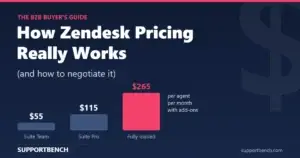
Zendesk kicks off with its Suite Team plan at $55 per agent per month, escalating to $115 per agent for the Professional tier. If you want advanced AI features, that’s an extra $50 per agent per month – mandatory for every team member. This can add up fast. Matt Gordon, VP Customer Support at Siteimprove, shared his experience:
We were on Zendesk previously… it turned out their gating system and additional costs for new features kind of kicked us in the teeth.
For a 50-agent team utilizing AI, Zendesk’s annual cost lands around $63,000, not including extra charges like storage, data protection, and onboarding.
Freshdesk provides a more accessible entry point, offering a free tier for up to 10 agents. Its AI Copilot add-on costs $29 per agent per month and can be assigned selectively, which is a big plus. However, additional services like live chat and telephony often come at an extra cost, which can reduce its initial affordability as your team grows.
Supportbench takes a different route with flat pricing at $32 per agent per month. This includes all enterprise-level features – AI automation, predictive analytics, sentiment analysis, dynamic SLAs, and advanced reporting – without hidden fees or premium tiers. This straightforward pricing avoids the "growth penalty" that can occur as teams outgrow their initial plans.
| Platform | Entry Price | AI Cost | 50-Agent Annual Cost (with AI) | Additional Fees |
|---|---|---|---|---|
| Zendesk | $55/agent/month | $50/agent (mandatory) | ~$63,000 | Storage, data protection, onboarding |
| Freshdesk | $0 (up to 10 agents) | $29/agent (optional) | ~$46,800 | Separate chat/telephony services |
| Supportbench | $32/agent/month | Included | ~$19,200 | Minimal; all-in-one B2B focus |
Pricing aside, the platforms also take very different approaches to integrating AI into their workflows.
AI Capabilities and Implementation
The way AI is integrated and used varies significantly across these platforms.
Zendesk offers advanced AI features, such as predictive triage and intent detection, but these are locked behind a $50 per agent add-on. These tools tend to work best with higher-tier plans, which allow for more customization.
Freshdesk delivers Freddy AI, which is geared toward small to medium-sized businesses. Freddy AI includes features like autotriage, sentiment analysis, and a "thank-you detector" that automatically closes resolved tickets. At $29 per agent per month, it’s more affordable than Zendesk’s AI. However, Freddy AI isn’t as robust for handling complex enterprise workflows, such as account health scoring or renewal-driven SLAs.
Supportbench takes a different approach by embedding AI throughout its platform. Designed specifically for B2B support, its AI handles tasks like ticket prioritization, issue classification, and generating insights from historical data. These features are built-in at all pricing tiers, with no additional per-agent charges.
| Capability | Zendesk | Freshdesk | Supportbench |
|---|---|---|---|
| AI Type | Add-on (Advanced AI) | Add-on (Freddy AI) | Native / Built-in |
| B2B Focus | General Enterprise | SMB/General | B2B SaaS specific |
| Key Features | Intent models, predictive triage | Autotriage, sentiment analysis, auto-closure | Sentiment, predictive CSAT/CES, health scoring |
| Availability | Gated behind a $50/agent add-on | Gated behind a $29/agent add-on | Included at all tiers |
| Setup Complexity | Pre-trained but complex | Straightforward | Integrated and accessible |
AI capabilities are just one piece of the puzzle. Scalability and ease of use are equally crucial when choosing the right platform.
Scalability and Ease of Use
Scalability and usability play a big role in determining how well a platform fits your team’s needs.
Zendesk is a strong choice for large enterprises with thousands of agents. It holds a 16.53% market share in customer experience software and boasts over 1,500 third-party integrations. However, it comes with a steep learning curve and often requires dedicated administrators or consultants for customization. On the upside, users transitioning from Freshdesk to Zendesk have reported a 42% improvement in time to first response and a 15% boost in admin productivity.
Freshdesk is known for its user-friendly interface and quick setup, earning a 4.5/5 rating on G2 from over 7,840 reviews. While its simplicity is great for small teams, its separate interfaces for chat, phone, and ticketing can make it less effective for handling complex B2B workflows. Chuck Courtney, Support Manager at Wyze, shared:
For a company that really strives to have a high response rate within minutes, not being able to see customer replies quickly was always a struggle using Freshdesk.
Supportbench strikes a balance, catering to B2B teams with 25 to 250 agents. Its design supports complex workflows, such as dynamic SLAs that adjust based on customer milestones. This makes it ideal for managing long-term cases and intricate approval processes, all without requiring heavy IT involvement.
| Criteria | Zendesk | Freshdesk | Supportbench |
|---|---|---|---|
| Ideal Team Size | Enterprises (1,000+ agents) | SMB to Mid-Market | SMB to Enterprise (25–250 agents) |
| Ease of Use | High learning curve | Highly intuitive | Balanced and accessible |
| Complex B2B Workflows | Robust (often requires APIs/consultants) | Basic ticketing | Native support for long-running cases |
| SLA Management | Advanced (high tiers only) | Basic to moderate | Dynamic, milestone-driven (all tiers) |
| Reporting | Advanced (Professional tier+) | Basic dashboards | Predictive and real-time (all tiers) |
| G2 Rating | 4.3/5 (6,210+ reviews) | 4.5/5 (7,840+ reviews) | Recognized as a leader |
sbb-itb-e60d259
Zendesk Vs Freshdesk (2026) | Which Helpdesk Tool Is Better?
Which Platform Fits Your Organization in 2026?
Choosing the right platform for your organization depends on your specific support needs and long-term goals.
Small and Mid-Sized B2B Teams
If you’re running a small B2B team with basic ticketing needs and a limited budget, Freshdesk is an appealing option. It’s easy to set up, user-friendly, and has earned a 4.5/5 rating on G2 from over 7,840 reviews.
That said, if your business involves more intricate workflows, extended case management, or customer health tracking, Supportbench may offer better long-term value. While Freshdesk is great for getting started, its limitations might prompt an upgrade sooner than expected. On the other hand, Supportbench, priced at $32 per agent per month, includes enterprise-grade AI, sentiment analysis, and SLA-driven workflows – all without costly add-ons. As your customer base expands, you won’t face unexpected costs for features like predictive analytics or 360-degree customer views, which are included from the start.
Freshdesk is a solid entry-level choice, but for SMBs planning to scale, Supportbench offers a smoother path by avoiding the need for future migrations.
For teams anticipating rapid growth, having predictable costs and fully integrated features from the outset can save time and money.
Growing Teams with Budget Constraints
As your team grows, the initial affordability of a platform can quickly be overshadowed by rising operational costs. For example, Freshdesk’s modular pricing – separating ticketing, chat, and telephony – can drive up costs as you scale. Similarly, Zendesk can become expensive, with its AI Copilot add-on priced at $50 per agent per month. For a 50-agent team, that’s an additional $30,000 annually.
In contrast, Supportbench offers all enterprise features – such as AI automation, predictive CSAT and CES, health scoring, and advanced reporting – at a flat rate of $32 per agent per month. This all-inclusive approach eliminates the need for mid-contract upgrades or extra purchases, helping growing teams maintain consistent costs. While Freshdesk claims to cut support expenses by up to 50% compared to Zendesk, Supportbench’s pricing model provides even greater predictability, making it easier to plan your budget as you scale.
Enterprises with Complex Customer Relationships
For large organizations managing intricate customer interactions, the platform’s ability to handle complex workflows is critical. Zendesk is a strong contender for enterprises with thousands of agents, offering robust scalability. However, advanced customization often requires significant IT resources, which can add to the overall cost and complexity.
Supportbench, on the other hand, is specifically designed for complex B2B environments. It includes built-in tools for proactive customer health monitoring, dynamic SLAs that adjust based on key milestones (like renewals), and AI-driven insights to identify at-risk accounts before they churn. These features support the kind of long-term, relationship-focused strategies that B2B SaaS companies rely on, without the heavy technical overhead that Zendesk often demands.
Industry research highlights the importance of customer experience: 86% of customers are willing to pay more for better service, and 89% of companies now compete primarily on customer experience. For enterprises where retention is directly tied to revenue – remember, increasing retention by just 5% can boost revenue by as much as 95% – having the right tools is essential.
For B2B SaaS companies, Supportbench stands out as the best choice. Its combination of AI, scalability, and built-in customization is perfectly suited for managing the high-touch, long-term relationships that define the SaaS industry.
Conclusion
Selecting the right support platform in 2026 means finding one that fits your organization’s specific needs and growth trajectory. Each platform brings unique strengths to the table, catering to different aspects of B2B support.
Zendesk remains a trusted choice for traditional enterprises that require extensive customization and have the IT resources to handle complex configurations. However, the added costs for advanced AI features can stretch budgets thin. Freshdesk, on the other hand, provides a budget-friendly option for smaller teams with basic ticketing needs. But as workflows become more intricate, its limitations in handling complex B2B operations can become a hurdle.
Supportbench stands out by offering enterprise-level features at just $32 per agent per month. This includes AI automation, predictive CSAT and CES, dynamic SLAs, and comprehensive customer views – all without hidden fees or costly add-ons. Unlike older platforms where AI is an optional extra, Supportbench integrates AI directly into every workflow, offering a smarter and more cohesive experience.
"Supportbench addresses what Zendesk overlooked: maintaining context across complex B2B customer relationships." – Nooshin Alibhai, Founder and CEO of Supportbench
With 67% of B2B companies already leveraging AI and machine learning to drive growth, having these tools built into the platform – rather than as expensive add-ons – provides a clear competitive edge. Supportbench’s design, tailored specifically for B2B needs, includes features like account hierarchies, renewal-aware SLAs, and deep CRM integration. This makes it an ideal choice for SaaS companies and enterprises where customer retention is directly tied to revenue.
This thoughtful alignment ensures that as your business grows, you’ll have the tools necessary to manage the increasingly complex demands of modern B2B support.
FAQs
What are the key pricing differences between Zendesk, Freshdesk, and Supportbench in 2026?
The pricing structures for Zendesk, Freshdesk, and Supportbench in 2026 showcase some clear differences:
- Zendesk starts at $55 per agent/month, but AI tools like predictive intelligence and bots are sold separately. This means costs can rise quickly as your team expands.
- Freshdesk begins at $15 per agent/month for the basic plan (or $29 per agent/month for the Omni plan) and even offers a free tier for up to 10 agents. However, its AI features, such as Freddy, are optional and come with additional fees.
- Supportbench charges a flat $32 per agent/month, which includes enterprise-level AI tools in every plan without any hidden costs. Pricing increases in a straightforward way as your team grows.
To put it simply, Zendesk has the highest starting price and charges extra for AI, Freshdesk is cheaper upfront but adds costs for AI features, while Supportbench offers a predictable, all-inclusive pricing model with AI already built in.
How does Supportbench’s AI compare to Zendesk and Freshdesk in 2026?
Supportbench includes AI as a native, built-in feature with every plan, starting at $32 per agent/month. This ensures that all users – whether part of a small team or a large enterprise – benefit from advanced AI tools like predictive routing, automated case enrichment, and actionable insights. And here’s the best part: there’s no need to pay extra for add-ons. The AI is seamlessly integrated into workflows, making it especially effective for B2B operations that deal with complex cases, renewals, and escalations.
Zendesk, on the other hand, offers its AI capabilities through the premium "Copilot" suite. While it’s marketed as a powerful solution, it comes at a high cost and is typically sold as an add-on. This makes it better suited for enterprises with large budgets and extensive data sets. Its automation tools are designed for scale but may not be the most practical choice for smaller teams due to the expense.
Freshdesk’s AI, known as "Freddy", emphasizes chatbot-first automation and tools to boost agent productivity. While it’s great for managing basic queries and improving efficiency, it offers less customization and is more tailored to small-to-mid-sized teams. Unlike Supportbench, Freddy’s AI doesn’t integrate as deeply into workflows designed for complex B2B operations.
Bottom line: Supportbench provides a fully integrated, budget-friendly AI solution that grows with your business. In contrast, Zendesk and Freshdesk come with limitations, whether it’s cost or functionality.
Which support platform is best for managing complex B2B workflows?
Supportbench is built to tackle the intricate needs of complex B2B workflows effortlessly. With its AI-native design, the platform incorporates advanced automation and customization right out of the box. This makes it simple to manage long-term cases, handle renewals, and navigate multi-step escalations – all without the need for expensive add-ons. Plus, every pricing tier comes with enterprise-level features, making it a great fit for both small teams and large-scale, high-touch operations.
Zendesk, while offering strong scalability and AI tools, tends to cater more to larger enterprises with bigger budgets. Freshdesk, in contrast, might find it challenging to meet the nuanced requirements of complex B2B workflows as businesses expand.