
AI workflows are reshaping B2B support, leaving legacy systems struggling to keep up. Here’s why:
- AI workflows: Use real-time data, predict issues, and reduce manual work. They’re modular, scalable, and cost-efficient.
- Legacy systems: Depend on rigid rules, manual updates, and struggle with exceptions. They’re slower, less flexible, and costly to maintain.
AI-native platforms automate repetitive tasks, improve response times, and save costs. For example, companies like Remote and Unity have saved millions and reduced workloads by adopting AI workflows. Meanwhile, legacy systems often fail under pressure, require more staff, and lead to hidden costs.
Quick Comparison:
| Feature | AI Workflows | Legacy Systems |
|---|---|---|
| Architecture | Modular, easy to update | Monolithic, hard to modify |
| AI Integration | Built-in, real-time functionality | Add-on, limited capabilities |
| Scalability | Handles growth without extra staff | Requires more resources |
| Cost Efficiency | Transparent, outcome-based pricing | Hidden costs, expensive |
| Response Times | Faster, predictive capabilities | Slower, reactive approach |
AI workflows are transforming B2B support by cutting costs, boosting efficiency, and enabling smarter operations. If your system feels outdated, it’s time to explore AI-native solutions.
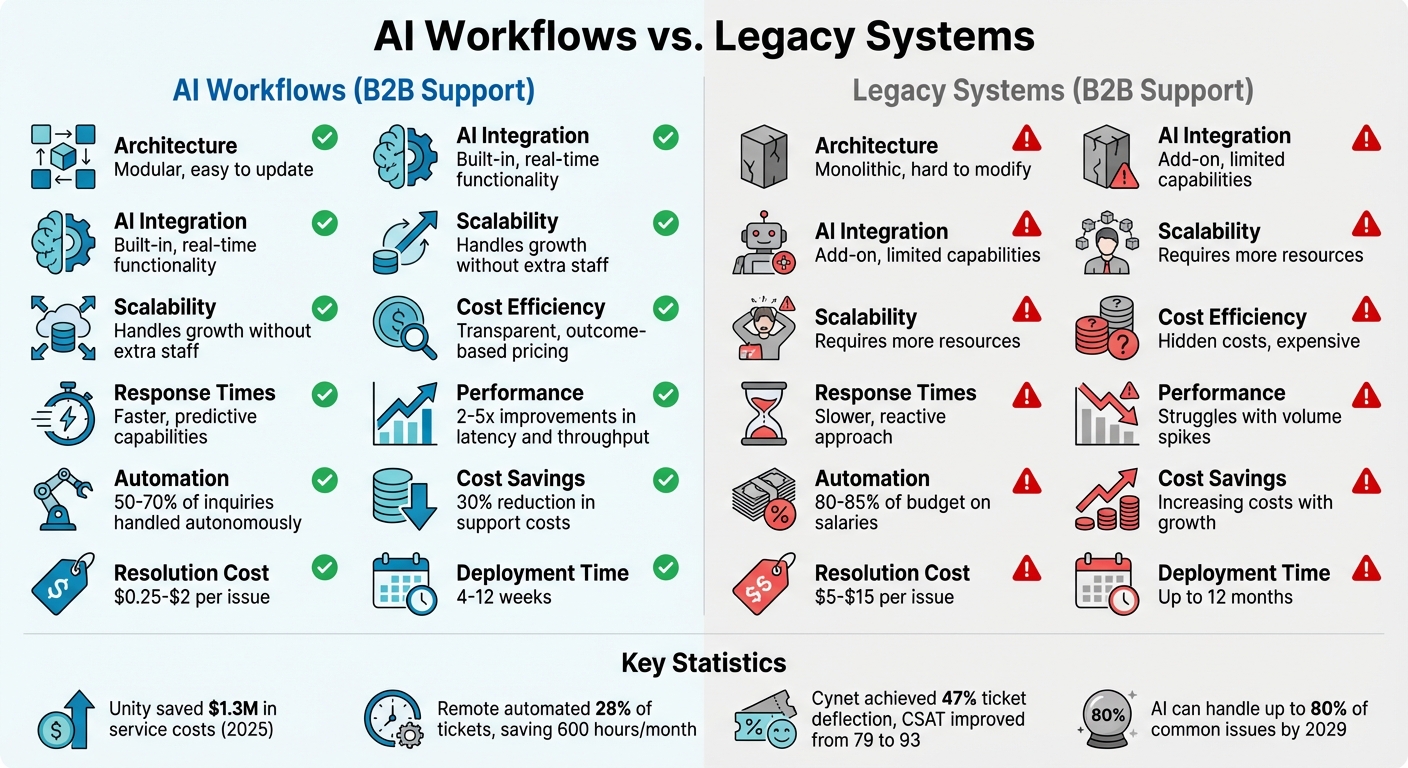
AI Workflows vs Legacy Systems: Feature Comparison for B2B Support
AWS re:Invent 2025 – Migrate and Modernize Legacy Workflows to Intelligent Agents (PEX304)
How AI Workflow Design Differs from Legacy Systems
Grasping the differences between AI-native workflows and legacy systems is key to understanding how AI-driven designs enable scalable and cost-effective support operations. These two approaches diverge fundamentally in terms of architecture and AI integration. Legacy systems rely on rigid, monolithic structures that were not designed for modern B2B needs that demand manual updates and frequent IT intervention. On the other hand, AI-native workflows are built to handle complexity, adapt in real time, and function autonomously. This allows support teams to scale operations, automate repetitive tasks, and respond more efficiently to customer needs. Let’s break down these differences further.
Modular vs. Monolithic Architecture
Legacy systems are built on monolithic architectures where components are tightly interconnected. Any change to one part often requires halting or significantly modifying the entire system, resulting in long deployment cycles.
AI-native platforms, however, embrace modular designs. Think of these as independent building blocks that can be updated, replaced, or scaled without affecting the rest of the system. For example, an online retailer used AI-native agents to manage tasks like order ID collection and uploading product images autonomously. This freed up human agents to focus on more complex customer issues.
The performance benefits are hard to ignore. AI-native systems can deliver 2–5x improvements in latency and throughput compared to legacy systems that have been retrofitted with AI. They also support zero-touch operations, automatically handling configurations, optimizations, and even failure recovery. A notable example is Unity, which saved over $1.3 million in service costs in 2025 by adopting collaborative AI workflows during a period of rapid growth. These architectural advantages translate into faster issue resolution and lower operational costs for B2B support teams.
Native AI vs. Bolted-On Features
The way AI is integrated further sets these systems apart. Native AI is woven into every layer of the system, from data processing to decision-making, making intelligence a foundational element. In contrast, bolted-on AI is added to legacy systems as an afterthought, often leading to compatibility issues and limited functionality.
This difference has a direct impact on how these systems perform. Bolted-on AI typically handles basic tasks like answering simple FAQs or making API calls, often in isolated silos. In contrast, native AI platforms integrate data and context across systems, enabling predictive support. For example, LATAM Airlines demonstrated this in 2025 by rolling out AI-powered employee services for its 30,000 staff members, achieving an impressive 80% accuracy rate in resolving internal inquiries autonomously.
Another major advantage of native AI is its ability to evolve quickly. Updates and new features can be deployed in days or weeks, keeping pace with advancing AI models. Legacy systems, constrained by their monolithic design, often require months or even quarters to implement similar changes. This agility is essential for B2B support teams striving to meet growing customer demands and stay ahead in a competitive landscape.
Scalability and Automation Compared
Scaling with Business Growth
Legacy systems often struggle to keep up with growth. As businesses expand and customer demands increase, these systems create a "coordination overhead", which means more staff is needed to manage the workload. This results in a cycle where growth directly leads to higher headcount demands, making it hard to sustain.
AI-native workflows change the game by automating coordination itself. Unlike traditional systems, these workflows scale like software, managing thousands of interactions simultaneously without requiring additional labor. For example, Remote’s use of AI-native workflows automated 28% of their support tickets, saving over 600 hours each month – all with just three IT staff members.
Legacy systems, with their rigid, rules-based structures, often buckle under pressure during volume spikes or when faced with unanticipated scenarios. In contrast, AI-native platforms excel by using real-time, multi-step reasoning. They can assess context, make decisions, and act independently of human input. A great example is Unity, which faced rapid growth in 2025. By implementing collaborative AI workflows, they deflected support tickets and introduced self-service options, cutting service costs by more than $1.3 million. This kind of scalable coordination not only keeps up with growth but also automates repetitive tasks seamlessly.
Automating Repetitive Support Tasks
AI-native systems take scalability a step further by handling repetitive tasks across multiple systems at once. For instance, they can process a refund in a payment gateway while simultaneously updating a CRM and closing a support ticket. This isn’t just about speed – it fundamentally changes how work gets done.
"The advantage of AI is not necessarily what it does on its own, but the cognitive offload that it offers for your people",
- Chris Chiancone, Chief Information Officer at the City of Carrollton.
By taking over tasks like interpreting inputs, identifying intent, and making judgment calls, AI-native systems free up human agents to focus on more complex or emotionally charged issues.
Take Popl, for instance. In 2025, they handled hundreds of demo requests daily by integrating OpenAI with HubSpot and Salesforce. Their AI workflow triaged incoming emails, filtered spam, and enriched leads by pulling company data from domains, saving them $20,000 annually. Similarly, Cynet centralized its knowledge base and automated routine Tier-1 support tasks, achieving a 47% ticket deflection rate. This cut resolution times nearly in half and improved their customer satisfaction score (CSAT) from 79 to 93 points. These examples highlight how automation doesn’t just make processes faster – it elevates the overall customer and employee experience.
Cost and Efficiency Comparison
Transparent vs. Hidden Costs
Legacy systems often disguise their true costs through seat-based pricing, leading to "shelfware" – software that sits unused while still consuming budgets without delivering a return on investment (ROI). The financial burden grows when businesses attempt to integrate AI capabilities into these outdated platforms. Such integrations can cost anywhere from $25,000 to $60,000 or more, compared to the significantly lower $3,000 to $10,000 for modern, API-friendly systems.
Another hidden expense arises when automation falls short and human intervention becomes necessary. In these cases, businesses end up paying twice: once for the failed automated process and again for manual resolution. On top of that, maintaining legacy systems demands ongoing IT support and manual updates, with knowledge engineering costs ranging from $1,000 to $50,000 per quarter, depending on system complexity.
AI-native platforms, on the other hand, offer a more transparent and efficient cost structure. These systems often adopt outcome-based or consumption-based pricing models, where businesses pay for actual usage or resolved issues rather than unused capacity. Additionally, built-in AI capabilities eliminate the need for expensive integrations, reducing hidden costs and simplifying budgets. The financial impact is stark: while resolving a customer issue through a human agent costs $5 to $15, an AI-driven resolution costs just $0.25 to $2. These savings directly boost operational efficiency and productivity.
Doing More with Fewer Resources
Lower costs don’t just mean saving money – they also allow businesses to operate with fewer resources. On average, companies allocate 80% to 85% of their support budgets to salaries and benefits. Legacy systems exacerbate this by scaling inefficiently: as ticket volumes grow, so do staffing needs, including agents, managers, and overhead.
AI-driven B2B enterprise customer support platforms disrupt this pattern by autonomously handling 50% to 70% of inquiries, freeing human agents to focus on more complex, high-value tasks like managing B2B relationships. A striking example comes from Lovepop, which adopted an AI-native platform in 2025 under the guidance of Anthony Tedesco, Head of Customer Support Operations. The results were transformative: email first-reply times plummeted from over seven hours to just 18 seconds, and the team managed double the ticket volume with fewer staff members. Seasonal hiring became unnecessary, and the company’s Trustpilot score improved from 3.6 to 4.3.
"We went from 20% accuracy to the high 90s within weeks. We were in a time crunch and Crescendo moved fast…and the improvement was exponential."
- Anthony Tedesco, Head of Customer Support Operations, Lovepop
Businesses that implement AI-native platforms report an average 30% reduction in customer support costs, with some cutting average resolution costs by over 20%. While legacy system deployments can take up to 12 months, AI-native platforms are typically operational within 4 to 12 weeks. This rapid rollout allows teams to start benefiting from cost savings and efficiency improvements in a matter of weeks, not years.
sbb-itb-e60d259
Impact on B2B Customer Support Performance
Increasing First-Contact Resolution Rates
AI-native workflows are reshaping how first-contact issues are managed, offering a level of efficiency that outdated systems simply can’t match. Instead of waiting for customers to report problems and relying on rigid decision trees, these platforms proactively identify and address issues – often before customers even notice something’s wrong.
Traditional systems depend on fixed "if-then" rules, which struggle with unstructured data. In contrast, AI-native workflows can interpret unstructured information, reason through complex scenarios, and perform multi-step actions across tools like CRM systems, billing platforms, and support tickets. This means much of the preliminary work is done before a human agent even steps in.
Take, for example, a company that saw a 14-point boost in customer satisfaction (CSAT) and cut resolution times in half by centralizing knowledge through AI. Suzanne Duffy, Head of Customer Service at Papier, highlighted this benefit:
"Even if the AI agent doesn’t fully resolve a query, it handles the initial data collection – freeing agents for complex issues".
AI tools are also speeding up response times, reducing first response times by 37% and increasing ticket resolution speeds by 52%. And looking ahead, it’s predicted that by 2029, AI agents could handle up to 80% of common issues. These advancements are not just incremental improvements – they’re setting the foundation for a major transformation in B2B support.
Protecting Customer Retention and Revenue
Fast resolutions are great, but proactive support goes a step further by safeguarding long-term customer relationships. In B2B settings, where contracts often span years and customer lifetime value can reach six or seven figures, this kind of support is vital. Even a modest 5% increase in customer retention can drive profits up by over 25%.
AI-native platforms help shift the focus from reactive problem-solving to proactive relationship management. For example, instead of waiting for customers to report billing errors or usage anomalies, AI agents can detect and resolve these issues in real time – sometimes before the customer even notices.
A compelling case is ActiveCampaign, which faced a 25% churn rate in 2024 among users who lacked personalized onboarding. By rolling out an AI-driven onboarding system that tagged users by language and enrolled them in tailored webinars, the company achieved impressive results: a 15% drop in early churn, a 440% jump in webinar attendance, and double the product adoption within 90 days.
AI doesn’t just protect existing revenue – it also identifies growth opportunities. By analyzing usage patterns, support history, and engagement data, customer success teams can pinpoint accounts ripe for upselling or flag those at risk of downgrading. This data-driven approach not only protects revenue but also helps teams grow it without depending solely on manual reporting.
Supportbench exemplifies how AI can enhance case management, streamline knowledge creation, and improve workflows – boosting first-contact resolution rates and safeguarding revenue. These advancements are paving the way for a new era in B2B support operations.
Moving from Legacy Systems to AI-Native Workflows
Evaluating Your Current System’s Limitations
Take a close look at the shortcomings of your current system. Legacy systems often rely on rigid decision trees, which quickly fall apart when faced with unusual scenarios or specific customer needs. If your team spends more time finding workarounds than actually using the system as intended, it’s a clear sign of inefficiency.
Another major issue is fragmented data. In many legacy setups, information is scattered across disconnected platforms. This lack of centralized data makes it nearly impossible for AI to access the comprehensive insights it needs to perform effectively. When your team spends valuable time searching for information instead of resolving customer issues, operational costs inevitably rise.
Traditional systems also tend to be reactive by nature. They only respond after a customer reports a problem, missing opportunities to address potential issues before they escalate. In B2B environments, this reactive approach can lead to significant risks, including lost revenue and damaged client relationships.
Recognizing these limitations is the first step toward transitioning to AI-native workflows that are more efficient and proactive.
Implementing an AI-Native Platform
To make the shift, start with straightforward, high-impact use cases. Focus on areas like Tier-1 troubleshooting or account management – tasks that occur frequently and follow well-defined processes. These are ideal starting points because they offer measurable benefits with minimal complexity.
During the transition, adopt a human-in-the-loop (HITL) approach. This means letting the AI suggest actions for human approval rather than acting independently from the beginning. This method not only builds trust among your team but also ensures the system adapts to your specific business needs. Set a 95% confidence threshold for AI-driven decisions, and route cases with lower confidence levels to human agents for review.
Before rolling out the platform, unify your data. Consolidating fragmented information into a single, AI-ready system gives the platform full context for every customer interaction. For example, tools like Supportbench combine case management, knowledge creation, and customer insights into one platform. This eliminates the data silos that often hinder legacy systems. With AI fully integrated into the workflow, your team can automate tasks like triage, predictive CSAT and CES analysis, and manage dynamic SLAs – all without increasing headcount or relying heavily on IT support.
Set clear guidelines and escalation protocols from the outset. Define operational limits and ensure that high-frustration or complex issues are sent directly to human agents. Keep an eye on technical aspects such as API rate limits and authentication tokens to avoid silent failures in workflows. To measure the platform’s value, use this ROI formula: (Time Saved × Hourly Rate × Frequency) – (Platform Costs + Setup Time). This will help justify the investment and track your progress over time.
Supportbench: AI-Native Workflow Design for B2B Support
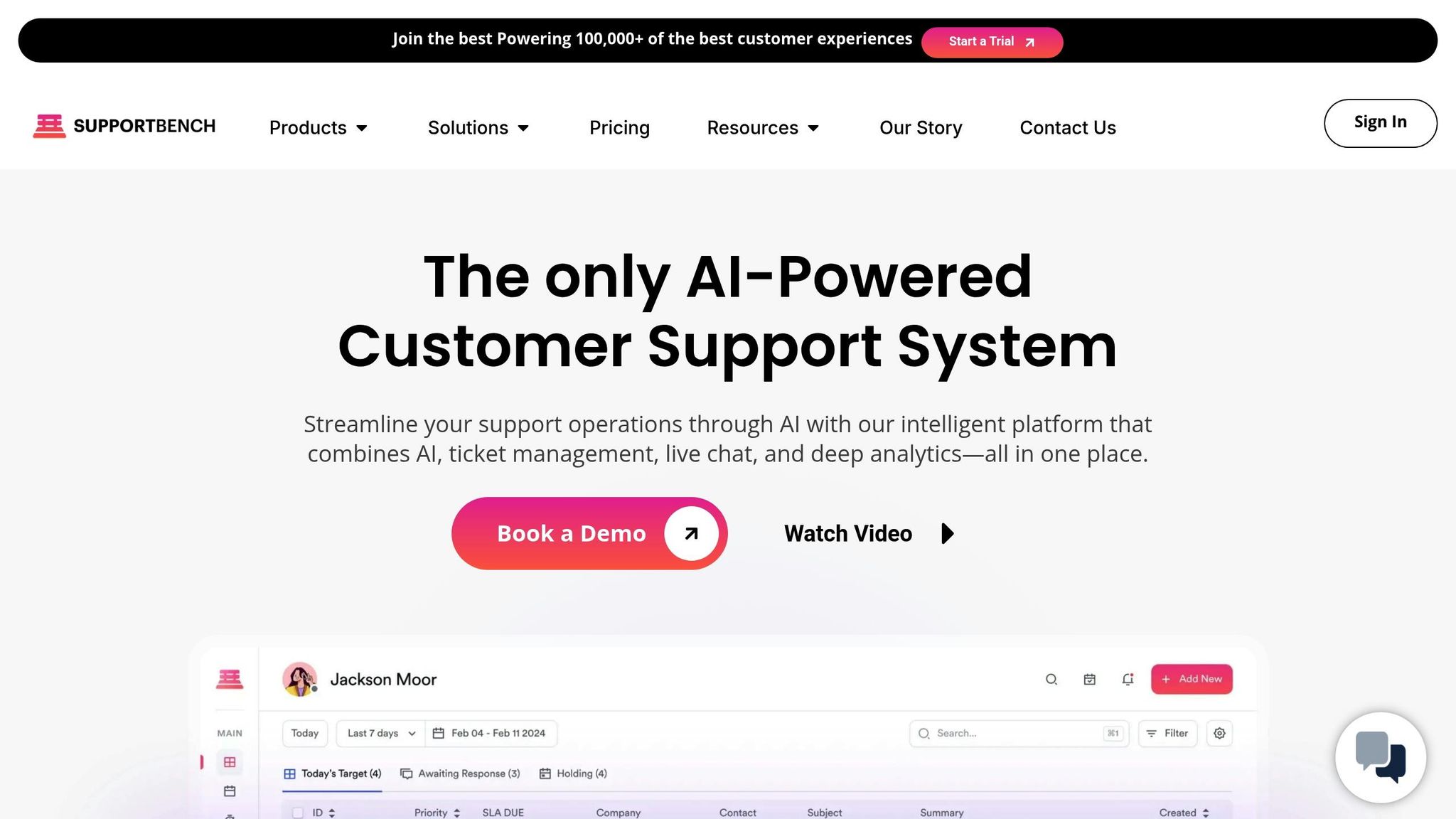
Supportbench takes B2B support to the next level by embedding AI-driven scalability and automation into a single, cohesive platform.
Integrated AI for Smarter, Scalable Support
Supportbench doesn’t treat AI as an afterthought – it’s part of the foundation. From the start, the platform uses AI to streamline workflows, automatically creating case summaries and notes. This means agents don’t have to sift through endless email threads, freeing them up to tackle more complex challenges. This approach, often called "cognitive offload", allows teams to focus their energy where it truly matters: problem-solving.
The platform also offers predictive tools like CSAT and CES analysis, which can identify potential issues before they escalate. Impressively, nearly 50% of Tier 1 tickets are resolved without any human input. This not only cuts operational costs but also ensures service quality remains high.
AI further simplifies tasks like triage and prioritization. By automatically tagging and assigning cases, Supportbench eliminates the need for manual categorization. With 76% of customers expecting fast, personalized responses, these AI features help teams meet growing demands without needing to expand their workforce.
Say Goodbye to Multiple Systems
Traditional setups often rely on a patchwork of tools: a helpdesk for tickets, a CRM for customer data, Slack for team communication, and various add-ons for analytics. Supportbench eliminates this complexity by consolidating everything into one platform. This unified approach not only streamlines operations but also removes the headaches caused by syncing data across disconnected systems.
With Supportbench, agents get instant access to a complete view of customer history, product documentation, and past interactions – all without switching apps. Its user-friendly API and integration options ensure real-time access to customer data, making workflows seamless. Pricing starts at $32 per agent per month, and every customer gets access to the same enterprise-level features, regardless of team size. There’s no tiered gating of AI capabilities, so everyone benefits equally.
This all-in-one setup is especially valuable for managing the intricate relationships that define B2B support.
Tailored for Complex B2B Relationships
B2B support isn’t just about resolving tickets – it’s about managing long-term, intricate workflows. Supportbench is built with this in mind, offering dynamic SLAs that adapt based on customer behavior. For example, SLAs automatically tighten if a customer is nearing renewal or showing signs of churn, addressing the inflexibility of older systems.
Agents also gain access to detailed, 360-degree customer overviews. These include account health, past escalations, training history, and even custom data like infrastructure details or login credentials. Notes from customer success managers (CSMs) appear as pop-ups, ensuring every response is informed by the full context of the relationship. This level of insight is crucial in B2B, where a single mistake could jeopardize recurring revenue.
Additionally, the platform’s escalation management tools track multi-layered issues and monitor their resolution. This helps safeguard revenue by boosting customer retention. Considering that a 5% increase in retention can drive profits up by more than 25%, these features play a direct role in protecting your bottom line during critical moments in the customer lifecycle.
Conclusion
The differences between AI-native workflows and legacy systems highlight clear operational advantages. Legacy platforms tend to rely on rigid, rule-based actions, often reacting to problems only after they arise. They also demand constant manual updates, which can be both time-consuming and inefficient. On the other hand, AI-native solutions like Supportbench stand out for their proactive approach, often resolving issues before customers even realize there’s a problem.
Companies that have embraced AI-native platforms report impressive results, including up to 30% lower operational costs and a 17% increase in customer satisfaction. These figures reinforce earlier discussions about the benefits of scalability, automation, and cost savings. However, despite these advantages, only 28% of organizations have managed to achieve measurable business value from generative AI in customer service. Analysts predict that by 2029, AI agents could handle up to 80% of common customer issues, signaling a significant shift in support operations.
For B2B support teams, which often handle complex, long-term relationships, the stakes are even higher. Research shows that a 5% increase in customer retention can lead to a 25% or more boost in profits. AI-native platforms like Supportbench help protect this revenue by embedding intelligence directly into essential workflows, such as case management, knowledge creation, and escalations. Unlike legacy systems, which often come with essential support tools and hidden costs, these platforms streamline processes and eliminate inefficiencies. Beyond automation, they also reduce cognitive load by taking over repetitive tasks, allowing teams to focus on solving high-value, complex problems.
"Agentic AI isn’t just a tool. It’s a strategic capability that enables customer service to evolve from a reactive cost center to a proactive value creator"
(Boston Consulting Group)
This evolution does more than just cut costs – it transforms the way B2B support operates in demanding environments. If your current system requires constant manual workarounds, excessive data entry, or scales only by adding more staff, it might be time to rethink your approach. AI-native workflows aren’t just built to handle volume; they redefine what’s possible in B2B support.
FAQs
How do AI-native workflows reduce costs compared to traditional legacy systems?
AI-driven workflows slash costs by automating repetitive tasks and refining processes in real-time. Unlike outdated systems that depend on manual setups and disconnected tools, AI solutions simplify operations, minimize errors, and allow teams to focus on more strategic work. This often translates into operating expense reductions of 20% to 40%.
By analyzing and learning from data, AI enhances key areas like routing, triage, and SLA management without the need for expensive add-ons or constant manual intervention. It also transforms workflows involving high-volume interactions or knowledge-intensive tasks, making budgets more predictable and cutting down on the hidden expenses tied to maintaining outdated systems. The outcome? A scalable, efficient, and cost-conscious approach to customer support.
What challenges do businesses face when moving from legacy systems to AI-native platforms?
Transitioning from older systems to AI-focused platforms isn’t always straightforward. Challenges often stem from technical debt and outdated processes. Many companies face issues like disjointed workflows, reliance on manual data entry, and inflexible interfaces – all of which can slow down scalability and automation. On top of that, legacy systems frequently store data in inconsistent formats, making it tough for AI models to access the clean, structured data they need to perform well.
But the hurdles aren’t just technical. Businesses also need to embrace a cultural shift. Moving to AI-powered workflows requires rethinking operations, training teams to use advanced tools, and fostering confidence in AI-driven decisions. It’s also necessary to align on new performance metrics, such as AI-based first-contact resolution rates or predictive customer satisfaction scores. While the journey can be challenging, it holds the promise of modern, efficient, and cost-effective support systems.
How do AI-native platforms improve B2B customer support?
AI-native platforms are reshaping how support teams operate by embedding intelligent automation directly into the heart of their processes. Tasks like ticket triage, suggesting resolutions, and handling routine actions are automated, freeing up agents to tackle more complex and impactful customer issues. The result? Faster response times, greater efficiency, and a smoother experience for customers.
What sets AI-native platforms apart from older systems is their ability to continuously learn from interactions. This enables them to deliver predictive insights – like forecasting customer satisfaction (CSAT), recommending next steps, and dynamically adjusting SLAs. These features allow support teams to adapt to changing customer demands without needing to expand their workforce or invest in IT-heavy custom solutions.
A great example of this is Supportbench. By combining case management, knowledge creation, and operational workflows into one streamlined platform, it gives teams the tools to automate repetitive tasks, scale their operations with ease, and maintain complete visibility into customer relationships. And all of this comes with the added benefits of reduced costs and better service quality.