
AI-powered customer health scores help businesses understand how likely customers are to stay, upgrade, or leave. By analyzing data from tools like CRMs, support tickets, and product usage, AI can predict churn risks faster and more accurately than manual methods. Here’s what you need to know:
- Purpose: Identify at-risk customers and upsell opportunities.
- Key Benefits:
- Retention rates can double with AI-driven health scoring.
- Predict churn risks 25–40% faster.
- Detect issues 60–90 days before renewals.
- How It Works: AI uses metrics like product usage, support health, sentiment analysis, and financial data to create dynamic, real-time scores.
- Why It’s Better: Traditional methods rely on static formulas, while AI adapts to new patterns, processes unstructured data (like emails), and provides higher accuracy.
AI simplifies account management, allowing teams to focus on building stronger relationships while cutting down on manual work. For example, platforms like Supportbench offer tools starting at $32 per agent per month to integrate AI scoring into your workflow.
Why Your Customer Health Score Isn’t Working (and How AI Can Fix It) | TSIA Research Journey
Data Sources AI Uses to Calculate Health Scores
AI combines data from various sources to create a complete view of customer health. This includes pulling information from CRMs, support tickets, product databases, and even communication platforms like Slack, email, and meeting transcripts. By analyzing this data, AI creates a 360-degree perspective on customer relationships, with different data points weighted to reflect their relative importance.
To make these insights actionable, AI often uses a weighted scoring system. For instance, a common framework might allocate 40% of the score to product usage, 20% each to support health and relationship quality, and 10% each to Net Promoter Score (NPS) and expansion signals. These weightings can vary based on the type of customer. Enterprise accounts may put more emphasis on relationship quality and executive engagement (30% and 20%, respectively), while small and medium-sized businesses (SMBs) often prioritize product usage, sometimes up to 50% of the score.
| Data Domain | Key Metrics for AI Analysis | Significance |
|---|---|---|
| Product Usage | DAU/MAU ratio, feature breadth, license utilization | Tracks "stickiness" and value realization |
| Support Health | Ticket severity mix, resolution time, reopen rate | Highlights friction and customer challenges |
| Sentiment | NLP on emails/chats, NPS, CSAT scores | Assesses emotional tone and relationship strength |
| Commercial | ARR growth, invoice delinquency, renewal proximity | Predicts financial trends and expansion opportunities |
| Engagement | Meeting frequency, executive sponsor involvement | Evaluates the depth of the partnership |
To ensure fairness, support metrics are normalized by dividing ticket counts by the number of active users, preventing larger accounts from being unfairly penalized. Time-decay algorithms are also applied, giving more weight to recent interactions – like a login yesterday versus one from a month ago.
Product Usage and Feature Adoption
Each data category contributes unique insights to the overall health score. When it comes to product usage, AI doesn’t just look at how often a customer logs in – it focuses on how deeply they engage with the platform. A customer logging in frequently but only using basic features might actually signal a problem. Instead, the emphasis is on value-driving behaviors like exploring a wide range of features, consistent usage, and effectively utilizing licenses. Completing onboarding milestones, for example, can increase the likelihood of renewal by 3–5×. AI also tracks achievements such as integrating with other tools, setting up workflows, or nearing plan limits – key indicators of long-term success.
Customer Support Metrics
Support data often reveals issues that product usage alone might not catch. AI evaluates customer support metrics like normalized ticket volumes, the mix of ticket severity, resolution times, reopen rates, and first-contact resolution rates. For instance, a sudden spike in high-priority tickets could indicate brewing dissatisfaction. Patterns like slower resolution times or recurring issues might also highlight customer struggles. Beyond ticket data, AI reviews the overall communication dynamic – tracking response times from both the support team and the customer.
Sentiment Analysis and Feedback Scores
Natural Language Processing (NLP) adds another layer by analyzing the tone of customer communications, such as emails, chats, and meeting transcripts. AI assigns sentiment labels like Green (positive), Yellow (neutral), or Red (negative/risk) based on this analysis. Unlike traditional surveys, this method provides real-time insights into customer sentiment. Some AI-powered churn prediction models using sentiment analysis claim accuracy rates as high as 94%. For example, subtle changes in tone – like a shift toward more formal language or reduced responsiveness – can signal disengagement, often before human managers notice.
Renewal and Business Signals
Financial and business data further round out the health score. Metrics like ARR growth, payment timeliness, and invoice delinquency help AI predict churn risk, often 60–90 days before renewal discussions even begin. Expansion signals, such as usage nearing plan limits, also indicate growth potential. Additionally, business signals can highlight risks that product metrics might miss. For example, the departure of a key advocate or reduced executive engagement can raise red flags. Some platforms even integrate third-party data, such as stock performance or merger and acquisition activity, to account for external factors that could impact customer retention.
As Mikko Mäntylä, Co-founder & CEO of Realm, puts it:
"A customer health score is a single number that tells you whether a customer will renew, expand, or churn… Think of it like a credit score for your customer relationships."
How AI Algorithms Calculate Health Scores
AI-Driven vs Rule-Based Customer Health Scoring Comparison
AI transforms a variety of data points into a single, actionable score. This process involves normalizing data for fair comparisons, assigning weights to prioritize key metrics, and using predictive models to keep scores updated in real time. Here’s how it all works.
Data Normalization and Weighting
AI algorithms take diverse metrics and convert them into a common numerical scale – often between 0–100 or as a percentile. This makes it possible to compare metrics that would otherwise be apples and oranges. The system uses two approaches: absolute scoring, which evaluates a customer against their historical performance, and relative scoring, which compares them to similar accounts within the same segment.
Unlike traditional manual formulas, AI dynamically optimizes the importance of each metric by analyzing historical data. It identifies which behaviors most closely align with churn or growth trends. Recent interactions are given greater importance through time-decay weighting.
"AI health scoring doesn’t replace your health model – it enhances it. Instead of a fixed formula, AI looks for patterns, correlations, and anomalies across your entire customer base."
Real-Time Scoring with Predictive Models
AI-powered health scores are dynamic, updating continuously as new data is collected. These predictive models act as an early-warning system, forecasting churn or growth probabilities 90 to 180 days ahead. They also detect subtle behavioral changes – like a drop in engagement or shifts in communication tone – that might go unnoticed otherwise.
Anomaly detection plays a key role here. For example, if a previously active user suddenly stops logging in, the system flags this as a potential risk. Similarly, Natural Language Processing (NLP) analyzes emails, meeting notes, and support tickets to gauge sentiment, categorizing communications as Green (positive), Yellow (neutral), or Red (indicating dissatisfaction). This AI-driven sentiment analysis allows teams to respond more effectively to customer emotions.
These models are trained on historical churn and renewal data, leveraging techniques like logistic regression, gradient-boosted trees, and ARIMA models to refine their predictions over time. Companies using AI-enhanced health models report up to double the retention rates and can identify churn risk 25–40% faster. For instance, ZapScale‘s AI-driven churn prediction model claims a 94% accuracy rate, achieved through advanced time-series analysis.
This dynamic scoring approach stands in stark contrast to the more rigid, rule-based methods discussed below.
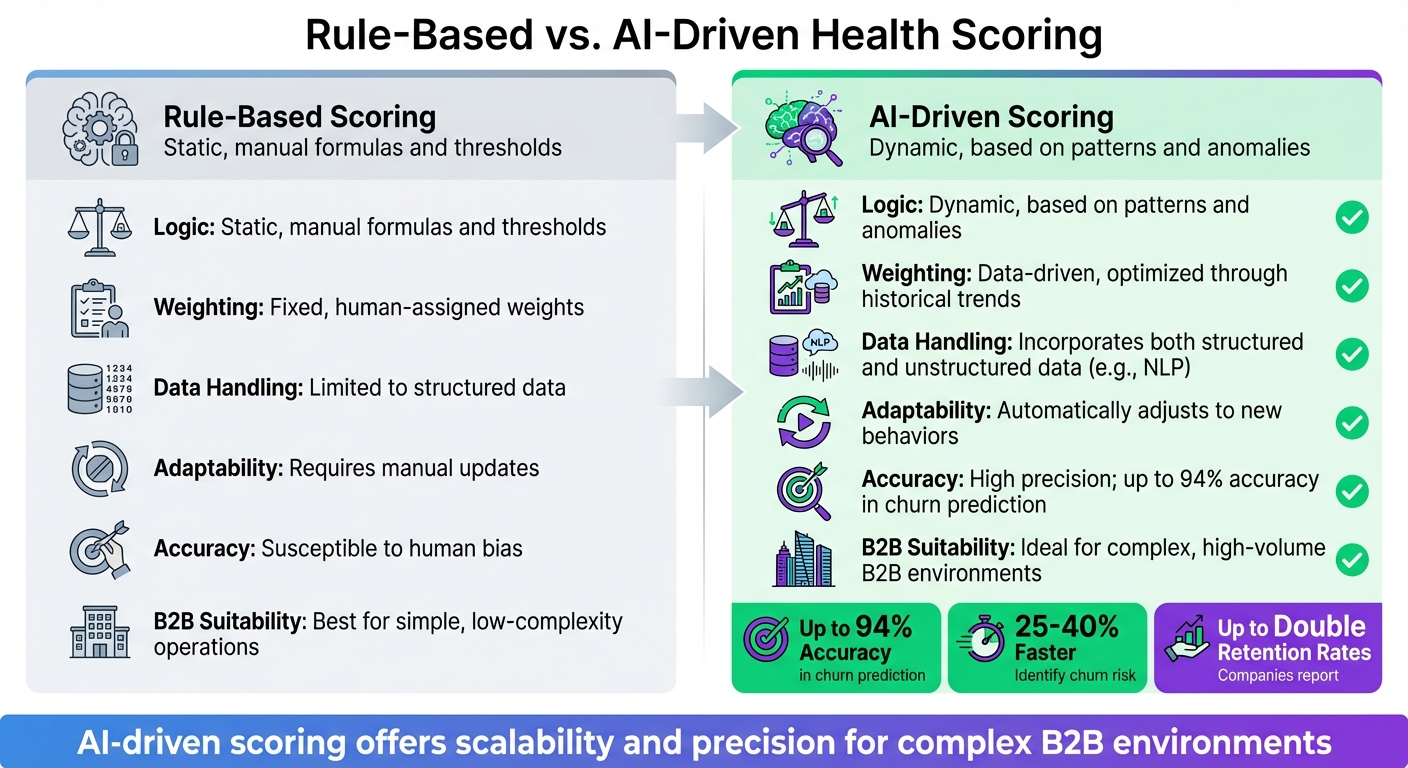
Rule-Based vs. AI-Driven Scoring
Traditional rule-based systems depend on fixed formulas and manually set thresholds – like flagging accounts with "less than 20% usage." While these systems are straightforward and easy to interpret, they fall short when it comes to handling complex behavioral patterns. They also require frequent manual updates as businesses grow.
AI-driven methods, on the other hand, excel at processing large datasets, identifying correlations, and adapting to new behaviors without human intervention. These systems can even analyze unstructured data, like customer emails, using NLP.
| Feature | Rule-Based Scoring | AI-Driven Scoring |
|---|---|---|
| Logic | Static, manual formulas and thresholds | Dynamic, based on patterns and anomalies |
| Weighting | Fixed, human-assigned weights | Data-driven, optimized through historical trends |
| Data Handling | Limited to structured data | Incorporates both structured and unstructured data (e.g., NLP) |
| Adaptability | Requires manual updates | Automatically adjusts to new behaviors |
| Accuracy | Susceptible to human bias | High precision; up to 94% accuracy in churn prediction |
| B2B Suitability | Best for simple, low-complexity operations | Ideal for complex, high-volume B2B environments |
For B2B companies managing intricate accounts with long sales cycles, AI-driven scoring offers scalability and precision that traditional methods simply can’t match. However, keeping a human-in-the-loop approach is critical. Customer Success Managers can validate or adjust AI predictions, ensuring the system remains accurate and fair.
sbb-itb-e60d259
Implementing AI-Driven Health Scores with Supportbench
Built-In AI Capabilities
Supportbench integrates AI directly into its platform, removing the need for third-party tools. Among its standout features are predictive CSAT and CES scoring, which anticipate customer satisfaction levels even before surveys are sent. This gives support teams a heads-up on potential issues. Real-time sentiment analysis evaluates incoming emails, chats, and tickets, categorizing them as positive, neutral, or negative. Additionally, AI-driven summaries simplify complex interaction histories, making it easier to understand customer interactions at a glance. The platform leverages unified data from CRM systems, marketing tools, support interactions, and product usage, offering a well-rounded view of customer health.
Eric Klimuk, Founder and CTO of Supportbench, highlights the value of this approach:
"CHS is a data-driven method for evaluating the likelihood that a customer will churn, renew, or expand their business with you".
This unified AI-driven system ensures businesses gain a complete perspective on customer relationships.
360-Degree Customer Views
Supportbench takes customer management to the next level by consolidating data from all touchpoints into a single, easy-to-navigate dashboard. This dashboard provides insights into product usage, ticket response times, request patterns, and sentiment trends. Dynamic SLAs adapt in real time based on customer health scores, ensuring quicker responses or escalating cases when necessary. These features help teams shift from merely reacting to problems to strategically managing customer retention. The result? Better insights, improved efficiency, and reduced operational costs.
Cost Savings for B2B Operations
Supportbench eliminates the need for multiple tools, consolidating essential features into one platform starting at $32 per agent per month. This reduces both software expenses and the inefficiencies tied to manual data handling. By simplifying operations, Supportbench aligns with the broader industry push to reduce complexity in B2B environments. According to Harvard Business Review, a mere 5% increase in customer retention rates can lead to profit growth of 25% to 95%. Supportbench’s continuous learning models also improve predictive accuracy over time, enabling teams to focus on strategic actions rather than maintaining complex scoring systems. As Klimuk puts it:
"The purpose of business should be to make life better for people. With CHS, businesses can do exactly that – make life better for their customers, drive customer retention, and ultimately, foster business growth".
Conclusion
AI-powered customer health scoring is reshaping how B2B companies approach support, shifting from reactive problem-solving to proactive relationship management. By detecting subtle changes – like drops in engagement or shifts in communication tone – AI equips teams to step in before customers decide to leave. This approach dramatically improves retention rates and speeds up issue detection. Considering that 47% of customers might switch to a competitor within just 24 hours of a poor support experience, timely action is no longer optional – it’s critical to safeguarding revenue.
AI doesn’t just help with retention; it also streamlines the health scoring process. Instead of spending hours updating spreadsheets, Customer Success Managers can focus on building stronger relationships. Automated tools prioritize high-risk accounts and uncover growth opportunities, while AI’s ability to predict support escalations up to 72 hours in advance ensures teams can resolve potential problems before they snowball. These operational upgrades set the stage for more integrated AI-driven solutions.
Supportbench offers all this and more for just $32 per agent per month. It combines predictive CSAT/CES scoring, real-time sentiment analysis, dynamic SLAs, and comprehensive 360-degree customer views in a single platform. By eliminating the need for costly add-ons, it provides the unified data foundation AI needs to deliver precise health scores – all while keeping costs in check.
FAQs
How does AI identify at-risk customers versus healthy ones?
AI systems analyze a variety of important metrics, including how often a product is used, the volume and severity of support tickets, payment patterns, and customer sentiment. These data points are then fed into a predictive model that generates a customer health score.
When a customer’s score falls below a certain threshold, they’re marked as at-risk. This triggers alerts and encourages proactive outreach. On the other hand, higher scores signal strong, positive customer relationships. This method allows businesses to prioritize retention efforts and enhance customer satisfaction effectively.
What data does AI analyze to predict customer churn?
AI examines a variety of critical data points to pinpoint customers who may be at risk of leaving. These include metrics tied to product engagement, such as how often a product is used and which features are adopted. It also looks at support-related data, including ticket volume, response times, and sentiment analysis from customer interactions. Financial signals, like revenue patterns and payment history, are also factored into the analysis.
On top of that, AI assesses customer sentiment through tools like NPS (Net Promoter Score) surveys and feedback from customer success managers (CSMs). It also takes into account broader organizational KPIs. By combining these elements, AI delivers insights that enable businesses to take proactive steps to reduce churn.
What makes AI-based customer health scoring better than traditional rule-based methods?
AI-driven customer health scoring takes the lead over traditional rule-based methods by analyzing a wide range of data, including customer behavior, sentiment, and financial metrics. Powered by machine learning, it adjusts in real-time to shifting patterns, delivering predictive insights that are more precise and responsive.
While rule-based systems depend on fixed thresholds and remain static, AI scoring evolves alongside your customers. This dynamic approach allows support teams to anticipate risks like churn and take proactive steps to enhance customer satisfaction. The result? Smarter decisions and deeper, more meaningful customer relationships.