
AI is transforming how B2B support teams manage knowledge bases, significantly reducing costs and improving efficiency. Here’s how:
- Automated Article Creation: AI analyzes resolved tickets and generates draft articles, saving up to 70% of the time spent on manual writing.
- Content Updates: AI flags outdated information and suggests updates in real-time, ensuring accuracy without constant manual audits.
- Streamlined Search: AI-powered semantic search delivers precise answers, cutting search time by up to 35%.
- Lower Cost Per Ticket: AI-driven systems reduce the average cost per ticket from $22 to $11, a 50% saving.
- Scalability Without Extra Staff: AI handles increased customer interactions, deflecting up to 85% of inquiries through self-service tools.
For just $32 per agent per month, tools like Supportbench provide these AI capabilities, eliminating hidden fees and making advanced support accessible. The result? Reduced operational costs, faster resolutions, and more time for agents to focus on complex tasks.
Why Manual Knowledge Base Management Costs So Much
Time Required for Manual Article Creation and Updates
Creating a single knowledge base article manually takes at least 30 minutes of a support agent’s or technical writer’s time. For B2B teams handling complex products with hundreds of features, integrations, and configurations, this time commitment quickly becomes overwhelming. Multiply that by dozens – or even hundreds – of articles, and the labor costs skyrocket.
Every product update adds another layer of complexity. Manual audits, rewrites, and gap identification rely on periodic reviews based on assumptions rather than real-time analysis. This leads to outdated content, higher support costs, and inefficiencies that AI-driven automation could easily resolve. The problem becomes even worse when critical information is scattered across disconnected systems.
How Disconnected Systems Increase Costs
The use of fragmented tools spreads essential data across multiple platforms. On average, companies juggle about 137 apps, with employees switching between roughly eight different SaaS apps daily. For support teams, this means valuable knowledge gets lost in Slack threads, CRM notes, email chains, or private drives.
This fragmentation doesn’t just waste time – it costs real money. Fortune 500 companies lose $31.5 billion annually due to failures in information sharing. When agents struggle to find the right information, they waste time recreating documents or, worse, provide inconsistent answers. Inconsistent terminology across platforms adds to the chaos, requiring time-consuming manual reconciliations.
The financial impact doesn’t stop there. Poor data quality across disconnected systems costs companies an average of $12.9 million annually. On top of that, compliance risks add another layer of expense. For example, GDPR fines for data breaches caused by fragmented systems averaged €2.8 million in 2024. The cost of managing knowledge through disjointed systems is anything but trivial.
Measuring Time and Resource Waste
These outdated, scattered processes result in significant time and resource waste. Employees spend 21% of their work time searching for information and 14% recreating missing data. This inefficiency drives up the cost per support ticket.
For B2B support teams, the numbers speak for themselves. Manual support operations result in an average cost per ticket of $22, compared to just $11 with AI-driven systems – a 50% reduction. Manual ticket categorization alone takes 30–45 minutes per instance, while AI can handle it in seconds. Plus, with 35% of tickets misrouted in manual systems, delays and rework only add to the problem.
For a mid-sized B2B support team, automating knowledge management could save approximately $660,000 annually by cutting the cost per ticket. These savings aren’t just theoretical – they represent real hours that can be redirected to more meaningful work, like building stronger customer relationships, instead of wasting time on administrative tasks.
How AI Automates Knowledge Base Creation and Updates
AI-Powered Article Generation from Support Cases
AI tools have the ability to analyze resolved support tickets – especially those from web forms and email channels – and extract the key elements: the problem, the solution, and the context behind them. These tools then summarize the ticket interactions, group them by topic, and remove any sensitive personal information before drafting articles based on the data. This streamlined approach can speed up content creation by as much as 70%.
Take Supportbench’s AI KB Article Creation, for example. It transforms resolved cases into draft articles in a single step by pulling in the subject, summary, and keywords from all relevant interactions. The result? Content that’s ready for review without any heavy lifting.
Beyond just creating articles, AI monitors ticket data and customer search queries to spot where "knowledge gaps" exist – areas where content is missing or not performing well. Instead of relying on periodic manual reviews, the system suggests new topics in real time, directly addressing customer needs. In one case, an electronics company discovered that 70% of AI-driven content suggestions effectively met their support team’s needs. This proactive approach naturally feeds into a cycle of continuous content updates and monitoring.
Automated Content Updates and Monitoring
AI doesn’t stop at creating content – it also keeps it fresh. These systems constantly scan knowledge bases to flag outdated or "stale" information, helping teams schedule updates when needed. For B2B teams handling complex products with frequently changing features or integrations, AI can analyze ticket trends and recurring issues to recommend updates to existing articles or suggest new ones.
User feedback loops, like thumbs-up or thumbs-down ratings, are also incorporated. These feedback mechanisms help refine search results and identify content that needs attention.
"AI continually scans the knowledge base, identifying and updating outdated information to ensure accuracy." – Sprinklr
Faster Workflows Through AI Integration
AI doesn’t just create and update content – it also simplifies workflows. It can suggest article titles, tags, and categories automatically, saving time for support teams. Teams can even take simple bullet points or brief case notes and turn them into full, detailed help articles with AI’s assistance. This ability to transform raw support interactions into actionable insights speeds up response times and boosts overall efficiency.
AI-native platforms go a step further by integrating data from tools like Slack, Notion, and Confluence. This creates a unified knowledge hub, so agents don’t have to waste time switching between systems to find what they need. By reducing the time spent searching for information – by as much as 35% – these integrations not only improve response times but also cut operational costs. It’s a win-win: less manual effort, faster support responses, and more efficient workflows.
How To Create An Accurate AI Knowledge Base
sbb-itb-e60d259
AI Features That Cut Knowledge Base Costs
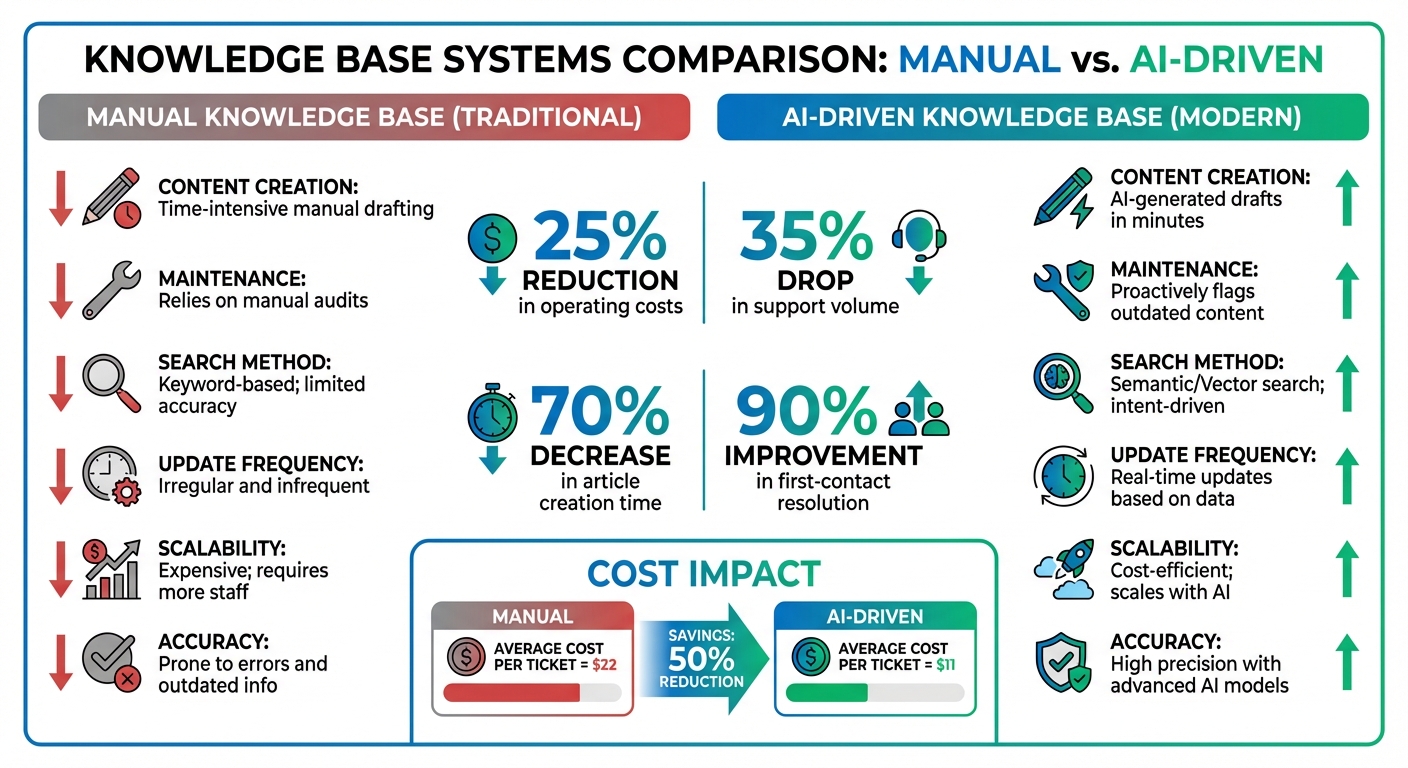
Manual vs AI-Driven Knowledge Base: Cost and Efficiency Comparison
Manual vs. AI-Driven Processes: A Cost Comparison
When comparing manual processes to AI-driven systems, the difference in resource efficiency is striking. Manual workflows demand significant time and effort – agents must draft articles from scratch, conduct periodic audits to identify outdated content, and rely on keyword-based searches that often fail to deliver relevant results. On the other hand, AI-driven systems streamline these tasks. They generate article drafts within minutes, automatically flag outdated content, and use semantic search to interpret user intent more effectively.
Here’s a breakdown of how these approaches differ in costs and efficiency:
| Feature | Manual Knowledge Base | AI-Driven Knowledge Base |
|---|---|---|
| Content Creation | Time-intensive manual drafting | AI-generated drafts in minutes |
| Maintenance | Relies on manual audits | Proactively flags outdated content |
| Search Method | Keyword-based; limited accuracy | Semantic/Vector search; intent-driven |
| Update Frequency | Irregular and infrequent | Real-time updates based on data |
| Scalability | Expensive; requires more staff | Cost-efficient; scales with AI |
| Accuracy | Prone to errors and outdated info | High precision with advanced AI models |
The numbers speak for themselves: AI-driven solutions can reduce operating costs for contact centers by 25%. Companies using AI-powered knowledge bases have reported a 35% drop in support volume, a 70% decrease in article creation time, and a 90% improvement in first-contact resolution for basic inquiries. These efficiencies make AI a game-changer for support workflows, especially in cost-conscious environments.
Supportbench‘s AI Knowledge Base Tools

Supportbench takes full advantage of these cost-saving opportunities by offering AI-powered tools tailored to B2B support needs. For just $32 per agent per month, Supportbench includes all features without hidden fees. One standout feature is the AI KB Article Creation tool, which transforms resolved cases into draft articles by extracting key subject lines, summaries, and keywords. This drastically reduces the time it takes for support teams to review and publish content.
Another key tool, the AI Agent Knowledgebase AI Bot, reads both internal and external knowledge base articles to deliver instant, context-aware answers during live cases. This eliminates the need for agents to jump between systems or waste time searching, cutting search time by up to 35%. For customer-facing interactions, the AI Custom Knowledge Base AI Bot autonomously handles repetitive queries, resolving up to 80% of common questions without requiring human involvement.
AI Solutions Built for Complex B2B Support
B2B support environments come with their own set of challenges – longer case durations, multiple stakeholders, and the need for detailed, account-specific responses. Consumer-focused tools often fall short in these scenarios. Supportbench’s AI tools are designed specifically for these complexities, seamlessly integrating with CRM systems to pull in account histories, plan details, and open cases. This ensures every response is tailored to the customer’s unique situation.
In renewal-driven industries, features like Dynamic SLAs use AI to prioritize responses based on account health and renewal timelines, ensuring high-value customers receive personalized attention. Additionally, AI Predictive CSAT and AI Predictive CES analyze case histories to predict customer satisfaction and effort scores. These insights help identify at-risk relationships early, reducing churn and safeguarding revenue.
Unlike older platforms that treat AI as an optional add-on, Supportbench embeds AI as a core part of its solution. This gives B2B teams access to advanced capabilities – automated triage, predictive analytics, and intelligent workflows – without the need for costly upgrades or complex IT setups. By integrating AI at every level, Supportbench delivers enterprise-grade tools that simplify and enhance the support process.
ROI: Cost Savings With AI-Powered Knowledge Bases
Cost Reductions Through Ticket Deflection
AI-powered knowledge bases save money by enabling customers to resolve their issues independently, reducing the need for support agents to step in. This process, known as ticket deflection, can help businesses deflect anywhere from 20% to 85% of customer inquiries.
Take Unity Technologies, for example. In 2020, their automated self-service system deflected 8,000 tickets, leading to savings of about $1.3 million – even as ticket volume surged by 56%.
Another example is GEMA, a music rights society representing 90,000 members. Between January 2023 and April 2024, GEMA introduced "Melody", an AI assistant that handled over 248,000 inquiries with an 88% success rate. This saved more than 6,000 working hours – the equivalent of three full-time employees – and resulted in annual cost savings estimated between €182,000 and €211,000.
"Our AI assistant isn’t just a support tool – it forms the backbone of our knowledge infrastructure, enabling us to serve members better, faster, and smarter."
These real-world savings highlight how AI can transform cost management in customer support.
Supportbench Pricing: AI Included at $32 per Agent per Month
With the measurable savings from ticket deflection, Supportbench offers a pricing model that ensures predictable ROI. Unlike legacy platforms, which often come with hidden fees for AI features, Supportbench provides all AI capabilities upfront at a flat rate of $32 per agent per month. There are no hidden costs, premium tiers, or complex configuration requirements involving IT teams.
This pricing includes features such as AI-driven knowledge base article creation, knowledge base bots, predictive CSAT and CES tools, and dynamic SLAs. The flat-rate structure allows teams to scale confidently without worrying about unexpected expenses, making it easier to manage budgets and avoid the inflated costs often associated with older systems.
Protecting Revenue With AI-Enhanced Support
AI-powered support systems do more than save money – they help protect revenue. In B2B settings, customer support is vital for retaining clients, securing renewals, and maximizing lifetime value. Poor support experiences can directly impact these metrics. In fact, 73% of business leaders believe that delivering excellent customer service is especially critical during economic downturns to safeguard revenue.
AI-driven knowledge bases improve first-contact resolution (FCR) rates, reaching as high as 93%. This ensures customers get accurate answers during their initial interaction, reducing frustration, boosting satisfaction, and strengthening loyalty. For instance, Liberty London, a premium UK department store, implemented AI-powered triage and self-service in 2023. This initiative led to a 9% jump in CSAT, a 73% reduction in first-reply time, and $21,461 in self-service cost savings within a year.
Supportbench enhances this further with its AI Predictive CSAT and CES tools, which analyze case histories to predict satisfaction and effort scores before surveys are sent. This proactive approach allows support teams to address potential issues early, reducing churn and protecting renewal revenue. By turning support into a strategic function, businesses can drive customer retention and foster growth.
Conclusion: Reducing Knowledge Base Costs With AI
Managing a knowledge base manually eats up countless agent hours – whether it’s creating content, updating it, or maintaining accuracy. AI flips the script by automating these tasks. It can generate content from resolved tickets, spot knowledge gaps in real time, and offer customers smarter search tools to solve problems on their own.
The cost benefits are clear. Companies that adopt AI-driven knowledge bases see support costs drop by 20–30%. On top of that, AI can cut the time agents spend hunting for information by up to 35%. This frees them up to tackle more complex challenges and build stronger customer relationships.
Industry leaders are taking notice.
"AI is not just a productivity enhancer – it is reshaping the culture of customer service itself. The focus shifts from resolving issues to preventing them."
– Eric Klimuk, Founder and CTO, Supportbench
Supportbench offers these AI capabilities for $32 per agent per month. That price includes features like AI-powered article creation, predictive CSAT/CES, and dynamic SLAs – without hidden fees or complicated IT setups.
For B2B teams handling intricate customer relationships and long-term cases, AI transforms static documentation into a dynamic, ever-improving resource. The payoff? Lower costs, quicker resolutions, and support teams that focus on retaining customers instead of just putting out fires. With AI, knowledge bases become more than just tools – they become strategic assets that redefine what support can achieve.
FAQs
How does AI simplify creating and updating knowledge base articles?
AI takes the hassle out of creating and maintaining knowledge base articles by converting raw support data – like tickets, chat logs, and CRM notes – into polished, ready-to-use content. With natural language processing, it pinpoints key issues, outlines solution steps, and pulls in relevant details to craft well-organized articles. These articles follow a consistent format and include searchable tags, making them easy to navigate.
Beyond creation, AI ensures articles stay accurate and up to date. It continuously scans new tickets and source material changes, automatically updating content as needed. This not only eliminates the tedious task of manual updates but also reduces support ticket volume and helps agents quickly find reliable answers. Platforms such as Supportbench integrate these features seamlessly into their workflows, allowing B2B teams to maintain an always-accurate knowledge base without the need for additional tools or extra expenses.
How does AI help B2B support teams reduce costs?
AI makes building and managing knowledge bases faster and easier, cutting down the time and effort needed. With generative AI, you can turn a few key points into detailed articles, ensuring your content remains current without relying on a dedicated writer. This not only saves on labor costs but also keeps your support materials accurate and up-to-date.
It also boosts efficiency by instantly addressing routine questions, which reduces ticket volumes and helps support teams solve more issues on the first try. By automating repetitive tasks and minimizing escalations, teams can provide better service without needing to hire more staff. On top of that, AI-native platforms combine tools like case management and automation into a single system. This eliminates the need for expensive add-ons or juggling multiple solutions. Together, these advantages pave the way for significant cost savings for B2B support teams.
How does AI enhance the accuracy of knowledge base content?
AI takes knowledge base accuracy to the next level by analyzing real-world support interactions through natural language processing (NLP). It scans ticket transcripts, chat logs, and search queries to pinpoint outdated details, missing information, or wording that doesn’t quite match customer expectations. This ensures the content remains aligned with what customers actually need and reflects the latest updates.
When gaps are identified, AI steps in to draft updates or even create entirely new articles, drawing from historical data to keep terminology and solutions relevant. By learning from countless resolved cases, it also suggests precise wording tweaks that enhance first-contact resolution rates. This automated process not only saves time but also keeps the knowledge base current and reliable – an essential tool for B2B support teams aiming to deliver top-notch service.