choosing the right customer support software for your team is a crucial decision for customer support teams in 2026. Here’s the key takeaway: AI-native platforms are designed with AI fully integrated into their core, while bolt-on solutions add AI features to existing systems as separate components. This impacts how effectively they handle workflows, automate tasks, and scale with your business needs.
Key Differences:
- AI-Native Systems: Built from the ground up with AI, these platforms automate workflows, provide unified customer context, and reduce manual work. They continuously improve without requiring constant IT intervention.
- Bolt-On Solutions: Add AI as an extra layer to legacy systems. Often require manual activation, have fragmented data access, and struggle with complex workflows.
Why It Matters:
- Efficiency: AI-native platforms reduce agent workload by automating repetitive tasks and providing real-time insights. Bolt-on systems often create extra steps for agents.
- Scalability: AI-native systems handle growing demands seamlessly, while bolt-on solutions may require costly integrations and updates.
- Cost: AI-native platforms include AI in their pricing, while bolt-on systems often charge extra for usage, leading to unpredictable costs over time.
Quick Comparison:
| Feature | AI-Native | Bolt-On AI |
|---|---|---|
| Integration | Fully embedded in workflows | Added as separate tools or features |
| Data Access | Unified, real-time | Fragmented, siloed |
| Automation | Dynamic, end-to-end | Limited, rule-based |
| IT Dependency | Minimal | High |
| Cost Model | Predictable | Usage-based, often expensive |
If you’re managing complex, multi-department workflows or want to reduce agent workload, AI-native systems are the better choice for long-term efficiency and cost savings. Bolt-on solutions may work for simpler needs but often introduce inefficiencies in the long run.
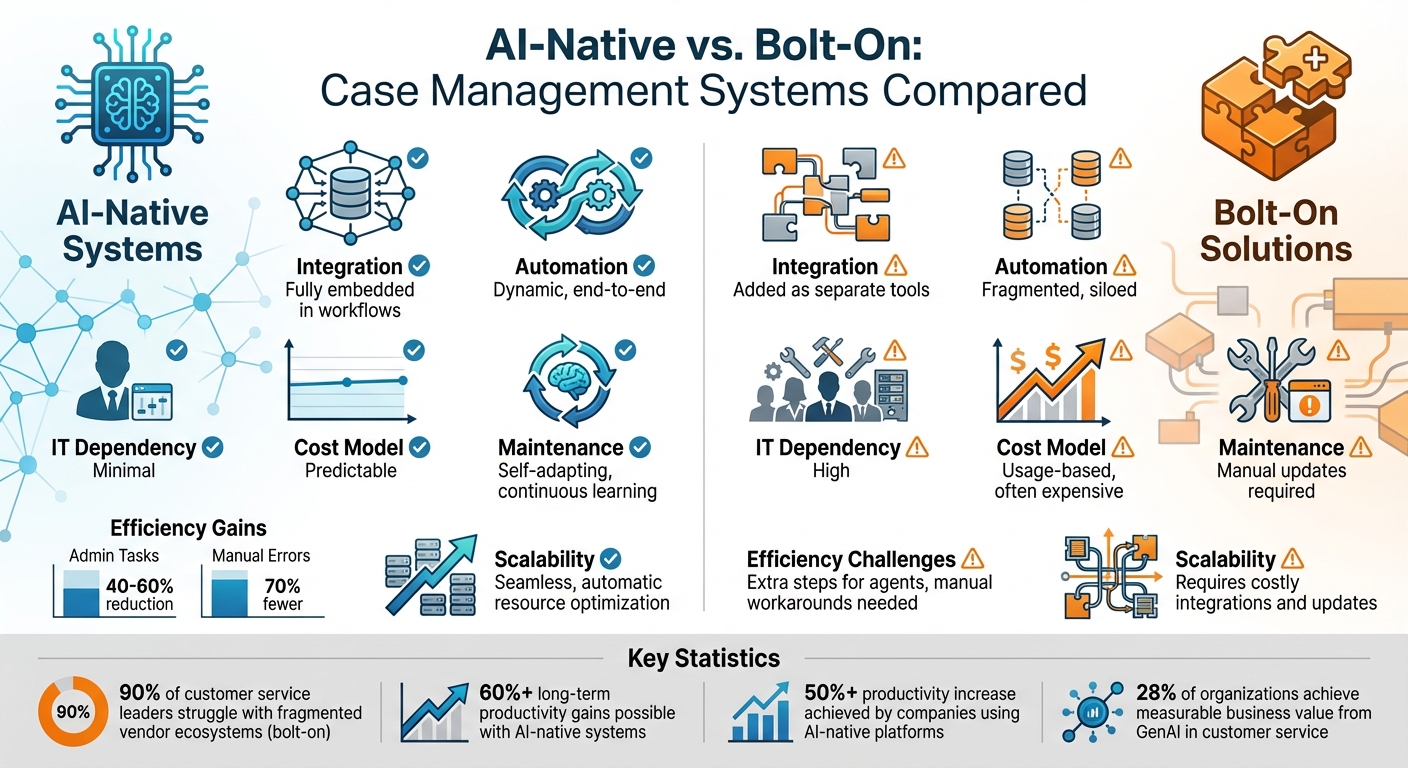
AI-Native vs Bolt-On Case Management Systems Comparison
How AI Integrates with Case Management Workflows
The way AI integrates with your case management system can either simplify or complicate your daily operations. AI-native platforms build intelligence directly into their core, while bolt-on solutions layer AI features on top of existing systems. Often, these bolt-on features require manual activation or navigating separate interfaces to use them effectively [1].
This difference in design impacts everything from how cases are created to how agents access customer information. In AI-native systems, intelligence is seamlessly embedded, enabling automatic workflows. For instance, these platforms can autonomously create cases from emails, chats, or voice interactions, assign fields based on the conversation’s context, and update timelines – all without requiring manual input [3][4]. This deep integration supports more flexible and efficient automation. On the other hand, bolt-on solutions often need users to activate AI features manually, functioning as standalone tools rather than integrated components [1].
AI in Workflow Automation
Workflow automation is a built-in capability for AI-native platforms, not an afterthought. These systems rely on real-time data and adaptive reasoning instead of rigid, pre-set rules. This flexibility shines when cases deviate from standard scenarios. For example, if a billing dispute escalates to legal review or a technical issue spans multiple departments, AI-native platforms adjust dynamically to handle the changes [1][2].
Bolt-on systems, however, are less flexible. They stick to linear, pre-scripted workflows, which can break down when faced with unexpected situations. This often forces agents to fall back on manual processes, like using spreadsheets or relying on handoffs, to manage tasks that automated workflows can’t handle [2].
Another advantage of AI-native platforms is their ability to maintain a consistent conversation identifier across different interactions and AI agents. This ensures that the full case context is preserved during handoffs or escalations, streamlining the process for both agents and customers [5]. These differences in automation capabilities highlight the impact of the underlying data architecture.
Data Models: Unified vs. Disconnected
The data architecture behind your case management system plays a critical role in determining what AI can accomplish. For B2B support, unified data models are essential because they provide AI with the complete context required for accurate decision-making. AI-native platforms use unified data models – like ServiceNow‘s RaptorDB or Microsoft’s Dataverse – that offer real-time access to customer history, billing records, product data, and support interactions in one cohesive system [7][5].
In contrast, bolt-on systems often rely on fragmented data sources. AI in these systems might access case details but lack visibility into related customer purchase history or previous escalations. This disconnection forces agents to piece together information manually, slowing down resolution times and increasing the chance of errors [1].
| Feature | AI-Native Platform | Bolt-On AI System |
|---|---|---|
| Data Structure | Unified model with real-time access | Fragmented sources with siloed data |
| Context Access | Comprehensive across all touchpoints | Limited to individual tools or datasets |
| Workflow Logic | Dynamic and real-time | Fixed, rule-based workflows |
| Learning Capability | Continuous, automatic improvement | Static models needing manual updates |
The impact of these differences is clear in day-to-day operations. An AI-native system can automatically create cases, identify similar past issues, and recommend next steps while maintaining consistent data across all customer interactions [3][4]. In contrast, a bolt-on solution might summarize an email but still require agents to manually input case details, search for related tickets, and prioritize tasks.
These distinctions are especially critical in managing complex B2B cases, where multiple stakeholders are involved, and accuracy is vital. Unified data models in AI-native platforms ensure a complete understanding of the customer relationship, improving operational reliability and directly influencing customer satisfaction and retention.
sbb-itb-e60d259
Impact on Agent Efficiency and Workload
AI-native platforms are designed to lighten the administrative load by embedding intelligence directly into their systems. On the other hand, bolt-on solutions require agents to manually switch between tools and activate features, which can slow things down. This difference in architecture plays a big role in daily productivity and the quality of responses. With AI-native systems, agents can focus more on solving customer issues and less on juggling tools.
Take this example: In December 2025, a Chinese insurance company saw a productivity increase of over 50% by using GenAI and automated tools [6]. Similarly, a global tech firm cut service request resolution times in half after adopting agentic AI systems [6]. These results were possible because AI-native platforms can monitor cases, spot anomalies, and kick off workflows automatically – tasks that bolt-on solutions struggle to handle effectively [9].
AI-native platforms also save agents a lot of time. They can reduce administrative tasks by 40–60% and cut manual errors by 70% or more [9]. By contrast, bolt-on systems often add to the cognitive strain on agents. Why? Because agents have to manually activate features, navigate between different interfaces, and transfer data across tools [1][9].
"The result [of bolt-on AI] depends on the user’s capability to prompt. Human work doesn’t decrease significantly compared to using external genAI." – Ákos Szabó, Author and Automation Expert [9]
Access to Customer Context
Another key difference between these systems is how they provide access to customer context, which can make or break an agent’s ability to deliver great service.
AI-native platforms offer a unified view, pulling together customer history, billing records, product details, and past support interactions – all in one place. The AI interprets this data seamlessly, including past actions and company-specific rules, without needing extra manual input [9][10]. This means when an agent opens a case, they can instantly see the full customer relationship: past escalations, unresolved billing issues, renewal dates, and other related tickets. Everything is contextualized by AI, making it easier to take informed action.
In contrast, bolt-on systems often fall into what experts call the "chat window trap" [9]. Agents using these systems have to manually re-explain context, upload documents, or prompt the AI for every interaction because these tools lack real-time access to the broader system.
"If you’re plugging in a third-party point solution… there’s no way to actually connect deeply into all these data dimensions… you’re going to have lack of access to the data, or you’re going to have lack of context." – Cat Allday, Vice President of Product at AppFolio [10]
This forces agents to manually piece together information, jumping between tools and copying data, instead of benefiting from automated, real-time context.
Reducing Repetitive Work
AI-native systems excel at automating repetitive tasks like triage, prioritization, and follow-ups. They can monitor case data in real time, flag billing errors before customers notice, escalate urgent cases nearing SLA deadlines, and route complex issues to the right teams – all without human intervention [9][6]. These platforms even support "chained agents", where multiple AI components work together to complete entire workflows, freeing up agents to focus on more nuanced customer problems [9].
Bolt-on solutions, however, offer limited automation because they’re designed to react rather than anticipate. Agents often need to manually activate features, reducing the time they can spend on solving tricky customer issues that require human insight [9]. Instead of streamlining processes, these systems can end up creating more work for the very teams they’re supposed to help.
The difference in efficiency has a direct impact on how quickly and effectively teams can resolve complex, multi-layered customer cases. AI-native systems clearly have the upper hand in helping agents deliver faster, higher-quality outcomes.
Accuracy, Scalability, and Automation Performance
The architecture of an AI system plays a critical role in ensuring automation remains dependable as support demands grow and cases become more intricate. AI-native platforms and bolt-on solutions tackle these challenges in fundamentally different ways.
Handling Complex Cases
AI-native platforms treat each case as a dynamic workspace that evolves with new data [2]. For example, if a billing issue overlaps with a product problem or if a customer escalation requires input from multiple departments, the AI adapts automatically to the changing context. This process happens without the need for manual adjustments.
On the other hand, bolt-on systems rely on rigid, pre-set rules. When exceptions arise, these systems often fail to keep up. Teams may resort to manual workarounds, shuffling data between tools, or even abandoning the AI features altogether [2]. Without a full understanding of customer relationships and previous interactions, these systems lack the flexibility to adapt effectively.
"Case management brings order to the work that doesn’t fit into a traditional mold, offering the flexibility teams need without losing structure or control." – Flowable [2]
Take the example of a European financial institution that automated 90% of its consumer loan processes using an AI-native system. Such a high level of automation is difficult for bolt-on systems to achieve, especially when business rules change [6]. This adaptability makes AI-native platforms better suited for scaling automation.
Scaling AI Capabilities
As customer support demands grow, AI-native platforms can scale effortlessly without requiring additional integrations, third-party vendors, or complex workflows [6]. Bolt-on systems, however, often need extra integrations or manual adjustments, leading to fragmented operations. This limitation is one reason why only 28% of companies report achieving measurable business value from generative AI in customer service [6].
AI-native systems utilize "Agentic AI", which observes patterns in customer data, plans actions based on business needs, and executes tasks autonomously [6]. For instance, in 2025, a Chinese insurance company boosted its contact center productivity by over 50% by enabling AI to manage entire customer journeys instead of handling isolated tasks. Companies adopting agentic AI are aiming for long-term productivity gains of 60% or more [6]. This scalability is essential for maintaining reliable automation as business operations evolve.
Automation Reliability Over Time
A dependable AI system must adapt to changes in business processes. AI-native platforms are built to do exactly that, using continuous learning loops to analyze patterns and make automatic adjustments as they process more data [1]. Whether it’s updating workflows, modifying business rules, or accommodating new product lines, these platforms adapt without manual intervention.
In contrast, bolt-on systems often falter when processes change. Their rigid configurations typically require IT teams to step in and update integrations or rules.
"Building AI-native isn’t about sticking intelligence on top of what you already have. It’s about starting fresh, with AI as the foundation." – Superhuman Team [1]
Additionally, AI-native systems maintain a consistent thread across all customer interactions, preserving the full history of conversations and case details [5]. This continuity is especially important for B2B support teams managing complex, long-term cases involving multiple stakeholders. By retaining this context, AI-native platforms ensure a seamless and effective customer experience.
Cost Structure and Total Cost of Ownership
AI pricing can either become a strategic advantage or a heavy financial burden. AI-native platforms typically include intelligence as part of their standard pricing because it’s built into the core functionality of the system [1]. On the other hand, bolt-on solutions often treat AI features as optional add-ons, charging extra for these capabilities. This creates a pricing structure where increased usage leads to higher costs [1].
Pricing Models: Included vs. Usage-Based
Businesses currently allocate up to 20% of their tech budgets to AI, and 58% plan to increase their investments by 2025 [1]. This makes clear pricing models essential. AI-native platforms offer predictable costs since their AI capabilities are baked into the system from the start. In contrast, bolt-on solutions often rely on third-party APIs, where each call adds to the bill [11]. As teams use these features more frequently, costs can spiral unpredictably.
Scaling amplifies this difference. AI-native systems are designed to optimize resources dynamically, scaling up during busy periods and scaling down when demand is low [1]. Bolt-on systems, however, tend to use fixed resources, which can lead to inefficiencies and higher expenses over time.
Hidden Costs of Bolt-On Systems
The initial price tag of bolt-on AI solutions rarely reflects the full cost. Integration expenses are often the first unexpected hurdle – connecting disparate data sources to a bolt-on AI layer typically requires significant manual configuration and ongoing IT support [1]. When workflows change or exceptions arise, these systems frequently falter, forcing teams to rely on manual workarounds like spreadsheets and emails [2]. This adds a hidden labor cost that can quickly accumulate. Furthermore, the lack of seamless data integration often results in additional manual effort to maintain consistency across systems.
Another challenge with bolt-on systems is "technical debt." Many of these solutions layer modern AI onto outdated codebases – some dating back to 2005 – leading to system instability and higher maintenance costs [8][12]. Around 90% of customer service leaders report difficulties navigating the fragmented vendor ecosystem, adding to the complexity and expense [6]. Additionally, half of the executives surveyed cite change management as the biggest obstacle to realizing AI’s full potential. This often requires businesses to invest heavily in redesigning processes, retraining staff, and hiring specialized roles [6].
Long-Term ROI of AI-Native Platforms
AI-native platforms tend to deliver better long-term returns by reducing operational overhead and avoiding the pitfalls of fragmented tools. Organizations using advanced AI implementations report direct cost savings between 8-15% and long-term productivity improvements of over 60% [9][6]. These gains stem from automating repetitive tasks that bolt-on systems struggle to handle, cutting manual work by 60-80% and reducing errors by 70% [9].
The efficiency advantage is striking. In one case, an AI-native team of just two engineers developed a feature in three months, while a legacy competitor estimated it would require 10 times the staff and up to nine months [8]. Beyond development, AI-native systems scale efficiently through training data and feedback loops, avoiding the need for proportional increases in staffing [12]. Unlike legacy vendors, which often make data extraction costly and complex, AI-native platforms are typically designed for interoperability, minimizing future migration costs [8].
Over time, the financial picture becomes clear. While bolt-on solutions might seem cheaper upfront, their usage-based pricing, integration costs, IT dependencies, and operational inefficiencies often lead to a total cost of ownership that surpasses AI-native platforms within the first 12-24 months. These long-term savings pave the way for further evaluation of maintenance and IT dependencies in modern support systems.
Maintenance, IT Requirements, and System Updates
The level of effort required to maintain AI case management systems can vary greatly depending on how the system is designed. AI-native platforms are built to continuously adjust themselves by analyzing usage patterns, reducing the need for manual intervention [1]. On the other hand, bolt-on solutions often demand manual adjustments from IT teams whenever workflows change [1].
This distinction becomes especially clear when navigating the broader technology landscape. A staggering 90% of customer service leaders report challenges in managing the fragmented vendor networks created by bolt-on systems [6]. Each integration adds complexity, requiring constant coordination across multiple platforms and vendors – a task that typically falls to IT teams. In contrast, AI-native platforms embed these capabilities directly into their architecture, enabling support teams to independently manage workflows and make real-time adjustments without waiting on IT support [2]. Below, we’ll explore how this impacts IT dependency, team autonomy, and the ability to adapt to new AI advancements.
IT Dependency and Team Autonomy
The differences between AI-native and bolt-on systems significantly influence daily IT operations. With bolt-on systems, even minor changes can trigger lengthy IT projects and testing cycles [13]. IT teams must manually configure JSON payloads, establish administrative rules for field predictions, and assign custom agents to specific intents [5]. This creates a bottleneck, leaving support teams reliant on IT for even the smallest adjustments.
AI-native platforms, however, shift this dynamic entirely. Their modular design empowers business and support teams to deploy new workflows in just days – without requiring extensive IT involvement [13]. When case volumes surge or customer needs change, these systems automatically adjust, scaling resources during peak times and optimizing costs during quieter periods – all without manual input [1]. As the Superhuman Team puts it:
"AI-native systems… analyze patterns, spot trends, and adapt without anyone having to manually update them. They get better on their own" [1].
This autonomy allows support teams to respond quickly to changes, freeing IT teams to focus on more strategic initiatives.
Adapting to New AI Capabilities
AI-native systems not only reduce IT workload but also simplify the introduction of new features. This is a key part of embracing AI technologies to modernize operations. These platforms typically roll out updates seamlessly across the system, thanks to their modular design. AI models can be upgraded without requiring a complete system overhaul [8].
In contrast, bolt-on solutions face a much steeper challenge. Adding new AI features often involves complex integrations or lengthy vendor negotiations [6]. As the Stackpoint team warns:
"If a big team took months to add AI features, that’s technical debt, not progress. Choose vendors who move fast with small teams" [8].
Over time, this maintenance gap becomes even more pronounced. While 98% of executives agree that effective change management is critical for AI success, half of them cite it as the biggest obstacle to realizing value [6]. Teams relying on bolt-on systems often face significant costs related to redesigning processes, retraining staff, and hiring specialized talent – expenses that AI-native platforms largely avoid due to their built-in flexibility and adaptability.
Conclusion: Choosing the Right Approach
Key Differences
The core difference between AI-native and bolt-on case management lies in their design. AI-native platforms are built with intelligence at their core, seamlessly integrating AI across workflows right from the start [1]. In contrast, bolt-on solutions add AI features to existing legacy systems, often requiring agents to toggle between features or navigate extra menus to access AI capabilities [1].
These design differences affect every aspect of case management, from how workflows are automated to the level of IT involvement required. AI-native systems are designed to learn continuously, adapting to patterns over time, while bolt-on solutions depend on manual updates by IT teams to stay current [1]. While some companies pioneering AI report aiming for long-term productivity gains of 60% or more [6], only 28% of organizations have so far achieved measurable business value from generative AI in customer service [6]. Ultimately, the ease and depth of integration make all the difference.
How to Evaluate Your Options
To decide which approach fits your needs, start by assessing your current system’s readiness for AI-native integration. Conduct a gap analysis focusing on data accessibility, internal expertise, and key areas where AI-native solutions could bring immediate improvements [1]. Ask yourself: Does your system enable real-time data sharing across all customer touchpoints, including an AI-powered knowledge base,, or is information trapped in silos across disconnected tools?
Another critical consideration is the 10/20/70 rule: successful AI transformation involves dedicating 70% of your effort to operational changes, 20% to data and technology infrastructure, and only 10% to the algorithms themselves [6][14]. This means you should focus on how each approach will impact your team’s day-to-day workflows, not just the technical specs. If your organization lacks the resources to handle complex integrations and vendor management, an AI-native platform could help minimize long-term challenges.
Before committing to a full-scale rollout, test a specific use case with measurable outcomes [2]. For example, you could aim to reduce average resolution times or improve first-contact resolution rates. Pilot these goals in a real B2B support environment to see how each approach performs. The aim isn’t simply to automate existing inefficient workflows but to rethink processes entirely, leveraging AI’s potential – like monitoring 100% of interactions instead of the traditional 1% to 2% manual quality assurance coverage [14]. Taking these steps ensures your support operations achieve greater efficiency while delivering meaningful, context-aware customer interactions.
FAQs
What are the benefits of using an AI-native case management system compared to a bolt-on solution?
An AI-native case management system weaves AI directly into the platform’s core workflows and data models. This means it can provide smarter, context-aware outputs such as summaries, routing, and prioritization. By having AI deeply integrated, every case benefits from a complete view of customer history, relevant documents, and stakeholder details – helping agents resolve issues faster and more effectively.
Unlike add-on solutions that depend on separate modules or third-party tools, AI-native platforms streamline operations by eliminating fragmented integrations. They also avoid usage-based pricing models, which can lead to cost inefficiencies. Over time, this approach results in a lower total cost of ownership. Plus, these platforms are designed to scale easily and adapt as workflows or data sources change, reducing the risk of broken automations while maintaining long-term reliability.
Since AI is embedded at the core, these systems continuously learn from every interaction. This ongoing learning refines recommendations without requiring constant reconfiguration. The result? Agents become more efficient, customers enjoy smoother experiences, and modern B2B support teams get a solution that keeps up with their evolving needs.
What are the long-term cost differences between AI-native and bolt-on case management systems?
AI-native platforms often offer a more predictable and cost-effective approach over time compared to bolt-on systems. Why? Because AI-native solutions have artificial intelligence seamlessly integrated into their core workflows. This eliminates the need for separate AI modules or third-party tools, which often come with extra costs for integration and upkeep.
In contrast, bolt-on systems can become more expensive in the long run. They often rely on usage-based pricing, require frequent reconfigurations, and depend heavily on IT teams to maintain compatibility as workflows change. While their upfront costs might look appealing, their fragmented setup can lead to a higher total cost of ownership – especially as businesses expand their AI capabilities. Opting for an AI-native system simplifies operations, cuts down on hidden expenses, and delivers a better return on investment over time.
How does AI-native integration improve agent efficiency and reduce workload?
AI-native systems embed generative AI directly into essential workflows and data models, offering context-aware support precisely when agents need it most. By tapping into complete case histories, automatically filling in fields, and presenting relevant knowledge, these systems cut down on tedious tasks like data entry or searching for information. This frees up agents to concentrate on resolving cases more quickly and efficiently.
Thanks to their advanced understanding of context, AI-native platforms provide highly relevant and actionable insights, such as summaries, suggested next steps, and prioritized rankings. This enables agents to manage intricate, multi-stakeholder cases with greater ease and confidence. By automating repetitive processes and delivering smarter guidance, these systems not only boost productivity but also help alleviate workload fatigue.
Related Blog Posts
- 7 AI Tools That Improve Customer Support Efficiency
- AI Workflow Design vs. Legacy Systems
- AI vs. Legacy Tools for Account Management
- Zendesk vs AI-Native Platforms: Feature Gaps
Evaluating help desks for a B2B team?
Supportbench is all-inclusive from $32 per agent per month, with migration and onboarding included. See pricing or book a 20-minute demo.