When customers reach out for support, they often reveal clues about their needs – clues that can lead to upsell, cross-sell, or renewal opportunities. But here’s the challenge: acting on these insights without breaking customer trust.
AI tools can help by analyzing support tickets for patterns like AI-driven sentiment analysis, usage trends, and escalation signals. For example, positive sentiment combined with increased product usage might signal readiness for an upgrade. However, ethical implementation is critical. Timing matters – offering an upsell during a frustrating moment, like a billing issue, can damage relationships.
Key takeaways:
- AI’s role: Spot patterns like feature requests, plan limits, or growth signals faster than manual methods.
- Ethical practices: Always resolve the issue first. Only pitch when it aligns with customer needs.
- Actionable workflows: Use AI to tag opportunities, validate them with human oversight, and prioritize high-impact leads.
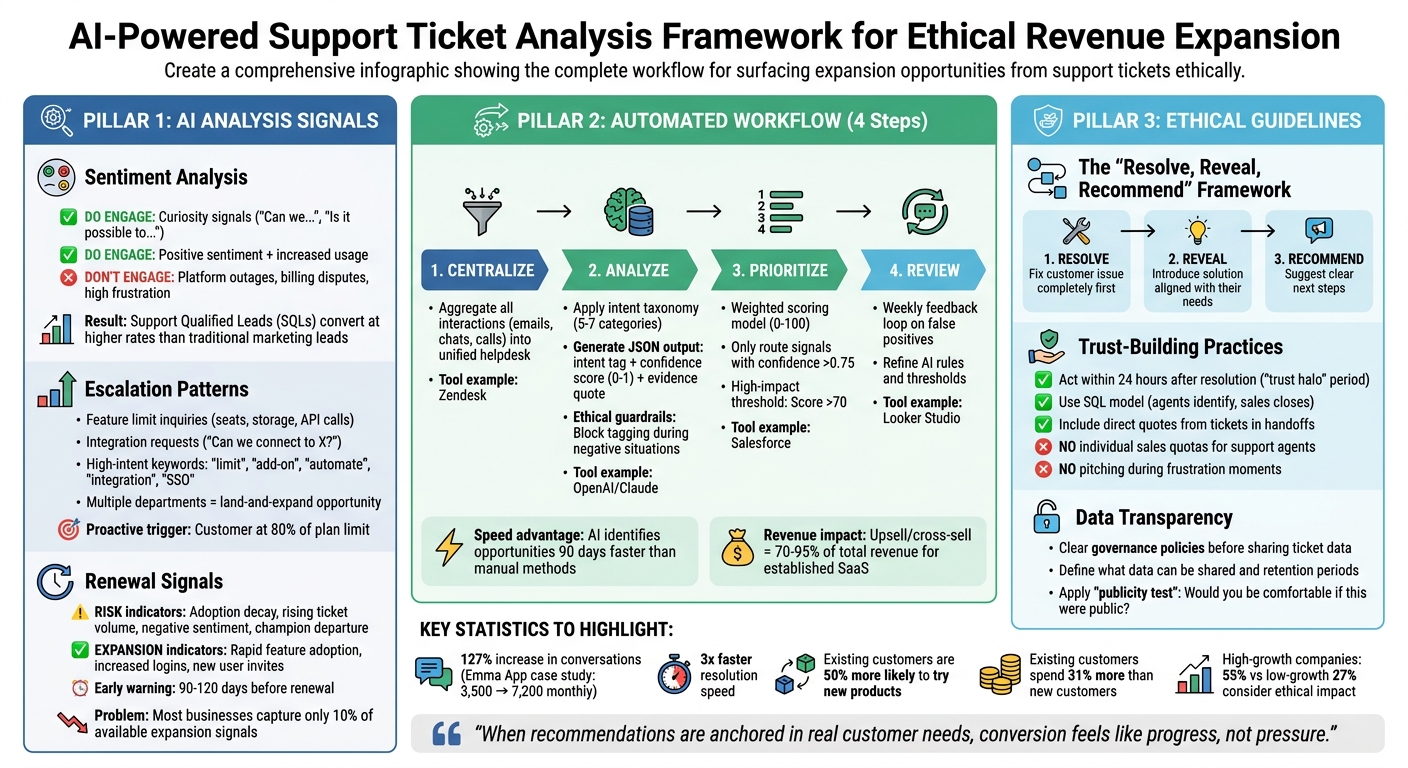
AI-Powered Support Ticket Analysis Framework for Ethical Revenue Expansion
Using AI to Analyze Support Ticket Data
Manually reviewing support tickets just can’t keep up with the sheer volume and complexity involved in spotting hidden revenue opportunities. AI, on the other hand, can sift through massive amounts of data quickly, uncovering patterns that might take a human team weeks – or longer – to notice. The real challenge comes down to identifying the right signals to track and interpreting them in a way that stays fair and ethical.
AI focuses on three main signals: emotional cues that hint at customer readiness, behavioral patterns showing customers may have outgrown their current plans, and usage trends that can forecast renewal possibilities. Together, these signals give a well-rounded view of potential opportunities for account growth. But even with all this data, ethical interpretation is key. Let’s dive into how sentiment analysis can pinpoint the best times to engage.
Sentiment Analysis to Identify Customer Needs
Sentiment analysis acts as a timing tool to help zero in on the right moments for upselling or cross-selling. AI scans the language used in tickets to pick up on emotions – whether it’s frustration, satisfaction, or curiosity – to gauge how open a customer might be to hearing about additional offerings. Timing is everything, and knowing when NOT to pitch is just as critical as spotting when to make a move.
For example, situations like platform outages, billing disputes, or high frustration levels are clear "do not engage" zones [1]. AI can flag these instances automatically, helping avoid offers that could damage trust. On the flip side, sentiment analysis can pick up on "curiosity signals" in phrases like "Can we…" or "Is it possible to…" – signs that a customer might be exploring options beyond their current plan.
AI also identifies "implied needs" by spotting workaround requests. If a customer describes manual processes or mentions limitations they’re trying to bypass, it could indicate they’d benefit from a higher-tier product that solves those issues directly [4]. These leads, often called Support Qualified Leads (SQLs), tend to convert at much higher rates than traditional marketing leads because they’re based on clear, expressed intent [1].
"When recommendations are anchored in real customer needs, conversion feels like progress, not pressure." – Team Zigment [1]
The most effective systems combine sentiment analysis with models that predict expansion potential. For example, when positive sentiment aligns with increased product usage, it adds a "health bonus" to a customer’s overall score [4]. This keeps expansion efforts aligned with customer satisfaction and trust.
But emotional cues are just one piece of the puzzle. Escalation patterns can also reveal when a customer might be ready for more.
Escalation Patterns That Signal Upsell Opportunities
Repeated escalations often signal that a customer has outgrown their current plan. AI keeps an eye on escalation patterns, such as inquiries about feature limits (seats, storage, API calls), requests for integrations, or questions about premium-tier capabilities – all of which can indicate a readiness to expand.
For example, when customers ask questions like, "Can we connect this to X?" or inquire about API access, they’re often signaling deeper engagement with the product [1]. AI identifies these opportunities by looking for high-intent keywords like "limit", "add-on", "automate", "integration", and "SSO", and pairing them with usage data. By combining ticket details, usage trends, and conversation transcripts, AI can effectively score the likelihood of expansion.
Another strong indicator is when tickets come in from multiple departments within the same organization. This often signals organic growth within the company – a classic "land and expand" scenario [4] – making these accounts prime candidates for broader enterprise agreements.
AI can also flag situations where a customer is nearing 80% of their plan limit, allowing support teams to reach out proactively before any friction arises [5]. For instance, a customer asking about API limits may already be preparing to scale [1]. By identifying these signals early and ethically, support teams can offer solutions that genuinely meet customer needs.
Trend Analysis to Track Renewal Signals
AI doesn’t just help with upselling; it’s also a powerful tool for monitoring renewal risks and opportunities. By pulling data from support systems, CRM tools, and product analytics, AI can update "Renewal Risk" and "Expansion Propensity" scores in real time [6]. These scores evolve as new tickets come in, tracking signs like adoption decay, rising ticket volume, negative sentiment, or the departure of key product champions.
On the flip side, expansion signals often include rapid feature adoption, increased logins, and new user invites – all signs that a customer is becoming more invested in the product [4]. Behavioral indicators like executive-level report generation can also suggest readiness for enterprise-level features.
AI is especially useful in identifying churn risks early, ideally 90–120 days before renewal, so teams can intervene in time [6]. The challenge is that most businesses only capture about 10% of available expansion signals because the data is scattered across different systems [4]. AI solves this by creating a unified view, ensuring opportunities don’t slip through the cracks.
| Signal Category | AI-Tracked Indicators | Revenue Implication |
|---|---|---|
| Renewal Risk | Adoption decay, rising ticket volume, negative sentiment, champion departure, late payments | High risk of churn; requires a proactive "save" play |
| Expansion Signal | Feature requests for higher tiers, integration/API questions, hitting seat limits, new department adoption | High upsell/cross-sell potential; requires an "expansion" play |
| Behavioral Signal | Increased login frequency, new user invites, executive-level report exports | Suggests deeper product investment; indicates readiness for enterprise features |
The key is acting quickly – ideally within 24 hours – after resolving a support issue to capitalize on the "trust halo" that follows [1]. This approach ensures that any expansion efforts feel helpful and aligned with what the customer actually needs, strengthening the relationship instead of straining it.
sbb-itb-e60d259
Building AI Workflows for Opportunity Tagging
Once you’ve identified key signals, the next step is to create automated workflows that tag and route opportunities effectively. The goal? Build a system that captures every potential for expansion while staying within ethical boundaries. This means designing workflows that demand evidence, prioritize resolving issues first, and block outreach when customers are frustrated or dealing with critical problems.
A streamlined approach works best: centralize all customer interactions in one system, use AI to extract structured intent tags with confidence scores, and direct only high-quality signals to your sales team. For established SaaS companies, upsell and cross-sell activities can account for 70-95% of total revenue[4]. Missing these signals isn’t just inefficient – it can lead to significant missed opportunities. These workflows build on prior AI analysis methods while ensuring every lead is ethically validated and seamlessly ties data capture to responsible outreach practices.
Automating Opportunity Identification
AI workflows begin by aggregating all customer interactions – emails, chats, and call summaries – into a unified helpdesk system. This creates a single conversation record[3]. Next, the workflow applies a strict intent taxonomy with 5–7 actionable categories, such as expansion seats, plan upgrades, add-on interest, and procurement or security requests[3].
The AI generates a machine-readable JSON output for each interaction, including an intent tag, a confidence score (ranging from 0 to 1), and a verbatim "evidence quote" pulled directly from the ticket[3][4]. This ensures accurate intent capture and minimizes the risk of AI errors or hallucinations.
To maintain trust, ethical workflows include guardrails that block tagging during negative situations, such as billing disputes, platform outages, or when customers express frustration[1]. This prevents support teams from pitching upgrades at inopportune moments and protects the customer relationship.
The framework follows the principle of "Resolve, Reveal, Recommend"[1]. It ensures the customer’s issue is fully resolved before introducing new capabilities or suggesting upgrades. Customers who feel their problems have been addressed are naturally more open to discussions about additional services.
"Support-driven upsells work best when they feel helpful, not transactional"[1].
This approach also respects the rule that "support’s job is to capture intent and context; sales owns commercial follow-up"[3].
Once identification is automated, the next step is ranking opportunities based on their potential impact.
Prioritizing Opportunities by Impact
Not all signals are equal. AI uses a weighted scoring model (0–100) to prioritize opportunities based on factors like usage patterns, support signals, trigger phrases, account health, and timing[4]. Only high-impact opportunities – those scoring above a set threshold (e.g., 70) – are routed to sales.
For instance, a customer nearing 80% of their seat limit, submitting multiple tickets about integrations, and showing positive sentiment might score 85 out of 100. Meanwhile, a customer with vague feature questions and low engagement might score 40. The system routes only high-scoring opportunities to the CRM, along with a "handoff payload" that includes the ticket link, evidence quote, and suggested next steps[3][4].
Confidence scores play a critical role here. Signals are only sent to sales when the confidence score exceeds a predefined threshold, such as 0.75[3]. This prevents sales teams from being overwhelmed by low-quality leads and ensures every handoff is backed by clear customer intent.
To keep improving, it’s essential to establish a weekly feedback loop. This involves reviewing "false positives" – signals that were routed but didn’t result in action[3]. These reviews help refine AI rules, adjust thresholds, and improve signal quality over time. The result? A self-improving system that gets better at identifying genuine opportunities while filtering out noise.
This workflow complements earlier analytical strategies by making opportunity handoffs more efficient and accurate.
| Workflow Step | Tool Example | Role in Opportunity Tagging |
|---|---|---|
| Centralize | Zendesk | Consolidates omnichannel interactions into a single, taggable record[3] |
| Analyze | OpenAI / Claude | Generates structured intent tags with confidence scores and evidence[3][4] |
| Route | Salesforce | Assigns ownership and tracks measurable outcomes for expansion[3] |
| Review | Looker Studio | Monitors signal quality and evaluates pipeline creation[3] |
The benefits are clear. AI-driven workflows can identify expansion opportunities up to 90 days faster than manual methods used by customer success managers[4]. And because existing customers are 50% more likely to try new products and spend 31% more than new customers[4], this approach transforms your support team into a revenue-generating powerhouse – without sacrificing trust.
Ethical Guidelines for Acting on Support Insights
Using AI to identify opportunities is just the beginning – what truly matters is acting in a way that maintains customer trust. The line between helpful recommendations and aggressive sales tactics depends on how you handle the insights surfaced by AI. This demands clear ethical boundaries, transparent data practices, and a focus on prioritizing customer needs over revenue goals.
Balancing Revenue Goals with Customer Trust
The first step in any expansion conversation should always be resolving the customer’s issue completely[1]. Only after their problem is addressed should you introduce a solution that aligns with their needs, paired with a clear recommendation for the next steps. Positioning upselling as a way to "solve a future problem" or "eliminate friction" can build trust and strengthen loyalty[1]. On the other hand, offering irrelevant solutions during a stressful situation may lead to a drop in CSAT scores.
Timing is just as important as intent. Avoid reaching out during periods of high frustration – like outages, critical bugs, billing issues, or other sensitive moments[1]. Automated workflows should include risk flags, such as open P1 incidents, to delay sales outreach until the issue is resolved[2].
To keep interactions ethical, avoid tying individual sales quotas to support agents. This prevents them from feeling pressured to make rushed pitches[1]. Instead, implement a Support Qualified Lead (SQL) model where agents are recognized for identifying opportunities and passing them to the sales team, rather than being responsible for closing deals. This approach ensures that revenue growth from support insights doesn’t come at the expense of customer trust, preserving the valuable data collected through AI workflows.
Transparency and Consent in Data Usage
In addition to balancing revenue goals, being transparent about how customer data is used is critical. Customers share their information during support interactions with the expectation that it will be handled responsibly. To honor this trust, establish clear data governance policies before sharing ticket data with sales teams or AI systems[3]. Define what data can be shared, how long it will be stored, and whether sensitive information needs to be redacted to protect privacy[3]. A good litmus test is the "publicity test": Would you be comfortable if your reasons for using support data for sales were made public?[7]
When passing leads to sales, include a direct quote from the original support ticket[3]. This ensures that recommendations are rooted in the customer’s actual needs and allows sales reps to tailor their outreach without requiring customers to repeat themselves. By prioritizing listening and thoughtful recommendations, growth becomes a natural outcome[1].
Lastly, consider the language used internally. Shifting terms like "upselling" to "educating customers on features" or "advising" can help reduce resistance among agents and maintain a customer-focused tone[1].
Common Pitfalls and How to Avoid Them
When using AI to analyze support tickets for revenue opportunities, it’s easy to fall into traps that can damage customer trust. Even with good intentions, prioritizing speed and automation over understanding and trust often leads to problems. Here’s how to spot and steer clear of these common mistakes.
Overreliance on AI Without Human Oversight
AI has the ability to spot patterns – like customers frequently hitting API limits or inquiring about features beyond their current plan – up to 90 days faster than manual processes [4]. However, relying solely on AI without human validation can backfire. For instance, a customer asking about webhook functionality might simply be troubleshooting an issue, not planning to expand their integration. Misreading these signals can waste time and harm trust.
To address this, consider adopting a Support Qualified Lead (SQL) model. In this system, AI flags potential opportunities, but agents validate them through direct conversations before involving sales [1]. Use forward-looking questions like, "Are you planning to scale this process?" to confirm the AI’s findings. Also, set confidence thresholds – only pass leads to sales when AI scores are 0.75 or higher [3]. This ensures sales teams don’t lose trust in support-generated leads due to irrelevant recommendations.
Misinterpreting Customer Intent
Understanding what customers really need is just as important as leveraging AI. Keyword-based approaches often fail without context. For example, a ticket mentioning "Stripe webhook error" might seem similar to one asking about "billing integration options" if you’re only scanning for terms like "Stripe" and "integration" [10]. The first customer needs technical help, while the second might be ready to upgrade. Treating them the same not only misallocates sales efforts but also damages trust.
Another pitfall is ignoring customer sentiment. Trying to pitch new features during times of frustration – like platform outages, billing errors, or major bugs – is both unwise and unethical [1]. Train your team to double-check AI insights against the actual situation. Using the "Resolve, Reveal, Recommend" framework ensures you solve the immediate issue first before introducing any additional capabilities [1].
Ignoring Ethics Under Revenue Pressure
Revenue goals can tempt teams to cut corners, but this often backfires. One common mistake is tying hard sales quotas to support agents, which leads to rushed interactions and aggressive pitches that lower customer satisfaction scores (CSAT) [1]. When agents focus on closing deals instead of solving problems, they undermine the trust that makes support-generated leads effective in the first place [1][3].
Interestingly, high-growth companies are almost twice as likely as low-growth ones – 55% versus 27% – to consider the ethical impact of their technology decisions [13]. This shows that ethical practices and sustainable growth go hand in hand. Instead of quotas, use SQL incentives that reward identifying opportunities rather than closing deals [1]. When facing revenue pressure, use a structured decision-making process: identify ethical concerns, consult guidelines, involve leadership, and document the process [12].
"Companies should seek to become ‘moral laboratories’… it’s acceptable to fail and learn from that" [7]
Make time for "premortems" to anticipate potential risks before rolling out new AI workflows and "postmortems" to review the outcomes after implementation [7]. Regularly revisiting ethical practices ensures your team stays aligned with company values during every customer interaction.
| Pitfall | Impact | Avoidance Strategy |
|---|---|---|
| Rigid Sales Quotas | Rushed tickets, aggressive pitching, lower CSAT | Use SQL incentives instead of quotas [1] |
| Poor Data Quality | AI inaccuracies, misread customer intent | Audit and standardize help content before deploying AI [8] |
| Ignoring Sentiment | Brand damage, increased churn | Identify "no-go" zones for upsells during outages or disputes [1] |
| Generic Outreach | Low conversion, customer frustration | Integrate AI with CRM and usage data for tailored recommendations [9][4] |
Conclusion
AI empowers support teams to spot growth opportunities faster than ever. But its real strength lies in combining AI’s speed with human intuition, ethical decision-making, and a commitment to earning customer trust.
Success in this area hinges on five key principles: transparency, bias mitigation, privacy and data security, human oversight, and accountability [14]. Take the Emma App as an example – its five-person team managed to increase conversations by 127% (from 3,500 to 7,200 monthly) and triple resolution speed, all without hiring additional staff. They achieved this by automating repetitive tasks while ensuring humans remained central to decision-making [11].
These results highlight the value of a thoughtful, ethics-driven strategy. This approach not only scales operations but also strengthens customer relationships. Adopting the "Resolve, Reveal, Recommend" mindset ensures trust stays intact by focusing on solving customer problems before suggesting upgrades [1]. It’s this trust – seeing your team as problem-solvers rather than salespeople – that makes support-generated leads so effective.
"Trust is the currency of modern customer experiences, and in an AI-powered world, ethical AI is at the heart of building and maintaining it." – Alice Hunsberger, PartnerHero [14]
FAQs
What support ticket signals are the most reliable expansion indicators?
When customers start requesting advanced features – like SSO, SAML/SCIM, role-based permissions, or audit logs – it’s often a clear sign they’re ready to explore higher-tier plans. Similarly, capacity-related triggers, such as frequent ‘rate limit exceeded’ tickets or consistently hitting storage, usage, or seat quotas, can signal an opportunity for an upgrade. These trends highlight changing customer needs and their intent to scale or expand their use of your product.
How do we use ticket data for growth without violating privacy or trust?
To use ticket data responsibly for growth, prioritize analyzing patterns like customer sentiment, types of inquiries, and escalation indicators, all while safeguarding sensitive information. Leverage AI tools to spot trends in anonymized, aggregated data. Establish secure workflows, such as auto-tagging intent, integrating routing signals into your CRM, and defining clear qualification criteria. These steps help maintain transparency, build trust, and uncover real opportunities for business expansion.
How can we prevent AI from sending bad upsell leads to sales?
To ensure AI doesn’t escalate low-quality upsell leads, it’s important to establish clear qualification rules and implement structured workflows. This helps filter out noise and ensures only strong opportunities are passed along.
Leverage AI to auto-tag and analyze support tickets, focusing on identifying genuine intent. Regularly review and adjust your qualification criteria based on performance data and outcomes. This continuous refinement helps improve accuracy over time.
Finally, enforce these processes with Service Level Agreements (SLAs). This ensures that only high-confidence, relevant opportunities make it to sales, preserving both trust and operational efficiency.