
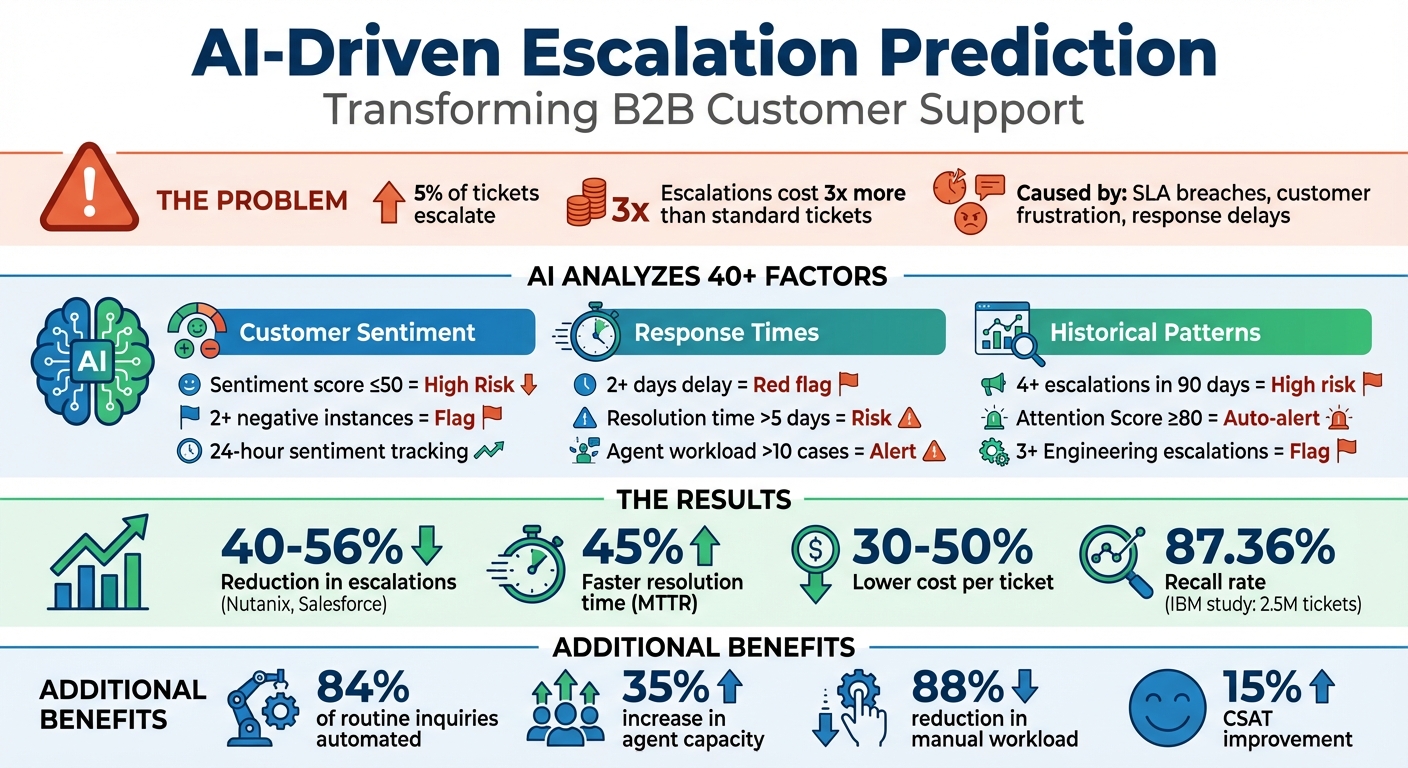
AI tools are reshaping customer support by predicting ticket escalations before they happen. Escalations – when a support issue moves to a higher expertise level – are costly and time-intensive, often tripling resolution costs. By analyzing over 40 factors like customer sentiment, response delays, and case history, AI can identify high-risk tickets early.
Key insights include:
- 5% of tickets escalate, often due to SLA breaches or customer frustration.
- AI reduces escalations by 40%–56%, saving time and improving satisfaction.
- Tools like NLP detect negative sentiment, while real-time scoring highlights urgent cases.
- Companies like Salesforce and Nutanix have seen SLA breaches drop and CSAT improve.
AI also learns continuously, refining predictions and automating workflows to optimize support efficiency. The result? Faster resolutions, reduced costs, and happier customers.
AI Escalation Prediction: Key Metrics and ROI Impact
Deep data insights & predictive models for service desk ticket data
Metrics AI Uses to Predict Escalations
AI steps in where manual escalation processes often fall short, using data-driven insights to predict potential risks before they spiral out of control. By analyzing over 40 data points – such as case specifics, customer sentiment, agent performance, and historical interactions – AI can flag high-risk tickets early on . These models prioritize catching as many potential escalations as possible, even if it means a few false positives along the way. For example, a large-scale IBM study involving 2.5 million tickets reported an impressive recall rate of 87.36% in predicting escalations . Below, we’ll explore the key metrics – like sentiment shifts and response delays – that power these predictive systems.
Customer Sentiment and Emotion Detection
Natural Language Processing (NLP) plays a major role in AI’s ability to detect emotional cues in customer interactions. By scanning ticket text for signs of frustration or urgency, AI tracks sentiment trends and flags cases where the tone takes a sharp downturn within 24 hours . Tickets with a sentiment score of 50 or lower, or those showing more than two negative sentiment instances, are marked as high-risk.
This approach isn’t just theoretical – it’s been validated in real-world applications. Katherine Sullivan, SVP of Customer Success at Salesforce, highlights the impact of sentiment analysis:
"Whenever we witness a surge in negative sentiment, our team springs into coordinated action, and the outcomes we achieve are consistently on target."
- Katherine Sullivan, SVP Customer Success, Salesforce
Advanced systems don’t stop at general tone. They dig deeper, identifying specific "churn risk" language or urgency-related keywords hidden in the text . This granular analysis helps teams intervene before customer frustration escalates into formal complaints.
Response Times and SLA Breaches
Timing is another critical piece of the puzzle. AI monitors delays in response and resolution times, with a response gap of over two days or resolution times exceeding five days raising red flags. It also keeps an eye on the volume of back-and-forth communication. If a case requires significantly more interactions than usual, it may indicate unresolved issues.
Frequent changes in ticket ownership can also signal trouble – especially when these changes aren’t part of a planned collaboration. On top of that, agent workload is factored in. If an agent is juggling more than 10 open cases or lacks the specific skills needed for a particular ticket, the risk of escalation increases. AI even considers an agent’s history with a specific account, adjusting risk scores based on prior challenges.
Historical Escalation Patterns
AI doesn’t just focus on the present – it learns from the past. Accounts with four or more escalations in the last 90 days are flagged as higher risk for new tickets. Similarly, if a customer already has three or more cases escalated to Engineering, it suggests ongoing technical issues that could lead to further dissatisfaction.
One powerful tool AI uses is the "Attention Score", a real-time risk rating that combines factors like case age, sentiment trends, response delays, and overall customer health. When a score hits 80 or higher, it triggers an automatic high-risk alert. By analyzing thousands of past tickets, these systems refine their ability to spot warning signs, enabling proactive intervention that human managers might miss.
| Category | Key Metric | High-Risk Threshold |
|---|---|---|
| Sentiment | Negative Sentiment Count | More than 2 instances |
| Sentiment | Sentiment Score | 50 or below |
| Responsiveness | Agent Response Delay | 2+ days of inactivity |
| Customer History | Recent Escalations | 4+ in last 90 days |
| Case Activity | Attention Score | 80 or above |
| Agent Workload | Open Case Backlog | More than 10 cases |
How AI Prediction Models Work
AI-driven escalation prediction operates through three main stages: gathering data, assessing risks in real time, and continuously sharpening its accuracy. These systems don’t just respond to problems – they evolve by learning from each interaction, tailoring their insights to your organization’s unique patterns. Let’s break down how these models identify potential escalations.
Data Collection and Preparation
To predict escalations effectively, AI needs access to a wide range of data that could signal potential issues. This includes pulling information from CRMs, communication platforms like Slack and Microsoft Teams, and knowledge repositories like Confluence or Notion. The aim? To capture the full context of customer interactions – not just the ticket details.
Advanced platforms use natural language processing (NLP) to analyze cases for customer intent, urgency, and sentiment. They also employ feature engineering, which transforms expert knowledge into measurable data points. These data points typically fall into three categories:
- Case Factors: Metrics like the number of conversations in a ticket.
- Agent Factors: Indicators such as backlog size.
- Customer Factors: Metrics like customer health scores.
A great example is Rapid7, which implemented Mosaic AI across its support channels. By centralizing knowledge sources, the company achieved a 30% faster ticket resolution and a 95% customer satisfaction score (CSAT). The AI’s success was rooted in its ability to access data from all relevant silos, ensuring no critical piece of information was overlooked.
Once the data is collected and organized, the system moves on to evaluate risks in real time.
Real-Time Risk Scoring
After data preparation, the AI begins analyzing every incoming interaction. Instead of making simple yes-or-no predictions, it assigns a probability score to gauge the likelihood of escalation. These models process over 40 unique signals, such as customer sentiment, urgency-related keywords, and historical case behavior, to prioritize cases based on escalation risk.
The system flags the top 1%–5% of high-risk cases, enabling teams to focus on the most pressing issues. As Matt Blair, SVP of Support and Customer Success at Databricks, explains:
"[SupportLogic can] look at the actual content, process it intelligently, and generate alerts and signals to intercept and intervene at the right time."
- Matt Blair, SVP Support and Customer Success, Databricks
Salesforce applied this real-time scoring method to analyze customer history and sentiment. The result? A 56% drop in escalation rates and significant productivity improvements for support managers.
Model Training and Improvement
An AI model’s ability to improve over time is what sets it apart. By learning from both resolved and escalated cases, the system continuously refines its predictions. This feedback loop is essential. Research shows that models incorporating features designed by expert analysts outperform generic models significantly.
One key performance metric here is recall – the percentage of actual escalations the model correctly predicts in advance. IBM demonstrated this with a large-scale study, training a machine learning model on over 2.5 million support tickets and 10,000 escalations. The result? A recall rate of 87.36%, meaning the system flagged nearly nine out of ten cases that would eventually escalate, giving teams ample time to act.
Qlik adopted a similar strategy, using AI to analyze sentiment and attention metrics. This transformed their support team from reactive to proactive, reducing customer escalations by 30% in just six months for their core analytics product. The model’s effectiveness grew as it learned not just from escalated cases but also from those resolved successfully before reaching a critical stage.
sbb-itb-e60d259
Using Supportbench for Predictive Escalation Management
Supportbench takes the advanced AI techniques discussed earlier and applies them to predictive escalation management, seamlessly integrating this capability into its platform. By continuously analyzing every open case, the system uses advanced classification models like decision trees and gradient boosting to identify potential risks. Through probability scoring, Supportbench highlights the top 1% to 5% of high-risk tickets, ensuring critical cases get the attention they need. These predictive tools also generate actionable insights, supported by integrated metrics, to help teams stay ahead of potential issues.
Predictive CSAT and CES Metrics
Supportbench evaluates historical data alongside real-time ticket trends to identify risks before they escalate. The platform processes over 40 real-time signals, such as customer sentiment, urgency levels, case activity patterns, and responsiveness metrics. One key metric it tracks is the ratio of a case’s current age to the median resolution time – if this ratio is exceeded, a risk flag is triggered.
The system incorporates human feedback into its machine learning model, creating a feedback loop that improves accuracy over time. Unlike models focused solely on precision, Supportbench prioritizes recall, aiming to catch as many potential escalations as possible. This proactive approach has led to tangible results, with companies like Nutanix reporting a 40% drop in customer escalations thanks to AI-driven prediction models.
Dynamic SLA Management
Supportbench takes SLA management to the next level by adapting rules automatically based on factors like account value, contract terms, and time-sensitive events. For example, renewal-aware SLAs tighten automatically when a customer is nearing a renewal period – such as 30 days before renewal – ensuring they receive priority support during this critical time. As Nooshin Alibhai, Founder and CEO of Supportbench, puts it:
Supportbench makes escalation management smarter and faster, automating ticket routing, enforcing dynamic SLAs, and providing real-time insights
The platform also issues automated breach warnings to prevent SLA violations before they occur. With tier-based routing, tickets are sent to the appropriate support tier or specialist based on SLA priority and account segmentation. This real-time urgency assessment ensures the correct SLA policy is applied without requiring manual input – essential given that escalations can cost three times more to resolve than standard support cases.
Customer Visibility and Automated Workflows
To complement its dynamic SLA capabilities, Supportbench ensures agents always have complete customer context at their fingertips. By unifying CRM data with SLA awareness, the platform allows agents to view customer health scores, renewal timelines, and ticket deadlines all in one place. Designed specifically for B2B environments, where long-term relationships and complex service entitlements are common, Supportbench automates actions when escalation risks are detected. This includes routing cases to experienced agents, adjusting priorities, or notifying managers – all without requiring IT team involvement.
The system’s 360-degree customer overviews consolidate information from past cases, internal and external knowledge bases, and customer activity summaries. This level of visibility is critical: while 79% of customers expect consistent experiences with support teams, 55% feel like they’re dealing with disconnected departments. Supportbench addresses this issue by centralizing customer data and automating workflows based on escalation risks, ensuring every agent has the full story before responding. This eliminates fragmentation and helps teams deliver a seamless, unified support experience.
Benefits and ROI of AI-Driven Escalation Prediction
AI-driven escalation prediction delivers measurable returns by streamlining support operations and enhancing customer satisfaction. Its impact is evident in three primary areas: improving efficiency, boosting customer retention, and cutting costs.
Efficiency Gains
AI transforms support processes from reactive problem-solving to proactive issue resolution. By automatically categorizing and routing high-risk tickets, AI-powered escalation prediction reduces Mean Time to Resolution (MTTR) by 45%. Instead of tickets sitting idle, they’re addressed promptly.
Additionally, AI agents can autonomously handle up to 84% of routine inquiries, such as password resets. This automation relieves support teams of repetitive tasks, allowing them to dedicate 70% of their time to high-impact, complex issues that demand human expertise. The result? A more efficient support system that not only saves time but also enhances the quality of service.
These operational improvements lay the groundwork for stronger customer relationships and significant cost reductions.
Customer Retention and Satisfaction
AI’s ability to detect at-risk cases early enables support teams to act before minor frustrations escalate into customer churn. For example, Nutanix leveraged machine learning to analyze case histories and sentiment patterns, achieving a 40% reduction in customer escalations. Chad Singleton, Vice President of Support Readiness at Nutanix, highlighted the impact:
Our collaboration with SupportLogic has leveled up our customer support experience and has resulted in a 40% reduction in escalations.
Salesforce saw even greater success. Under the leadership of Katherine Sullivan, SVP of Customer Success, the company implemented AI-driven predictions and reduced escalation rates by 56%. Sullivan described the results as transformational:
First and foremost, we saw north of fifty percent reduction in our escalations – game changer.
These advancements directly enhance customer satisfaction. For instance, Databricks improved its Customer Satisfaction (CSAT) scores by 15% and reduced SLA breaches by 25%. Faster, more precise resolutions mean customers don’t have to repeat their concerns to multiple agents, leading to a smoother and more satisfying experience.
Beyond happier customers, these predictive capabilities also deliver substantial cost savings.
Cost Savings and Performance Metrics
The financial benefits of AI-powered escalation prediction are undeniable. Escalations are expensive, costing three times more than standard tickets. By preventing unnecessary escalations, organizations can cut costs significantly. AI ticketing systems have been shown to reduce cost-per-ticket by up to 50%, primarily by deflecting routine issues at Tier 1 and preserving the time of specialized experts.
| Operational Metric | Impact of AI Implementation |
|---|---|
| Mean Time to Resolution (MTTR) | 45% Reduction |
| Cost Per Ticket | 30%–50% Reduction |
| Escalation Rate | 40%–60% Reduction |
| Autonomous Resolution Rate | Up to 84% of inquiries |
| Agent Capacity | 35% Increase |
| Workload for Identifying At-Risk Tickets | 88.23% Reduction |
A large-scale study by IBM involving 2.5 million support tickets revealed that machine learning models can reduce the manual workload for identifying at-risk tickets by 88.23%. This means support managers can spend less time sifting through queues and more time focusing on coaching agents and refining processes. The overall result? A support operation that’s faster, more efficient, and significantly more cost-effective, all while delivering a superior customer experience.
Conclusion
AI-driven escalation prediction is transforming B2B support by moving away from reactive problem-solving and toward proactive risk management. By analyzing factors like sentiment, urgency, and over 40 additional signals in real time, it identifies cases likely to escalate before they spiral out of control.
Considering that escalations cost three times more than standard tickets, AI models that reduce escalation rates by 40%–56% and cut at-risk ticket workloads by an impressive 88.23% are a game-changer. These systems not only boost efficiency and lower costs but also increase agent capacity by 35%. The impact on cost savings, operational efficiency, and overall capacity highlights the practical benefits of AI in customer support.
For B2B organizations handling complex, renewal-driven customer relationships, Supportbench stands out by integrating CRM data – like account value, renewal timelines, and health scores – with support metrics. It also automates SLA adjustments dynamically, especially as renewal dates approach. This ensures agents have a complete view of the customer, rather than just isolated ticket details.
Beyond these operational gains, Supportbench empowers B2B teams to deliver higher-quality support. As Nooshin Alibhai, Founder and CEO of Supportbench, puts it:
Effective ticket escalation is not just a backup option – it’s a vital strategy for delivering fast, personalized, and trustworthy customer support
FAQs
How does AI identify negative sentiment in customer support tickets?
AI can spot negative sentiment in support tickets by analyzing text through natural language processing (NLP) models, often powered by large language models (LLMs). These models evaluate factors like word choice, punctuation, tone, and context to assign a sentiment score – commonly on a scale such as -1 to +1. A lower score or frequent use of negative language can signal that a ticket carries negative sentiment.
What sets advanced AI tools apart is their ability to pick up on subtle emotions, such as frustration or urgency, which simpler keyword-based systems might overlook. Platforms like Supportbench use these insights to prioritize tickets that show worsening sentiment or sudden spikes in negativity, allowing teams to respond more effectively. By tracking sentiment patterns, AI helps support teams tackle problems early, minimize customer churn, and maintain strong relationships – all without adding to operational costs.
How does AI help predict and manage ticket escalations?
AI empowers support teams to anticipate ticket escalations by examining historical patterns like shifts in customer sentiment, the complexity of issues, and response time trends. These insights help pinpoint tickets that are more likely to escalate, giving teams the chance to intervene early and keep escalation rates in check.
With probability-based predictions, AI enables teams to focus on high-risk tickets, adjust SLAs in real-time, and allocate resources where they’re needed most. This forward-thinking strategy not only reduces delays but also boosts customer satisfaction, lightens the workload for senior engineers, and trims costs – creating a smoother, more efficient support experience for everyone involved.
How does AI improve its accuracy in predicting ticket escalations?
AI is getting better at predicting ticket escalations by continuously learning from new ticket data and evolving customer interactions. It examines key factors like sentiment, time-to-first-response, issue type, customer tier, and escalation history to spot patterns that often lead to escalations. As tickets get resolved, their outcomes – whether escalated or not – are added to the training data. This helps the model adapt to changes such as new product launches, seasonal shifts, or updates in support processes.
With advanced techniques like tracking interaction frequency or identifying risks of SLA breaches, AI models can sharpen their predictions even further. In platforms like Supportbench, these insights are seamlessly woven into workflows. Agents can see predictions, confirm or adjust them, and their feedback is automatically fed back into the system to make it smarter. This creates a dynamic, self-improving system that lightens the workload while staying in sync with the ever-changing demands of customer support.