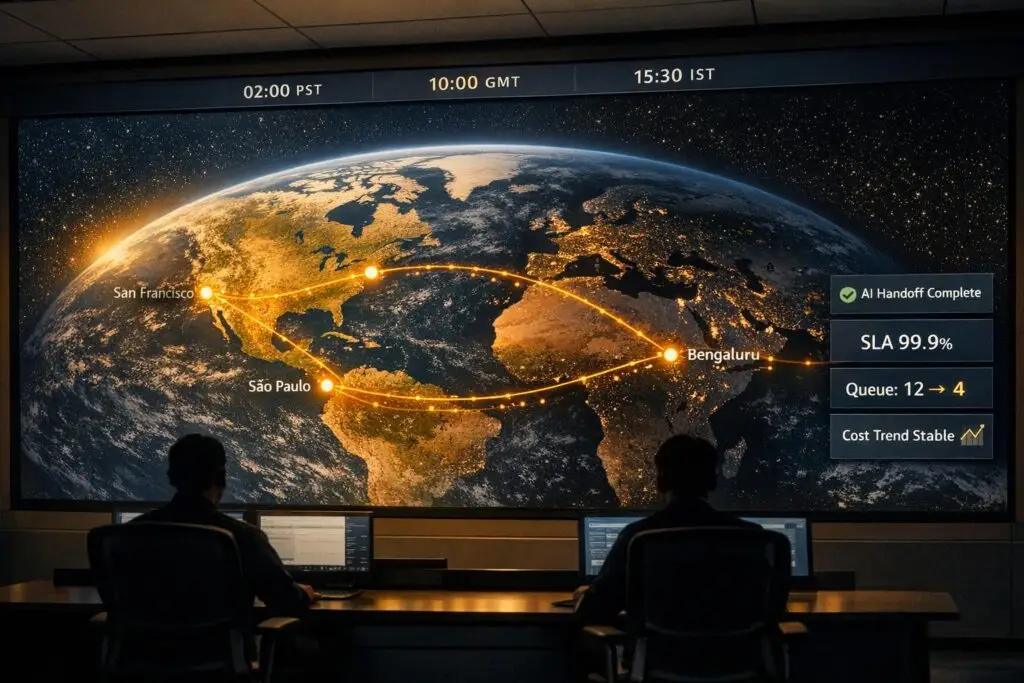
The "Follow-the-Sun" (FTS) model is a global staffing strategy that ensures 24/7 customer support by shifting work across teams in different time zones. This approach eliminates the need for night shifts, reduces errors caused by fatigue, and improves response times. Here’s why it works:
- How It Works: Teams in regions like the Americas, EMEA, and APAC handle tickets during their local business hours, ensuring uninterrupted support.
- Core Benefits:
- Faster response times: Tickets don’t sit idle overnight.
- Reduced burnout: Employees work during normal hours, improving health and morale.
- Cost savings: Eliminates night shift premiums and lowers operational expenses by 30–50%.
- Geo-redundancy: Safeguards operations from disruptions like weather or outages.
- Implementation Steps:
- Map time zones and workload data.
- Create clear handoff protocols with overlap periods.
- Use standardized tools and processes for consistency.
- Train teams on regional communication styles and service standards.
- Leverage AI for ticket routing automation, staffing forecasts, and seamless handoffs.
FTS is ideal for businesses needing real-time, around-the-clock support, especially in high-stakes industries where downtime costs can reach $5,600 per minute. With proper planning and tools, this model transforms global support into a reliable, efficient system.
Follow-the-Sun Support: 24/7 Global Incident Management
sbb-itb-e60d259
What Is the Follow-the-Sun Model?
The Follow-the-Sun (FTS) model shifts responsibility for support tickets across global teams, ensuring that each region handles them during their local business hours [6][8]. Instead of requiring agents in one location to work overnight, FTS distributes teams strategically across the Americas, EMEA, and APAC regions. For example, when your San Francisco team finishes at 5:00 PM PST, your Dublin team steps in to pick up where they left off.
This approach ensures uninterrupted support without the need for overnight shifts. By minimizing downtime, FTS helps avoid the costly consequences of service delays [6]. It also creates geo-redundancy, which safeguards operations against regional disruptions like power outages or severe weather events [1][3]. So, if a hurricane affects your Miami office, teams in Manila or Dublin can continue working without interruption.
Core Principles of Follow-the-Sun
FTS relies on three key principles: time zone alignment, standardized handoffs, and consistent training [6][4]. Teams are strategically positioned to overlap slightly between regions, ensuring smooth transitions and preventing tickets from being left unattended. Outgoing agents document ticket statuses, priority levels, and "Next Action" steps, so incoming teams can hit the ground running without having to review the entire ticket history [1][2].
Consistent training ensures that all teams – whether they’re in Colorado, Beijing, or Budapest – adhere to the same service standards and maintain a unified brand voice [6][4]. Many companies also schedule a 60-minute overlap between shifts for live video briefings, which are especially helpful for [critical escalations] (https://www.supportbench.com/how-to-set-up-an-escalation-management-system/) or VIP issues [1]. This "Warm Handoff" method prevents tickets from lingering in a "Cold Queue" and helps avoid SLA breaches. These pillars are what make FTS a reliable solution for meeting B2B support needs.
Why Follow-the-Sun Works for B2B Support
FTS is particularly effective for B2B support because it addresses the high expectations of business customers. These clients often face complex technical issues that can disrupt entire operations, making quick resolutions essential. In fact, 88% of customers say the support experience is just as important as the product itself [6], and 69% expect real-time, 24/7 availability [6]. By staffing qualified agents during their peak working hours, FTS avoids the risks associated with overnight fatigue and ensures that customer needs are met promptly.
Benefits of Follow-the-Sun Staffing
The Follow-the-Sun (FTS) model offers clear advantages in improving customer service, supporting employee well-being, and cutting costs. These outcomes are supported by data from companies that have transitioned from traditional 24/7 setups.
Better Customer Experience
With 24/7 availability, customers receive help whenever they need it. The FTS model improves response times significantly, with some organizations seeing a 40% reduction in mean response times [5]. Instead of leaving tickets untouched overnight, they’re handed off to active teams in different time zones. This approach is crucial when considering that IT downtime costs businesses an estimated $5,600 per minute [6].
Traditional on-call setups often struggle during night shifts, with customer satisfaction (CSAT, CES, and NPS) scores dropping by 18–22 points compared to daytime shifts [5]. The reason? Fatigued agents are more likely to make mistakes and engage less effectively with customers. As one customer experience leader put it, "Support never sleeps, and neither should your customer care strategy" [6]. Beyond keeping customers happy, the FTS model fosters a healthier, more sustainable work environment for support teams.
Less Agent Burnout
Night shifts can take a heavy toll on employees, both mentally and physically. By eliminating overnight work and spreading tasks across global teams operating during their normal business hours, the FTS model aligns with natural sleep cycles. This reduces fatigue and helps maintain better overall health for employees.
A healthier work-life balance also leads to higher job satisfaction and retention rates. Agents who work regular hours are more energized, engaged, and motivated. Additionally, the FTS approach removes the burden of "pager fatigue" by ensuring that only active teams handle alerts.
"Knowing that the associates are working daytime hours, which is better for their health, better for their responsibilities and their family, gives me peace of mind that they are bringing their A-game to work every day."
- Evan Stewart, Program Manager, PartnerHero [9]
Lower Operating Costs
FTS isn’t just about happier customers and healthier teams – it also delivers major cost savings. By eliminating night shift premiums and other allowances, companies can see operating costs drop by 30–50% compared to traditional 24/7 in-house teams [6]. These savings come from reduced shift differentials, lower turnover rates, fewer recruitment needs, and smarter use of global resources.
When employees work standard hours, companies also avoid productivity losses caused by fatigue-related mistakes. Additionally, the model helps prevent costly SLA breaches that stem from delayed responses. Another bonus? Distributed teams provide geo-redundancy, offering backup coverage during regional disruptions without the need for expensive duplicate infrastructure.
How to Implement the Follow-the-Sun Model
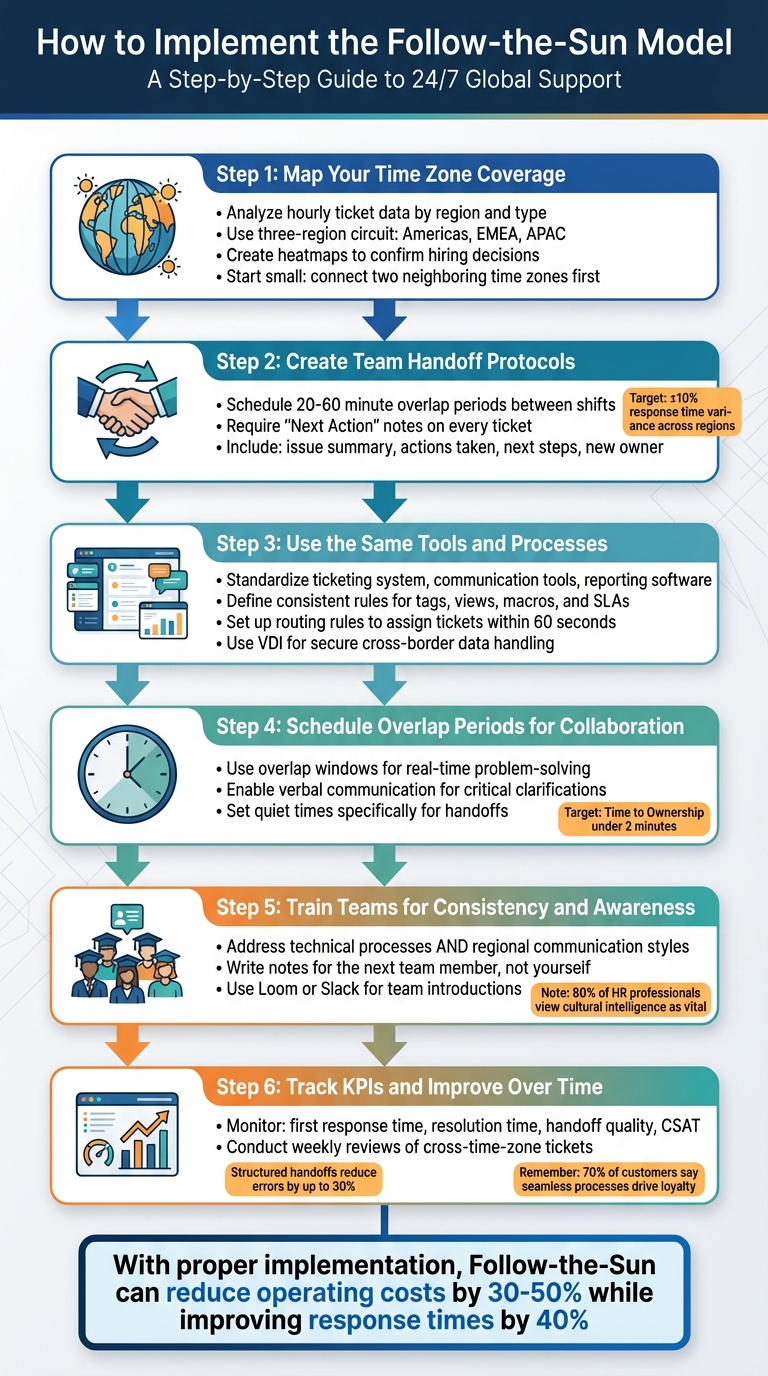
6-Step Implementation Guide for Follow-the-Sun Support Model
To make the Follow-the-Sun (FTS) model work effectively, you need careful planning, consistent processes, and well-timed overlaps across regions. Here’s a step-by-step breakdown to help you get started.
Step 1: Map Your Time Zone Coverage
Start by analyzing hourly ticket data by region and type instead of relying on guesses. Pay attention to peak hours, weekends, and holidays [7][4]. Most 24/7 setups follow a three-region circuit: Americas (covering both coasts), EMEA (Europe, Middle East, and Africa), and APAC (Asia-Pacific) [2].
Match your workload to each region’s strengths. For example:
- The Philippines and India are ideal for high-volume Tier 1 support due to their scalability.
- Latin America works well for Tier 2 and real-time support, thanks to time zone alignment and familiarity with U.S. customers.
- Eastern Europe is a strong choice for Tier 3 and technical SaaS escalations [1].
Use heatmaps to confirm hiring decisions and plan handoff schedules [7]. If FTS is new to your team, start small – connect two neighboring time zones first to fine-tune your handoff process before expanding to all three regions [7].
Step 2: Create Team Handoff Protocols
Smooth handoffs are the backbone of the FTS model.
"The follow-the-sun model only works if you can facilitate great handoffs between different time zones. Without that, you’re dead on arrival" [7].
Schedule 20–60 minute overlap periods between shifts for live briefings [1][5]. For critical updates or escalations, team leads should hold video stand-ups during a 60-minute overlap [1]. To avoid wasting time, require every ticket to include a "Next Action" note that outlines what’s been done and what’s next [1][5].
Develop a handoff template that includes:
- A summary of the issue
- Actions already taken
- Next steps
- The new owner of the task [7]
High-performing global teams aim to keep response time variance within ±10% across regions [5].
Step 3: Use the Same Tools and Processes
Standardization is key. All regions should use the same ticketing system, communication tools, and reporting software. A unified ITSM system ensures everyone works from the same queues and SLA timers.
Define consistent rules for tags, views, macros, and SLAs to maintain service quality [7]. Assign specific channels for different tasks – like Slack for urgent issues and your ticketing system for tracking customer history [12]. Set up routing rules to automatically assign tickets to the active region’s queue within 60 seconds of receipt [5].
For secure handling of customer data across borders, use Virtual Desktop Infrastructure (VDI). This keeps sensitive data on secure servers rather than on local devices [1].
Step 4: Schedule Overlap Periods for Collaboration
Overlap periods aren’t just for handoffs – they’re an opportunity for real-time problem-solving and team bonding. Use these windows for verbal communication to clarify details that might get lost in written notes [11]. Minimize distractions by setting quiet times specifically for handoffs [11]. A good benchmark for "Time to Ownership" in global operations is under 2 minutes during active hours [5].
Step 5: Train Teams for Consistency and Awareness
Training should address both technical processes and regional communication styles. For instance, DACH customers often value concise communication, while LATAM customers may prefer a more relational approach [1]. Quality Assurance scorecards should reflect the customer’s expectations, not just the agent’s location.
Encourage agents to write notes for the next team member, not themselves. Notes should include a summary, current status, and clear next steps [7]. Use tools like Loom or Slack for team introductions to help global members build trust and familiarity [7].
According to recent surveys, nearly 80% of HR and L&D professionals view cultural intelligence and diversity awareness as vital to organizational success [13].
Step 6: Track KPIs and Improve Over Time
Once tools, handoffs, and training are in place, monitor your KPIs. Focus on metrics like first response time, resolution time, handoff quality, and customer satisfaction. Conduct weekly reviews of cross-time-zone tickets to identify gaps where information was lost or delays occurred [7].
Structured handoff protocols can reduce task-related errors by up to 30% in complex environments [11]. Adjust overlap periods or routing rules based on recurring issues. Keep in mind that 70% of customers say seamless processes, like smooth handoffs, are critical to earning their loyalty [10].
Common Pitfalls in Follow-the-Sun Operations
The Follow-the-Sun model offers clear advantages, but it’s not without its challenges. To truly benefit from this approach, it’s critical to address key pitfalls like poor handoff coordination, communication gaps, and inconsistent service quality. Missteps in these areas can erode customer trust and demoralize your team. Let’s dive into these common issues and how to tackle them.
Poor Handoff Coordination
A poorly managed handoff can lead to stalled progress, missed SLAs, and frustrated customers. When handoffs lack clarity, agents may waste time retracing steps, leaving issues unresolved for hours.
"If an agent has to ask, ‘Can you explain the issue again?’, you have failed." – Epicenter.tech [1]
The absence of clear ownership is a major culprit. Without a "Next Action" note or acknowledgment of responsibility, tickets can easily fall through the cracks. To prevent this, enforce direct acknowledgment (like an @-mention) within 5–10 minutes of a handoff. If no acknowledgment occurs, escalate to a team lead. Automating ticket routing to the active region’s queue within 60 seconds of a shift change can also streamline the process [5].
Here’s how poor handoff practices compare with effective ones:
| Handoff Element | Poor Practice (Context Lost) | Best Practice (Context Preserved) |
|---|---|---|
| Update Channel | "Ticket #123 is still open. Please take over." | "Ticket #123: API returning 500 errors. Root cause isolated to EU load balancer. SLA breach in 4h." |
| Ownership Signal | Message posted in a general public room. | Direct @-mention of the incoming on-call lead with a pinned ticket link. |
| Next Steps | None provided. | "Restart balancer once traffic drops; monitor error rate for 15 min; escalate if >2%." |
Communication Gaps Between Teams
Even with smooth handoffs, misaligned communication practices can lead to inconsistency. Globally distributed teams often develop their own interpretations of processes, creating confusion for customers and team members alike.
The "train-the-trainer" approach is a common misstep here. When vendors interpret training materials, accuracy drops to just 70% [1]. Instead, ensure all teams access a centralized, company-owned knowledge base to standardize practices across regions.
Another challenge arises from conflicting priorities. For instance, outsourced partners might focus on speed (Average Handle Time), while internal teams prioritize quality (First Contact Resolution) [1]. Aligning vendor contracts and internal KPIs around shared metrics like First Contact Resolution and CSAT can help bridge this gap. AI tools can also provide real-time performance tracking, flagging any emerging misalignments.
Inconsistent Service Quality
Service quality can vary significantly across regions due to differences in training, tools, and cultural expectations. What’s considered excellent support in one country might come across as rude or unhelpful in another [1]. For example, DACH markets value brevity, while LATAM customers often expect a more relational tone.
To address this, adopt a globally standardized but locally adapted approach to Quality Assurance. QA scorecards should reflect the customer’s regional expectations, not the agent’s location. Train agents on region-specific communication styles – concise and direct for DACH customers, more conversational for LATAM – and ensure tools and processes are consistent, with flexibility for cultural nuances.
Traditional 24/7 support models relying on night shifts often see a CSAT drop of 18–22 points, with night crews experiencing a 37% increase in error rates [5]. The Follow-the-Sun model can mitigate these issues, but only if service quality remains consistent across all regions.
Using AI to Improve Follow-the-Sun Workflows
Managing Follow-the-Sun operations has its fair share of challenges, especially when it comes to manual handoffs and coordination. AI-driven tools are stepping in to transform these workflows, making global support operations faster and more efficient. With 69% of customers expecting real-time support 24/7 [6], traditional methods of routing, handoffs, and escalations often fall short. AI bridges these gaps by automating triage, maintaining context across shifts, and predicting staffing needs before demand surges.
AI for Staffing Forecasts and Ticket Routing
AI uses historical ticket data to optimize regional workloads and fine-tune shift overlaps [6]. Automated routing ensures tickets are assigned based on agent availability, expertise, and location. This means that customer inquiries are directed to active teams during their local business hours, enabling near-instant resolution [1][14].
AI-powered triage takes it a step further by managing routine FAQs and categorizing ticket severity before a human agent even steps in [14]. When human intervention is necessary, AI ensures the ticket lands with the right expert in the active region – often within 60 seconds [5]. This level of precision in ticket routing significantly reduces delays.
The results are tangible. IT downtime, which costs businesses an estimated $5,600 per minute [6], can be minimized when ticket handoffs between regions happen seamlessly.
AI for Escalation Management and Handoff Summaries
AI also tackles the common problems of handoff delays and communication gaps by introducing smarter escalation and summarization tools. One standout feature is the ability to generate detailed, context-rich handoff summaries. These summaries include "Next Action" notes and case details, ensuring that incoming agents don’t waste time piecing together ticket histories [1][3]. This prevents issues from lingering for hours due to missing context, a phenomenon often referred to as "ticket pong."
AI further enhances escalation management by monitoring SLA timers and automatically escalating tickets to backup regions if the primary team is overwhelmed [5]. Predictive CSAT alerts identify high-risk cases early, allowing teams to intervene before customer satisfaction takes a hit. Additionally, automated ownership enforcement requires acknowledgment of transferred tickets within 5–10 minutes, reducing the risk of tickets being overlooked [5].
| AI Stage | Action | Benefit |
|---|---|---|
| Triage | AI classifies severity and skill set | Ensures the right expert in the active region gets the case [5] |
| Routing | Time-zone-aware auto-assignment | Prevents tickets from sitting idle for extended periods [1] |
| Handoff | AI generates "Next Action" summaries | Saves time by eliminating the need to re-read entire ticket histories [1] |
| Escalation | Predictive SLA monitoring | Flags high-risk tickets before SLA breaches occur [5] |
Supportbench AI Features for Global Teams
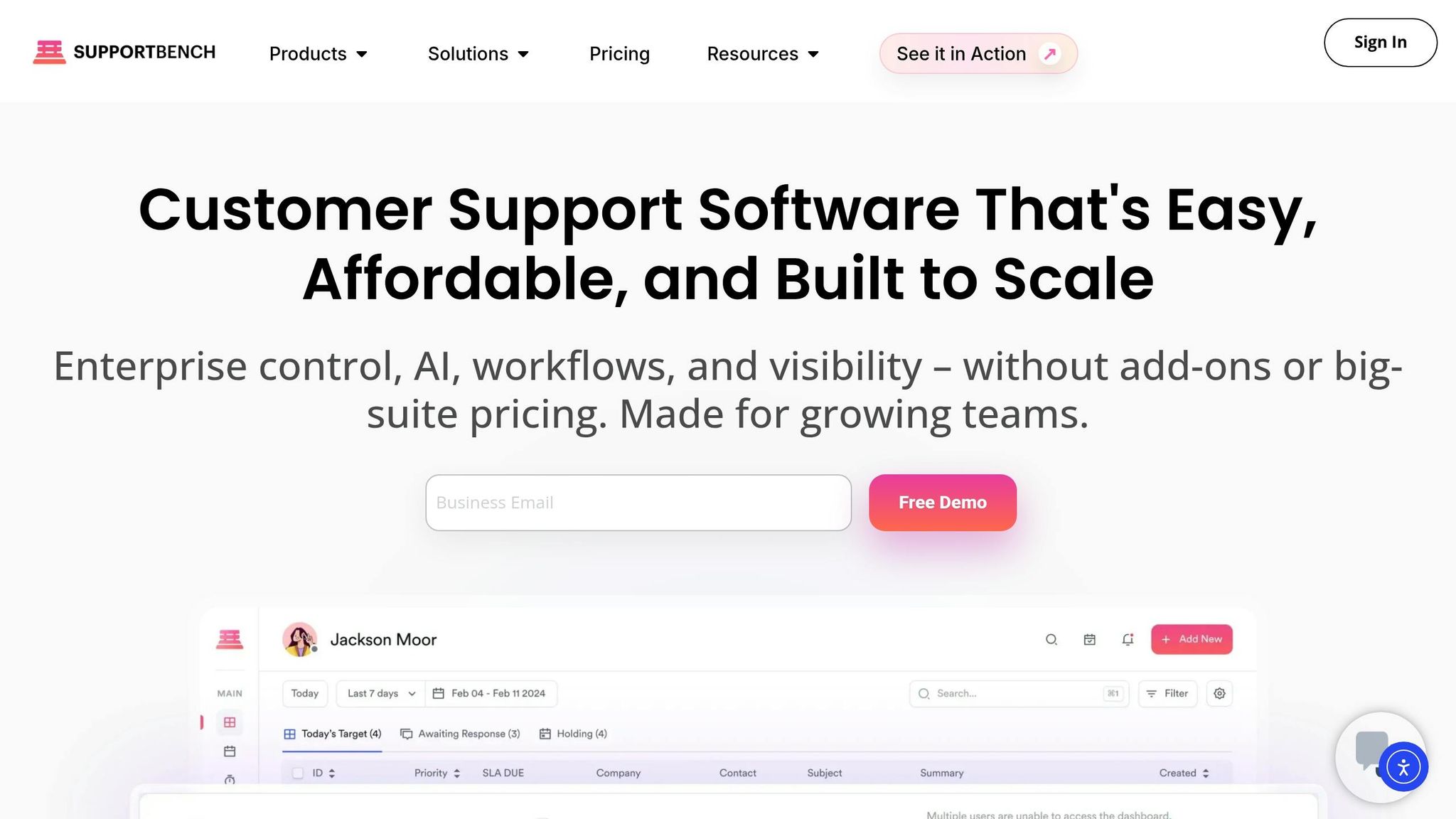
Supportbench takes these AI capabilities to the next level, offering features tailored for global teams managing complex operations across time zones. For example, its AI-driven case summaries streamline handoffs by automatically generating structured notes that capture the issue summary, last status, actions taken, and next steps – eliminating the need for manual documentation during shift changes.
Predictive CSAT is another standout feature, identifying at-risk accounts early enough for customer success teams to take action. Additionally, knowledge base automation supports self-service in regions with fewer staff, reducing ticket volume during off-peak hours. AI even adjusts the tone of support responses to align with regional preferences – such as concise replies for DACH markets or more relational tones for LATAM and Asia [1].
Supportbench’s AI Agent-Copilot further boosts efficiency by reviewing past cases and knowledge bases to suggest relevant solutions. When a case is suitable for documentation, the AI automatically generates a complete knowledge base article, including a subject, summary, and keywords. These tools help global teams maintain consistent service quality without requiring agents to sift through multiple systems for context.
These AI-driven tools make Follow-the-Sun operations a more efficient and effective approach for modern B2B support teams. By addressing key pain points, they enable organizations to deliver consistent, high-quality service around the clock.
Conclusion
The Follow-the-Sun model turns the challenge of global B2B support into an opportunity for seamless, round-the-clock service. By distributing teams across time zones, businesses can provide 24/7 support during local business hours, eliminating the need for night shifts or weekend rotations. This approach aligns with the expectations of 69% of customers who demand real-time support and can cut operational costs by 30–50% compared to maintaining an in-house 24/7 team [6].
As highlighted throughout this guide, success with this model depends on careful planning and the smart use of technology. Structured handoff protocols and a unified technology stack are non-negotiable. Without tools like standardized templates, scheduled overlap periods, and a shared context layer, tickets can sit idle for more than 16 hours, frustrating customers. The difference between a "warm handoff" – complete with detailed "Next Action" notes and live briefings – and a cold, stagnant queue is the difference between satisfied customers and operational headaches. Adding AI into the mix enhances these processes further. Automated ticket routing, predictive customer satisfaction alerts, and AI-generated handoff summaries reduce manual errors and improve efficiency. Considering IT downtime costs can hit $5,600 per minute [6], these tools are not just helpful – they’re essential for protecting revenue and retaining customers.
Take a moment to evaluate your current support setup: Are international customers waiting too long for responses? Are SLA commitments at risk or do you need to escalate a customer service issue due to downtime? Are your agents struggling with burnout from irregular shifts? If the answer to any of these is yes, the Follow-the-Sun model – bolstered by AI-driven tools – can make a measurable difference. It improves response times, boosts customer satisfaction, and enhances team morale. In a world where 88% of customers say the quality of support is just as important as the product itself [6], adopting this approach isn’t just a good idea – it’s a strategic necessity. The real question is: how soon can you start?
FAQs
Do I need three regions to start Follow-the-Sun?
You don’t need to have three regions to kick off a Follow-the-Sun model. Many companies start with just 2–3 main hubs like the Americas, EMEA, and APAC to provide around-the-clock support. The key is to prioritize regions that match your customer base and specific support requirements. Starting small – focusing on fewer regions – can help ensure smooth handoffs and consistent coverage before expanding further.
What’s the minimum overlap time for good handoffs?
The recommended minimum overlap time for smooth handoffs in a follow-the-sun support model is 20–30 minutes. This window allows regional teams to transition effectively and ensures ongoing support without interruptions. Some experts recommend extending this overlap to 60 minutes for even greater efficiency. At a minimum, sticking to the 20–30 minute overlap helps ensure seamless ticket transfers and maintains consistent service continuity.
Which KPIs show the Follow-the-Sun model is effective?
Key performance indicators (KPIs) to watch are faster response times, fewer SLA breaches, higher customer satisfaction scores, and better support continuity. These metrics highlight smooth transitions between teams, steady service quality, and reliable global support coverage.
Related Blog Posts
- 9 Tips for Scaling Support Without Hiring More Staff
- How AI Improves Time Management in Support
- How do you build a support staffing model for time zones and coverage (follow-the-sun)?
- The “Always On” Expectation: Setting Boundaries in Slack-First Support
Evaluating help desks for a B2B team?
Supportbench is all-inclusive from $32 per agent per month, with migration and onboarding included. See pricing or book a 20-minute demo.