Canadian teams face rising challenges when selecting SaaS vendors due to tariffs, currency fluctuations, and regulatory complexities. Here’s what you need to know:
- Tariffs and Costs: U.S.-Canada trade tensions have introduced tariffs up to 25%, increasing SaaS costs by nearly a third when combined with GST. A weaker Canadian dollar adds further expense.
- Regulatory Issues: U.S. laws like FISA allow access to data stored by U.S.-based vendors, even if hosted in Canada, raising sovereignty concerns. Compliance with Canadian laws like the Export and Import Permits Act (EIPA) adds complexity.
- Vendor Restrictions: Policies in Ontario and other regions now limit public contracts to U.S. vendors with significant Canadian operations.
- Risk of Disruptions: Trade disputes and sanctions can lead to service interruptions, affecting software updates, support, or access.
Key Solutions:
- Data Residency: Prioritize vendors with Canadian-based data storage and operations to reduce jurisdictional risks.
- Pricing Stability: Negotiate fixed pricing in CAD and include clear exit strategies in contracts.
- Compliance: Ensure vendors meet Canadian standards like PIPEDA and provide certifications (e.g., SOC 2 Type 2, ISO 27001).
- Diversification: Reduce reliance on U.S. vendors by exploring domestic or non-U.S. options.
The shifting trade landscape means Canadian organizations must rethink how they evaluate SaaS vendors, focusing on cost certainty, compliance, and service continuity.
How Tariffs and Cross-Border Risks Affect SaaS Costs and Operations
Understanding the factors driving costs is crucial for Canadian teams navigating pricing uncertainties and regulatory hurdles.
Cost Increases and Hidden Fees from Tariffs
The USMCA may block direct tariffs on digital products, but SaaS vendors still face rising costs due to tariffs on physical infrastructure like semiconductors, servers, and data center components. These higher expenses often trickle down to Canadian businesses in the form of increased subscription fees and "cloud surcharges".
Tariffs also compound sales taxes. For example, a $100 product with a 25% surtax adds $25 in duties. When GST is applied to the new total of $125, the cost rises by an extra $6.25, creating nearly a one-third price hike.
"A commercial product with a value for duty of $100 to which a 25% surtax is applied will result in duties and GST of $31.25 (nearly a third of the declared value of the product)." – Gowling WLG
Currency fluctuations act as a hidden tariff. A weaker Canadian dollar against the U.S. dollar increases costs for USD-priced subscriptions. Canadian businesses should account for a 10–15% swing when planning IT budgets. These rising expenses not only affect pricing but also add complexity to compliance, as vendors juggle cross-border regulations.
Data Sovereignty and Regulatory Compliance Across Borders
Costs aren’t the only concern – cross-border operations also bring compliance headaches. When Canadian data is stored in U.S.-based SaaS platforms, it falls under U.S. laws like the CLOUD Act and the Foreign Intelligence Surveillance Act (FISA). These laws allow U.S. authorities to access data, sometimes without informing the owner, even if the data is physically stored in Canada.
"As long as a CSP that operates in Canada is subject to the laws of a foreign country, Canada will not have full sovereignty over its data." – Government of Canada White Paper
Canada’s Export and Import Permits Act (EIPA) adds another layer of complexity. Storing "controlled technology" in the cloud could be classified as an export if there’s any chance of access by someone outside Canada. In such cases, an export permit may be required unless encryption and Canadian-managed keys are in place. To mitigate risks, the Canadian government restricts public cloud storage to data classified at the "Protected B" level or lower.
Operational Risks from Trade Tensions and Policy Changes
Trade disputes can lead to price spikes and service disruptions. For example, under the International Emergency Economic Powers Act (IEEPA), the U.S. President can impose tariffs or sanctions by declaring a national emergency, bypassing protections in agreements like CUSMA.
In January 2025, the U.S. imposed a sudden 25% tariff on all imports from Colombia, with plans to raise it to 50% within a week. Though the situation de-escalated, it demonstrated how quickly emergency measures can override trade agreements.
"Free trade agreements are unlikely to protect any trading partners of the U.S. from vulnerability to tariff measures." – Wendy J. Wagner, Partner and Practice Group Leader, Regulatory, Gowling WLG
Canadian organizations also face risks of service interruptions. Geopolitical disputes can lead to disruptions in software updates, technical support, or even access to platforms. Heavy reliance on a few global tech providers amplifies this vulnerability; if a major provider encounters restrictions, the ripple effects could impact both public and private sectors.
sbb-itb-e60d259
What to Look for When Evaluating SaaS Vendors Under Tariff and Risk Constraints
Canadian businesses must rethink how they evaluate SaaS vendors. With shifting jurisdictional risks, fluctuating pricing, and growing compliance demands, the old focus on features and uptime guarantees just doesn’t cut it anymore. Cross-border tensions can lead to sudden cost hikes or service interruptions, making a more thorough evaluation process essential.
Data Residency and Canadian Infrastructure
One of the first things to verify is whether a vendor has a genuine Canadian presence. This means they should have local operations and store data domestically, reducing the risk of foreign legal interference.
"Using a Canadian supplier or storing data in Canada does not guarantee data will be outside the jurisdiction of foreign courts." – Government of Canada Digital Sovereignty Framework
By 2026, at least five major cloud providers are expected to offer infrastructure that keeps data within Canadian borders. For highly sensitive information, like data classified as Protected B or higher, using Canadian computing facilities is critical. It minimizes jurisdictional risks and ensures business continuity. Vendors that qualify as "Canadian Suppliers" under the Buy Canadian policy can also offer cost advantages, such as a 10% price reduction during federal procurement evaluations.
Additionally, insist on full control over your encryption keys. This prevents unauthorized access from foreign entities.
Pricing Stability and Total Cost of Ownership
Pricing predictability is just as important as data location, especially in a climate of tariff volatility.
To protect against unexpected costs, choose vendors that provide fixed ceiling prices and detailed documentation to support cost certainty. When evaluating Total Cost of Ownership (TCO), don’t just look at subscription fees – factor in renewals, add-ons, and scaling expenses. Operational costs like training, integration, and data retrieval can also add up quickly.
| TCO Component | Description | Risk Factor |
|---|---|---|
| Subscription Fees | Base cost of the software license | Currency/tariff fluctuations |
| Scaling Costs | Fees for adding users or storage | Unexpected scaling fees |
| Integration/Training | Resources needed for system setup | High "learning curve" costs |
| Exit/Data Retrieval | Costs to transfer data off the platform | Risk of "deplatforming" |
| Compliance Audits | Verifying certifications and standards | Regulatory misalignment |
It’s also wise to negotiate "conflict of law" clauses. These outline how the vendor will handle situations where foreign laws might force them to disclose data or interrupt services. Finally, ensure the contract includes a clear exit strategy, detailing how your data will be removed and delivered in a usable format.
Compliance Certifications and Security Standards
Security certifications are another critical factor when assessing vendors. These certifications demonstrate a vendor’s efforts to safeguard your data, but not all certifications are created equal. For instance, SOC 2 Type 2 is highly recommended because it evaluates the effectiveness of controls over an extended period, unlike SOC 2 Type 1, which only provides a snapshot. SOC 2 focuses on five key principles: Security, Availability, Processing Integrity, Confidentiality, and Privacy.
"A SOC 2 type 2 report is generally recommended due to the increased level of assurance that it provides." – Canadian Centre for Cyber Security
For Canadian-specific needs, check if vendors comply with ITSG-33, which is based on NIST 800-53. For cloud security, look for ISO 27017 and ISO 27018 certifications, which address key concerns like securing personal data. Cryptographic operations should also meet FIPS 140-2/3 standards.
When reviewing a SOC 2 report, pay close attention to the Complementary End User Controls (CEUC) section. These are the tasks your team must complete to ensure the vendor’s security measures work as intended. For ISO 27001, request the Statement of Applicability to see which specific controls were audited. Lastly, verify that vendors comply with PIPEDA for private-sector data or the Privacy Act for federal institutions to ensure they meet Canadian legal standards.
How to Reduce Cross-Border SaaS Risks
It’s essential to put measures in place now to protect your data and maintain operations in the face of cross-border risks. Here are some practical steps focusing on data residency and operational continuity.
Choose Vendors with Domestic Data Storage and Processing
Opting for a vendor that uses Canadian-hosted infrastructure and operates entirely within Canada is a smart way to limit exposure to foreign legal actions. Even if data is stored in Canada, a provider with ties to foreign operations or parent companies could still be subject to non-Canadian court orders, leaving your data vulnerable.
"The GC can fully maintain legal control only when it delivers services itself or works with providers that operate entirely under Canadian jurisdiction." – Government of Canada Digital Sovereignty Framework
To enhance your data security, maintain exclusive control over encryption keys. Additionally, include contractual obligations that require vendors to notify you immediately if they receive foreign government access requests.
Plan for Service Continuity During Trade Disruptions
Trade disputes can escalate quickly, leading to tariffs and service interruptions. For example, in August 2025, the U.S. imposed a 35% tariff on certain Canadian goods, citing national security concerns. To prepare for such scenarios, establish flexible vendor relationships and ensure you have robust data migration plans in place.
Diversify your vendor network by identifying domestic or non-U.S. providers who can step in if your primary vendor faces disruptions. This reduces reliance on a single foreign market and provides critical flexibility during crises.
Using vendor-neutral data formats is another safeguard, as it allows for seamless migration to other platforms without being restricted by proprietary systems.
Lastly, develop a comprehensive continuity plan that outlines how to handle potential loss of access to non-domestic services. Include recovery steps, alternative delivery options, and communication strategies to ensure your team can keep running smoothly during unexpected outages.
A Step-by-Step Framework for SaaS Vendor Selection in Canada
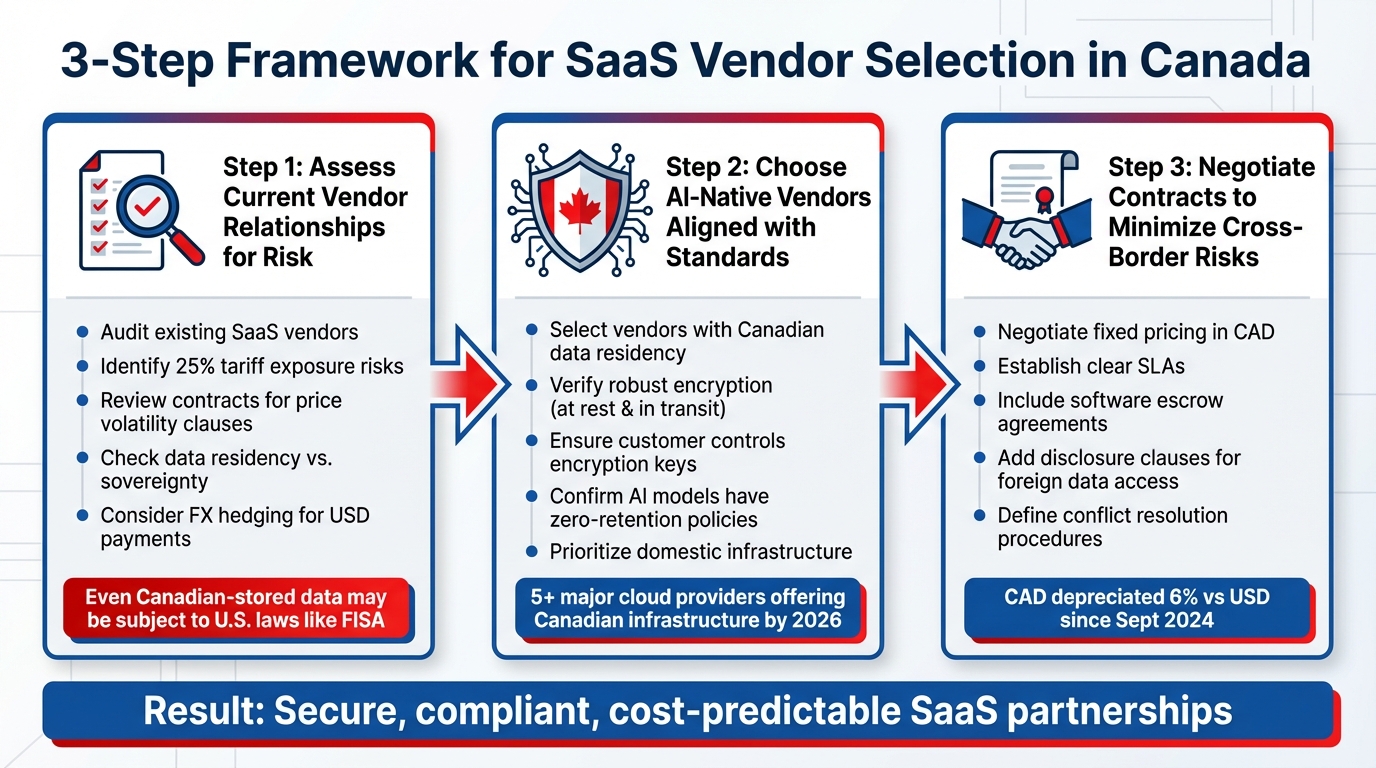
3-Step Framework for Canadian SaaS Vendor Selection Under Tariff Risks
Navigating tariff and cross-border risks requires a structured approach, especially for Canadian businesses. Here’s a practical framework to help you evaluate and select the right SaaS vendors.
Step 1: Assess Current Vendor Relationships for Risk
Start by auditing your existing SaaS vendors to understand how their tools align with your business activities and identify areas of high risk. For instance, a 25% tariff risk could lead to unpredictable pricing and disrupt service delivery.
"Review your contracts for clauses that could expose you to price volatility if tariffs are enacted, such as fixed price contracts." – Export Development Canada (EDC)
Pay close attention to data residency versus sovereignty. Even if your data is stored in Canada, vendors subject to U.S. laws like FISA might be required to disclose it without informing you. Ensure contracts account for these risks and prioritize data sovereignty protections. Additionally, consider using FX hedging to manage currency fluctuations when paying U.S.-based vendors.
With these risks identified, the next step is finding vendors that integrate AI while adhering to Canadian compliance standards.
Step 2: Choose AI-Native SaaS Vendors Aligned with Canadian Standards
Focus on AI-native vendors that meet Canadian data sovereignty and compliance requirements. Many of the largest global cloud providers offer solutions to keep data isolated within Canadian borders. Look for platforms that provide robust encryption for data both at rest and in transit, ensuring your organization has sole control over encryption keys.
Prioritize vendors whose AI models avoid retaining customer data and offer zero-retention or private model instances. Confirm that their hosting solutions provide true Canadian data residency to maintain compliance. Platforms like Supportbench, which combine compliance with cost-efficiency, can modernize your operations while reducing cross-border risks.
Once you’ve identified compliant AI-native vendors, focus on contract negotiations to further mitigate cross-border challenges.
Step 3: Negotiate Contracts to Minimize Cross-Border Risks
When finalizing agreements, negotiate for fixed pricing in Canadian dollars and clear SLAs to protect against tariff-related cost increases and potential service interruptions. This is especially critical given the Canadian dollar’s nearly 6% depreciation against the U.S. dollar since late September 2024.
"Contracting authorities should ensure that all contracts with CSPs include clauses that compel the CSP to disclose all unauthorized access to data, including access made under court order." – Government of Canada
Incorporate software escrow agreements to safeguard operations if a vendor exits the market due to trade tensions. Ensure contracts include clauses requiring vendors to disclose any unauthorized foreign access to your data. Additionally, demand clear procedures for resolving conflicts between contractual obligations and domestic legal requirements.
Conclusion
Tariffs and cross-border risks have reshaped how Canadian teams evaluate SaaS vendors. With the 5.9% average U.S. tariff rate on Canadian goods as of October 2025 and unpredictable trade policies, relying solely on U.S.-based vendors now carries significant operational and financial challenges. Beyond these direct costs, laws like FISA create additional concerns by exposing Canadian data to foreign government access.
"Digital sovereignty is the capacity to operate effectively and make independent decisions about digital assets, regardless of where technologies are developed, hosted, or supported." – Government of Canada Digital Sovereignty Framework
This framework highlights the importance of tailoring vendor evaluations to fit Canada’s regulatory landscape. Choosing vendors that prioritize domestic data residency ensures compliance while also strengthening business continuity in the face of growing trade uncertainties. Policies and trends are increasingly favoring providers with infrastructure rooted in Canada.
"Diversification is no longer just a strategic advantage – it’s a necessity. Over-reliance on the United States as a source for critical goods and inputs exposes organizations to risks tied to unilateral policy changes." – Wendy J. Wagner, Partner, Gowling WLG
AI-driven domestic platforms offer both innovation and protection against cross-border risks. By implementing strong encryption and carefully structured contracts, Canadian teams can build secure, resilient vendor partnerships.
FAQs
How can Canadian teams manage the impact of tariffs on SaaS costs?
Canadian teams can tackle the challenges posed by tariffs on SaaS costs by employing a few practical approaches. One effective step is to look for vendors offering flexible pricing models that can accommodate cost fluctuations. Another smart move is to diversify your vendor base – this might include exploring local or regional providers to limit reliance on cross-border solutions.
Keeping up-to-date with trade policies and tariff updates is equally crucial. This knowledge allows teams to make informed decisions and adjust procurement strategies as needed. It’s also wise to negotiate contracts that include provisions for cost variability, helping to ensure expenses remain predictable even when external economic factors shift. By taking these measures, teams can manage financial risks effectively while keeping operations running smoothly.
What compliance standards should Canadian teams look for when selecting SaaS vendors?
Canadian teams need to ensure their SaaS vendors comply with PIPEDA (Personal Information Protection and Electronic Documents Act). This law outlines how personal information is collected, used, and disclosed within Canada. Key requirements include maintaining transparency, taking accountability, and implementing safeguards – especially when data crosses international borders.
When dealing with cross-border data transfers, vendors should adopt strong security controls and adhere to data residency requirements. It’s essential to verify that vendors have systems in place to protect personal information and address risks tied to international data handling.
By focusing on these compliance measures, teams can ensure their SaaS vendors meet Canadian regulations while fostering customer trust.
How can Canadian businesses protect data sovereignty when working with U.S.-based SaaS providers?
Canadian businesses can maintain control over their data while working with U.S.-based SaaS providers by focusing on strong contractual protections and compliance measures. Under PIPEDA (Personal Information Protection and Electronic Documents Act), companies are required to ensure that any personal data transferred outside Canada is safeguarded by measures comparable to those within the country. Additionally, they must inform individuals about such data transfers. This can be managed through clear data processing agreements and consistent monitoring of privacy laws in other jurisdictions.
Another key step is adopting data residency policies and implementing security measures that align with Canadian government standards. Leveraging frameworks like security guardrails and risk management strategies can help businesses stay compliant while minimizing potential risks. By taking these precautions, Canadian companies can effectively safeguard sensitive information and fulfill their legal and privacy responsibilities, even when partnering with U.S.-based SaaS vendors.
Related Blog Posts
- What should Canadian teams check before switching to a non-US SaaS helpdesk?
- How do Canadian data residency requirements affect helpdesk selection?
- What does “Buy Canadian” mean for software and SaaS procurement in Canada?
- What’s the best helpdesk for Canadian B2B companies that need strict data location controls?