If your business must keep data within Canada for compliance, here’s what you need to know upfront:
- Supportbench offers Canadian data residency, advanced B2B support features, and AI tools for $32/agent/month. However, its data center locations in Canada are not clearly disclosed.
- OpenText Secure Platforms ensures strict Canadian data residency with dedicated data centers, making it ideal for highly regulated industries. Pricing is higher, targeting enterprise-level users.
- Planisware Cloud Services provides Canadian data centers but focuses on project management over helpdesk functionality, limiting its use for customer support.
Key takeaway: Supportbench is budget-friendly with AI-driven tools, while OpenText prioritizes strict compliance with locally stored data. Your choice depends on whether cost or compliance is more critical.
Quick Comparison:
| Platform | Data Residency | B2B Support Features | AI Tools | Pricing |
|---|---|---|---|---|
| Supportbench | Canadian (unclear locations) | Advanced workflows | Predictive CSAT, ticket automation | $32/agent/month (Pro Plan) |
| OpenText | Dedicated Canadian centers | ITSM + multi-department support | AI-driven issue resolution | Enterprise-level pricing |
| Planisware | Canadian centers | Project management only | Limited AI features | Not specified |
Next steps: Verify SLAs to ensure Canadian data residency and weigh features against your compliance needs.
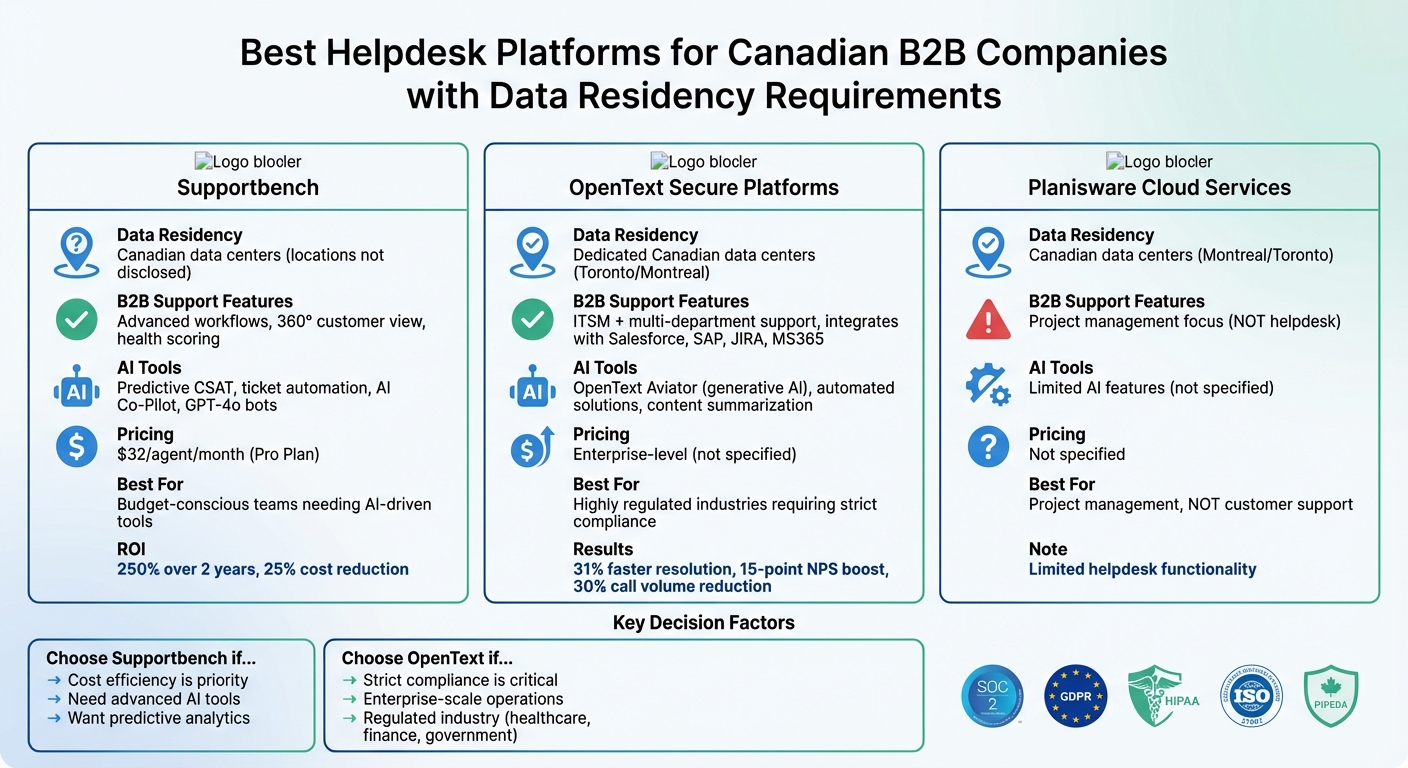
Canadian Helpdesk Platforms Comparison: Data Residency and Features
1. Supportbench
Canadian Data Residency
Supportbench offers full control over where your data is stored. During setup, you can choose a Canadian data center for databases, file storage, and web services, ensuring all your data stays within Canada. The platform encrypts data both during transmission and while stored, and it maintains detailed audit trails to meet compliance needs.
Supportbench is designed to align with SOC 2, GDPR, and HIPAA standards right out of the box. Its multi-tenant architecture ensures that client data is kept entirely separate – a critical feature for managing multiple B2B accounts with varying compliance requirements. Role-Based Access Controls (RBAC) ensure that agents only access data relevant to their roles, while clients using white-labeled portals can view only their own documents and updates.
"Supportbench includes encrypted data handling, customizable access roles, and comprehensive logging, so MSPs can stay compliant and build long-term client confidence." – Nooshin Alibhai, Founder and CEO of Supportbench
These compliance-focused features also support the platform’s ability to handle complex B2B workflows with confidence and precision.
B2B Features
Supportbench is built to handle the intricate relationships often found in B2B environments. It supports hierarchical company structures, making it easy to manage workflows and reporting for firms with multiple divisions. A 360-degree customer view consolidates everything – interaction history, performance metrics, owned products, and even contract renewal dates – into a single, easily accessible dashboard.
The platform’s health scoring tool uses sentiment analysis and predictive scoring to flag at-risk accounts, helping your team address issues before they escalate. You can also create tailored support policies for various customer tiers and attach critical assets, like license agreements or credentials, directly to company profiles. Dynamic SLAs automatically adjust based on specific data points, ensuring that high-priority accounts receive the attention they deserve.
Businesses using Supportbench report an average 25% boost in revenue by cutting costs and reducing customer churn. Today, over 9,000 companies worldwide trust the platform.
AI Capabilities
Supportbench’s AI Co-Pilot takes support efficiency to the next level. Acting as a real-time assistant, it suggests replies based on case history, summarizes past interactions, and pulls relevant information from the knowledge base without manual input. It also automates ticket triage, tagging, and prioritization, saving agents valuable time.
The platform leverages AI-driven quality assurance to review tickets for empathy, tone, and overall effectiveness, minimizing the need for manual checks. It even predicts CSAT and CES scores, offering insights into customer satisfaction trends – even when surveys go unanswered. With one click, resolved cases can be turned into searchable knowledge base articles, while GPT-4o-powered bots provide 24/7 customer self-service. Additionally, natural language reporting lets you create custom charts by typing simple commands like, "Show me the top 3 customers creating tickets this month."
These AI-driven tools streamline operations, making them indispensable for modern B2B support teams.
Customers switching to Supportbench report an average ROI of 250% over two years and a 25% reduction in operational costs.
Pricing
Supportbench’s pricing model is designed to be both competitive and transparent, making it an attractive choice for B2B operations.
Pricing starts at $32 per agent per month (billed annually) or $40 per month (monthly billing) for the Professional Plan. This plan includes all AI features, ticketing, health scoring, and KPI scorecards – no additional purchases required. For teams needing advanced functionality, the Enterprise Plan is available at $100 per agent per month (annual billing) or $125 (monthly billing). This tier adds sandbox environments, white labeling, enhanced permissions, and a dedicated success manager. Teams with 60 or more agents automatically move to Enterprise pricing. Notably, all AI features are included in the base pricing, making it a cost-effective choice for teams of any size.
2. Planisware Cloud Services
Canadian Data Residency
In September 2025, Planisware launched two data centers in Montreal and Toronto to meet the growing demand for localized data residency from Canadian organizations. However, it’s important to note that data residency in Canada doesn’t guarantee complete sovereignty. Due to the provider’s corporate structure, foreign laws like FISA could still grant external access to data. To ensure full compliance, organizations should confirm that the corporate framework is governed exclusively within Canada.
Planisware’s infrastructure adheres to rigorous security standards, including ISO 27001, ISO 27018, ISO 27017, SOC 1/2 Type 2, and CSA STAR, ensuring a high level of security for its cloud services.
"By expanding our presence in North America, we reaffirm our promise to deliver unparalleled cloud security, operational sovereignty, and service continuity for our customers’ most critical initiatives." – Loïc Sautour, CEO of Planisware
Next, let’s look at how Planisware’s project management focus enhances its B2B offerings.
B2B Features
Planisware is tailored for project and portfolio management, rather than traditional helpdesk tasks. Its two flagship products – Planisware Enterprise and Planisware Orchestra – cater to distinct needs. Planisware Enterprise supports large-scale strategic portfolio management, while Planisware Orchestra is designed for flexible project management and collaborative team efforts. These tools enable B2B organizations to plan, manage, and execute complex projects across multiple departments and geographic regions.
That said, this platform does not cover helpdesk functionalities such as ticket tracking or customer communication management. Its primary focus remains on project management, but Planisware also emphasizes its use of AI, which we’ll discuss next.
AI Capabilities
Planisware markets its platforms as "AI-powered", claiming to leverage artificial intelligence to improve project execution and strategic decision-making. However, the specifics of these AI-driven features are not detailed. Capabilities like ticket triage, automated responses, sentiment analysis, or predictive customer satisfaction scoring are not mentioned as part of its offerings.
3. OpenText Secure Platforms
Canadian Data Residency
OpenText Private Cloud operates through Canadian data centers, offering Sovereign Cloud and Sovereign AI models to ensure strict local control over data. These single-tenant environments support AI-driven features like search and summarization while keeping data processing entirely localized. The platform adheres to stringent compliance standards, including Canadian Protected B status, ISO 27001, and HIPAA, with data segmentation adding an extra layer of privacy protection.
"OpenText Private Cloud is purpose-built for organizations that need to be global in scale but local in execution." – OpenText
By combining strict data residency controls with robust functionality, OpenText enhances both security and operational efficiency for its users.
B2B Features
OpenText Service Management takes IT support to the next level by extending its reach into departments like HR, R&D, facilities, finance, and marketing. Its low-code design studio includes ITIL-certified templates, along with premium modules for managing assets, procurement, and vendors. Pre-integrated connectors with platforms like Salesforce, SAP, Atlassian JIRA, Microsoft 365, and Microsoft Teams make long-term B2B account management smoother and more efficient. For example, organizations have reported a 30% drop in call volumes as customers are empowered to resolve more issues on their own.
These B2B tools are further strengthened by the integration of advanced AI, which optimizes support processes.
AI Capabilities
OpenText leverages AI to simplify and accelerate support workflows. OpenText Aviator, powered by generative AI, suggests solutions, summarizes content, and automates tasks across both structured and unstructured data. The platform ensures data protection while delivering tangible results: users have seen a 31% improvement in issue resolution times and a 15-point boost in Net Promoter Scores. Additionally, OpenText connects datasets from CRM, ERP, and supply chain systems, enabling service agents to access a unified view of customer interactions without transferring data between systems.
Pricing
OpenText provides two SaaS subscription tiers with clear licensing options. The Service Management Express plan includes unlimited ITSM capabilities for incident, change, and request management. It also offers a service portal, mobile app, multi-region data residency, integrated AI, and a 99.9% uptime SLA. For organizations needing more, the Service Management Premium plan adds features like IT asset and procurement management, vendor management, and tools for idea and proposal management. A 14-day free trial of the full-featured software is available for those looking to explore its capabilities.
sbb-itb-e60d259
Data Sovereignty in Canada: Why It Matters for Every Business
Pros and Cons
Supportbench is designed to handle intricate B2B workflows, offering features like predictive CSAT, automated ticket classification, and dynamic SLA management, all powered by integrated AI. Priced at $32/agent/month, it’s also budget-friendly, making it an appealing option for teams looking to optimize costs. Additionally, it adheres to HIPAA and ISO 27001 standards, ensuring a solid foundation for security and compliance. However, one notable drawback is the lack of transparency regarding its Canadian data center locations. For organizations with strict data residency requirements, this could pose an issue, especially when compared to platforms that prioritize data localization over affordability.
On the other hand, OpenText Secure Platforms takes a firm stance on data residency, operating exclusively through dedicated Canadian data centers. This ensures that sensitive data remains within national boundaries, meeting rigorous data sovereignty mandates. While this level of localization is a significant advantage for enterprises with strict compliance needs, the platform’s enterprise-level pricing might make it less accessible for smaller teams or businesses operating on tighter budgets.
Comparative Summary
| Platform | Key Strengths | Main Limitations |
|---|---|---|
| Supportbench | Integrated AI features; advanced B2B workflows; cost efficiency at $32/agent/month | Lacks clarity on Canadian data center locations |
| OpenText Secure Platforms | Dedicated Canadian data centers ensuring data residency | Enterprise pricing may deter smaller teams |
Both platforms excel in managing complex, multi-stakeholder issues and supporting long-term account servicing. However, they approach the challenge of data residency differently. Choosing between them ultimately depends on whether cost efficiency or strict data residency compliance is the higher priority for your organization.
Conclusion
For Canadian B2B companies that require strict data localization, finding the right helpdesk solution means striking a balance between meeting regulatory demands and maintaining operational efficiency. If your business operates in highly regulated industries like government, healthcare, or financial services, choosing platforms with Canadian-based data centers is crucial for ensuring data residency – though it often comes with higher costs.
For organizations focused on affordability and leveraging AI, Supportbench offers a competitive pricing model at $32 per agent per month. Its AI-driven tools, such as predictive CSAT, automated ticket categorization, and dynamic SLA management, are designed to streamline operations and handle complex, multi-stakeholder challenges effectively.
It’s essential to confirm in writing that all data remains stored in Canada, as outlined in your SLA, to comply with PIPEDA and mitigate risks associated with the U.S. CLOUD Act.
Additionally, ensure your chosen solution includes RBAC (Role-Based Access Control) and detailed audit trails to support accountability. If your B2B clients operate in the EU, Canada’s GDPR adequacy status simplifies data transfers under European regulations.
FAQs
What should Canadian B2B companies look for in a helpdesk to meet data residency requirements?
When choosing a helpdesk platform that aligns with Canadian data residency laws, prioritize data sovereignty. This means ensuring all data is stored and processed within Canada to comply with regulations like PIPEDA. Platforms that are either self-hosted or hosted on Canadian servers typically provide greater control and security.
Pay close attention to security features as well. Encryption, strict access controls, and privacy compliance measures are essential for safeguarding sensitive information. Additionally, opt for platforms capable of managing complex workflows, handling multi-stakeholder operations, and leveraging automation to streamline processes while staying compliant.
Lastly, think about how well the platform integrates with your existing tools, its ability to scale with your needs, and its AI-driven features for automation and analytics. These elements not only improve efficiency but also help ensure your helpdesk can adapt to evolving data residency standards.
How does Supportbench meet Canadian data residency requirements for B2B companies?
Supportbench addresses Canadian data residency laws by utilizing sovereign cloud solutions hosted entirely within Canada. This ensures that all customer data stays within the country’s borders, aligning with privacy standards such as PIPEDA.
The platform also emphasizes data sovereignty and traceability, providing strong security features tailored to meet the demands of Canadian B2B companies that require localized data storage and strict compliance.
How do Supportbench and OpenText compare in pricing and data residency for Canadian B2B companies?
When it comes to pricing and data residency, Supportbench and OpenText take very different approaches.
Supportbench keeps things simple with an all-inclusive pricing model starting at $32 per user per month. This plan covers AI-powered tools, ticket management, and various customer support features, making it a budget-friendly option for businesses looking for modern, AI-driven solutions.
In contrast, OpenText doesn’t publish standard pricing. Instead, it offers quotes on request, reflecting its focus on enterprise-level customization and scalability. This approach often means higher costs, but it caters to businesses needing tailored solutions.
When it comes to data residency, OpenText stands out for organizations with strict data localization requirements. It emphasizes compliance, robust security, and the ability to manage data across multiple regions, making it a strong fit for companies needing precise data control. Supportbench, while prioritizing operational transparency, doesn’t place as much emphasis on data residency, which may make OpenText the better choice for businesses with stringent localization needs.
Related Blog Posts
- What are the best non-US helpdesk platforms for Canadian companies in 2026?
- Which helpdesk tools are built outside the United States (UK/EU/Canada/Australia)?
- How do Canadian data residency requirements affect helpdesk selection?
- Which helpdesks offer Canadian hosting – and what questions should you ask vendors?