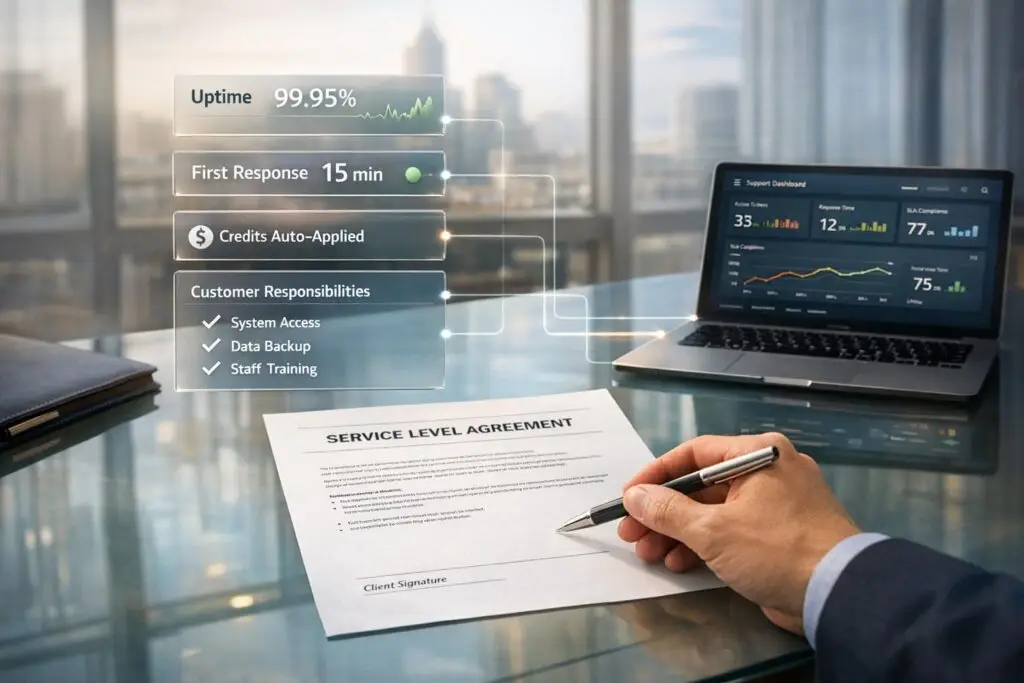
In B2B customer support, Service Level Agreements (SLAs) are crucial for setting clear expectations and maintaining trust between vendors and customers. They provide measurable service commitments, define roles, and outline consequences for unmet goals. Without them, service relationships risk becoming ambiguous, leading to dissatisfaction and inefficiency.
Key points about SLAs:
- What They Are: Contracts specifying response times, resolution deadlines, and escalation processes.
- Why They Matter: Customers with positive experiences spend 140% more, and SLAs help formalize service quality.
- Common Mistakes: Vague terms, unrealistic targets, and lack of enforceable remedies.
- Modern Trends: AI tools now enable dynamic SLA management, real-time monitoring, and predictive analytics.
SLAs are no longer static documents – they are tools for driving measurable outcomes and improving customer satisfaction. By integrating AI technologies, vendors can streamline SLA creation, ensure compliance, and adjust to evolving customer needs.
Understanding Service Level Agreements (SLAs)
sbb-itb-e60d259
What to Include in a B2B SLA
A B2B SLA serves as a framework for accountability. Its success hinges on the details included and the clarity of its structure [4]. Each clause should have a specific function: setting expectations, assigning roles, or outlining consequences for unmet commitments.
Key SLA Clauses
Start by defining severity and priority levels. Not all issues carry the same weight. For instance, a full system outage (Severity 1) demands immediate action, while a minor interface glitch (Severity 4) can be addressed later. Establishing these distinctions ensures critical issues are prioritized without overextending your team [4].
Next, specify service level metrics such as response times, resolution times, and availability goals. For example, a 99.9% monthly uptime target ("three nines") translates to about 43.8 minutes of downtime per month. Raising that to 99.99% ("four nines") allows for just 4.4 minutes. These targets directly affect resource allocation and infrastructure planning [4].
Service credits and financial penalties hold providers accountable. These clauses outline the compensation (often capped at a percentage of fees) for failing to meet SLA targets. While they don’t cover all potential business losses from outages, they incentivize consistent performance [4].
Include exclusions and carve-outs to limit liability for events beyond your control, such as scheduled maintenance, customer-related issues, or third-party failures. Clearly state that maintenance will occur during low-traffic times and provide advance notice to avoid penalties for planned downtime [4][5].
Define measurement methodology and reporting to ensure transparency. Specify how performance will be tracked and how often customers will receive updates. Using independent monitoring tools can provide unbiased data, helping to avoid disputes or "metric gaming" that obscures brief service lapses [4].
Don’t forget customer responsibilities. Customers must provide necessary data, timely notifications, and access to their systems to help you meet your obligations [6]. Additionally, include termination rights for persistent failures, allowing customers to exit the agreement if SLA targets are consistently missed over a defined period [4][6].
"The architecture of an effective SLA rests on three pillars: metrics that are measurable, meaningful, and within the provider’s control; measurement methodology that is objective, transparent, and not manipulable by the provider; and remedies that create genuine incentive for performance." – Contracta HQ [4]
Each of these clauses addresses specific challenges in managing B2B support with customer service software for B2B SaaS.
Addressing B2B Operational Challenges
SLA clauses do more than set expectations – they actively resolve common B2B support hurdles. For example, severity definitions ensure resources are allocated effectively, avoiding conflicts over priorities [4].
Escalation paths are critical for complex issues, ensuring they quickly reach the right technical experts. In B2B environments, resolving a ticket might involve legal, engineering, or product teams. Without clear escalation procedures, problems can stall as teams debate responsibilities [4].
Service credits create financial accountability, even though they may not fully compensate for lost revenue or reputational damage [4].
Exclusions protect providers from being held responsible for factors outside their control, such as customer-side network failures or third-party API issues. Defining these limits helps maintain fairness and avoid disputes [4].
Finally, measurement methodology prevents the "Watermelon Effect", where technical metrics appear fine ("green") while the customer experience suffers ("red"). By focusing on metrics tied to actual business outcomes, your SLA ensures the service aligns with what customers value most [3].
Table: SLA Clauses and Their Impact
| SLA Clause | Impact | Risk Level | Implementation Difficulty |
|---|---|---|---|
| Service Level Metrics | High: Directly impacts team workload and speed. | High: Failure results in financial penalties. | Medium: Requires tracking tools. |
| Severity Definitions | High: Key for prioritizing resources effectively. | Medium: Risk of "severity inflation." | Low: Needs documentation/training. |
| Service Credits | Medium: Financial accountability for underperformance. | High: Missed targets can result in revenue loss. | Medium: Requires clear formulas. |
| Escalation Paths | High: Ensures prompt resolution of complex issues. | Medium: Poorly defined paths can cause delays. | Low: Needs an internal org chart. |
| Exclusions | Low: Relevant only during disputes or maintenance. | High: Poor definitions can create liabilities. | Medium: Needs legal/technical input. |
| Reporting Requirements | Medium: Builds trust through transparency. | Low: Primarily administrative. | Medium: Can be automated. |
How to Define and Track Service Metrics
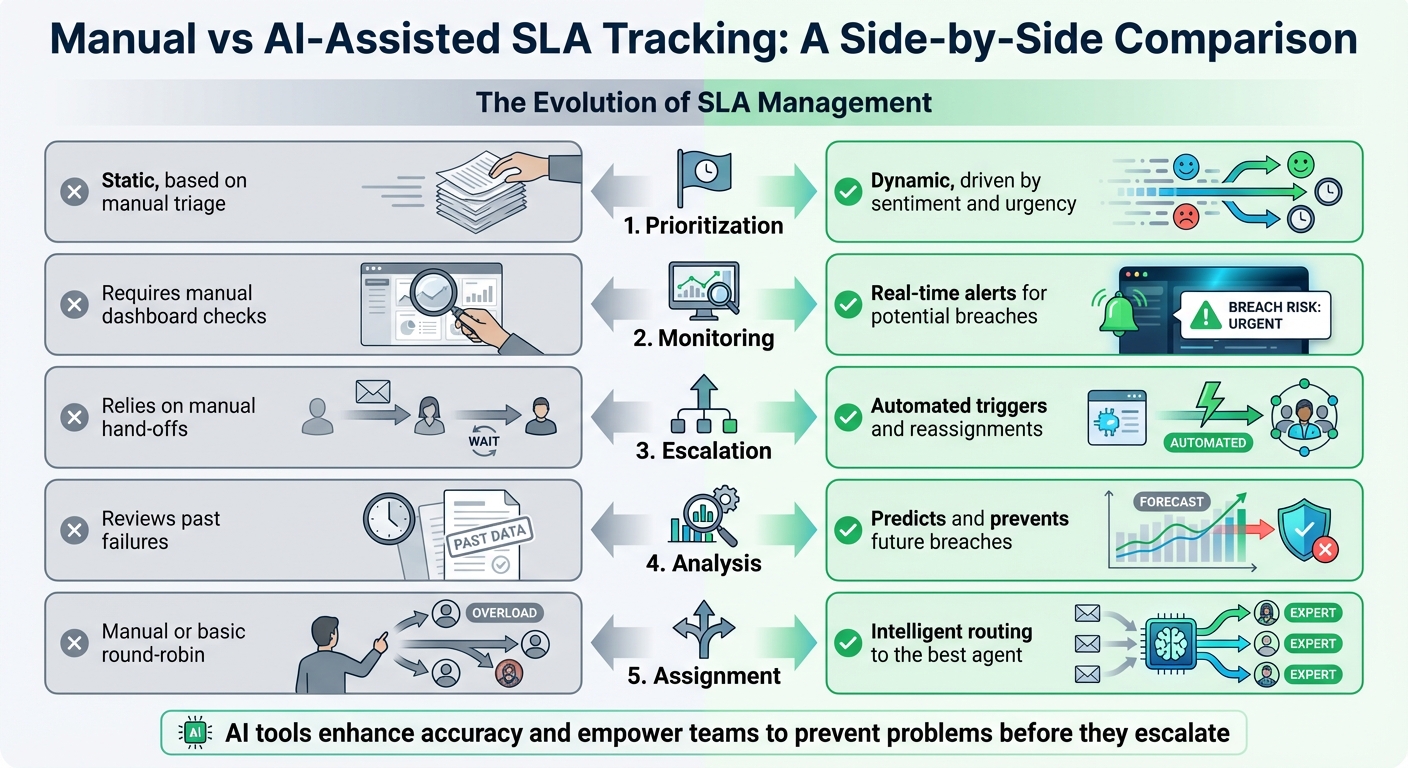
Manual vs AI-Assisted SLA Management Comparison
Defining service metrics begins with understanding what matters most to your customers. Focus on KPIs that directly impact their experience. For example, metrics like First Response Time (how quickly you acknowledge a request), Resolution Time (how long it takes to fully resolve an issue), First-Contact Resolution Rate (how often issues are fixed without reopening), and Uptime (system availability) are essential [2][7]. These metrics address the biggest challenges in B2B support: reducing customer stress, ensuring operational reliability, and maintaining service quality. They also provide a foundation for setting measurable goals and using AI tools for real-time tracking.
Core Metrics for B2B SLAs
Each metric serves a specific purpose in enhancing the customer experience:
- First Response Time: Sets the stage for a positive interaction. Customers need reassurance that their issue is acknowledged, even if it can’t be resolved immediately.
- Resolution Time: Helps customers plan by providing a clear timeline for fixes.
- Escalation Rate: Tracks how often tickets require higher-level support, pointing to potential gaps in agent training or documentation [2].
- First-Contact Resolution: Aims to keep ticket reopen rates below 3%, a benchmark for efficient service in complex environments [2].
AI tools can also monitor Customer Satisfaction (CSAT) and Customer Effort Score (CES) through sentiment analysis, offering insights into customer emotions [7].
Setting Achievable Metric Targets
To set realistic targets, start by categorizing issues based on their urgency and business impact. For example, critical system outages might require a 30-minute response time and a 2-hour resolution, while less urgent requests could allow for a 2-hour response and resolution within one business day [2]. Historical data, team capacity, and the complexity of your product should guide these benchmarks.
"SLAs aren’t static. Reassess them quarterly to make sure targets are still relevant and achievable." – Nooshin Alibhai, Founder and CEO, Supportbench [2]
Although these targets are initially set manually, AI tools simplify ongoing monitoring and adjustments.
Using AI to Track Metrics
Manual tracking methods like spreadsheets or periodic dashboards often delay issue detection. AI-powered platforms such as Supportbench provide a more efficient alternative by automating tasks like ticket classification, prioritization, and real-time monitoring [7]. For instance, early warning alerts notify team leads when a ticket approaches 50% or 75% of its SLA limit, enabling proactive intervention [2]. Sentiment analysis can escalate tickets automatically based on customer frustration levels, ensuring urgent issues get immediate attention [7]. Additionally, AI systems analyze the root causes of SLA breaches and suggest improvements [2][7].
| Feature | Manual SLA Tracking | AI-Assisted SLA Tracking |
|---|---|---|
| Prioritization | Static, based on manual triage. | Dynamic, driven by sentiment and urgency. |
| Monitoring | Requires manual dashboard checks. | Real-time alerts for potential breaches. |
| Escalation | Relies on manual hand-offs. | Automated triggers and reassignments. |
| Analysis | Reviews past failures. | Predicts and prevents future breaches. |
| Assignment | Manual or basic round-robin. | Intelligent routing to the best agent. |
AI tools not only enhance the accuracy of SLA tracking but also empower teams to prevent problems before they escalate, making them a game-changer in customer support.
How to Draft and Negotiate an SLA
Creating an SLA that works is all about balancing what your customers expect with what your team can realistically deliver. This process relies on a three-layer system that keeps internal goals separate from external promises. Here’s the breakdown: Service Level Indicators (SLIs) are the actual metrics you track, Service Level Objectives (SLOs) are your internal targets with some buffer built in, and the Service Level Agreement (SLA) is the formal contract you share with customers [3]. This structure helps avoid overpromising while setting the stage for clear drafting and successful negotiation.
Step-by-Step SLA Drafting Process
Start by defining the scope clearly, and don’t forget to include what’s not covered. Replace vague terms like "quickly" with specific timeframes, such as "within four business hours" [9]. Metrics should be SMART – Specific, Measurable, Achievable, Relevant, and Time-bound. Focus on outcomes that matter to your customers, like measuring transaction success rates instead of internal metrics [8].
Choose independent monitoring tools that provide objective data and minimize the chance of gaming the system [4]. Be clear about what qualifies as downtime – does it include slow performance, or only complete outages? For example, a 99.9% uptime target allows for about 43.8 minutes of downtime per month, so define these terms carefully [4].
Include remedies that encourage accountability. Service credits should have real weight – after all, "an SLA without enforceable remedies is just a wish list dressed up as a contract", as ContractaHQ puts it [4]. Limit financial liability to a reasonable percentage of monthly fees to avoid outsized penalties for a single issue. Also, add clauses that let customers exit without penalty if you repeatedly fail to meet targets [4]. Finally, have a legal team review liability and indemnification clauses to ensure your promises align with what your team can deliver [8][6].
Negotiating SLA Terms with Customers
When negotiating SLAs, especially in B2B settings, you’re often dealing with multiple stakeholders who have different priorities. Being upfront about your operational limits can build trust. Clearly define service tiers and exclusions, as these details directly impact your day-to-day operations. Offer tiered levels of service – like Tier 1 for critical systems and Tier 3 for less essential ones – so customers pay for what they truly need [4].
Exclusions are just as important. Protect yourself by specifying what’s outside your control, such as scheduled maintenance, customer-caused outages, or issues with third-party services. This ensures you maintain cost-efficiency without sacrificing quality.
Shift the focus from penalties to performance incentives during negotiations [8]. This approach fosters collaboration rather than conflict. Schedule quarterly reviews to adjust targets based on factors like ticket volumes or team capacity [8]. If a customer insists on aggressive targets – like 99.999% uptime, which allows only 26 seconds of downtime per month – use historical data to show why a 99.9% target might be more realistic and cost-effective [4].
Table: Manual vs. AI-Assisted SLA Creation
| Feature | Manual SLA Creation | AI-Assisted SLA Creation |
|---|---|---|
| Speed | Slow; requires multiple meetings and manual drafting [8] | Fast; generates or analyzes drafts in under 60 seconds [8] |
| Accuracy | Prone to ambiguous language and metric gaming [4] | Identifies red flags and ensures quantified thresholds [4] |
| Resource Requirement | High; involves legal, IT, and management hours [3] | Low; uses AI negotiators and pre-trained benchmarks [6] |
| Benchmarking | Limited to internal historical data [3] | Uses industry-wide pricing and performance benchmarks [6] |
| Scalability | Hard to manage unique needs for many clients [3] | Automated rules apply across diverse customer bases [3] |
AI tools like Supportbench simplify the entire SLA process. They can generate custom legal documents from plain language, spot risks in draft clauses, and provide real-time pricing benchmarks during negotiations [8][6]. These tools not only make drafting faster and more accurate but also streamline ongoing SLA monitoring and updates. This allows your legal and technical teams to focus on higher-priority work while ensuring SLAs are enforceable and aligned with industry norms. By following this framework, you set the stage for smooth, AI-driven SLA management in your daily operations.
Implementing and Monitoring SLAs with AI
After finalizing an SLA, the real challenge begins: executing it effectively on a daily basis. The difference between a well-drafted SLA and actual compliance often lies in how you track, monitor, and adjust your service delivery. AI platforms like Supportbench turn SLAs from static agreements into dynamic tools, cutting down on the manual effort traditionally required for SLA management.
Making SLAs Work in Daily Operations
To maintain consistent compliance, start by setting up SLA timers based on agreed terms and integrating SLA policies into tools like Salesforce or JIRA. Platforms like Supportbench allow you to create workflows that automatically adjust SLA parameters in response to real-world conditions – like tighter response times during renewal periods.
It’s also critical that agents understand SLA goals, ticket classifications, and routing processes. AI-powered ticket routing can streamline this by assigning cases based on license types or ticket attributes, helping to avoid delays from the start. When SLA policies are connected to your CRM or project management tools, everyone on the team gains visibility into compliance status. This operational setup ensures that advanced AI tracking can effectively manage SLA performance in a proactive way.
AI-Driven SLA Tracking and Automation
Live dashboards make it easy to monitor key metrics like wait times, potential breaches, and escalated tickets. These tools allow managers to track compliance without spending hours on manual oversight. Automated alerts can flag impending SLA breaches, giving teams the chance to act before deadlines are missed.
AI takes this a step further by dynamically adjusting SLA priorities. For instance, sentiment analysis can detect frustration in a customer’s tone and automatically escalate the ticket’s priority, ensuring urgent cases get immediate attention. Accountability is reinforced through performance scorecards that track metrics like escalation handling, CSAT, and QA, helping identify areas that need improvement – whether it’s specific agents or workflows.
Updating SLAs Based on Performance
Real-time monitoring is just the beginning. Continuous improvement requires regular reviews of SLA performance, guided by AI-driven insights. Quarterly assessments can help you reevaluate targets, taking into account team capacity, ticket volumes, and customer feedback. AI-generated reports can uncover trends in escalations or breaches, helping you address root causes. Predictive analytics even allow you to anticipate SLA risks based on historical data, giving you the chance to make adjustments before issues arise.
"SLAs are operational – not just theoretical. They are tied directly to ticket properties and enforced automatically through Supportbench’s workflow engine." – Supportbench [2]
If you notice recurring issues – like missed resolution times for a particular product line – use the data to renegotiate terms during contract renewals or refine internal processes. Insights from metrics like CSAT, CES, and QA offer a comprehensive view of whether your SLA targets align with customer expectations. By leveraging this data, your SLAs can adapt as your business and customer needs evolve, ensuring service delivery remains practical and competitive.
Common Mistakes and SLA Template
This section builds on the earlier discussion of AI-enhanced SLA tracking by identifying common mistakes in SLA drafting and offering a clear template to align expectations with real-world operations.
SLA Mistakes to Avoid
When drafting SLAs, B2B vendors often make predictable errors. One of the biggest issues is vague language – phrases like "high availability" or "fast response" sound good but lack measurable thresholds, leading to confusion and accountability issues [4].
Another common problem is the "Watermelon Effect". This happens when technical metrics look great on paper (green on the outside) but fail to reflect the customer’s actual experience (red on the inside). For example, a vendor might focus on server uptime while ignoring delays in issue resolution or poor communication. This mismatch can lead to unmet business outcomes despite seemingly strong metrics [3].
Metric gaming is another pitfall, though less frequent. This occurs when providers manipulate how metrics are calculated or exclude certain scenarios to meet SLA requirements without improving service quality. For instance, calculating uptime annually can disguise severe monthly outages [4]. Similarly, SLAs that lack enforceable remedies fail to motivate real improvement.
"An SLA without enforceable remedies is just a wish list dressed up as a contract." – ContractaHQ [4]
Service credits, if capped too low, also fail to incentivize better performance. Another issue is relying solely on provider-side monitoring, which can lead to biased reporting. Overly broad exclusions or unrealistic targets can also render SLAs ineffective. For example, high-performing support teams often aim for 90% of tickets to meet SLA response windows, with fewer than 3% reopened due to unresolved issues [2].
To avoid these pitfalls, the following SLA template provides a clear framework.
B2B SLA Template
A practical SLA for B2B customer support should include the following sections:
- Agreement Overview: Define the parties involved, the start date, and the scope of services. Specify which products, service tiers, or customer segments the SLA covers.
- Service Definitions: Clearly explain terms like "business hours", "downtime", and "critical issue." For instance, clarify whether "downtime" includes performance slowdowns or just complete outages [4].
- Performance Metrics: Use measurable benchmarks like uptime (e.g., 99.9% monthly uptime allows for about 43.8 minutes of downtime), First Response Time (FRT), Mean Time to Resolve (MTTR), and CSAT scores. Metrics should follow SMART criteria [3].
- Service Tiers: Categorize issues by severity (e.g., Critical, High, Medium, Low) and assign appropriate response and resolution times. For mission-critical issues, stricter standards should apply [4].
- Remedies & Credits: Include a table for calculating service credits based on the severity of SLA breaches. For example, uptime below 99.0% might result in a 10% credit [5].
- Monitoring & Reporting: Define how metrics will be tracked, who is responsible, and how often performance reports will be shared. Independent or customer-side monitoring can help ensure transparency [4][3].
- Exclusions: Clearly state situations where the SLA doesn’t apply, such as scheduled maintenance, customer-caused issues, or third-party failures [4][3].
- Review & Termination: Set a regular review schedule (e.g., quarterly) and outline termination conditions, such as repeated SLA breaches over consecutive periods [9][4][2].
Table: Common Pitfalls and AI Solutions
AI tools can help address these challenges effectively:
| Common Pitfall | Likelihood | Impact | AI/Automation Mitigation Strategy |
|---|---|---|---|
| Vague Definitions | High | High | Use AI-driven templates to standardize specific, time-based metrics [3]. |
| Unrealistic Targets | Medium | High | Leverage AI to set realistic, data-backed targets using historical data [9]. |
| Delayed Escalation | High | Medium | Automate alerts and countdowns to notify managers before deadlines [2]. |
| Static Documents | High | Low | Use AI dashboards for real-time tracking and automated SLA reviews [2]. |
| Metric Gaming | Low | High | Apply independent, automated monitoring for unbiased performance data [4]. |
| Manual Tracking Errors | High | Medium | Automate SLA timers and dashboards to reduce human errors [2]. |
Supportbench offers solutions to many of these problems with features like automated SLA timers, dynamic adjustments based on ticket details, and real-time dashboards. By combining precise definitions with intelligent automation, vendors can create SLAs that are fair, transparent, and effective in driving better service outcomes.
Conclusion: Building SLAs That Work for Modern B2B Support
In this guide, we’ve explored how to design, monitor, and refine SLAs to tackle the challenges of modern B2B support. A well-structured SLA is more than just a contract – it’s a tool that fosters trust, minimizes customer effort, and sets your brand apart. Research from Accenture highlights this shift, showing that treating customer service as a value driver rather than a cost center can potentially triple revenue growth [10]. Companies that prioritize exceptional customer experiences often see significant revenue increases [1].
Modern SLAs are moving away from reactive approaches to embrace proactive, AI-driven strategies. Instead of focusing solely on speed, today’s SLAs prioritize delivering accurate, tailored solutions that align with customer needs. This reinforces the importance of tying service delivery to measurable outcomes, as discussed earlier.
"Promises don’t scale, but service level agreements (SLAs) do." – G2 [9]
Dynamic SLAs that adapt in real time – based on factors like customer value, account health, and request complexity – are becoming essential. Regular quarterly reviews help ensure your SLAs remain aligned with changing customer expectations and operational capabilities.
Integrating AI into SLA management allows businesses to track every interaction, automate repetitive tasks, and free up agents to focus on building stronger customer relationships. For example, Zoom’s AI-first self-service solution, launched in January 2026, achieved a 97% success rate in resolving inquiries through self-service [10]. This demonstrates the readiness and effectiveness of AI-driven solutions in modern SLA frameworks.
Think of your SLA as a dynamic, evolving document – one that grows alongside your customers’ goals and your operational capabilities. By embracing this approach, you can ensure your SLAs remain relevant and impactful in today’s fast-changing business landscape.
FAQs
How do I choose SLA targets that are ambitious but realistic?
To improve your service level agreements (SLAs), start by diving into historical data and collecting customer feedback. This helps you pinpoint critical metrics such as response times and resolution rates. From there, set SMART goals – targets that are Specific, Measurable, Achievable, Relevant, and Time-bound. These goals should push your team to excel without setting unrealistic expectations.
Leverage AI tools to keep an eye on performance and anticipate potential issues before they escalate. Test your SLAs within your organization first, gathering input from your team to make necessary adjustments. Strive for a balance between ambitious goals and realistic commitments to foster trust and ensure your team’s success.
What’s the difference between SLIs, SLOs, and an SLA?
The difference between these terms comes down to their specific roles in managing service performance:
- SLIs (Service Level Indicators): These are metrics used to track and measure how a service performs, such as response time or uptime. Think of them as the raw data that tells you how things are going.
- SLOs (Service Level Objectives): These are the internal performance goals set for a service, based on SLIs. For example, you might aim for 99.9% uptime as your target.
- SLAs (Service Level Agreements): These are formal agreements made with customers, outlining the performance levels they can expect. SLAs are often built around SLOs and rely on SLIs to verify compliance.
How can AI help prevent SLA breaches before they happen?
AI plays a key role in preventing SLA breaches by enabling proactive support through smarter tools like dynamic SLAs and predictive analytics. Dynamic SLAs adapt in real-time, tailoring metrics such as response times based on factors like customer tier, sentiment, or the complexity of an issue. Meanwhile, predictive analytics uses historical data to forecast potential breaches before they occur.
On top of that, real-time monitoring tools keep teams informed about potential risks, triggering alerts that allow for quick action. This kind of anticipatory approach not only boosts reliability but also aligns with modern strategies aimed at balancing efficiency and cost-effectiveness in support operations.