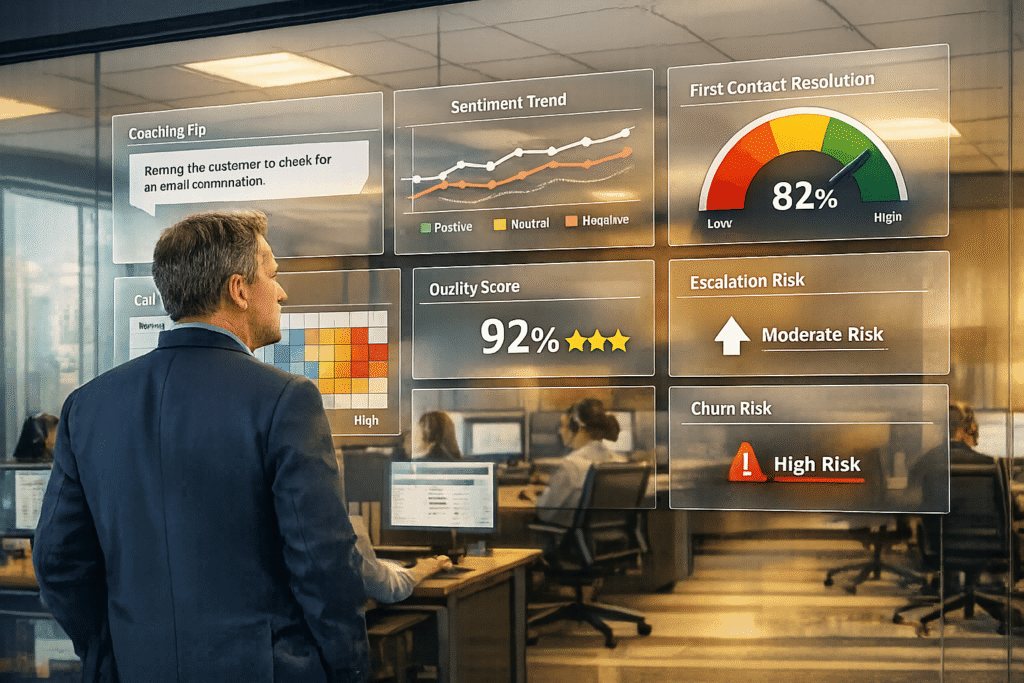
Many support teams struggle with outdated, manual QA systems that review only a fraction of customer interactions. These methods often lead to delayed feedback, inconsistent evaluations, and missed opportunities to improve agent performance. AI-powered tools are changing the game by analyzing 100% of interactions, delivering real-time insights, and linking agent behaviors to business outcomes. Here’s a quick look at the top tools reshaping support agent tracking:
- Supportbench AI Predictive CSAT and CES: Predicts customer satisfaction and effort scores in real time to flag churn risks early.
- Supportbench AI First Contact Resolution Detection: Analyzes ticket histories to ensure true resolution, not just quick closures.
- Convin Agent Assist: Provides real-time coaching during live interactions to address skill gaps immediately.
- Cresta Real-Time Agent Assist: Tracks agent behaviors live and links them to business outcomes for better coaching.
- Observe.AI Auto QA Engine: Automates QA by evaluating 100% of interactions across all channels.
- Zia AI Assistant: Offers real-time sentiment analysis and tracks emotional shifts during interactions.
- Convin Supervisor Assist: Simplifies team management with centralized dashboards and automated QA.
These tools help support teams move from reactive to proactive performance management, improving agent skills and reducing churn. They save time, eliminate scorer bias, and ensure consistent quality across every interaction.

Top 7 AI Tools for Support Agent Performance Tracking – Features Comparison
1. Supportbench AI Predictive CSAT and CES
Most support teams rely on survey responses to understand customer sentiment, but by the time those results come in, negative impressions may have already taken root – potentially leading to churn.
Supportbench’s AI Predictive CSAT and CES changes the game by analyzing every case in real time, predicting satisfaction and effort scores before surveys are even completed [2]. This system examines ticket content for essential quality indicators like empathy, accuracy, tone, and effectiveness. It flags interactions that show signs of churn risk or potential escalation [2]. Managers are alerted through visual dashboards, offering early warnings as issues arise.
"Know how difficult a case was, what the sentiment is, and whether it could lead to churn – all before they fill out a survey." – Supportbench [2]
This feature is fully integrated into the platform, eliminating the need for third-party tools, manual quality checks, or constant switching between tabs [2]. It also provides detailed case summaries and tracks sentiment changes during lengthy B2B interactions, giving managers a clear, real-time view of predicted scores. For high-value accounts approaching renewal, predictive scoring acts as an early warning system, flagging declining sentiment or recurring issues before they harm the customer relationship [3].
The system doesn’t just help managers – it also supports agents. Continuous feedback is tied directly to customer outcomes, allowing agents to improve without the burden of traditional quality assurance processes. At the same time, managers gain deeper insights into performance gaps, all without adding extra administrative work.
2. Supportbench AI First Contact Resolution Detection
Figuring out if an issue was truly resolved on the first contact can be tricky, especially in B2B environments. Just because a ticket is marked as closed doesn’t always mean the customer is satisfied. Tickets can be reopened, escalated, or require additional follow-ups, making it hard to rely on closure status alone.
Supportbench’s AI First Contact Resolution Detection tackles this problem by diving deep into case histories and interactions. Instead of assuming a closed ticket equals success, the AI examines the actual content of the ticket. It looks at whether the solution provided was accurate and effective. The system considers key factors like priority, topic, customer value, and even the emotional tone of interactions. Using sentiment analysis, it can pick up on unresolved frustration – something a closed ticket might not reveal. By combining this with the entire case history and knowledge base, the AI ensures that the solution provided matches what has worked successfully in the past for similar issues. This approach provides a much clearer picture of whether the issue was genuinely resolved on the first try. [2]
"A multinational design and marketing firm discovered that 30% of refunds were unwarranted. Using AI to monitor and train on resolution protocols saved over $30 million in one year and boosted customer satisfaction by 47%." [5]
This level of insight is a game-changer for B2B teams. Agents sometimes aim for quick closures or offer refunds to calm things down, rather than addressing the root of the problem. Supportbench’s AI helps identify these patterns, ensuring that true problem solvers are recognized and rewarded.
The results feed directly into KPI scorecards, breaking down performance by agent, team, or issue type. Managers can see who’s actually resolving problems and who’s just closing tickets quickly. This allows for coaching that focuses on improving resolution quality, rather than just chasing agent performance metrics like ticket count or response speed. [2]
3. Convin Agent Assist
B2B support often highlights a disconnect between what customers need and the skills agents bring to the table. Traditional coaching methods rely on delayed reviews of past interactions, which means valuable opportunities for immediate improvement are missed. Convin Agent Assist changes the game by analyzing conversations in real time, identifying skill gaps as they emerge, and enabling continuous development on the spot.
This system processes live customer interactions, detecting intent and emotions like frustration [5][6]. It provides agents with contextual guidance and tailored response suggestions, helping them navigate tricky situations without simply feeding them scripted replies. The goal? To empower agents to handle new or challenging scenarios with confidence and adaptability.
What sets this tool apart is its ability to intervene in real time. It flags moments where agents might be struggling, missing key cues, or even excelling. Instead of combing through endless call recordings or ticket logs, support leaders can focus on specific conversation snippets that highlight areas for improvement. This targeted approach makes coaching efforts far more effective.
In the high-pressure world of B2B support, static scorecards often miss the nuances of customer interactions. For instance, an agent might resolve tickets quickly but fail to address underlying customer concerns – showing technical expertise but falling short on empathy. Convin Agent Assist bridges this gap by integrating AI for customer service into daily workflows, moving quality assurance from a reactive process to a proactive strategy for developing well-rounded agents.
4. Cresta Real-Time Agent Assist

Evaluating agent performance in B2B support goes far beyond tallying ticket counts or calculating average handle times. Cresta Real-Time Agent Assist uses generative AI to analyze 100% of live conversations in real time, offering a detailed look at agent behavior as it unfolds [7][1]. Unlike traditional methods that rely on random sampling or delayed reviews, Cresta ensures immediate and comprehensive oversight across every interaction and communication channel.
What sets Cresta apart is its Outcome AI feature, which links agent actions directly to business outcomes [7][1]. This isn’t about tracking superficial metrics like talk time or flagging specific keywords. Instead, it pinpoints which behaviors drive successful resolutions and highlights actions that may create unnecessary friction. This approach allows support leaders to move away from subjective assessments, focusing instead on clear, evidence-based performance patterns that are tied to actual customer results.
Cresta’s behavioral scoring dives deeper than standard metrics, using generative AI to uncover insights that static scorecards simply can’t provide [1]. When managing complex B2B cases – often involving multiple stakeholders and strict service-level agreements (SLAs) – Cresta evaluates how agents steer conversations, apply effective strategies, and influence customer responses. This comprehensive view of agent behavior lays the groundwork for measurable and meaningful quality improvements.
The results speak for themselves. Oportun, for example, implemented Cresta’s automated quality management system and transitioned from random sampling to full QA coverage. This shift reduced their QA team’s workload by 50% [1].
"With Cresta, we’re able to see if agents are executing the behaviors we know drive success, which is allowing us to coach more effectively and drive improved results. It’s extremely valuable to our business success."
– Associate Vice President, Collections, A Fortune 500 Bank [7]
Snap Finance also highlighted the platform’s ability to provide a fairer evaluation process. Adam Christensen, VP of Resource Management, shared:
"It allows the agent to breathe knowing that they’re not going to be held accountable for one subpar call. We can take their full portfolio of work into account."
– Adam Christensen, VP of Resource Management, Snap Finance [1]
sbb-itb-e60d259
5. Observe.AI Auto QA Engine
In traditional B2B support, quality assurance typically reviews only about 1-2% of interactions. This leaves support leaders making decisions based on a tiny sample of data. Observe.AI’s Auto QA Engine changes the game by leveraging AI technologies to analyze 100% of customer interactions – whether they happen over voice, email, or chat.
The engine evaluates every conversation using standardized rubrics that measure key factors like empathy, tone, accuracy, and alignment with the brand. This includes analyzing sentiments to ensure responses match customer emotions. This approach ensures evaluations are both consistent and unbiased.
For B2B support teams managing complex cases involving multiple stakeholders, this complete analysis reveals critical trends, uncovers skill gaps, and highlights coaching opportunities that random sampling would likely overlook. By automating the review process, teams can shift their attention from time-consuming manual checks to more strategic coaching sessions guided by AI-driven insights. This deeper understanding enables support leaders to address performance issues and refine skills in real time.
6. Zia AI Assistant

Zia takes customer interactions to the next level with real-time sentiment analysis, assessing the emotional tone of conversations and categorizing them as positive, neutral, or negative. It doesn’t stop there – Zia tracks sentiment shifts throughout the lifecycle of a ticket, offering a dynamic view of how interactions evolve.
In the intricate world of B2B environments, where multiple touchpoints are the norm, Zia’s Sentiment Trend tracking stands out. It helps uncover whether agents are successfully turning a frustrated customer’s mood around or if things are heading south. This makes it easier to identify areas where agents might need additional coaching. But Zia isn’t just about scoring sentiment. It also evaluates interaction quality by picking up on signals like thank-you messages or signs of frustration. These nuanced insights provide supervisors with a richer understanding of agent performance compared to traditional metrics.
Zia also uses anomaly detection to catch sudden spikes in negative sentiment. This feature ensures supervisors can act quickly, offering timely coaching based on real performance shifts rather than waiting for issues to escalate.
7. Convin Supervisor Assist
Convin Supervisor Assist takes real-time insights to the next level, focusing specifically on helping leaders manage their teams effectively. Supervising large support teams often means being buried in data, but this tool simplifies the process by analyzing 100% of customer interactions – calls, chats, and emails. This creates a complete picture of how the team is performing.
The platform doesn’t just stop at data collection; it organizes the information into centralized dashboards. These dashboards make it easy for supervisors to spot areas where agents may be struggling, such as showing empathy or following processes. With this clarity, coaching becomes more targeted and impactful. Plus, the tool uses pattern recognition to highlight areas where improvement is needed, offering actionable, data-driven suggestions.
What sets Convin apart is its ability to identify winning strategies. By analyzing the habits of top-performing agents, the system flags specific phrases, workflows, or behaviors that consistently lead to better outcomes. These insights allow other team members to adopt proven techniques, leveling up high-performing support team performance.
Convin Supervisor Assist also automates quality assurance, saving time and eliminating the need for manual evaluations. Agents receive feedback based on real performance metrics rather than subjective opinions, ensuring evaluations are fair and consistent. This automation keeps quality high without adding extra administrative burdens.
For B2B teams, this tool reduces management complexity while uncovering what truly drives customer satisfaction and improves resolution rates. It’s a practical solution for supervisors looking to streamline their workflow and elevate team performance.
Conclusion
AI-powered competency tracking is transforming how B2B support teams operate. Instead of waiting days – or even weeks – for feedback, agents now get real-time, objective insights from every interaction. This eliminates the delays that often slowed coaching and skill development in the past.
The tools discussed in this article tackle the real challenges faced by support leaders. They help pinpoint skill gaps before they lead to bigger problems, maintain consistent quality by choosing the right customer support software for complex B2B cases, and ensure SLAs are met – all without the need for constant micromanagement. By analyzing factors like sentiment, resolution quality, and escalation trends, these platforms create continuous feedback loops that empower agents to improve while reducing the administrative workload for supervisors.
Rather than replacing human judgment, these tools enhance it. AI takes care of data collection and scoring, allowing managers to dedicate their time to meaningful mentorship and strategic coaching.
Companies adopting AI-driven quality assurance have seen impressive results, including a 50% reduction in QA workload [1]. Support teams using real-time AI tools report saving 45% of time on calls and resolving issues 44% faster [4]. These gains come from streamlined workflows and better insights into customer needs – all achieved without expanding teams or adding extra layers of oversight.
FAQs
How can AI tools help improve support agent performance and competency?
AI tools are reshaping how support teams evaluate and enhance agent performance by analyzing every customer interaction as it happens. Instead of relying on manual reviews or outdated scorecards, these tools assess critical factors like the quality of case resolution, customer sentiment, SLA compliance, and escalation trends. This allows teams to pinpoint skill gaps and identify coaching opportunities early, boosting both individual and team effectiveness.
These tools also offer real-time support, guiding agents with next-best action recommendations, surfacing relevant knowledge, and ensuring responses maintain a consistent tone and quality. On top of that, AI-driven insights help managers track performance trends, spot potential red flags like churn risks, and provide focused coaching – all while cutting down on overhead and ensuring evaluations are fair and actionable.
By integrating competency tracking into daily workflows, AI tools go beyond measuring ticket volume to provide a clearer picture of agent effectiveness. This approach not only improves performance but also helps keep operations scalable and cost-effective.
What are the advantages of using real-time sentiment analysis in customer support?
Real-time sentiment analysis helps support teams gauge customer emotions during interactions by analyzing the tone of their messages. It identifies sentiments – positive, negative, or neutral – as they occur, allowing managers to spot frustration early, step in when needed, or provide live coaching to agents. This also empowers agents to adjust their responses in real time, aligning with the customer’s mood to deliver a more empathetic and tailored experience. The result? Fewer escalations and improved resolution rates.
Beyond individual interactions, sentiment data can be compiled to uncover trends across products, regions, or customer groups. This gives leaders actionable insights to refine processes, address potential issues proactively, and make quicker decisions. By linking sentiment data to metrics like CSAT, NPS, and churn, teams can identify at-risk accounts and implement strategies to boost customer satisfaction and retention. Essentially, real-time sentiment analysis converts emotional feedback into valuable insights, enhancing agent performance and driving better outcomes for the business.
How does AI accurately measure first contact resolution?
AI takes a comprehensive look at every customer interaction, examining factors like case outcomes, customer sentiment, quality of the resolution, and escalation trends. This allows it to assess whether an issue was genuinely resolved during the first contact. Unlike traditional metrics that often focus on superficial measures like fast ticket closures, AI digs deeper, analyzing meaningful signals from actual support efforts.
By doing so, it ensures customers receive the help they need the first time, boosting satisfaction and cutting down on repeat inquiries.