Setting clear expectations with customers is key to avoiding frustration and building trust. Miscommunication, vague promises, or delayed updates can lead to dissatisfaction, especially in B2B relationships. Here’s how you can manage expectations effectively:
- Define scope early: Lay out what’s included and what isn’t to avoid misunderstandings. Use collaborative language to set boundaries without shutting customers down.
- Communicate timelines clearly: Replace vague promises like "soon" with specific deadlines, ensuring your team can meet or exceed them.
- Provide regular updates: Keep customers informed throughout the process, even if there’s no resolution yet. This reduces follow-ups and reassures them.
- Handle delays carefully: Reframe bad news by explaining the reasons and emphasizing the benefits of the updated timeline.
- Leverage AI tools: Use sentiment analysis, automated summaries, and predictive tools to identify at-risk customers and improve communication and maintain a consistent tone.
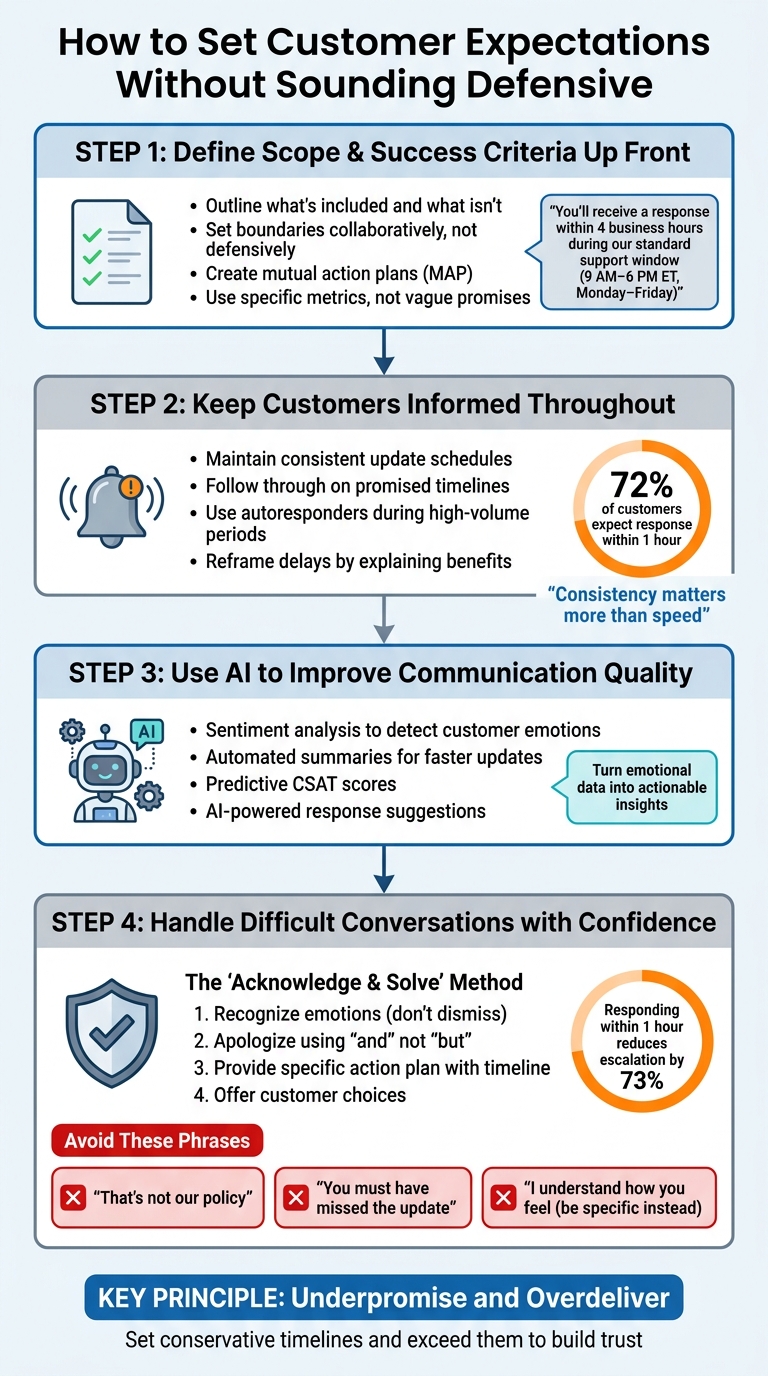
4-Step Framework for Setting Customer Expectations Without Sounding Defensive
Client Expectations Gone Wild? How to Tame the Beast
sbb-itb-e60d259
Step 1: Define Scope and Success Criteria Up Front
When it comes to clear communication, defining the scope and success criteria early on can save everyone from frustration later. These initial conversations set the tone for the entire interaction. By outlining what’s included – and what isn’t – you create a shared understanding from the start.
For instance, if a customer requests something beyond your product’s current capabilities, respond in a way that acknowledges their needs while offering an alternative solution. Here’s an example:
"You’ve asked about automated invoice generation, which isn’t part of your current plan. However, I can show you how to export your data for easy integration with your accounting software. Would that work for you?"
This approach ensures boundaries are set, but in a way that feels collaborative rather than dismissive.
Setting Boundaries That Feel Collaborative
Nobody likes hearing "no", but how you frame limitations can make all the difference. Instead of presenting them as rules or barriers, explain them as measures designed to benefit the customer. For example, strict policies around account ownership transfers exist for a reason – protecting sensitive data. Communicating this effectively might sound like:
"We require verification to ensure your account security."
Doesn’t that feel more cooperative than simply saying, "That’s our policy"?
Another great strategy is to create a mutual action plan (MAP). This involves assigning tasks to both parties, making the resolution process feel like a partnership. For example:
"Here’s what I’ll do: I’ll escalate this issue to our engineering team by 3:00 PM today. On your end, could you send me screenshots of the error and confirm your browser version? Once I have that, I’ll update you by the end of the day tomorrow."
This not only keeps the customer engaged but also speeds up the process by ensuring both sides are actively contributing.
Sample Phrases for Defining Success Metrics
Clear benchmarks are essential to avoid misunderstandings. Vague promises like "we’ll get back to you soon" leave too much room for interpretation, which can lead to disappointment. People tend to judge service quality based on their expectations, so setting measurable timelines is key.
Here are some practical examples of how to phrase success metrics:
- "You’ll receive a response within 4 business hours during our standard support window (9:00 AM–6:00 PM ET, Monday through Friday)."
- For troubleshooting: "Success here means identifying the root cause and providing three resolution options by Friday at 5:00 PM ET."
- For account changes: "We can process the account transfer once we verify ownership through the email on file. This typically takes 24–48 hours after receiving confirmation from both parties."
The trick is to underpromise and overdeliver. If you set a conservative timeline (like three days) and resolve the issue sooner, it creates a positive impression. On the flip side, missing an overly ambitious deadline – even by a small margin – can leave customers dissatisfied. Being transparent and realistic builds trust over time, far more than optimism ever could.
Step 2: Keep Customers Informed Throughout the Process
Setting clear expectations is just the beginning. Keeping customers updated throughout the process is just as important. Regular updates not only reassure customers but also help reduce unnecessary inquiries that can bog down your support team. The key is maintaining a consistent flow of communication.
Creating a Regular Update Schedule
When it comes to updates, consistency is more important than speed. For instance, studies reveal that 72% of people expect a brand to respond to a tweet within an hour[2]. But true satisfaction comes from setting clear expectations, not just quick replies. As Sarah Chambers, a Customer Support Consultant, puts it:
"If we don’t provide our customer reference points by setting customer expectations, customers will search out their own reference points."[2]
For issues that take longer to resolve, stick to a regular check-in schedule that matches the timeline you’ve shared. For example, if you’ve promised an update by Friday at 5:00 PM ET, make sure to follow through – even if the issue isn’t fully resolved yet. A simple progress report like this can go a long way: "As promised, here’s an update. Our team is actively working on the issue and testing potential fixes. We’ll have more definitive news for you soon."
During busy periods, autoresponders can help set expectations immediately. For instance: "Thanks for reaching out. We’re experiencing higher-than-usual volume and will respond within 3 to 4 business days. If your issue is urgent, reply with ‘URGENT,’ and we’ll prioritize it." This kind of proactive customer support reduces follow-ups and helps manage customer expectations during high-demand times[2].
Next, let’s look at how to address delays or changes without losing customer trust.
Reframing Bad News to Maintain Trust
When you need to deliver less-than-ideal news – like delays or changes – how you communicate makes all the difference. Instead of bluntly stating, "We missed the deadline", try reframing it: "The timeline has shifted because we discovered an additional compatibility issue that needs addressing. This added time ensures a robust fix that integrates seamlessly with your system, helping to prevent future disruptions."
This approach not only explains the delay but also emphasizes the benefit to the customer. Providing a clear reason – especially when tied to quality or long-term stability – makes policies feel more reasonable and less arbitrary[2]. And remember, underpromising while overdelivering is always better than the reverse. Even small gaps between what you promise and what you deliver can chip away at trust[2].
Step 3: Use AI to Improve Communication Quality
AI is reshaping communication by analyzing customer emotions and crafting clear, thoughtful responses. These tools help your team manage expectations effectively, reducing misunderstandings and fostering smoother interactions. By detecting emotional cues, summarizing complex interactions, and anticipating potential challenges, AI transforms how businesses handle customer communication.
Reading Customer Emotions with Sentiment Analysis
Sentiment analysis uses AI to interpret the emotions behind customer messages in real time. Whether a customer feels frustrated, confused, or satisfied, this technology helps your team respond appropriately. For example, AI can flag messages showing high frustration levels, prompting immediate attention or suggesting a more empathetic tone. It can also send automated alerts for negative sentiment in high-priority accounts, allowing managers to step in before minor issues grow into major problems. This is particularly valuable in B2B settings, where delicate relationships and technical challenges demand careful, emotionally aware responses [3].
By turning raw emotional data into actionable insights, sentiment analysis equips teams to communicate more effectively.
Automated Summaries for Faster, Clearer Updates
Long ticket histories can be overwhelming, but AI-driven summaries and KB article creation simplify the process. These tools condense interactions into concise, clear updates, making it easier for agents to manage tasks and for customers to stay informed. Effective summaries highlight key points upfront and use transitions like "However" or "This means" to ensure clarity. They also surface important details early, reducing the risk of losing critical information during case reviews.
Automated summaries are especially useful during case handovers between support tiers. They ensure no context is lost, saving customers from repeating themselves and helping agents pick up where their colleagues left off seamlessly [4].
How Supportbench AI Features Support Better Conversations

Incorporating AI tools like those offered by Supportbench can significantly enhance communication workflows. For example, its Predictive CSAT feature uses historical sentiment and interaction data to predict customer satisfaction levels before surveys are even sent. This allows teams to intervene early, addressing potential issues proactively. Meanwhile, the AI Agent-Copilot reviews case histories and knowledge bases to suggest relevant solutions, helping agents resolve issues more efficiently and confidently.
Supportbench also offers AI-powered auto-responses that craft replies based on case history and knowledge bases. These responses maintain a consistent and empathetic tone, ensuring smoother interactions. For knowledge management, the platform’s AI KB Article Creation feature turns problem-solving cases into well-organized knowledge base articles, complete with summaries and keywords. This reduces the chance of miscommunication while streamlining documentation efforts.
Additionally, training agents to check AI-detected sentiment scores before replying to challenging tickets ensures that responses are empathetic, not reactive. This approach lays the groundwork for more productive and positive conversations [3].
Step 4: Handle Difficult Conversations with Confidence
Handling tough conversations in B2B support requires a mix of empathy, structure, and quick action. Situations like missed deadlines, service outages, or billing errors can challenge trust, but they’re also opportunities to demonstrate reliability. Responding within an hour can reduce escalation by 73% [5]. While speed is crucial, having a clear approach ensures these conversations stay focused on solutions. This complements AI-driven communication tools by turning tense situations into productive problem-solving moments.
The ‘Acknowledge and Solve’ Method
This method blends emotional acknowledgment with logical steps to resolve issues effectively. Start by recognizing the customer’s feelings without dismissing or minimizing them. For instance, avoid phrases like "calm down." Instead, name the emotion they’re expressing. For example: "I understand your frustration with the integration failure during your product launch" [5]. This technique, known as affect labeling, helps shift the discussion from emotional reactions to a more constructive tone, often supported by AI-driven sentiment analysis.
When apologizing, avoid using "but", as it can invalidate the apology. Aidly explains:
"Adding ‘but’ after an apology cancels the apology. Your brain hears everything before ‘but’ as fake" [5].
Instead, use "and" to connect the apology to a solution. For example: "I’m sorry this happened, and I’m working to fix it right now." Follow this with a specific plan and timeline. Replace vague promises like "We’ll look into it" with actionable steps: "I’m escalating this to our engineering team now. You’ll have an update by 3:00 PM ET today, and we aim to deploy the solution by Wednesday morning."
To rebuild trust, give the customer a sense of control by offering choices. Instead of dictating a single resolution, present options like a refund, replacement, or account credit [5]. Finally, share the internal steps being taken to prevent similar issues in the future. This transparency not only resolves the immediate problem but also strengthens the relationship.
Mistakes to Avoid in Tough Conversations
Even with a solid plan, certain phrases can derail progress. Avoid saying, "That’s not our policy" or "You must have missed the update", as these sound defensive and shift blame. Focus instead on what you can do. For example: "Here’s what I can do within our guidelines…"
Generic empathetic statements like "I understand how you feel" can come across as hollow. Instead, be specific: "I can imagine how stressful it must be to be charged twice before your fiscal quarter closes." Similarly, avoid starting with "unfortunately" when delivering bad news, as it sets a negative tone. Instead, state the facts clearly and move straight to solutions: "The current status is X. Here’s how we’ll move forward…"
After particularly tense conversations, take a short break to reset. This helps maintain professionalism and ensures you’re ready for the next customer interaction [5].
Conclusion
Setting customer expectations effectively requires three key practices: defining boundaries early, maintaining open communication throughout, and leveraging AI tools to ensure consistency and efficiency. By establishing clear guidelines – like response times, refund policies, and success metrics – you allow customers to evaluate your service based on realistic standards rather than assumptions [1].
AI can play a crucial role in this process by automating tasks such as routing tickets and drafting responses, summarizing ticket details, and pulling up relevant case histories. This not only speeds up support but also ensures your team delivers responses that are both timely and informed, helping you handle potential issues more smoothly.
FAQs
How do I say “no” without sounding defensive?
To decline a request without coming across as defensive, it’s important to use a polite and understanding tone. Start by acknowledging the customer’s request and showing appreciation for their inquiry. Then, provide a brief, tactful explanation for the refusal, and if possible, suggest alternatives or solutions. Using empathetic language throughout the conversation can help transform a “no” into a moment of connection. This approach not only maintains professionalism but also ensures the customer feels respected and valued, even when their request cannot be accommodated.
What update cadence should I set for long-running tickets?
Supportbench emphasizes the importance of establishing a clear communication schedule with customers. For urgent issues, aim to provide updates every 30–60 minutes. For less critical cases, longer intervals are acceptable.
Make sure to communicate the update frequency upfront so customers know what to expect. If circumstances shift, adjust the schedule accordingly and notify them of the changes. This approach not only keeps customers informed but also helps build trust and reduce frustration during the resolution process.
Which AI workflows best prevent miscommunication in B2B support?
AI workflows designed to reduce miscommunication in B2B support emphasize clarity, automation, and team collaboration. These workflows often include:
- Real-time AI transcription and translation: These tools help overcome language barriers, ensuring that messages are understood across different teams and regions.
- Automating repetitive tasks: Centralized AI platforms handle routine tasks, minimizing human error and freeing up time for more complex issues.
- Carefully crafted AI prompts: Writing clear and specific prompts for AI tools ensures they deliver accurate and relevant responses.
By integrating these strategies, businesses can enhance communication clarity and streamline their support operations.
Related Blog Posts
- How do you create a customer communication cadence during long investigations (update rules)?
- Customer portal SLAs: how to show response expectations without overpromising
- How to show ticket status updates to customers without creating confusion
- How to communicate boundaries and SLAs to high-pressure stakeholders