In B2B customer support, escalations happen when an issue is too complex for the first agent to resolve and is passed to someone with more expertise. These escalations can delay resolutions, frustrate customers, and use up resources if not managed properly. Here’s what you need to know:
- Definition: Escalations occur when frontline agents lack the knowledge, authority, or tools to solve an issue, pushing it to higher tiers (e.g., technical specialists or managers).
- Key Triggers:
- SLA breaches (missed deadlines for resolving issues)
- Technical problems requiring advanced expertise
- Billing or contractual disputes
- Time-critical issues like system outages
- Challenges:
- Lost context during handoffs
- Long resolution times
- Resource strain on senior experts
- Risk of customer churn, especially for high-value accounts
- Solutions:
- Use AI tools to detect potential escalations early (e.g., SLA risks or negative sentiment).
- Automate support workflows to prioritize urgent cases and reduce delays.
- Preserve context across tiers to avoid repeating information.
Quick Fact: Companies using AI-driven support strategies have reduced escalations by up to 47% and improved customer satisfaction. For example, Cynet improved its CSAT score by 14 points and deflected nearly half of its tickets at Tier 1.
Managing escalations effectively protects customer relationships, saves resources, and keeps support teams efficient.
Managing Customer Escalations Effectively
sbb-itb-e60d259
What Is an Escalation in B2B Support?
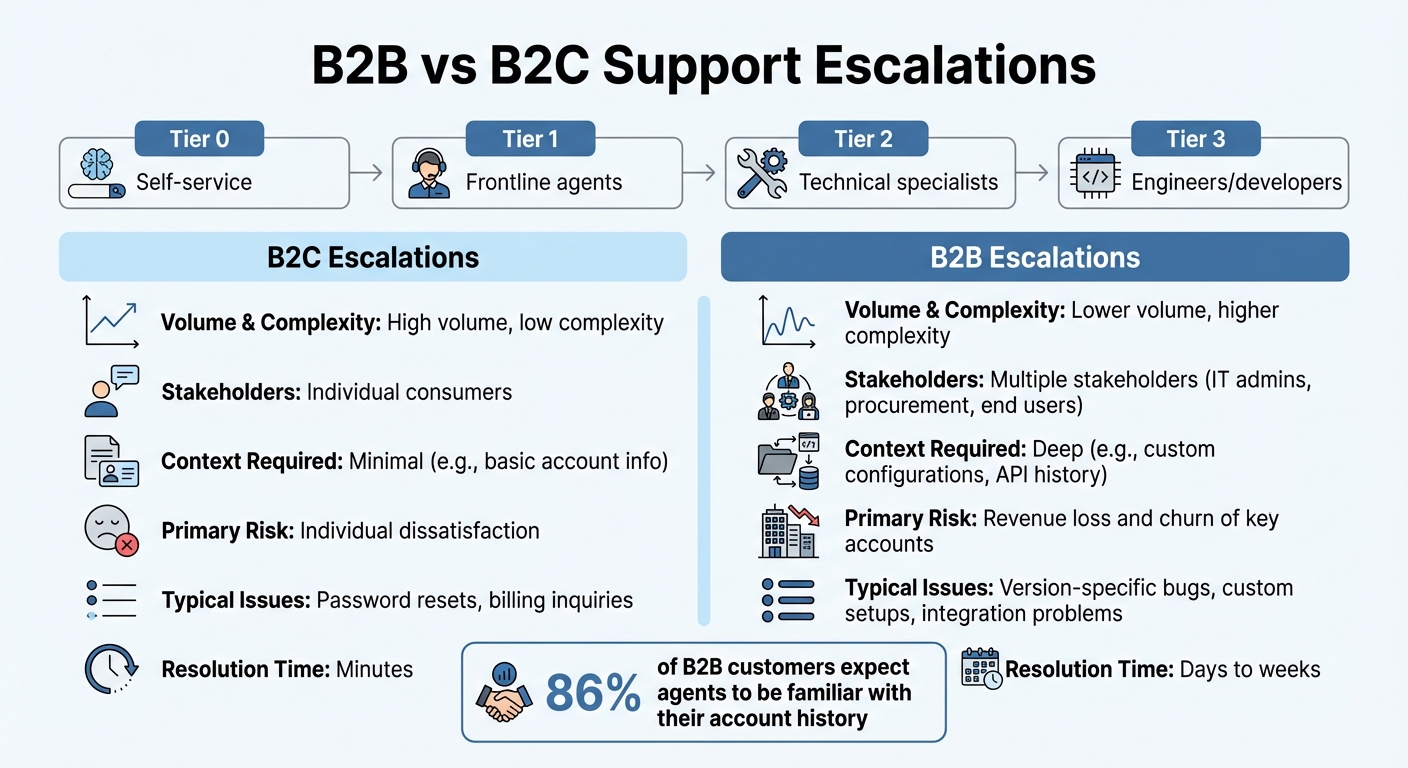
B2B vs B2C Support Escalations: Key Differences and Characteristics
In B2B customer support, an escalation happens when a customer issue is passed from a frontline agent to someone with more expertise, such as a specialist, technical expert, or manager. This typically occurs when the initial agent doesn’t have the technical knowledge, system access, or authority needed to resolve the problem.
The main difference between B2B and B2C escalations lies in complexity and impact. While B2C support often deals with straightforward issues like password resets or billing inquiries, B2B support involves more intricate challenges, such as version-specific bugs, custom setups, and integration problems. These issues can have a ripple effect, potentially disrupting an entire business’s operations.
B2B support often follows a four-tier system: Tier 0 (self-service options), Tier 1 (frontline agents), Tier 2 (technical specialists), and Tier 3 (engineers or developers). When an issue moves up the chain, it’s considered an escalation. However, every handoff carries the risk of losing important context, which can frustrate customers and delay resolution. These structural elements make B2B escalations uniquely challenging.
Key Characteristics of B2B Escalations
B2B escalations stand out because of their complexity and the involvement of multiple stakeholders. Resolving a single technical problem often requires coordination between various teams within the customer’s organization, such as IT administrators, procurement staff, and end users. This level of collaboration is rare in B2C scenarios.
High-value accounts are frequently at the center of escalations. For these accounts, a single unresolved issue can have a significant impact, potentially affecting revenue and customer loyalty.
These cases also tend to take longer to resolve. Unlike B2C tickets that might be closed in minutes, B2B issues can stretch across days or even weeks. Each handoff increases the chances of losing key details, forcing customers to repeat complex information – a process known as "context switching."
Additionally, B2B escalations often require specialized expertise that frontline agents may not have. For instance, resolving a custom Okta authentication issue demands a deep understanding of both the product and the customer’s unique setup. This reliance on subject matter experts (SMEs) can create a bottleneck, as these experts are pulled away from other critical tasks to handle escalations.
Why Escalations Matter in B2B Support
Escalations hold particular importance in B2B support because they directly impact customer retention and revenue. In subscription-based business models, a poorly handled escalation can lead to customer churn during contract renewals. With 86% of B2B customers expecting support agents to be familiar with their account history [2], forcing them to repeat information during an escalation can erode trust.
There’s also a hidden cost in overusing SME resources. When engineers or senior developers are repeatedly diverted to address escalations, they lose time that could be spent on product improvements. This creates a cycle where unresolved product issues lead to more escalations, further straining resources.
Another issue is the potential for frontline agents to lose confidence. If escalations are frequent and lack clear resolution guidelines, agents may start to see themselves as mere "routers" rather than problem solvers. This can lead to knowledge gaps, as effective solutions aren’t documented for future use.
| Feature | B2C Escalations | B2B Escalations |
|---|---|---|
| Volume & Complexity | High volume, low complexity | Lower volume, higher complexity |
| Stakeholders | Individual consumers | Multiple stakeholders |
| Context Required | Minimal (e.g., basic account info) | Deep (e.g., custom configurations, API history) |
| Primary Risk | Individual dissatisfaction | Revenue loss and churn of key accounts |
Managing escalations effectively is essential for improving operational workflows and ensuring customer satisfaction.
Common Triggers for Escalations in B2B Support
In B2B support, escalations often reveal where processes falter or resources fall short. These situations typically arise from SLA breaches, contractual disputes, or time-sensitive emergencies, each presenting unique challenges and requiring specialized expertise. Let’s break down these triggers to understand their specific risks and operational impacts.
Ideally, escalation rates should remain below 10%. When they exceed 15%, it’s often a sign that frontline agents lack specialized B2B helpdesk tools to resolve issues effectively [3]. High escalation rates point to systemic problems that need attention.
SLA Breaches and Unresolved Issues
An SLA breach occurs when a support ticket remains unresolved past its agreed deadline. This often happens because frontline agents don’t have the technical know-how or resources to address complex issues, such as API integration failures, version-specific bugs, or custom configurations.
Interestingly, 72% of customers would rather wait longer for a complete fix than receive a quick but incomplete solution [3]. Closing tickets prematurely to meet SLA deadlines can backfire, leading to repeated escalations and eroding customer trust. It’s a case where speed without quality does more harm than good.
Contractual or Billing Disputes
Billing mistakes, unexpected charges, or disagreements over contract terms can spark high-risk escalations in B2B settings. Unlike technical issues, these disputes can jeopardize entire account relationships, particularly around renewal periods.
Resolving these cases often involves multiple teams, including finance, account management, and even legal departments. A small billing error or miscommunication about contract terms can quickly escalate to the executive level if not handled swiftly. When customers feel overcharged or misled, they might start looking for alternative providers, making these disputes especially critical to address.
Time-Sensitive Priorities
Some escalations are driven by urgent issues like system outages, security breaches, or compliance deadlines. These situations demand immediate action and often bypass lower-tier support, heading straight to specialized teams. For example, a P1 (critical priority) issue may require a response within 15 minutes and resolution within 2 hours [3].
Downtime caused by authentication failures or API timeouts can have serious consequences, including lost revenue, damaged trust, and customer churn. Additionally, time-sensitive escalations can include external deadlines, like regulatory audits or major product launches, where standard support timelines simply won’t cut it. Proactive coordination and clear communication are essential in these cases.
| Trigger Type | Risk Level | Renewal Impact | Required Expertise |
|---|---|---|---|
| SLA Breach (Time-based) | High | Moderate | Tier 1 or 2 |
| Technical Complexity | Moderate | Moderate | Tier 2 or 3 (SME) |
| Contract Dispute | Moderate | High | Management / Finance |
| System Outage (P1) | Critical | Very High | Tier 3 / Engineering |
| High-Value Account Risk | High | Critical | Account Management |
| Negative Sentiment | High | High | Tier 2 or Management |
Types of Escalations with B2B Examples
Support teams categorize escalations into specific types to streamline how issues are resolved. By understanding the four main types of escalations, teams can better align workflows with how problems progress within an organization. Each type has its own triggers, resolution approach, and operational challenges, requiring tailored strategies.
Customer-Initiated Escalations
These occur when a customer directly requests to speak with someone higher up, often driven by frustration or urgency. In B2B scenarios, this is particularly common in accounts with multiple stakeholders, where dissatisfaction from one individual can jeopardize an organization’s renewal decision [4][1].
Take this example: A manufacturing client faces recurring defects in a product that disrupts their production line. After submitting multiple unresolved support tickets, the operations manager bypasses the usual support process and contacts the account executive, threatening to explore alternative solutions. This type of escalation is reactive and relationship-focused, often requiring immediate intervention from senior leadership to rebuild trust. Typically, these escalations follow a clear chain – agent → manager → account lead – and carry a high risk of churn if not handled swiftly and empathetically.
Agent-Initiated Escalations
Here, frontline agents escalate issues when they recognize the problem is beyond their technical expertise or authority. Unlike customer-initiated escalations, these are proactive and structured, with agents ensuring issues are passed to the right specialists before customer dissatisfaction grows.
For instance, a Tier 1 agent receives a ticket about complex API timeout errors affecting a client’s CRM integration. Realizing the issue requires advanced technical knowledge, the agent escalates the case to Tier 3, including detailed context like error logs, affected endpoints, and a timeline. This ensures the issue follows a functional path, maintaining context and avoiding delays. These escalations are a sign of good judgment, ensuring complex problems are addressed by the right experts. If the issue involves decisions beyond technical fixes, it may escalate further up the management chain.
Hierarchical and Managerial Escalations
These escalations move through the authority chain – agent to team lead to manager – when a situation requires managerial approval, involves sensitive client relationships, or needs decisions on refunds, contract adjustments, or policy exceptions. In B2B settings, these often involve disputes that impact an entire account rather than just one user.
For example, consider a billing dispute where a client claims overcharges due to a misconfigured licensing agreement. The frontline agent, lacking authority to approve a large refund, escalates the issue to a manager. The manager reviews the contract, consults finance, and collaborates with the account team to issue a credit while addressing the root cause to prevent further issues. These scenarios highlight the importance of equipping frontline agents with essential support tools and clear guidelines for escalation to minimize delays.
When time is of the essence, some escalations prioritize urgency over process.
Priority-Driven Escalations
Unlike process-driven or relationship-focused escalations, these address urgent, system-wide issues that require immediate attention. Problems like system outages, security breaches, or compliance deadlines trigger priority-driven escalations, often bypassing normal support tiers. The ITIL Priority Matrix is commonly used here, balancing urgency (how disruptive the issue is) with impact (the number of users or systems affected) [5].
For example, in 2025, Cynet – a B2B cybersecurity provider – faced a critical P1 escalation when its SaaS platform went down, impacting all enterprise users. Cynet’s AI-powered system flagged the outage, alerted Tier 3 engineers, and notified affected customers. By automating triage, Cynet resolved nearly half of its tickets at Tier 1, reducing the workload for senior engineers and improving its CSAT score from 79 to 93 [1].
Priority-driven escalations often combine hierarchical and functional paths. For instance, a customer might escalate an issue to a manager (hierarchical), who then brings in engineering (functional) to resolve a high-priority product bug. In these cases, speed and coordination are critical, requiring prompt action, clear communication across teams, and regular updates to stakeholders to maintain trust during high-stakes situations.
How Escalations Impact B2B Support Operations
Escalations in B2B support operations can ripple through an organization, influencing everything from how resources are distributed to the overall customer experience. While some escalations are inevitable, poorly managed processes can drain budgets, overburden teams, and put high-value accounts – critical to B2B revenue – at risk. Understanding these impacts allows support leaders to focus on improving processes to maintain efficiency and nurture strong customer relationships.
Delayed Resolutions and Increased Costs
Escalations can quietly rack up costs by pulling skilled experts away from their primary tasks, leading to notable productivity losses. Research shows that each interruption requires over 23 minutes of recovery time. Moreover, when escalations are misrouted or happen prematurely, the fallout can be significant: 38% of Tier 2 work involves redoing tasks, with agents wasting over 4 minutes per ticket due to repeated tests and miscommunication. Customers, too, feel the strain, spending an average of 2.7 minutes re-explaining their issues during handoffs. Additionally, assigning tickets to the "least busy" agent instead of using AI-powered ticket routing and prioritization adds an extra 11.3 minutes per ticket.
For a team managing 12,000 tickets annually, trimming just 29.4 seconds per escalation could free up nearly 98.6 labor hours. Beyond time, inefficiencies in escalation processes can also drive up technical expenses. For instance, cloud egress costs can rise by up to 17%, and median query latency in help desks can increase by 310 milliseconds [6].
These delays and inefficiencies don’t just inflate operational costs – they also strain relationships with key customers.
Customer Churn and Retention Risks
In B2B contexts, escalations often involve the most valuable accounts, where a single mishandled issue can jeopardize renewals or long-term contracts. Unlike B2C scenarios, these problems often affect multiple stakeholders within an organization, potentially disrupting workflows across entire teams. This ripple effect can erode trust and amplify frustration, especially when customers must repeatedly explain complex technical issues during handoffs. Such experiences not only lower satisfaction but also weaken agent morale, increasing turnover rates.
A real-world example comes from cybersecurity firm Cynet. In early 2026, the company adopted an AI-driven support strategy to tackle escalation challenges. By refining escalation tracking and improving resolution workflows, Cynet eased the workload on senior engineers and reduced churn risk for high-value accounts. This case highlights how smarter escalation management can directly safeguard customer relationships [1].
To address these challenges, adopting AI-driven strategies is essential. Smarter tools and workflows can mitigate inefficiencies and protect against customer churn, ensuring smoother operations and stronger client trust.
AI-Native Strategies to Manage Escalations
Escalations can disrupt operations and strain customer relationships, but modern AI-based strategies are changing the game. These tools allow B2B support teams to shift from reactive problem-solving to proactive, data-driven workflows. Instead of waiting for customers to demand a manager or for service-level agreements (SLAs) to fail, AI platforms monitor real-time signals and intervene before issues escalate. This approach not only reduces costs but also strengthens customer loyalty and lets senior engineers focus on higher-priority tasks.
Automated Escalation Detection
AI systems excel at spotting potential escalations by scanning for specific triggers like SLA breaches, high-risk keywords (e.g., "legal", "cancel", or "manager"), and changes in customer sentiment. For example, Supportbench can flag cases using customer metadata, such as high-priority designations or upcoming renewals, ensuring they’re addressed before reaching a breaking point. These tools also analyze incoming messages for escalation-prone language, routing them directly to senior agents or managers. This method has been shown to improve resolution times by 75% and cut escalation-related costs by 60% [8].
Dynamic Prioritization and Workflow Management
Not all escalations are created equal, and AI platforms help teams prioritize effectively. By using weighted scoring models, which combine rule-based logic with machine learning, these tools calculate priorities in real time. Factors like severity, sentiment, account health, SLA risks, and technical complexity determine how cases are ranked. High-value accounts or customers nearing contract renewal are flagged for immediate attention [7]. Natural language processing (NLP) further enhances this process by detecting emotional cues – such as anger or sarcasm – and triggering escalations to protect the brand’s reputation and improve emotional recovery [7][8].
Here’s a real-world example: A B2B software company with a 23% escalation rate implemented a "Warm Handoff" process and context preservation over eight months. Agents provided AI-generated context to specialists and followed a 24-hour update protocol. As a result, the company reduced its escalation rate to 14%, improved customer satisfaction scores for escalated cases from 4.8 to 7.9 out of 10, and cut resolution times by 31% [9]. These improvements show how AI tools streamline workflows and ensure consistent handling across all escalation levels.
AI Tools for Multi-Level Escalation Tracking
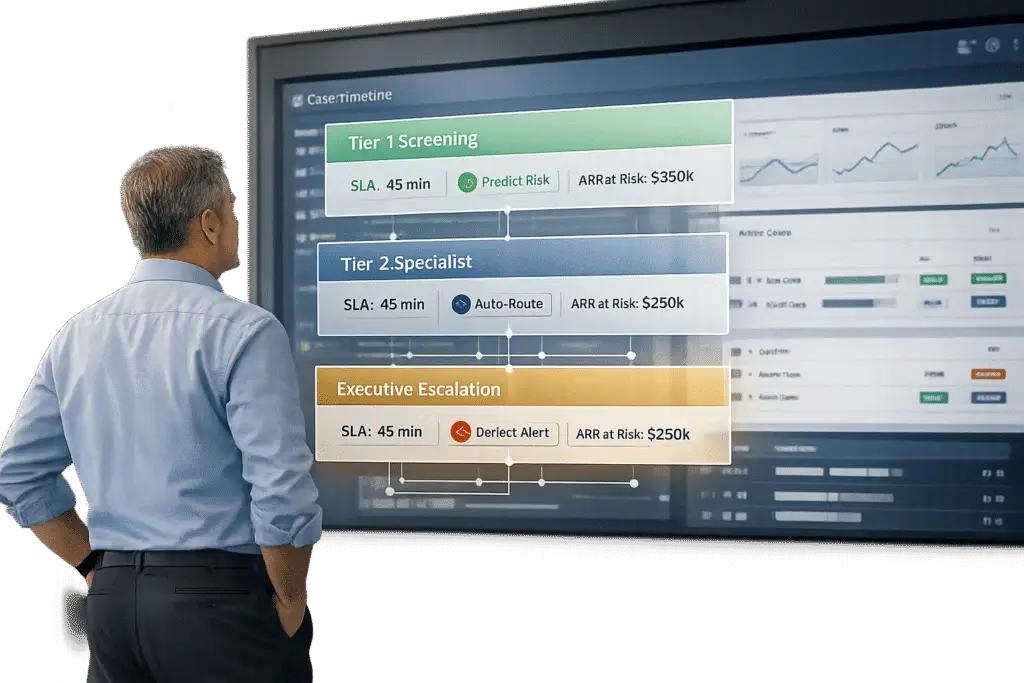
Managing escalations across multiple tiers – like frontline agents, engineers, and account managers – requires clear visibility and smooth handoffs. AI tools simplify this process by tracking escalations at every stage and generating concise case summaries. This eliminates the need for managers to sift through lengthy thread histories. Supportbench, for instance, allows agents to create and manage "Escalations" manually or automatically through system rules. It even tracks the time cases spend in an escalated state, helping teams identify bottlenecks and refine their strategies [7][9].
AI also preserves full conversation histories and metadata, so agents don’t have to start from scratch when cases move up the chain. For technical issues, AI vision capabilities analyze screenshots of error messages or UI bugs directly within the support ticket, speeding up diagnosis and resolution. Additionally, confidence thresholds ensure that complex problems are escalated to the right experts when the AI’s intent classification confidence drops below a set percentage [7]. These tools address the delays and resource challenges that often accompany escalations, resulting in faster resolutions and happier customers.
Key Takeaways for B2B Support Leaders
Defining escalation processes clearly is crucial for protecting your team’s time and avoiding customer frustration. By setting outcome-based criteria, you can empower frontline agents to handle issues without unnecessary escalations. This not only shields Subject Matter Experts (SMEs) from burnout but also ensures your top talent remains focused on strategic tasks instead of repetitive troubleshooting. Clear escalation guidelines also pave the way for better metrics and resource management down the line.
Preventing escalations can bring noticeable improvements. For example, in 2025, cybersecurity company Cynet adopted an AI-driven support strategy that gave agents instant access to centralized knowledge. The results? A 14-point increase in CSAT (from 79 to 93), a 47% ticket deflection rate at Tier 1, and resolution times nearly cut in half [1]. Tina Grubisa, Value Consultant at Mosaic AI, highlights the importance of addressing escalations:
"Escalations have a much more significant impact than they realize. It’s a bottleneck that can be removed rather easily" [1].
AI-native tools play a vital role here. They not only identify unnecessary escalations but also prevent them by equipping newer agents with expert knowledge and automatically documenting solutions. A key question for B2B leaders to ask is, "Does the agent have the necessary context and documentation to resolve this?" If the answer is yes, the ticket should stay at Tier 1.
To ensure your strategy is effective, track metrics such as SME time saved, identified knowledge gaps, and first-contact resolution rates. These indicators will show whether your approach is genuinely reducing workload or merely shifting it to another part of the team. The ultimate goal is fewer escalations, not just redistributing effort.
FAQs
What’s the difference between an escalation and a normal handoff?
Escalations and handoffs serve different roles in managing requests, with distinct levels of formality and intent. A handoff happens when a request moves between agents or teams, often to balance workloads or tap into specialized skills. Importantly, it doesn’t change the request’s priority level. On the other hand, an escalation is a more structured process. It kicks in when there are unresolved problems, urgent matters, or contractual obligations that demand higher-level attention or extra resources to resolve the issue properly.
How do I set clear escalation criteria for Tier 1 agents?
To ensure Tier 1 agents know when to escalate an issue, it’s essential to establish clear triggers. These triggers should be based on factors like complexity, urgency, or sensitivity. Here are some common examples:
- Technical challenges beyond Tier 1’s expertise: For instance, handling advanced bugs or system errors that require specialized knowledge.
- Sensitive or high-priority cases: This includes situations involving confidential data, security concerns, or important clients.
- SLA delays or breaches: When service level agreements are at risk of being violated due to unresolved issues.
- Customer requests for higher-level assistance: If a customer specifically asks to speak with a supervisor or manager.
By defining these criteria, agents can escalate cases at the right time, ensuring smoother operations and keeping customers satisfied.
Which metrics prove escalation reduction is actually working?
Metrics that show a reduction in escalations include a decrease in high-priority issues being passed to upper support levels, quicker resolution times for escalated tickets, and improved customer satisfaction scores. These trends suggest that lower support tiers are handling issues more effectively.
Related Blog Posts
- How do you stop “drive-by” escalations from Sales/Execs (without politics)?
- How do you run an executive escalation program without training customers to escalate?
- What are the signs you’ve outgrown Help Scout (SLAs, tiers, escalations, reporting)?
- How to design escalation paths that customers can understand