High-touch B2B support requires tools that manage complex relationships, multiple stakeholders, and technical challenges across various communication platforms. Here’s a quick rundown of the top tools tailored for these needs:
- Supportbench: Focuses on account-level support with AI triage, escalation management, and sentiment analysis. Starts at $32/agent/month.
- Plain: Designed for developer-focused teams, integrating Slack, Teams, and Discord. Features real-time responsiveness and AI-driven triage. Starts at $39/seat/month.
- Pylon: Centralizes multi-channel conversations, offers health scoring and SLA monitoring. Starts at $59/seat/month.
- Intercom: Known for its Fin AI Agent, resolving 66% of support volume and offering sentiment analysis. Starts at $29/seat/month plus $0.99 per AI-resolved outcome.
- Zendesk: Feature-rich but priced higher at $115/agent/month, with optional AI add-ons.
- Freshdesk: Affordable with AI capabilities like Freddy AI Copilot. Starts at $12/agent/month.
Quick Comparison:
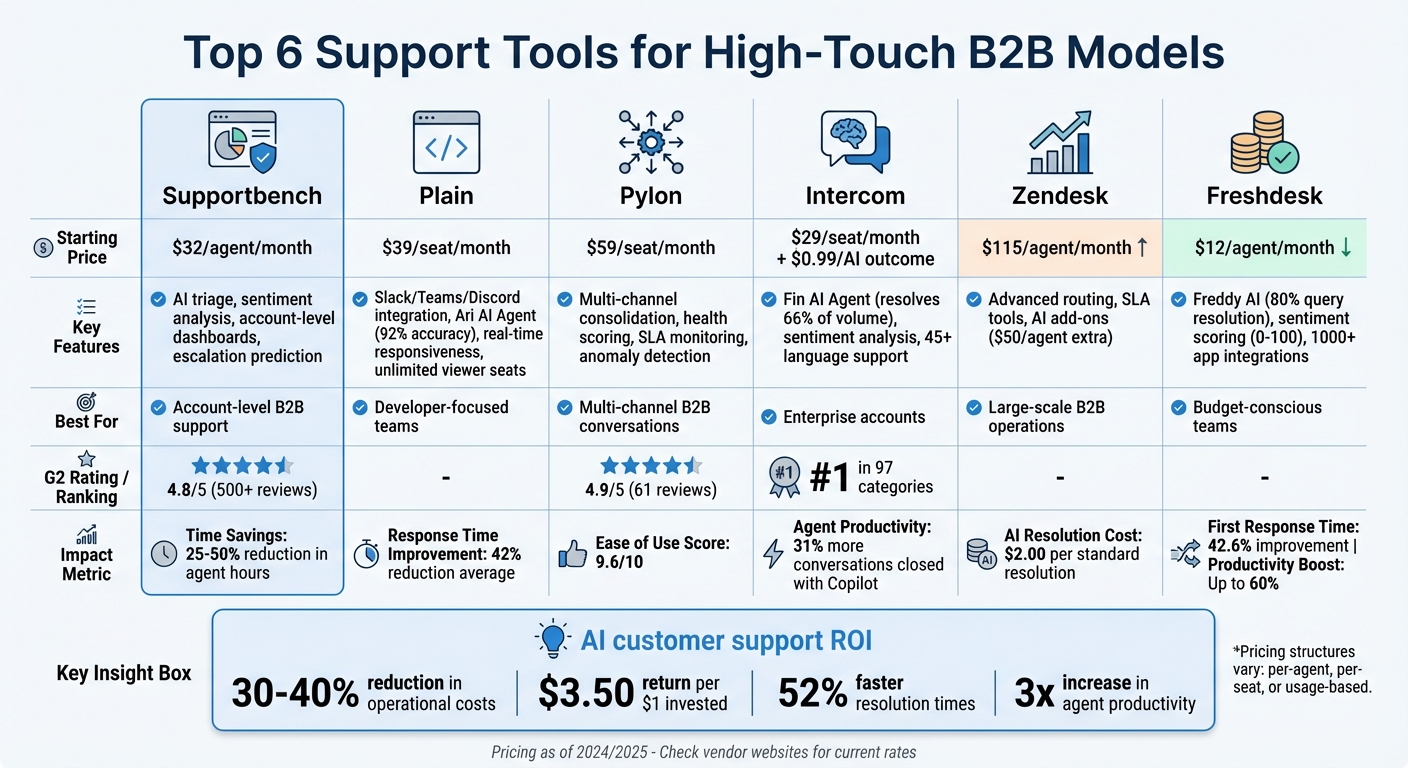
| Tool | Starting Price | Key Features | Best For |
|---|---|---|---|
| Supportbench | $32/agent/month | AI triage, sentiment analysis, dashboards | Account-level B2B support |
| Plain | $39/seat/month | Slack/Teams integration, real-time replies | Developer-focused teams |
| Pylon | $59/seat/month | Health scoring, SLA monitoring | Multi-channel B2B conversations |
| Intercom | $29/seat/month + $0.99/AI outcome | Fin AI Agent, sentiment analysis | Enterprise accounts |
| Zendesk | $115/agent/month | Routing, SLA tools, AI add-ons | Large-scale B2B operations |
| Freshdesk | $12/agent/month | Freddy AI, sentiment scoring | Budget-conscious teams |
Choosing the right tool depends on your budget, team size, and specific support needs. Read on for detailed insights into each platform.
B2B Support Tools Comparison: Features, Pricing and Best Use Cases
Marty Kausas, Pylon CEO on Modern B2B Support, AI KB & Post‑Sales Tools
sbb-itb-e60d259
1. Supportbench
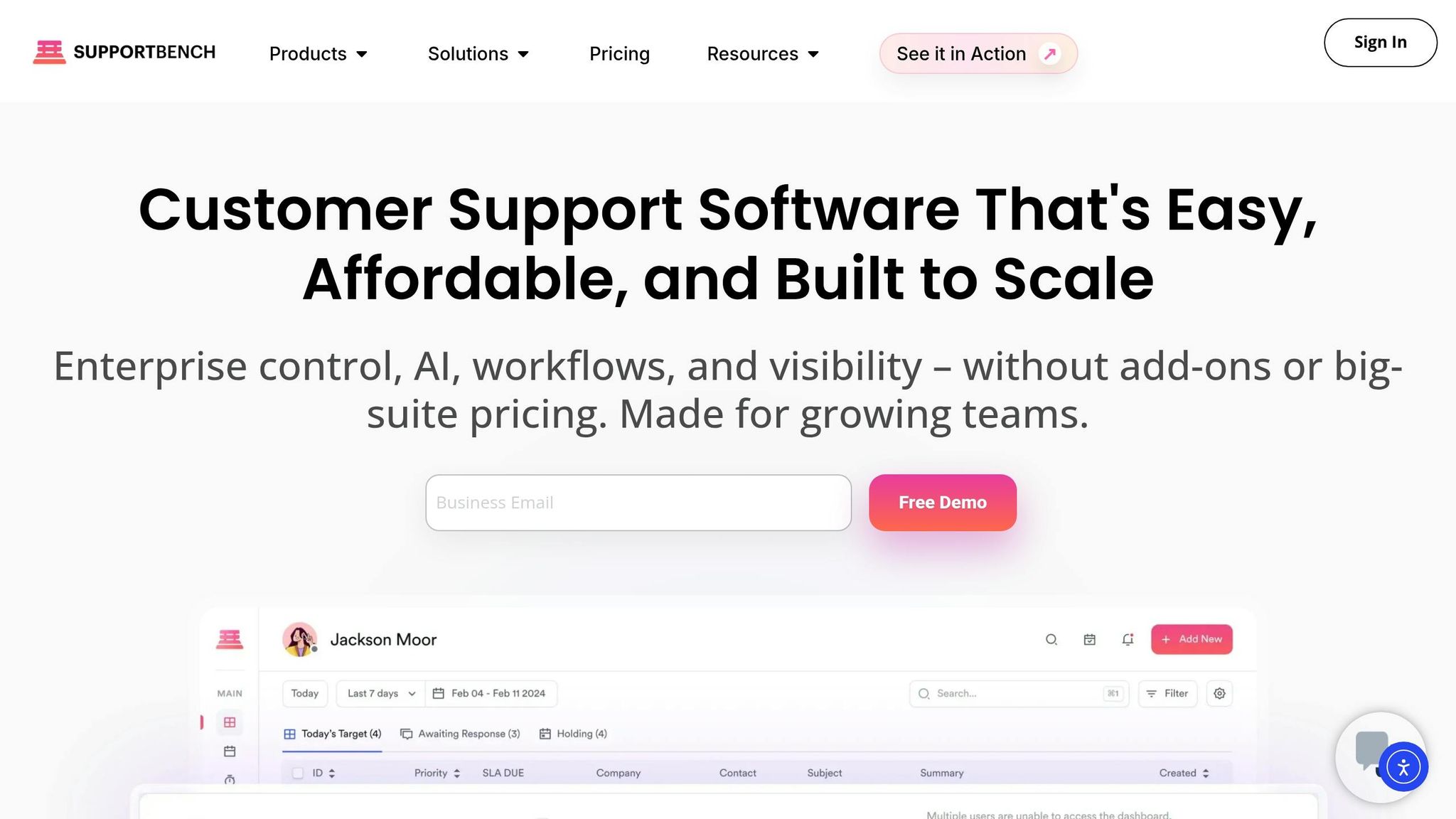
Supportbench is tailored for high-touch B2B support teams managing intricate accounts. Unlike help desks designed for high-volume B2C needs, this platform prioritizes the entire account as the central focus, offering comprehensive visibility into stakeholders, conversations, and issues within a customer relationship.
AI-Powered Triage and Automation
Supportbench leverages advanced AI to streamline ticket management. Its intelligent categorization automatically organizes and routes cases based on factors like priority, account value, and emotional sentiment, reducing manual sorting efforts by up to 40% [7]. For instance, tickets from high-value accounts are flagged for immediate escalation, ensuring critical clients get priority attention. The AI Copilot taps into past cases and the knowledge base to suggest responses and provide summaries, cutting down on time spent reviewing lengthy case histories [4]. Routine tasks, such as resolving access issues or handling installations, are managed by AI-powered virtual assistants, allowing agents to focus on more challenging problems [4].
Escalation Prediction and Management
The platform excels at identifying and addressing potential escalations before they become issues. By monitoring SLA timers, it predicts and triggers escalations ahead of deadlines [5][6]. SLAs are dynamically adjusted based on case content and customer value, prioritizing urgent, business-critical needs. Multi-step escalation paths can be customized with conditional triggers, while automated notifications ensure stakeholders – both internal and external – are promptly informed. With integrations for Salesforce and JIRA, escalation data flows seamlessly between sales and engineering teams [6]. Additionally, real-time sentiment analysis enhances customer insights, offering a deeper understanding of client needs.
Sentiment Analysis and Customer Insights
Supportbench uses real-time sentiment analysis to detect emotional cues in tickets and chats, pinpointing areas of frustration or satisfaction [7]. Predictive tools provide CSAT, CES, and NPS scores, along with churn risk assessments, often before customers even complete surveys [4]. Executive dashboards compile sentiment scores for each account, while the 360° customer view centralizes key metrics like journey context, health scores, and escalation trends. To maintain consistent communication quality, an AI-driven quality assurance system reviews every ticket for tone, empathy, and effectiveness – ensuring high standards across all interactions [4].
Scalable Solutions for B2B Support
Designed for scalability, Supportbench handles workloads ranging from hundreds to thousands of tickets daily without requiring additional staff [5]. Automation features cut agent hours by 25–50% and reduce resolution times by up to 50%, making it an ideal choice for teams managing 50+ complex accounts [7][8]. Pricing starts at $32 per agent per month, offering a cost-effective solution for small teams looking to grow without unexpected expenses. The platform supports multi-channel communication – including email, Slack, and chat – streamlining interactions across all customer touchpoints [8]. With a 4.8/5 rating on G2, backed by over 500 reviews, Supportbench is celebrated for its user-friendly design and ability to scale effectively in B2B environments [8]. These capabilities position it as a standout tool for managing complex customer relationships.
2. Plain
Plain is designed for technical B2B teams managing developer-focused products across various communication platforms. It brings together support conversations from Slack, Microsoft Teams, Discord, and email into one workspace, offering near-real-time responsiveness and eliminating loading delays that can slow down fast-paced support teams [8][12].
AI-Driven Triage and Automation
Plain’s Ari AI Agent takes care of routine queries across channels, escalating only when it detects low confidence [10][11]. With 92% accuracy, its auto-triage system categorizes and routes requests, automatically applying labels to ensure technical questions reach the right engineers [10][1]. The Sidekick Copilot assists by drafting responses, summarizing threads, and pulling context from past conversations using internal documentation [9]. Another standout feature, Cursor Lookup, connects support teams directly to a company’s codebase, enabling precise technical answers [10][11].
"Plain’s AI responses mean our team can respond to support requests much faster, and because they’re modeled on our own language and documentation, we’re not sacrificing sounding like a human for speed."
For instance, Tinybird cut its first response time from one hour to just 12 minutes by consolidating support into Plain’s workspace. Similarly, Voltage Park slashed its first response times from over an hour to just 3 minutes, thanks to real-time context sharing between support and engineering teams [11]. These AI features simplify handling technical queries, helping teams manage issues more effectively in complex environments.
Escalation Prediction and Management
Plain includes tiered SLA configurations with real-time alerts for potential breaches, enabling teams to escalate cases before they become critical – cutting first-response times by up to 50% [10][12]. By tracking account health and engagement data, the platform calculates risk scores to flag accounts that may churn or are nearing renewal deadlines. Bi-directional integrations with Linear, Jira, and GitHub ensure technical issues are escalated smoothly, while logging product events directly from the application allows teams to address potential issues before a ticket is even raised [8][10][12]. This proactive approach makes managing cases more efficient and scalable.
Scalability for High-Touch B2B Environments
Plain’s interface brings all stakeholder interactions into unified, persistent threads, ensuring communication stays organized. It includes unlimited free viewer seats, allowing product and engineering teams to stay in the loop without additional licensing costs [10][1]. Customers have reported an average 42% reduction in response times and up to 40% lower operational costs compared to traditional tools [8]. Pricing starts at $39 per seat per month, with a 14-day free trial available [10][1][9]. Plain offers a streamlined solution tailored to the needs of high-touch technical support teams.
3. Pylon
Pylon is tailored for B2B teams managing customer conversations across multiple platforms like Slack, email, chat, and forms. It brings all these interactions into a single workspace, simplifying access and tracking account health while automating escalations. With a 4.9/5 star rating on G2 from 61 reviews, users often praise its seamless Slack integration and AI-powered ticket classification as standout features [13].
Pylon emphasizes efficiency with tools designed to optimize ticket routing and escalation management, keeping operations smooth and effective.
AI-Driven Triage and Automation
In high-touch customer support models, quick and accurate responses are crucial. Pylon’s AI agents step in to classify, route, and manage routine queries automatically. This not only saves time but also ensures queries are directed to the right place instantly. The platform acts both as an autonomous agent for FAQs and simple updates and as a copilot for more complex tasks – helping support reps draft responses and gather context. This dual functionality allows teams to focus on high-priority and more nuanced customer needs.
Escalation Prediction and Management
Pylon’s tools help prevent critical issues from falling through the cracks. Automated routing and SLA monitoring ensure high-value accounts get the attention they need. Anomaly detection flags unusual patterns, like spikes in support volume or delayed responses, so teams can proactively escalate cases. Features like health scoring and churn forecasting further connect individual interactions to larger retention strategies, giving account managers a clear view of relationships that may need immediate action.
Built for Scaling High-Touch B2B Operations
Pylon consolidates conversations from platforms like Slack, Microsoft Teams, Discord, email, and chat into a unified record. It has earned a combined ease-of-use and support quality score of 9.6/10 on G2 [13]. Pricing starts at $59 per seat per month for the Starter Plan, which includes a support inbox, traditional communication tools, and a knowledge base. A free trial is also available for teams looking to explore the platform [13].
4. Intercom
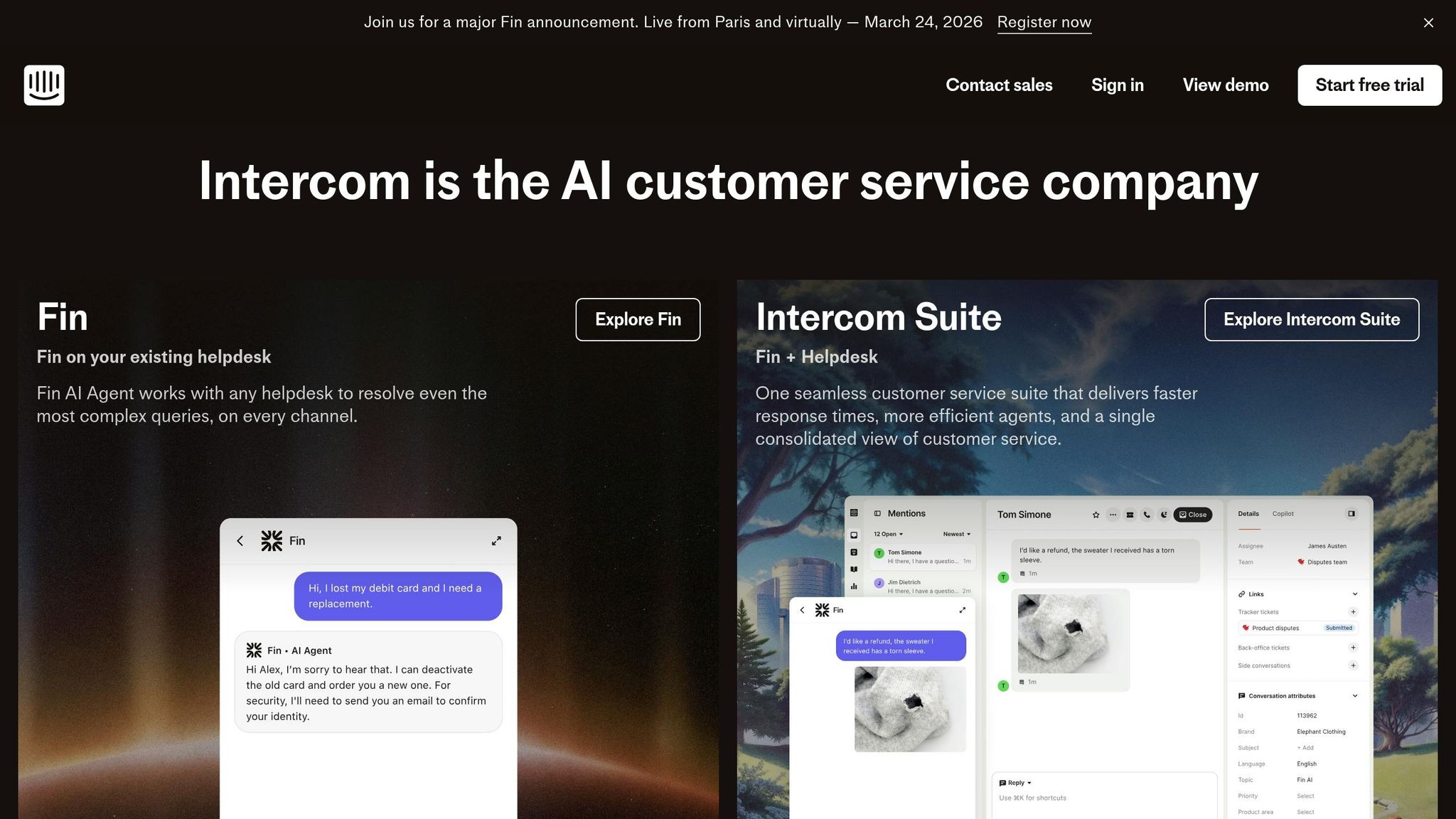
Intercom is a platform designed with AI at its core to support B2B customer service. It’s been ranked #1 in 97 categories on G2, including the top spot for AI Agent in G2’s 2025 Winter report [24,26]. Combining its Fin AI Agent with workflow automation and real-time sentiment detection, Intercom addresses the complexities of managing high-touch B2B relationships. With a 4.5/5 star rating on G2 and pricing starting at $29 per helpdesk seat per month plus $0.99 per AI-resolved outcome, it’s tailored for teams handling enterprise accounts across multiple channels [24,30].
AI-Driven Triage and Automation
At the heart of Intercom’s platform is the Fin AI Agent, which manages frontline support across chat, email, voice, and social channels. On average, it resolves 66% of support volume, with some customers seeing up to 68% resolution rates [24,26]. For example, Angelo Livanos, Vice President of Global Support at Lightspeed, shared in 2026 that Fin handles 99% of their conversations and resolves up to 65% of queries independently [16].
Intercom uses Fin Attributes to analyze conversations for intent, urgency, topic, and sentiment. This lets the platform perform silent triage – organizing conversations without requiring an AI reply – by using a "Let Fin answer" block followed by escalation rules [15]. For more complex cases, Fin AI Copilot assists agents by pulling information from internal sources like Notion or Confluence and summarizing lengthy conversation threads. Tests showed that agents using Copilot closed 31% more conversations daily [14]. This level of automation enhances efficiency while preparing for seamless escalations.
Escalation Prediction and Management
Intercom enables support leaders to establish structured escalation rules, such as prioritizing high-value accounts or addressing negative sentiment immediately [27,31]. The platform even allows natural language rules, like flagging conversations where competitor names are mentioned, to trigger escalations [17]. Once an escalation is identified, automated workflows gather additional details, create tickets, or route queries to specialized inboxes like "Tier 2 Support." These escalation tools work hand-in-hand with Intercom’s sentiment analysis to ensure smooth handovers.
Sentiment Analysis and Customer Insights
With Conversational Mood Insights, Intercom provides real-time emotional feedback during customer interactions, helping teams adapt their approach before situations worsen. The platform examines 100% of conversational data, including unstructured text, to identify at-risk accounts based on frustration levels or specific word choices [18]. This is especially useful in B2B settings, where traditional survey response rates often hover between 5% and 10% [18].
"AI can take customer data, fill those [survey] gaps, and even reveal issues that weren’t captured by surveys in the first place."
– Jim Tincher, Author of Do B2B Better [18]
"As a manager, being able to instantly summarize a conversation between my team and the customer is amazing… it helps to highlight areas for improvement within the team."
– Dean Kahn, Customer Experience Manager at RateMyAgent [19]
Scalability for High-Touch B2B Environments
Intercom’s visual no-code builder simplifies the creation of complex workflows. Teams can set up assignment rules, SLA targets for VIP accounts, and multi-step processes based on customer data like company size or subscription plans [27,28]. The platform also supports real-time translation in over 45 languages, making it easier for global teams to manage international accounts without language barriers [25,28]. This combination of streamlined workflows and multilingual support helps teams manage intricate B2B relationships efficiently.
For instance, Lee Burkhill, Project Manager at Mony Group, implemented Intercom to overhaul operations, resulting in measurable improvements in support metrics [14]. Similarly, Hazel Maw, Senior Operational Excellence Manager at TravelPerk, uses Intercom’s flexible workflows and AI tools to deliver a consistent "7-star experience" for B2B travel clients [14]. Teams interested in trying the platform can take advantage of a 14-day free trial before making a commitment [24,30].
5. Zendesk
Zendesk’s Suite Professional Plan starts at $115 per agent/month. For those looking to boost their capabilities, there’s an optional Advanced AI Add-on available for an extra $50 per agent/month, along with per-resolution fees ($2.00 per standard resolution or $1.50 with a volume commitment) [20].
AI-Driven Triage and Automation
Zendesk leverages AI to streamline the process of routing initial inquiries to the right teams. By automating the categorization of incoming requests using predefined rules, it helps reduce the manual workload for support teams. However, for B2B2B enterprises, it’s worth carefully considering whether the pricing structure matches their expected volume of automated resolutions. These tools are particularly useful for handling intricate, multi-stakeholder interactions with greater efficiency.
Scalability for High-Touch B2B Environments
For B2B support teams that prioritize personalized, high-touch service, implementing scalable and personalized B2B support strategies becomes crucial. Zendesk offers efficient routing options that consider account attributes, priority levels, and team specializations – perfect for managing complex, long-term client relationships. As businesses grow their support operations, evaluating how these scalability features fit their evolving needs is essential.
6. Freshdesk
Freshdesk offers a tiered pricing model for annual billing, designed to cater to different team sizes and needs. The Growth Plan starts at $12 per agent/month and includes 500 Freddy AI Agent sessions. If you want to add Freddy AI Copilot, it costs an additional $29 per agent/month. The Pro Plan, priced at $44 per agent/month, comes with both Freddy AI Copilot and Freddy AI Insights. For larger teams, the Enterprise Plan is available at $69 per agent/month, with Copilot offered as an optional add-on. If you need extra sessions, you can purchase additional 1,000-session blocks for $98 [23].
AI-Driven Triage and Automation
Freshdesk’s Freddy AI Agent takes on repetitive tasks, such as updating settings or triggering workflows based on documentation [21][22]. It also automates ticket categorization and routing by analyzing agent skills, workload, and even customer sentiment. Impressively, Freddy AI Agent can resolve up to 80% of queries while reducing average resolution time for conversations to under 2 minutes [22].
The platform comes equipped with over 50 prebuilt workflows and Vertical AI Agents tailored to specific industries, making it ready to use from the start. For B2B teams handling complex technical issues, features like Threads and private notes allow seamless collaboration between support agents and other departments like engineering, product, or finance [21].
Sentiment Analysis and Customer Insights
Using Natural Language Processing, Freshdesk assigns a sentiment score (ranging from 0 to 100) to each ticket: Negative (10–30), Neutral (31–70), or Positive (71–100). If a ticket’s sentiment drops – say, from “Positive” to “Negative” – automation rules can kick in, adding an "At-Risk Customer" tag and alerting the account manager. This proactive approach helps B2B teams address potential issues before they escalate.
"I want the ability to get one view of how we support our customers – not just the number of tickets, but any information on how we interact with them. You’ve got to bring everything into one platform. Freshworks allows us to do that." – Tony Barbone, Chief Revenue Officer [22]
Built for High-Touch B2B Needs
Freshdesk Enterprise offers features like HIPAA compliance, role-based access control, and audit logs – essential for regulated industries. By bringing together compliance tools, role-based permissions, and a wide range of integrations, Freshdesk simplifies the complexities of high-touch B2B environments. The platform connects with more than 1,000 apps via the Freshworks Marketplace, allowing teams to streamline their tech stacks.
Users in the software industry have reported a 42.6% improvement in First Response Time with Freddy AI Copilot, along with a productivity boost of up to 60% [21][22]. Additionally, Freshdesk achieves a 97% omnichannel first contact resolution rate [22].
With these features and performance metrics, Freshdesk stands out as a strong contender in the feature and pricing comparison.
Feature and Pricing Comparison
When choosing support tools for high-touch B2B models, factors like AI accuracy, pricing, and implementation speed play a big role. Unlike platforms that focus on customer service KPIs, Supportbench prioritizes a broader view of account health and long-term relationships. It uses AI-driven workflow automation designed specifically for the complexities of B2B environments [24]. For instance, one platform automates routine ticket handling, while another analyzes customer intent across multiple channels and can even auto-create tickets from voicemail with the right priority level [25].
Pricing structures vary significantly. Supportbench starts at $32 per agent/month, offering all enterprise features and built-in AI capabilities from the start [3]. Plain, on the other hand, uses a seat-based model priced at $39 per month, with unlimited free viewer seats. This is particularly useful for high-touch models where teams like product and engineering need visibility into customer data without extra licensing costs [1]. Other tools use fee-per-resolution pricing, which can make budgeting unpredictable in high-volume scenarios.
Implementation timelines also differ. Some platforms can be up and running in as little as 1–3 days, while others require 1–3 weeks, and more complex enterprise setups might take 4–12 weeks [1]. For B2B teams dealing with tight renewal cycles and complex accounts, faster deployment means quicker time-to-value. On average, businesses see a $3.50 return for every $1 invested in AI customer service, with AI-driven tools reducing operational costs by 30–40% [1].
The decision between seat-based and usage-based pricing is critical for managing budgets effectively. For high-touch B2B models, tools like Supportbench and Plain stand out because they offer features – like free viewer seats – that allow customer success, product, and engineering teams to access customer context without extra fees [1]. This ensures the tool not only streamlines operations but also supports the strategic goals of relationship-driven B2B environments.
"AI customer support delivers measurable ROI: 30-40% reduction in operational costs, $3.50 return for every $1 invested, 52% faster resolution times, and 3x increase in agent productivity." – Plain Blog [1]
Understanding these pricing and implementation details is essential for teams aiming to improve efficiency while ensuring long-term client success in complex B2B settings.
Conclusion
Selecting the right support platform for high-touch B2B operations goes beyond simply managing tickets – it’s about creating a foundation that supports long-term account growth. The contrast between basic help desks and specialized B2B platforms becomes clear when you look at improvements in retention rates, reduced operational expenses, and a team’s ability to expand without feeling overwhelmed. This shift sets the stage for stronger account retention and scalable operations.
The numbers back this up. AI-powered support tools not only lower costs but also deliver impressive results. For instance, when Navattic integrated their QBR and renewal workflows into a unified customer success platform in late 2023, their Head of Customer Success, Alisa Feng, saw a 20% drop in monthly churn [26]. Similarly, Conductor reported a 38% boost in ticket resolution speed and a 77% increase in the weekly ticket volume handled by their top agents after adopting AI-driven workflows [2].
The real game-changer is moving from addressing individual tickets to managing entire accounts holistically. Larry Hogan, Global Vice President of CS & Support at Triptease, captured this evolution perfectly:
"The concept of being a truly strategic CSM was impossible before. With the AI features… now they actually have the time and visibility to do the work they were hired to do" [26].
Platforms that simplify processes and deepen customer relationships are now indispensable. By automating repetitive tasks, your team can dedicate their energy to meaningful, high-value interactions that fuel renewals and growth. The right tools can transform customer support from a cost-heavy function into a strategic driver of success in today’s renewal-focused B2B environment. Leveraging AI-native platforms creates an efficient, unified system that powers long-term B2B growth.
FAQs
What makes a support tool “high-touch” for B2B?
A "high-touch" B2B support tool is designed to handle complex, long-term relationships involving multiple stakeholders by delivering personalized, proactive, and context-aware support. These tools come packed with features like AI-powered insights, sentiment analysis, and the ability to predict when escalations might occur. They also support communication across multiple channels, offer complete visibility into client accounts, and promote team collaboration to ensure smooth and consistent service. This method helps businesses stay ahead of potential issues, provide empathetic support, and nurture strong, high-value relationships with their clients.
How can I estimate total AI support costs before buying?
To get a handle on AI support costs, start by looking at the platform’s base price and any extra fees tied to AI features, like advanced automation or chatbot tools. Some platforms, for instance, may charge per session or per user for these add-ons. Think about what your team actually needs – whether it’s ticket triage, sentiment analysis, or other AI-driven tools – and include factors like the number of agents and potential scaling in your calculations. It’s also smart to regularly revisit and tweak your workflows to keep costs in check as your needs change.
How fast can a new support platform go live for my team?
A support platform can often be up and running in just a few days to a couple of weeks, depending on how complex your setup and integration requirements are. Modern AI-driven tools are built for quick deployment, letting businesses see operational advantages much sooner than with older, traditional platforms, which might take months to implement. These newer solutions are designed with ease of setup in mind, catering to the fast-paced needs of B2B teams.
Related Blog Posts
- Help Scout alternatives for B2B teams: what to choose when you outgrow shared inbox
- What are the signs you’ve outgrown Help Scout (SLAs, tiers, escalations, reporting)?
- Jira Service Management vs. Supportbench: Which is Better for External B2B Support?
- Freshdesk vs. Supportbench: Why B2B Teams Outgrow Freshdesk’s Ticket Model
Evaluating help desks for a B2B team?
Supportbench is all-inclusive from $32 per agent per month, with migration and onboarding included. See pricing or book a 20-minute demo.