57% of employees feel they must leave their job to advance their career. For support teams, this leads to costly turnover, loss of expertise, and weakened customer relationships. The solution? Clear career paths that motivate employees to grow within your organization.
Here’s what works:
- Dual Career Tracks: Offer growth paths for both technical specialists (Individual Contributors) and managers, with equal pay and status.
- AI-Powered Tools: Use AI to identify skill gaps, create personalized growth plans, and track progress in real time.
- Skill-Based Progression: Promote based on measurable skills, not tenure, using tools like AI-driven scorecards.
- Mentorship & Cross-Training: Pair employees with mentors and encourage cross-functional learning to build diverse skills.
- Transparency: Share clear, accessible career maps with steps, skills, and compensation for every role.
Companies that implement structured career frameworks see 34% higher retention rates and save thousands in recruitment costs. Investing in growth opportunities keeps top talent engaged, improves team performance, and strengthens customer relationships.
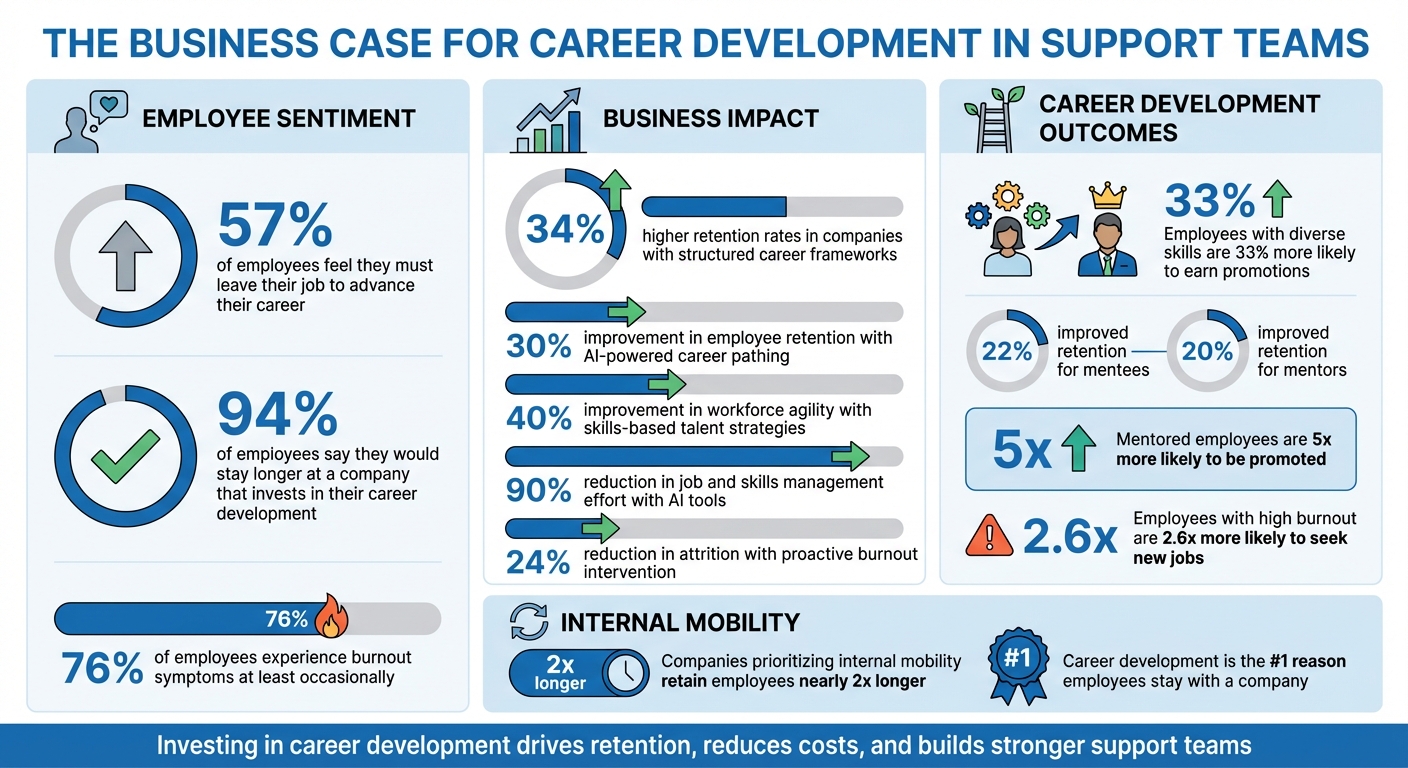
Career Development Impact on Employee Retention and Business Performance
Exploring customer service career paths in the age of AI
sbb-itb-e60d259
How to Structure Career Paths for B2B Support Teams
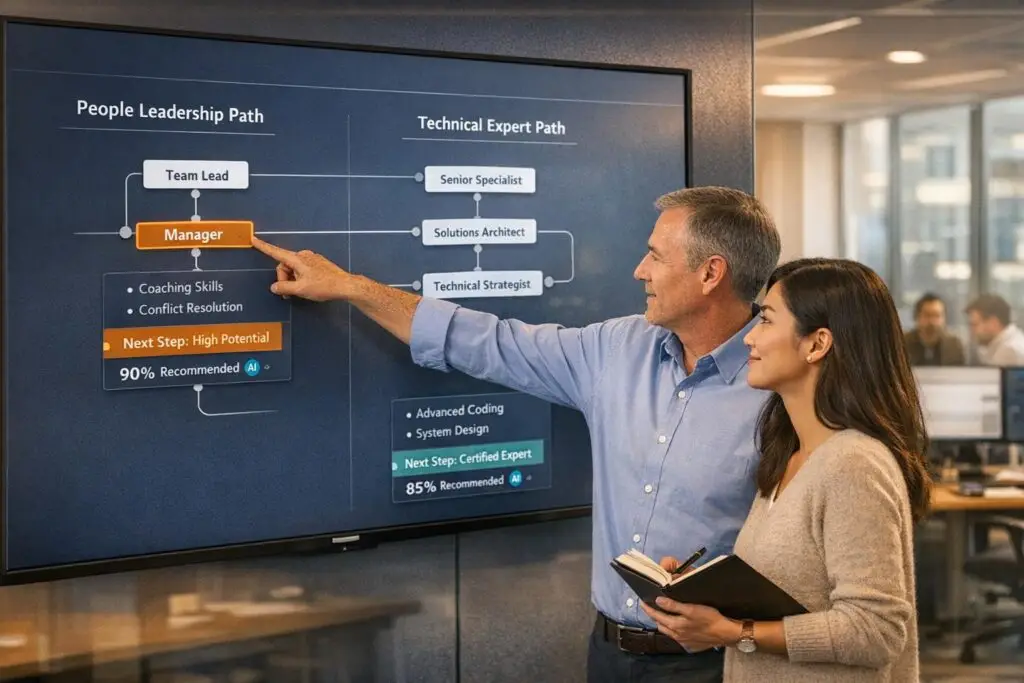
A well-designed career framework recognizes that not everyone aims for a management role. Interestingly, 94% of employees say they would stay longer at a company that invests in their career development [6]. The traditional "up or out" approach often pushes skilled technical specialists into leadership roles they might not want. A better solution? Create dual career tracks that value both individual contributors (ICs) and managers equally.
The IC track focuses on technical expertise and problem-solving. For example, employees might progress from Support Agent to Senior Support Engineer to Principal Specialist by tackling more complex challenges and driving team improvements. On the other hand, the leadership track emphasizes people management, with roles advancing from Team Lead to Support Manager to Director of Customer Experience. As Acciyo aptly puts it:
Becoming a manager is a career pivot, not just a promotion [6].
To ensure fairness, both tracks should offer comparable compensation and status, eliminating the belief that management is the only way to grow.
Individual Contributor and Leadership Tracks
Modern B2B support teams require career paths that align with AI-driven operations. The IC track can include specialized roles such as:
- AI Trainers: Optimize chatbot responses for better customer interactions.
- Quality Managers: Analyze data to improve interaction quality.
- Support Operations Specialists: Design workflows and implement automation.
Meanwhile, the leadership track goes beyond traditional management, incorporating skills like guiding teams through AI adoption and using predictive analytics for resource planning.
Companies with structured career frameworks report 34% higher retention rates [7]. Making both tracks equally appealing is crucial. For example, a Principal Support Engineer should earn compensation similar to a Support Manager at the same level, with both roles having clear paths to executive positions. Building progression around measurable skills ensures fairness and transparency.
Skill-Based Role Progression
Progress should be based on skills, not just time spent in a role. Define each level by measurable abilities, such as troubleshooting, product expertise, communication, and technical influence. Tools like Supportbench‘s AI-powered scorecards can assess these competencies objectively by analyzing customer interactions, sentiment, and resolution quality. This data-driven approach minimizes bias in promotions and gives employees clear targets for improvement.
For instance, a Junior Support Agent might handle straightforward inquiries using guided workflows. In contrast, a Senior Support Engineer could resolve complex issues while creating documentation to reduce future tickets. Employees with diverse skills are 33% more likely to earn promotions [1]. AI dashboards also allow real-time tracking of skill development, eliminating the need to wait for annual reviews. This system not only streamlines promotions but also ensures career paths are transparent and accessible to all.
Making Career Paths Visible to Your Team
Transparency is key to building trust and motivation. Internal career maps should clearly outline the skills, estimated timelines (without rigid deadlines), and compensation ranges for each step. For instance, Buffer’s dual-track framework includes four "steps" within each level to reflect incremental growth milestones:
A Level 3 employee might progress from "co-owning projects" (Step 1) to "fully owning projects with decreasing guidance" (Step 3) [8].
When these maps are easy to access – rather than buried in HR files – employees can see exactly how mastering AI workflows or leading cross-functional projects can lead to promotions. This clarity empowers team members to take charge of their growth.
Using AI to Find and Address Skill Gaps
Traditional methods for identifying skill gaps often rely on periodic reviews or a manager’s intuition. These approaches can miss real-time shifts in performance or fail to catch emerging gaps. AI changes the game by continuously analyzing support interactions, spotting areas where development is needed before they impact customer satisfaction or renewals. This real-time feedback creates the foundation for a dynamic skills matrix.
Creating a Skills Matrix
A skills matrix is a tool that maps out each team member’s proficiency across key areas like product knowledge, communication, technical troubleshooting, and AI tool usage. The challenge? Keeping it up-to-date. Fewer than half of HR teams systematically assess employee knowledge gaps [9].
This is where AI-driven skills intelligence comes in. By combining internal performance data with external labor trends, AI can automatically update proficiency levels based on metrics like ticket resolutions, customer feedback, and completed training. To keep evaluations consistent, use a standardized 1–5 scale:
- 1: Limited knowledge
- 2: Basic application
- 3: Working proficiency
- 4: Seasoned expertise
- 5: Expert-level mastery
This dynamic matrix not only tracks individual growth but also supports transparent career progression by clearly outlining development areas.
AI-Driven Performance Analysis
AI tools like Supportbench analyze key metrics – predictive CSAT (Customer Satisfaction), FCR (First Contact Resolution), and QA (Quality Assurance) – to identify which skills directly impact customer outcomes. For example, if agents frequently receive low predicted CSAT scores on complex technical issues, AI can pinpoint gaps in advanced troubleshooting or product knowledge rather than offering vague feedback.
AI also evaluates emotional intelligence by analyzing sentiment in customer interactions. This helps identify which agents excel at de-escalating tense situations and which might need more communication training. With 77% of HR professionals ranking talent development as a top priority [9], these insights eliminate guesswork, enabling targeted investments in skill-building that align with measurable outcomes.
Focusing Training on High-Impact Skills
Not every skill gap requires the same level of attention. AI helps prioritize training efforts by highlighting the competencies that have the biggest impact on customer satisfaction, resolution efficiency, and renewal rates. For instance, if data shows a strong link between proficiency in AI-assisted workflows and better case outcomes, training in that area should take precedence over more general soft skills programs.
When training aligns with career goals, employees are four times more likely to engage [9]. Using AI insights to tailor development paths ensures training not only improves team performance but also supports individual growth. For example, an agent aiming for a Senior Support Engineer role could focus on mastering complex product integrations and mentoring junior colleagues – skills that directly accelerate their career advancement.
Building Growth and Development Programs
Once AI highlights skill gaps, the next step is creating development programs that align with both business priorities and individual career aspirations. This involves focusing on three key areas: role-specific training, mentorship with cross-training, and leveraging AI for skill development.
Role-Specific Training Programs
Tailor training programs to match the core competencies of each role. For technical roles, this could mean advanced troubleshooting workshops or sessions on product integrations. For leadership positions, it might focus on skills like conflict resolution, coaching, or strategic planning.
The emphasis should be on applied learning. Instead of relying solely on passive modules, give employees the chance to put their new skills into action. For instance, an agent aiming for a Senior Support Engineer role could lead a workflow optimization project or mentor junior colleagues. These hands-on tasks not only build relevant skills but also improve retention rates.
Introduce a tiered system within roles – such as Support Agent I, II, and III – to create clear growth paths. This structure provides visible milestones for employees while balancing their day-to-day tasks like ticket handling with broader initiatives. For senior roles, focus on contributions beyond individual case resolution, such as cross-department projects, process documentation, or knowledge base updates.
To further refine skills, combine this training with mentorship and cross-functional learning.
Mentorship and Cross-Training
Mentorship programs offer development opportunities that traditional training can’t replicate. Research shows that structured mentorship improves retention rates by 22% for mentees and 20% for mentors, and mentored employees are 5 times more likely to be promoted[10]. However, effective mentorship requires mentors to be trained in active listening, setting goals, and giving constructive feedback.
Offer a variety of mentorship formats to suit different learning styles. One-on-one mentorship allows for personalized guidance, while group sessions encourage collaborative problem-solving and peer support. Reverse mentoring, where junior employees teach senior staff about emerging tools or technologies, can bring fresh perspectives while showcasing the skills of newer team members.
"Mentorship is a partnership between two individuals in which the mentor offers advice and guidance to the mentee, supporting their growth, learning, and professional development." – Chandni Ahuja, L&D Specialist[10]
Cross-training broadens employees’ skill sets and prepares them for lateral or vertical moves. For example, Front’s "Hop in the Support Queue" program lets non-support staff handle tickets, helping them build customer empathy and cross-functional skills. Additionally, Front uses a talent development rubric to track six key skills – such as mentoring and product development – to facilitate internal career transitions[5].
Track contributions from these programs systematically. Use a rubric that evaluates both ticket-handling metrics (like response times and CSAT) and strategic initiatives (like mentoring or process optimization). This ensures employees developing diverse skills – who are 33% more likely to be promoted[1] – receive recognition for their efforts.
To complement these mentorship and cross-training efforts, AI tools can accelerate skill-building.
AI Tools for Faster Skill Development
AI can fast-track learning by offering real-time coaching and instant access to relevant information. For example, Supportbench’s AI Co-Pilot analyzes past cases and searches knowledge bases to suggest answers during live interactions, enabling agents to learn while solving complex problems.
AI also provides real-time feedback on communication. If a customer’s tone signals frustration, the AI can prompt the agent to adjust their approach, fostering empathy and improving interactions on the spot.
Automated knowledge base creation is another game-changer. When an agent resolves a challenging issue, Supportbench’s AI can generate a knowledge base article from the case details, documenting both the problem and its solution. This not only speeds up documentation but also reinforces learning as agents review and refine the AI-generated content.
AI-powered career pathing tools, like TalentGuard, help map structured growth opportunities. These systems use verified skills data to recommend learning content, mentors, and development paths. In 2023, Accruent used TalentGuard to organize its workforce of over 250 roles into 14 job families, providing real-time career guidance to employees. This initiative reduced job and skills management effort by 90%[2].
"AI is not going to replace humans, but humans with AI are going to replace humans without AI." – Karim Lakhani, Harvard Business Review[11]
AI can also help set SMART goals, turning vague objectives into actionable plans. For instance, instead of a general goal to "improve technical skills", AI can suggest specific targets, like resolving 15 complex integration cases independently by a set deadline with a high CSAT score. These measurable milestones keep development on track between formal reviews.
Together, these programs not only build skills but also provide clarity on career paths, reducing turnover and strengthening customer support teams.
Planning for Future Team Needs and Retention Risks
Career paths are just one piece of the puzzle. To truly prepare for the future, organizations need data-driven insights to predict staffing and retention challenges. AI-powered analytics make it possible to shift from reacting to problems to anticipating them, ensuring your team is ready before issues arise.
Predicting Future Staffing and Skill Needs
Planning for future staffing starts by digging into historical data. Trends in case volume, complexity, and backlog growth offer valuable clues. AI tools can process this information to predict when ticket surges are likely to occur, allowing you to prepare in advance. For instance, if quarterly data consistently shows a spike in integration-related cases, you can train your team ahead of time or hire specialists to handle the demand.
It’s also important to categorize tickets by complexity and volume. A team managing 1,000 simple password resets needs a very different strategy than one handling 100 intricate API troubleshooting cases. AI can highlight gaps between your team’s current skill set and the expertise required for future needs[2].
Succession planning benefits from this approach too. AI can identify hidden talent within your team and assess readiness for key roles without bias. One company used an AI platform to streamline 250 roles into 14 job families, enabling personalized career guidance and laying the groundwork for effective succession planning[2].
Another factor to consider is the growing role of AI in handling routine tasks. For example, some UK support teams report that AI currently manages 27% of cases, with projections suggesting this could rise to 50% by 2027[12]. As AI takes on more repetitive work, human agents will focus on complex, high-stakes cases. This shift means hiring and training should emphasize skills like problem-solving and escalation management over routine task execution.
In addition to forecasting staffing needs, keeping an eye on team engagement ensures your workforce remains productive and motivated.
Tracking Engagement and Burnout Indicators
Staffing alone won’t solve retention challenges; team morale plays a huge role. Warning signs of burnout often appear long before someone resigns. By monitoring factors like workload imbalances, changes in sentiment, and escalation trends, you can catch these issues early. For example, spikes in after-hours work or reduced participation in meetings can signal potential burnout.
AI-powered sentiment analysis can pick up on emotional exhaustion in internal communications, while workload analytics can flag excessive overtime or skipped breaks. Research shows that 76% of employees experience burnout symptoms at least occasionally, and those with high burnout are 2.6 times more likely to look for a new job[13][14]. Addressing these issues proactively can reduce attrition by 24%, making early intervention a smart investment[13].
"Burnout starts with patterns you can measure, if you know where to look." – Insightful.io[13]
Tools like Supportbench can automate solutions to these risks. For instance, if workload data shows that an agent’s caseload is becoming unmanageable, the system can alert managers to redistribute tasks before burnout sets in[12]. Similarly, tracking escalation trends can reveal when agents are struggling with specific case types, pointing to a need for additional training or mentorship rather than simply adding more staff.
Measuring the Business Impact of Career Development
Proactive staffing and engagement strategies are only as good as the results they deliver. Measuring the business impact of career development programs helps clarify their value. One effective metric is internal mobility – the percentage of roles filled by existing employees versus external hires. Companies that prioritize internal mobility retain employees nearly twice as long as those that don’t[15]. In fact, AI-driven career pathing has been shown to boost retention by over 30%[2].
Supportbench’s modern support CRM and reporting tools can connect career development efforts to tangible outcomes. For example, reducing skill gaps can lead to better customer satisfaction scores or faster resolution times for complex cases. In AI-heavy environments, it’s essential to separate human performance (like handling complex cases) from system performance (like AI-driven self-service) to measure the impact of human-focused training[12].
Another key benefit is cost savings in recruitment and onboarding. A well-developed internal talent pipeline can reduce the time and expense of filling critical roles, while preserving valuable institutional knowledge[4][15].
Finally, tracking workforce agility – the speed at which your team can adapt to new projects or technologies – provides insight into your organization’s flexibility. Companies that adopt skills-based talent strategies report a 40% improvement in agility compared to traditional approaches[15]. This adaptability is especially useful when launching new products or entering new markets, where having a trained, ready-to-go team can significantly speed up time-to-market.
| Metric Category | Specific KPI | Business Impact |
|---|---|---|
| Retention | Internal Mobility Rate | Cuts recruitment costs and preserves institutional knowledge[4][2] |
| Efficiency | Talent Ops Effort Reduction | Reduces HR administrative workload by up to 90%[2] |
| Agility | Skill Gap Shrinkage | Improves ability to support emerging technologies or products[15] |
| Quality | Human Judgment Quality | Maintains high-level support as AI takes over routine tasks[12] |
| Engagement | Burnout Indicator Score | Prevents turnover and boosts team productivity[12][4] |
Conclusion
This guide has explored how dual-lane career tracks, AI-powered skills mapping, and forward-thinking planning can reshape support operations. Retaining top support talent hinges on offering clear paths for growth – not just surface-level perks. Career development remains the top reason employees stay with a company[1]. Yet, 57% of employees feel their only option for career advancement is to leave their current role[3]. This disconnect can lead to the loss of valuable talent and institutional knowledge within B2B support teams.
The strategies discussed – dual-lane progression tracks, AI-driven skills mapping, mentorship programs, and predictive workforce planning – turn rigid career frameworks into adaptable systems that align with both employee goals and business needs. For example, one organization’s 2024 transformation demonstrated how AI-powered career architecture significantly reduced the time and effort required for job and skills management[2].
AI platforms like Supportbench make this shift possible. These tools streamline skills tracking, provide tailored learning recommendations, and even identify early signs of burnout. The results? A 30% improvement in employee retention and a 40% increase in workforce adaptability[2][15]. By automating routine tasks, such as tracking skills and balancing workloads, AI frees up leaders to focus on coaching and strategic initiatives.
The future of B2B support goes beyond faster problem-solving – it’s about creating teams that grow alongside your business. Clear career pathways and AI-driven insights give employees a reason to stay invested. This increased transparency reduces turnover, cuts recruitment costs, and equips your support organization to handle future challenges with confidence.
FAQs
How do I build dual career tracks without creating pay inequities?
To establish dual career tracks that avoid pay inequities, align the managerial and technical/non-supervisory paths in terms of responsibilities, required skills, and overall contributions. Start by creating clear career frameworks that outline the competencies, duties, and expectations for each track. Regularly evaluate pay structures to ensure fairness, keeping the process transparent. Focus on rewarding employees based on their skills and contributions rather than their job titles, fostering equity as they progress in their careers.
Which support metrics best prove skill-based promotions are fair?
To demonstrate fair, skill-based promotions, it’s essential to rely on objective metrics. These include competency assessments, skill gap analyses, and progress tracking. Such metrics offer clear, measurable data that can back career advancement decisions. By using tools – especially those powered by AI – organizations can add an extra layer of transparency and ensure decisions are based on merit.
How can AI spot burnout risk before agents quit?
AI can help spot burnout risks by examining behavioral and performance patterns. For instance, it might flag a surge in ticket volume, recurring issues, or noticeable changes in customer tone. Sentiment analysis tools are particularly useful, as they can pick up on frustration or stress in communications. Additionally, tracking metrics like response times and the frequency of escalations can reveal signs of strain. With this information, support leaders can step in early – whether by redistributing workloads, offering coaching, or introducing wellness programs. This proactive approach helps keep teams engaged and lowers the chances of employee turnover.