AI can help customer support teams respond faster, but without proper setup, it risks diluting your brand’s tone. Here’s how to ensure consistency:
- Define your brand voice: Break it into measurable rules like tone, vocabulary, and sentence structure. Use clear instructions like "ALWAYS use ‘use’ instead of ‘utilize’" and "NEVER use words like ‘game-changing.’"
- Centralize guidelines: Store all rules and examples in one location to avoid inconsistencies.
- Craft effective prompts: Include role definitions, response formats, and examples to guide AI in generating on-brand drafts.
- Use a feedback loop: Continuously refine AI outputs by collecting and acting on agent feedback.
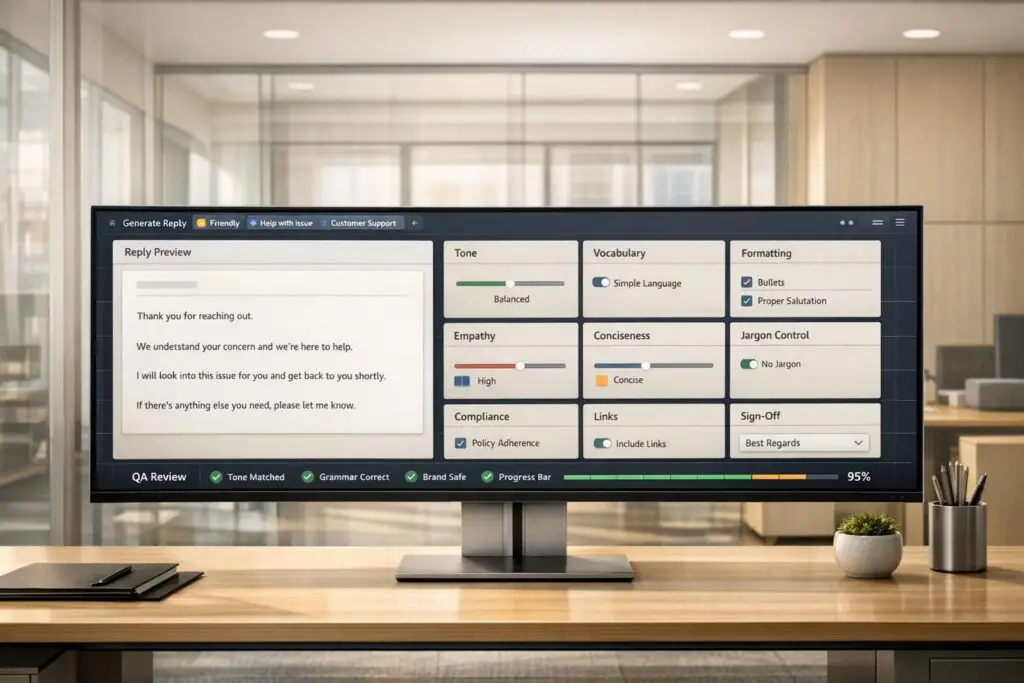
- Automate quality checks: Build safeguards into workflows to catch tone or formatting issues before replies are sent.
How to Use AI for On-Brand Customer Support Replies
Turning Your Brand Voice into Rules AI Can Follow
Documenting Your Brand Voice Basics
Most brand guidelines rely on subjective adjectives that aren’t very helpful for AI. To get consistent results, you need to translate your brand’s personality into specific, measurable rules that an AI can follow.
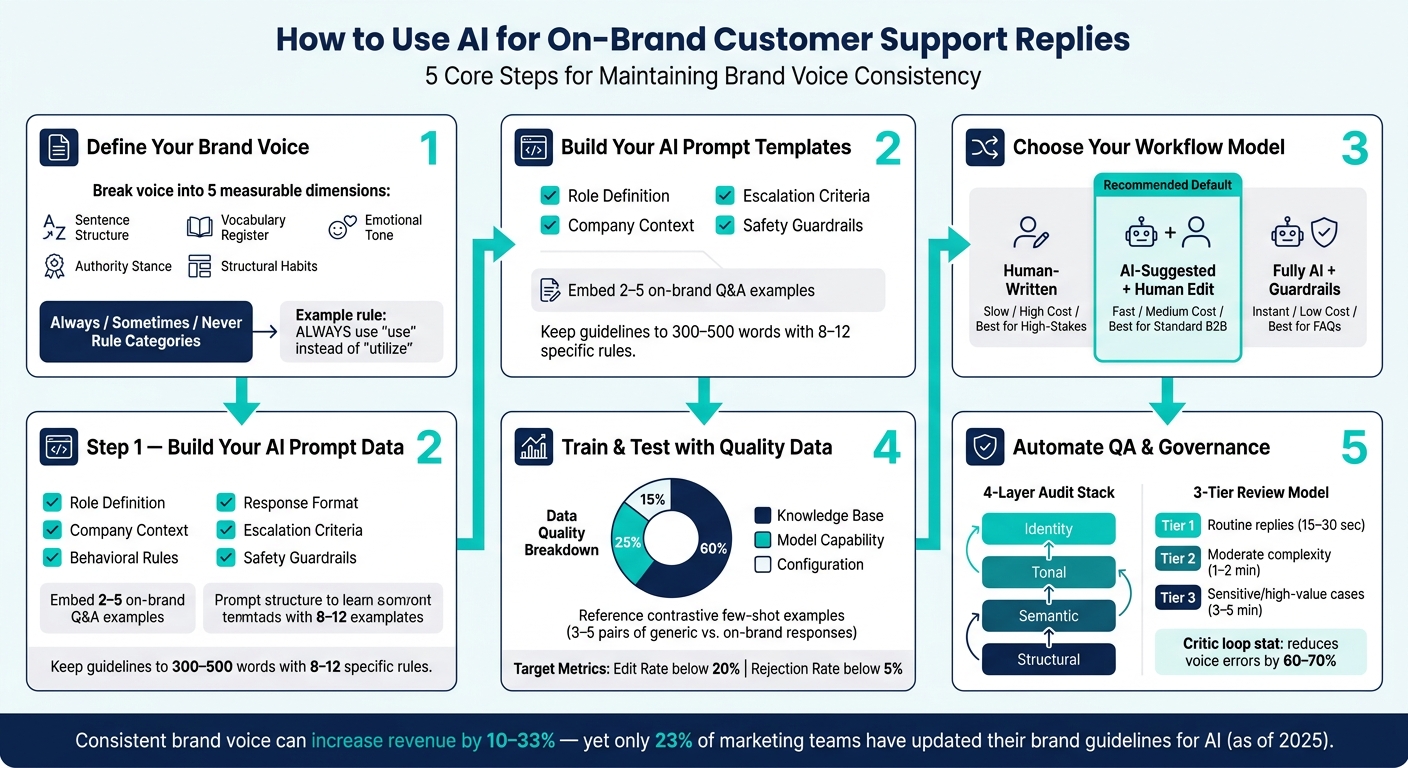
Consider five key dimensions: sentence structure (short and snappy or more flowing), vocabulary register (technical vs. conversational), emotional tone (warm and approachable vs. neutral), authority stance (expert vs. peer), and structural habits (bullet points or narrative style). Defining these elements gives AI clear instructions to replicate your brand voice. Once these dimensions are measurable, they can be turned into actionable AI guidelines.
Converting Brand Guidelines into AI Instructions
After identifying your voice attributes, the next step is creating clear instructions. Use three categories – always, sometimes, and never – to organize your rules. For example: "ALWAYS use ‘use’ instead of ‘utilize’"; "SOMETIMES start with a question"; "NEVER use words like ‘revolutionary’ or ‘game-changing’."
"Brand voice isn’t a vibe; it’s an operating system. When you codify it into prompt building blocks… you unlock speed and consistency without diluting what makes you distinct." – Ameya Deshmukh, Director of Growth Marketing [3]
Provide measurable guidelines, such as "keep sentences under 20 words" or "paragraphs should be 1–3 sentences long." These kinds of rules lead to more consistent results. A concise guide of 300–500 words with 8–12 specific rules works better than a longer document because AI tends to overlook deeply buried details [4].
Here’s an example of how to translate voice attributes into actionable AI instructions:
| Voice Element | AI Instruction Example | Purpose |
|---|---|---|
| Tone | "Maintain a Bold 7/10 and Pragmatic 8/10 tone." | Defines emotional tone. |
| Lexicon | "NEVER use ‘utilize’; ALWAYS use ‘use’." | Sets vocabulary standards. |
| Structure | "Keep sentences under 20 words. Use 1-sentence paragraphs for emphasis." | Improves readability and rhythm. |
| Negative Constraints | "Avoid ‘revolutionary,’ ‘cutting-edge,’ and ‘game-changer’." | Prevents overused, generic phrases. |
| Authority | "Write as a peer sharing experience, not an expert lecturing." | Establishes the brand’s perspective. |
To make these rules even more effective, include 3–5 examples of on-brand content and 2–3 examples of what to avoid. This approach helps AI clearly distinguish between acceptable and unacceptable styles [3][4]. Once your guidelines are set, keeping them centralized ensures consistency.
Keeping Brand Voice Instructions in One Place
Scattered guidelines lead to brand drift – small changes over time that alter your voice. To avoid this, store all approved voice rules, templates, and examples in a single, centralized repository. This ensures that everyone working with AI uses the same foundation, keeping your voice consistent.
Treat this repository as a read-only document, managed by a dedicated brand steward. Team members can reference it but not make changes. For instance, in January 2026, Apollo.io‘s CMO Marcio Arnecke implemented a centralized AI system using AirOps. This system included tone rules, keyword density guidelines, and other brand elements. The result? Content that not only performed better in search rankings but also stayed true to Apollo’s voice [2]. The same principle works for customer support – when every agent uses the same voice guidelines, consistency becomes automatic instead of a manual process.
sbb-itb-e60d259
From generic AI output to nailing your brand tone | Voice and Knowledge Graphs
Setting Up AI Workflows for On-Brand Reply Drafting
Once you’ve defined your brand’s voice, the next step is crafting AI workflows that ensure replies consistently reflect that voice. Here’s how to do it.
Building Prompt and Template Structures That Work
To get AI-generated drafts that align with your brand, turn your voice rules into detailed prompts. For customer support, a solid prompt should include six key elements: role definition, company context, behavioral rules, response format, escalation criteria, and safety guardrails [6].
For example, define the AI as a "senior support agent" to convey a professional and authoritative tone. Clearly outline behavioral rules, such as using bullet points for step-by-step instructions and starting responses with empathy when addressing negative feedback. Safety guardrails are essential to prevent issues like fabricating features, offering unauthorized refunds, or sharing internal information [6].
"Bad prompts create frustrating bots. Great prompts create helpful, trustworthy assistants." – Chatsy [6]
You can further refine your AI’s output by embedding a few ideal Q&A examples (2–5 pairs) directly into the prompt. For more complex scenarios, include chain-of-thought instructions, like breaking down a process into steps: "identify the plan, verify the invoice, explain the charge" [6].
Using AI Features to Speed Up Drafting
A well-structured prompt is just the beginning. To truly enhance efficiency, integrate AI tools into your workflow. Features such as AI case summaries, knowledge base integration, and auto-response generation can significantly reduce drafting time.
For instance, Supportbench‘s AI Agent-Copilot pulls insights from past case histories and the knowledge base to offer tailored suggestions in real time. Its auto-response feature can draft replies based on prior interactions in a case, allowing agents to focus on reviewing and refining the response rather than starting from scratch. Add to this the automatic inclusion of customer details – like their name, plan tier, or recent ticket history – and you get personalized replies without needing manual data entry [6].
This streamlined process also creates a feedback loop. When agents repeatedly edit AI-generated drafts, those patterns can signal where prompt rules need tweaking. Over time, this ensures the AI becomes even more aligned with your brand’s voice and context.
Comparing AI Drafting Workflows
Different situations call for different levels of AI involvement. Here’s a breakdown of common workflow models and when to use them:
| Workflow Type | Response Speed | Consistency Risk | Cost | Best For |
|---|---|---|---|---|
| Human-Written | Slow | Medium (varies by agent) | High | High-stakes issues |
| AI-Suggested + Human Edit | Fast | Low (human ensures accuracy) | Medium | Standard B2B inquiries and account support |
| Fully AI + Guardrails | Instant | High (requires strict rules) | Low | FAQs, structured data, and low-risk tasks |
For most B2B support teams, the AI-suggested + human edit model offers the best balance. It eliminates the "blank page" problem while ensuring a human touch keeps responses on-brand. Fully automated workflows can work for predictable, low-risk tasks – provided strict safety measures are in place and the underlying knowledge base is accurate [6].
"Your voice is your edge. By building a style profile… you can harness AI’s power without losing your authenticity." – Tyler Clayton, Platform Steward, SUCCESS [5]
To maintain consistency across all workflows, consider using reusable "voice wrappers." These act as a framework for applying your brand’s tone and style to every task, whether the reply is fully automated or human-assisted [5].
Training and Testing AI on Your Brand Language
To ensure your AI consistently reflects your brand voice, you need high-quality training data built around your established tone and prompt structures. This makes every interaction feel aligned with your brand identity.
Building a Training Dataset from On-Brand Content
The quality of AI output is heavily influenced by your source material: 60% depends on your knowledge base, 25% on the model’s capabilities, and 15% on configuration [8]. In other words, your content library is the foundation of success.
Begin by reviewing your top-performing materials. Collect 15–20 examples of your best content – like resolved customer support cases, polished email templates, or knowledge base articles. Analyze these for patterns in sentence structure, word choice, and tone. Translate your findings into specific, measurable guidelines. For instance, instead of simply describing your tone as "friendly", define it with criteria like: sentence length of 12–16 words, use of contractions, and avoiding passive voice for decisions [1][7].
A helpful tool here is contrastive few-shot examples. Pair an AI-generated, generic response with a rewritten version that matches your brand’s tone. Use 3–5 pairs to demonstrate the desired style. To ensure clarity, include a "never use" list of banned phrases or words, such as "In today’s fast-paced world" or "leverage" [1][7]. This approach helps the AI identify what to avoid, not just what to emulate.
"The brand voice that took years to build is dissolving into AI-generated uniformity. And the traditional style guide… wasn’t designed for this. It was built for humans who interpret nuance. AI needs something different." – My Writing Twin [7]
Once your dataset is ready, establish systems for continuous improvement to keep your AI outputs sharp and aligned.
Setting Up Feedback Loops for Ongoing Improvement
A solid training dataset is just the beginning. To maintain and improve quality, you’ll need a streamlined feedback system. Simplify the process for your team by embedding one-click quality ratings – options like Perfect / Good / Needs Improvement – directly into the drafting interface. Pair these with predefined error categories, such as "Tone mismatch" or "Factual error" [8].
Act on this feedback quickly. For example, update your knowledge base or prompt rules within a week of identifying consistent issues. To build trust and engagement, share a weekly digest highlighting updates – like the number of revised knowledge base articles and the current edit rate [8]. A well-functioning AI drafting system should aim for an edit rate below 20% and a rejection rate below 5% for stable content categories [8]. If these rates exceed targets, it’s a sign your prompts or source material need adjustment.
Another useful technique is the critic loop. After generating a draft, instruct the AI to review its own output as if it were a brand editor, using a simple internal checklist. This reflective step can reduce tone and style errors by 60–70% compared to single-pass generation [1].
Comparing Training and Validation Methods
Different training and validation approaches work best for different needs. Here’s a quick comparison:
| Method | Setup Ease | Maintenance Effort | Scalability | Best For |
|---|---|---|---|---|
| Manual Guideline Enforcement | High (relies on existing documents) | Very High (requires constant human review) | Low | Sensitive or high-risk content [2][8] |
| Prompt Engineering | Moderate (requires layered architecture) | Moderate (needs version control) | Moderate | Daily drafting and standard B2B support [1] |
| Fine-Tuning / System Training | Low (technical setup required) | Low (persistent rules) | High | High-volume support and scaling teams [2] |
Quality Assurance and Governance for Brand Voice Consistency
Once AI drafting workflows are active, the real challenge becomes maintaining consistency. Even small deviations from your brand’s tone can erode trust on a large scale. Ensuring consistent oversight helps every AI-assisted reply reinforce your brand’s identity. Governance isn’t about slowing things down – it’s about ensuring speed doesn’t come at the expense of quality.
Automating Voice and Quality Checks
Consistency starts with embedding automated checks directly into your drafting process. These safeguards catch issues before replies reach customers. A 4-layer audit system can be particularly effective:
- Structural: Checks for sentence length and formatting.
- Semantic: Flags banned words and ensures required vocabulary is used.
- Tonal: Ensures the emotional tone matches the brand’s guidelines.
- Identity: Verifies alignment with the brand’s overall voice.
Adding a critic loop – where the AI reviews its draft against brand voice guidelines before finalizing – can significantly reduce errors. This step has been shown to cut common voice failures by 60–70% compared to single-pass generation [1]. Pair this with an internal voice scorecard (on a 1–10 scale), where a score of 8 or higher signals strong brand alignment. This creates a fast, repeatable way to identify drafts that need further attention [9].
"Auditing creates a feedback loop. Proofreading does not." – Atom Writer [10]
Once automated checks are in place, human review can focus on higher-risk replies.
Designing a Tiered Review Workflow
Not every reply carries the same level of risk, so a one-size-fits-all review process can waste time and create bottlenecks. A risk-based, three-tier review model ensures drafts are treated according to their complexity and importance:
| Review Tier | Time Investment | Use Case | Action |
|---|---|---|---|
| Tier 1: Quick Review | 15–30 seconds | Routine, high-confidence replies (e.g., password resets) | Scan and approve if error-free [8] |
| Tier 2: Standard Review | 1–2 minutes | Moderate complexity (e.g., billing questions) | Validate against knowledge base; minor edits [8] |
| Tier 3: Deep Review | 3–5 minutes | Sensitive or high-value cases | Thorough validation or senior agent sign-off [8] |
One risk to watch out for is rubber-stamping, where agents approve drafts without actually reviewing them. Periodic spot-checks of approved responses can help identify this issue early. Monthly calibration sessions – where the review team independently rates the same 10 AI drafts – are another effective way to align quality standards and address blind spots before they become systemic [8].
"Speed without quality is worse than no speed at all. A customer who waits four hours for an accurate, helpful response is better served than one who receives an instant reply that misses the point." – Relay Team [8]
Monitoring Brand Voice Across Channels
To ensure consistency, it’s crucial to monitor brand voice across all channels. When email, customer portals, and knowledge base articles operate in silos, inconsistencies can easily creep in. Two key metrics help track this:
- Edit Rate: The percentage of AI drafts modified before sending. Aim to keep this below 20%.
- Rejection Rate: The percentage of drafts discarded entirely. This should stay below 5% [8].
If either metric starts trending upward, it’s a sign that your prompts or knowledge base content need adjustment.
Beyond internal metrics, compare CSAT scores for AI-assisted replies against those for human-only responses. If customer satisfaction drops after introducing automation, it’s often due to tone issues rather than factual errors [8]. Tools like Supportbench can provide predictive CSAT and QA insights, simplifying this comparison without requiring additional analytics platforms. Conduct monthly batch audits, sampling 10–15% of published content, to catch any compliance drift that daily reviews might miss [10]. When issues arise, map them back to specific areas: semantic problems may require refining banned word lists, while tonal issues might call for adjustments to tone descriptors.
Conclusion: Building AI and Brand Voice Governance into Daily Operations
Recap of Key Steps
Integrating AI drafting into your daily operations requires a structured approach. Begin by turning vague descriptors into measurable, actionable rules – think formality levels, banned word lists, and conditional logic. Next, create prompt templates and store them in a shared, version-controlled library to ensure all team members operate from the same foundation. Finally, implement QA measures like automated checks and tiered reviews to catch and correct any deviations from your brand voice. These steps ensure that every customer interaction stays aligned with your messaging.
Research shows that maintaining a consistent brand voice can increase revenue by 10% to 33% [11]. However, by 2025, 87% of marketing teams will use AI for content creation, yet only 23% will have updated their brand guidelines to reflect this shift [11]. This mismatch often leads to breakdowns in brand voice – not because AI lacks capability, but because the guidance it receives is outdated or incomplete.
"Brand voice breaks with AI when instructions are vague, knowledge is missing, and governance is weak, producing plausible but off-message copy that increases rework and risk." – Ameya Deshmukh, EverWorker [12]
Keeping Brand Voice Rules Current as You Scale
As your operations grow, ongoing governance becomes essential to prevent voice drift – a phenomenon where AI outputs slowly lose their distinctiveness and become overly generic due to outdated rules [5].
To counter this, schedule quarterly reviews to evaluate AI outputs, identify tone inconsistencies, and update your prompt library. When your audience or messaging evolves, adjust your central guidelines promptly to ensure your tone remains consistent [2][11][12]. Tyler Clayton, Platform Steward at SUCCESS, highlights:
"The investment is front-loaded. Once your system is built, maintenance takes just minutes per week." [5]
Tools like Supportbench simplify this process by consolidating QA insights and CSAT, CES, and NPS tracking in one platform, allowing you to identify voice issues across channels without juggling multiple tools. With this ongoing oversight, your brand voice stays polished and consistent across all customer interactions.
FAQs
What’s the fastest way to turn our brand voice into AI-ready rules?
Creating a detailed brand voice guide is the fastest way to ensure consistency in AI-generated content. This guide should cover your brand’s tone, preferred vocabulary, core values, and overall style. Once you have this, you can craft a system prompt that directs the AI to follow these guidelines.
To make the process even smoother, include examples of both on-brand and off-brand copy in your prompt. This helps the AI better understand your expectations, leading to replies that require minimal tweaking and align closely with your brand’s identity.
How do we stop AI replies from drifting off-brand over time?
To ensure AI-generated replies align with your brand, start by creating detailed style guides and voice profiles that the AI can follow. These guides should define tone, language preferences, and key messaging principles. Regular audits of AI-generated content help maintain consistency, while updating these profiles ensures they evolve alongside your brand’s standards.
Using shared templates can also minimize variability, making responses more uniform. For replies involving sensitive or high-stakes situations, consider implementing lightweight approval workflows to review and adjust responses as needed. Additionally, refining prompts based on user feedback can enhance the AI’s ability to produce replies that match your brand’s voice, even as your support demands grow.
When should we allow fully automated replies vs human review?
Fully automated replies are ideal for handling straightforward, low-risk tasks like answering FAQs, providing order updates, or confirming statuses – as long as the AI is properly trained and aligned with your brand’s tone and style. However, for more complex, sensitive, or high-stakes situations – like addressing complaints or managing escalations – human oversight becomes crucial. This ensures responses are accurate, appropriately toned, and maintain customer trust. Striking the right balance between automation and human involvement helps maintain consistency without compromising your brand’s voice.
Related Blog Posts
- AI Prompts for Customer Support: 25 Copy-Paste Prompts for Faster Replies
- Automated Rewrites: Turning Bullet Points into Professional Replies
- How to reduce back-and-forth emails: the “one-message diagnosis” method
- How to set customer expectations without sounding defensive
Evaluating help desks for a B2B team?
Supportbench is all-inclusive from $32 per agent per month, with migration and onboarding included. See pricing or book a 20-minute demo.