Account-based support and transactional support serve different purposes in customer service. Here’s the key takeaway:
- Transactional support is best for quick, straightforward issues like password resets or billing inquiries. It’s reactive, focuses on speed, and uses standardized processes to handle high volumes efficiently. Metrics like response time and customer satisfaction are key here.
- Account-based support is tailored for high-value, complex accounts. It emphasizes long-term relationships, proactive engagement, and understanding the customer’s broader goals. It’s ideal for managing enterprise clients, with metrics like customer retention and lifetime value taking priority.
Quick Comparison
| Dimension | Transactional Support | Account-Based Support |
|---|---|---|
| Focus | Immediate issue resolution | Long-term value and business goals |
| Scope | Individual queries | Entire organization |
| Approach | Reactive | Proactive |
| Team Structure | Shared pool of agents | Dedicated account managers |
| Metrics | Time to resolution, CSAT | Retention, NPS, customer lifetime value |
Both models have their place: transactional support excels in handling simple, repeatable tasks, while account-based support is crucial for managing strategic relationships. AI tools are enhancing both approaches, improving efficiency in transactional support and enabling deeper insights in account-based models.
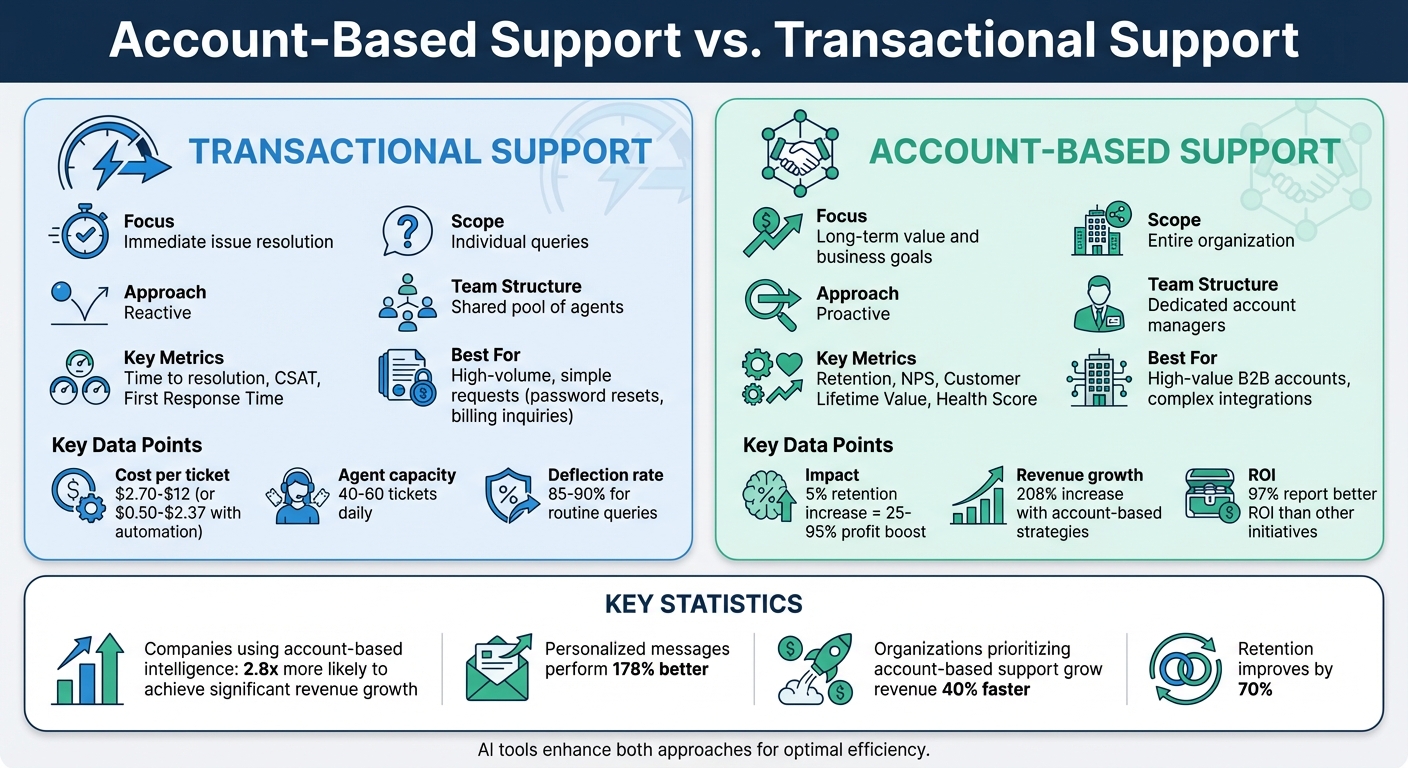
Account-Based vs Transactional Support: Key Differences Comparison
What is Transactional Support?
Transactional support is a reactive approach aimed at resolving individual customer issues as swiftly as possible. In this model, the customer initiates contact – often through chat, email, or phone – and the support team addresses the issue. Once resolved, the interaction ends. As Ben Nachmani from Mosaic explains:
B2C support is primarily reactive… focused on a world where you’re dealing with a high volume of low stakes customer requests [3].
The focus here is on speed and efficiency, with success measured by metrics like First Response Time (FRT), Average Handle Time (AHT), and Resolution Time. It’s particularly effective in high-volume situations where each interaction is relatively straightforward.
Transactional support is often categorized into Tier 0 (self-service tools and automation) or Tier 1 (basic troubleshooting and frontline support). A great example of its impact comes from Cynet, which implemented the Mosaic AI platform in late 2024 to automate Tier 1 requests. The results were impressive: 47% of Tier 1 tickets were deflected, resolution times were cut by 50%, and their Customer Satisfaction (CSAT) score rose by 14 points [3]. These outcomes highlight the strengths of transactional support in handling repetitive, high-volume tasks efficiently, though it’s less suited for personalized or complex issues.
Key Characteristics of Transactional Support
Transactional support revolves around standardized processes designed to handle large volumes quickly and consistently. Agents often rely on scripts or decision trees, ensuring uniformity across thousands of interactions. This system treats customers as cases to resolve, rather than as long-term partners. For straightforward problems, this works well – customers usually prioritize quick answers over a relationship.
Speed is the hallmark of this model. For example, Severity 1 issues typically require responses within 15–60 minutes, Severity 2 within 2–4 hours, and Severity 3 within one business day [4]. These benchmarks demonstrate the model’s ability to maintain efficiency at scale.
Another defining feature is the lack of historical context. Each interaction is treated independently, with no need for agents to understand the customer’s past interactions, broader goals, or account health. While this makes the model highly scalable, it limits its ability to handle complex or layered issues. The trade-off? Faster resolutions and higher capacity, but at the cost of deeper, more strategic customer engagement.
Transactional Support Examples
Common examples of transactional support include:
- Password resets and login issues: A user locked out of an account submits a ticket, receives a reset link, and the case is closed without follow-up.
- Basic troubleshooting: For instance, a customer reports a feature isn’t working. The agent guides them through a checklist – clearing the cache, restarting the app, or checking for updates. If unresolved, the issue is escalated to Tier 2.
- Simple product or pricing questions: Agents might refer customers to a knowledge base or provide setup instructions for software integrations.
In B2B settings, transactional support also handles standardized processes like EDI exchanges. This could involve processing purchase orders or invoices, where workflows are repetitive and don’t require in-depth customer context [6].
sbb-itb-e60d259
What is Account-Based Support?
Account-based support takes a relationship-centered approach, designed for high-value B2B customers who need more than just quick fixes. Instead of viewing each support ticket as a standalone issue, this model emphasizes long-term collaboration and coordination between organizations [2]. Eric Klimuk, Founder and CTO of Supportbench, explains it best:
B2B customer service is about long-term partnerships, technical depth, and coordination across organizations. [2]
Enterprise clients often involve 6 to 10 decision-makers – ranging from executives to end-users and technical staff [11]. Account-based support ensures that every interaction accounts for the broader organizational context, not just the individual submitting the ticket. The focus isn’t just on resolving issues quickly but on understanding the bigger picture to drive retention and growth.
Unlike traditional support, which prioritizes speed, account-based support transforms agents into strategic advisors. They proactively address potential problems by identifying early warning signs like unusual usage patterns or shifts in customer sentiment [2]. The numbers back up this approach: 88% of customers say how they’re treated is as important as the product itself, and excellent service increases repeat purchases by 82% [5]. Retaining a customer is also far more cost-effective – acquiring a new one costs 6 to 7 times more [5]. These stats highlight why account-based support makes sense for businesses handling high-value accounts.
Key Characteristics of Account-Based Support
This model operates on a "market of one" philosophy, treating each high-value account as its own unique market that requires a tailored approach. Success depends on close collaboration between sales, marketing, and support teams, all working from a shared understanding of the customer’s history, preferences, and goals. Instead of generic responses, agents use AI-powered ticketing and CRM tools to log detailed notes about customer interactions and preferences. Sales trainer Jen Suzuki emphasizes this, noting that effective relational sellers rely heavily on their CRM to track key details [7].
Account-based support often uses a tiered engagement structure:
- Tier 1 (1:1): Top-tier accounts receive highly personalized, strategic attention, often with dedicated account managers and custom solutions.
- Tier 2 (1:Few): Groups of accounts with similar needs are provided with semi-customized support.
- Tier 3 (1:Many): Automation and AI deliver personalized outreach at scale.
Proactive engagement is a cornerstone of this model. Teams monitor key triggers like leadership changes, contract renewal dates, or funding announcements, and they use technographic data to predict customer needs and prevent issues [10]. This shifts support from being a reactive cost center to a proactive driver of customer success.
Account-Based Support Examples
Here’s how these strategies play out in real-world scenarios:
- Handling complex technical integrations: Imagine an enterprise SaaS customer rolling out a complicated API integration across multiple departments. They’re assigned a dedicated technical account manager who works with engineering teams, schedules regular check-ins, and shares best practices from similar projects.
- Coordinating multi-departmental support: A manufacturing client with users across procurement, logistics, and finance benefits from a single point of contact. This person understands the workflows of each department, directs issues to the right specialists, and ensures updates are shared with all stakeholders.
- Retention-focused enterprise support: A support team tracks a client’s contract renewal date (90 days ahead), proactively reviews usage data, resolves any lingering issues, and highlights new features that align with the client’s evolving needs – turning support into a key driver of retention and growth.
These examples showcase how account-based support delivers value by going beyond simple ticket resolution. Companies using account-based intelligence report being 2.8 times more likely to achieve significant revenue growth [10], and personalized messages in this model perform 178% better than generic ones [10].
Key Differences Between Account-Based Support and Transactional Support
Expanding on earlier definitions, it’s essential to dive into how transactional and account-based support differ in their approach and impact. These differences go far beyond simply handling customer tickets. Transactional support operates reactively – it’s the go-to when customers encounter issues and need immediate help [12]. On the other hand, account-based support takes a proactive stance, focusing on understanding customer goals and encouraging product adoption before problems arise [12]. Bree Pecci from ChurnZero sums it up perfectly:
"Customer Success is proactive and assigned. Customer Support is reactive and round-robin." [12]
This distinction is reflected in how teams are structured. Transactional support often uses a round-robin system, where the next available agent handles the inquiry. Meanwhile, account-based support assigns dedicated managers to oversee specific accounts, acting as a consistent point of contact throughout the customer’s journey [12]. This setup allows account-based teams to focus on high-value accounts – those that justify the additional investment [13]. In contrast, transactional models cater to a broader customer base, sometimes leading to inefficiencies, with up to 50% of budgets spent on leads that don’t yield results [1].
The financial outcomes of these models speak volumes. Account-based strategies have shown a 208% increase in revenue growth and a 171% rise in annual contract values [16]. Additionally, 97% of marketers using account-based programs reported achieving a better ROI compared to other initiatives [1]. For example, one account-based engagement program saw a 45% boost in pipeline generation and a 53% increase in deal size for top accounts [1].
Comparison Table
| Dimension | Transactional Support | Account-Based Support |
|---|---|---|
| Primary Focus | Immediate issue resolution [14] | Long-term customer value and business goals [14] |
| Customer Scope | Individual users and one-off tickets [1] | Entire organization and buying committees [19][20] |
| Engagement Type | Inbound and transactional [12] | Ongoing and consultative [12] |
| Response Model | Reactive – first line of defense [12] | Proactive – continuous touchpoints [12] |
| Team Structure | Round-robin support queue [12] | Assigned accounts with dedicated POC [12] |
| Resource Allocation | Broad and generalized messaging [1] | Focused on high-value accounts [17] |
| Key Metrics | Time to Resolution, CSAT, CES [14][18] | Health Score, NPS, CLV, Retention [12][14][18] |
| Goal Orientation | Instructional – speed and quality of resolution [12] | Consultative – aligned with business outcomes [12] |
| Technology Use | Basic CRM and ticketing systems [1] | Advanced tools with predictive analytics and AI [1] |
Metrics further highlight the differences between these models. Transactional support prioritizes speed and efficiency, tracking metrics like first response time, average resolution time, and CSAT, CES, and NPS for individual interactions [14][18]. In contrast, account-based support measures broader, long-term indicators such as Net Promoter Score, customer lifetime value, product adoption rates, and churn risk [12][14][18]. These metrics underscore when and how each model should be deployed.
When to Use Transactional Support
Transactional support is ideal for handling high volumes of simple, repeatable requests that don’t demand in-depth investigation or ongoing relationships. It’s all about speed and efficiency, making it perfect for tasks like password resets, order status updates, basic troubleshooting, and account management. These are scenarios where solutions follow predictable patterns, ensuring quick resolutions [21][22].
From a cost perspective, the benefits are clear. In retail and e-commerce, transactional support costs range from $2.70 to $12 per ticket. Automation, however, can bring that down to just $0.50–$2.37, cutting costs by as much as 98% [28]. For example, if your team addresses the same 487 password reset requests every month, automation becomes a no-brainer [28]. This sharp focus on efficiency is why transactional support dominates in high-volume environments.
Operationally, it’s a game-changer. Agents handling transactional support can manage 40–60 tickets daily, thanks to standardized scripts and short average handle times [28]. These tasks don’t require deep expertise, meaning entry-level staff can be quickly trained using macros and templates, which further reduces labor costs [28].
Automation also offers excellent deflection rates for transactional inquiries. For instance, order tracking and delivery status requests in retail can achieve deflection rates of 85–90% [28]. A great example is Zoom Communications, which, in February 2026, used its Zoom Virtual Agent 3.0 to boost billing inquiry deflection from 0% to 30% in just three months. This saved over 1,000 agent hours per month while reducing the "no-match" rate from 35% to 0%, significantly improving first-touch resolution [27].
Best-Fit Industries and Scenarios
Transactional support thrives in several industries and scenarios:
- SaaS and IT environments: Perfect for Level 1 help desk tickets like VPN connectivity issues, software access requests, and basic troubleshooting. For example, ServiceNow’s IT help desk reached a 90% autonomous resolution rate in February 2026 by deploying its "Autonomous Workforce" bot. This system tackled networking (46%), software (43%), and hardware (11%) issues, achieving over 99% resolution rates for specific categories [26].
- E-commerce and retail: Handles tasks like warranty claims, return tracking, and shipping updates efficiently [23][28].
- Finance teams: Automates payroll inquiries, payment confirmations, and bank reconciliation, saving up to 10 hours per week on manual data entry [24].
- Workforce management: Manages shift swaps and time-off requests effectively, keeping systems running smoothly during busy periods [25].
If your support team deals with high-volume, low-complexity tasks that follow predictable workflows, transactional support offers an unmatched cost-to-efficiency balance [3]. By automating these routine queries, your team can focus on more complex issues that require human expertise. Next, we’ll dive into how account-based support can address complex, multi-stakeholder challenges.
When to Use Account-Based Support
Account-based support is designed for managing the intricate needs of strategic, high-value relationships. Unlike high-volume transactional support, this approach is tailored for scenarios where every interaction directly influences retention and revenue – particularly in B2B relationships with accounts generating hundreds of thousands to millions in Annual Recurring Revenue (ARR). These relationships require more than a one-size-fits-all model; they demand a deep understanding of the customer’s goals, proactive problem-solving, and seamless coordination across various stakeholders, from end-users to executives. This personalized strategy not only protects revenue but also strengthens long-term partnerships.
Here’s a compelling stat: boosting customer retention by just 5% can increase profits by 25% to 95% [29]. With numbers like these, the investment in dedicated account teams, technical resources, and customized support strategies becomes a no-brainer for top-tier clients.
This model is particularly effective in situations with long sales cycles and complex buying committees. For example, if your product is deeply integrated into a customer’s infrastructure – think developer tools, APIs, or cloud platforms – your support team needs to understand intricate technical workflows [30]. When a product failure could disrupt critical operations, a simple ticketing system won’t cut it. What’s needed is a strategic partnership that prioritizes proactive solutions.
"B2B support requires fundamentally different strategies than B2C: you’re managing high-stakes relationships with multiple stakeholders, complex technical products, and accounts worth hundreds of thousands to millions in ARR where every interaction impacts retention." – Mosaic [3]
Account-based support shines in multi-stakeholder environments, where support must address everyone from technical implementers to CFOs assessing ROI. On average, a B2B buying team includes 5.4 people, but larger technology purchases can involve 12 or more stakeholders [31]. Engaging multiple contacts at a target account increases the likelihood of closing deals by 37% [19]. This underscores the importance of cross-functional, coordinated support to drive both retention and account expansion.
Best-Fit Industries and Scenarios
This model works best in industries where relationships are central to revenue growth and switching costs are high. Here are some examples:
- SaaS and technology companies: These businesses thrive on usage data, technical engagement, and aligning product roadmaps with customer needs. For companies operating on "land-and-expand" models, account-based support ensures smooth integration into workflows. With 84% of developers now using or planning to use AI tools [30], support teams must speak the same technical language as their users.
- Manufacturing, logistics, and supply chain: These industries often deal with lengthy procurement cycles and intricate integrations. Account-based support helps navigate technical specifications and fosters personal relationships that can span years [29].
- Professional services firms: For these organizations, the depth of relationships often surpasses that of product-based companies. Account-based models allow them to provide expertise, advisory services, and identify expansion opportunities [29].
- Financial services and fintech: Here, managing sensitive data requires a focus on compliance, trust, and risk management. Support teams must understand regulatory requirements, assist with SOC 2 compliance, and address privacy concerns [29][30].
Account-based support is also critical in specific scenarios such as onboarding (to ensure early adoption and measurable success), maturity phases (to maximize value and address feature requests), and risk or escalation periods (to prevent churn) [3]. For high-value accounts, renewal discussions should start 6 to 18 months in advance to align with fiscal calendars and budget cycles [33]. Companies that refine their renewal processes see 13.7% more revenue from their existing customer base [32].
Organizations that prioritize account-based support grow revenue 40% faster and improve retention by 70% [31]. This makes it an obvious choice for businesses where a handful of strategic accounts drive the majority of revenue. Up next, we’ll dive into how AI can amplify these strategies to optimize support for high-value accounts even further.
How AI Improves Both Support Models
AI is transforming the way support teams operate, whether they’re handling thousands of individual tickets or managing portfolios for high-value accounts. In transactional support, AI focuses on speed and efficiency, while in account-based support, it emphasizes context and relationship management.
The McKinsey Global Institute highlights that intelligent automation can cut processing time by up to 80%, reduce operational costs by 30–40%, and help detect and contain breaches 70 days faster. These advancements allow support teams to shift from reactive problem-solving to proactive customer care [35].
Modern AI platforms act as centralized memory hubs, tracking critical data across teams, projects, and customers to provide context-aware assistance. They can prioritize tasks, assess risks, and route tickets efficiently [35]. This is especially vital in B2B environments, where resolving a single ticket might uncover a larger, account-wide issue requiring strategic action. While transactional support benefits from operational efficiency, account-based support gains from AI’s ability to strengthen customer relationships.
AI Tools for Transactional Support
In high-volume environments, AI streamlines operations by automating requests [34]. Key features include:
- Sentiment Analysis: Monitors customer emotions in real time, escalating urgent or frustrated interactions.
- Intent Detection: Automatically categorizes tickets, ensuring they reach the right agent.
- Predictive CSAT Scoring: Anticipates customer satisfaction levels based on prior interactions, flagging potential risks.
- First-Contact Resolution (FCR) Detection: Identifies opportunities for immediate resolution through automated workflows.
For example, AI-powered document processing can extract and validate data from invoices or orders, triggering automated communications like approval or rejection emails. This eliminates manual coordination delays, which can account for up to 70% of task completion time [35]. For transactional support teams, this means faster resolutions with fewer errors.
AI Tools for Account-Based Support
Account-based support requires tools designed for ongoing relationship management. Key features include:
- Customer Health Scoring: Combines data from all interactions to predict potential escalations.
- Case and Activity Summaries: Provides quick overviews of account history, helping managers stay informed.
- Dynamic SLAs: Adjusts service priorities based on account value, contract terms, or current health, ensuring top-tier accounts get the attention they need [15].
- Trend Analysis: Spots recurring issues within an account, enabling teams to address root causes before they escalate.
AI integrates data from multiple systems to provide seamless context. Dhruv Kapadia explains:
"The real expense isn’t just time spent on individual tasks but the accumulated friction of handoffs, inconsistency across team members, and delays when someone is unavailable" [35].
With these capabilities, account managers can access critical details – like contract terms or region-specific guidelines – without sifting through multiple systems.
Platforms like Supportbench include these AI-driven features, offering tools such as ticket summaries, resolution histories, QA insights, predictive CSAT and CES scoring, FCR detection, and automated knowledge base creation. These tools bridge the gaps left by traditional systems, enabling teams to handle both high-volume transactional tickets and strategic account management with a unified approach. Together, these AI capabilities are reshaping support models for greater efficiency and effectiveness.
Conclusion
Deciding between transactional and account-based support comes down to aligning your strategy with what your customers need most. Transactional support is all about speed and efficiency, designed for handling high volumes of straightforward requests where fast resolutions take center stage. On the other hand, account-based support focuses on building lasting relationships through personalized care, deeper engagement, and solving complex challenges – ideal for B2B accounts with intricate requirements.
These two approaches serve distinct purposes. Transactional models streamline costs through standardized workflows and high ticket throughput, while account-based models focus on reducing churn and increasing customer lifetime value – an essential priority when retaining a customer often costs far less than acquiring a new one [9]. However, forcing complex B2B issues into a rigid transactional system can create unnecessary tension, often leaving staff to "bend the rules" just to meet customer needs effectively [8].
AI plays a key role in elevating both models. In transactional support, it automates repetitive tasks, analyzes sentiment, and predicts satisfaction scores to maintain efficiency at scale. For account-based support, AI goes further – synthesizing account histories, monitoring health scores, and dynamically adjusting SLAs based on contract terms or renewal timelines [15]. Tools like Supportbench bring this to life with features such as AI-driven ticket summaries, predictive CSAT scoring, and customer health tracking, enabling teams to focus on strategic priorities instead of routine tasks.
The best B2B support organizations know how to apply each model where it makes the biggest impact. Routine issues like billing inquiries, password resets, and status updates fit perfectly within a transactional framework. Meanwhile, complex accounts with evolving needs, custom configurations, and renewal-driven goals are better served by an account-based approach.
FAQs
Can I use both support models at once?
Yes, it’s possible to use both models at the same time, and many organizations already do this to improve customer support. Account-based support is ideal for managing long-term, complex customer relationships, while transactional support handles individual, one-off issues. By combining these approaches, teams can efficiently address the needs of high-value accounts while also resolving simpler inquiries. With the help of modern AI tools, this hybrid method becomes even more effective, offering personalized workflows and faster issue resolution – delivering quality support without breaking the budget.
How do I decide which accounts need account-based support?
To identify which accounts require account-based support, start by focusing on customers that are high-value, complex, or strategically important. These are typically accounts that contribute significantly to revenue, involve multiple stakeholders, or show strong potential for growth. This approach works best for clients with intricate requirements or high-pressure projects, where tailored, hands-on support can strengthen relationships, boost long-term value, and reduce the risk of losing them. Dedicate your resources to accounts that hold strategic importance and present opportunities for shared success.
What should we automate first with AI?
Start with automating repetitive, time-consuming tasks that often drain resources and inflate costs. For instance, AI-powered knowledge base management can handle tasks like creating, updating, and searching for articles, which helps resolve issues faster and cuts down on ticket expenses. Another smart move is automating ticket triage and routing. By automatically prioritizing and assigning issues to the right teams, you’ll streamline workflows and boost efficiency. These changes free up your support team to focus on more strategic and personalized interactions, making them excellent first steps in adopting AI automation.
Related Blog Posts
- What Is Customer Service? Definition, Examples, and Best Practices
- Help Scout alternatives for B2B teams: what to choose when you outgrow shared inbox
- Freshdesk vs. Supportbench: Why B2B Teams Outgrow Freshdesk’s Ticket Model
- TeamSupport vs. Supportbench: Comparing B2B-First Features and Product Maturity