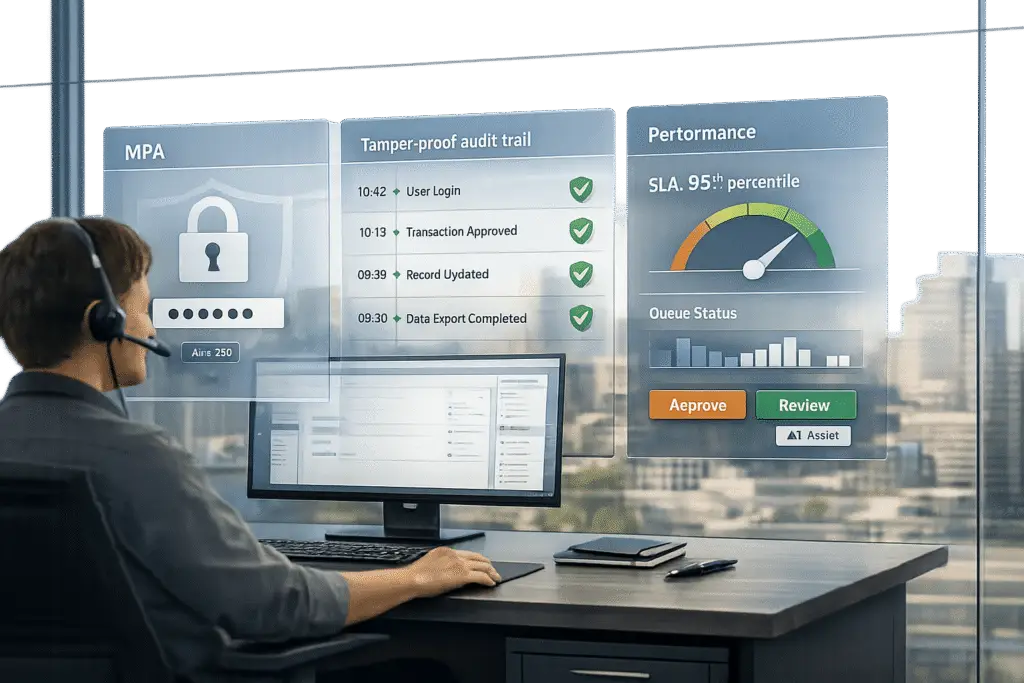
FinTech helpdesks face unique challenges:
- Security: Protect sensitive financial data with strict access controls, encryption, and fraud prevention measures.
- Auditability: Maintain detailed, tamper-proof logs for regulatory compliance (e.g., GDPR, PCI DSS, SOC 2).
- Speed: Deliver fast, accurate customer support to meet 24/7 expectations and prevent financial or reputational harm.
Key takeaways:
- Security is non-negotiable. Multi-factor authentication (MFA), encryption (AES-256), and role-based access ensure data stays protected.
- Compliance requires traceability. Automated audit trails and AI-driven compliance tools simplify regulatory adherence.
- AI boosts efficiency. AI agents handle 40–60% of queries, reduce ticket volumes, and prioritize urgent cases for faster resolutions.
Platforms like Supportbench integrate these priorities, combining security, compliance, and speed into a unified system. This ensures FinTech firms can safeguard customer trust while meeting strict regulatory demands.
Core Requirements for FinTech Helpdesks
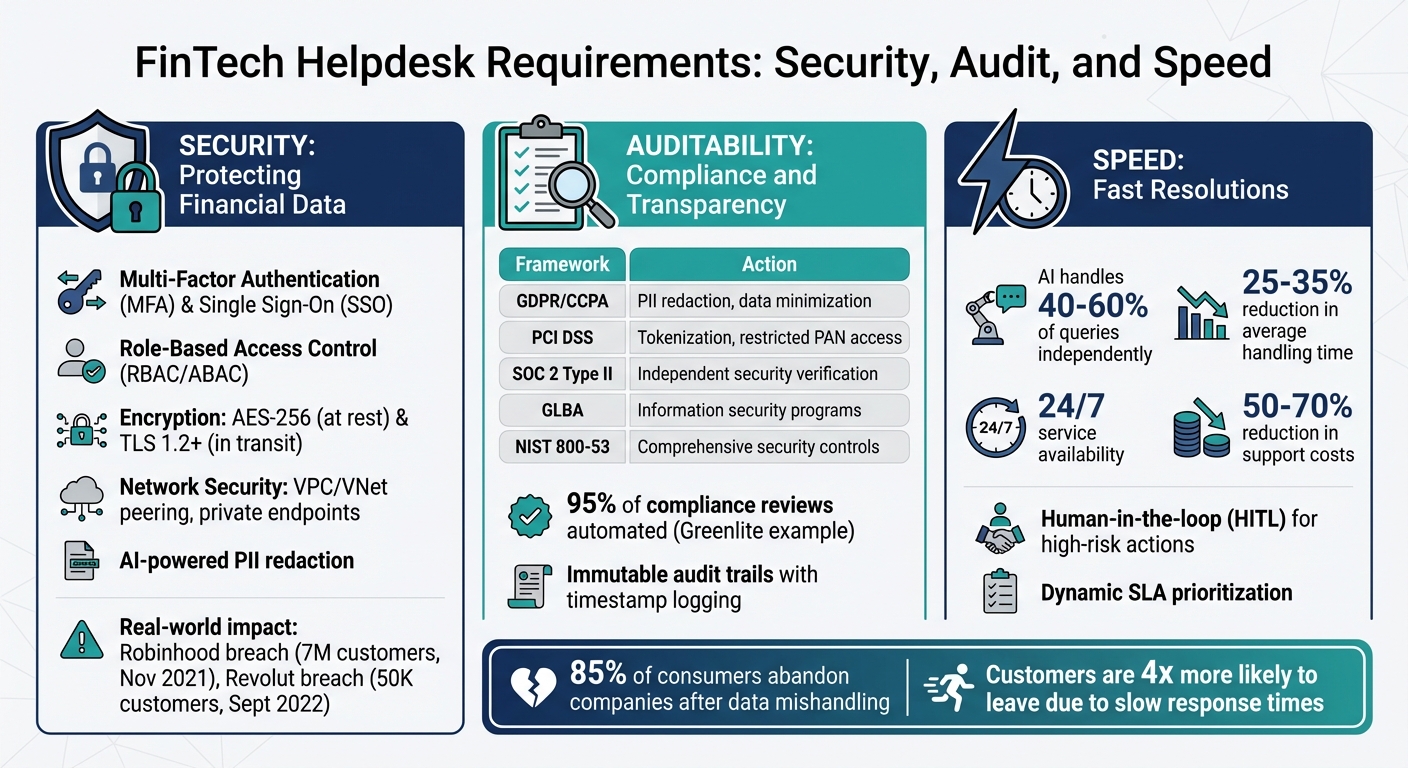
FinTech Helpdesk Security and Compliance Requirements Framework
FinTech helpdesks operate in a high-stakes, regulated environment where security, auditability, and speed are non-negotiable. These requirements stem from strict regulatory frameworks like GDPR, PCI DSS, SOC 2, and GLBA, alongside the reality that 85% of consumers will abandon a company after data mishandling.
Balancing these demands is no small feat. Support teams must work quickly to meet 24/7 service expectations while maintaining robust security measures to prevent social engineering attacks and ensuring detailed audit trails for compliance. As the TMC Insight Team aptly notes:
"Modernizing helpdesk services is as much about process as it is about tools. Support and security are now inseparable."
– TMC Insight Team [2]
This evolution has turned helpdesks into the "front line of defense." Agents now do more than resolve tickets – they play a critical role in preventing fraud, enforcing data protection policies, and creating the records needed for audits. Let’s explore how each of these requirements shapes daily operations and the tools that make it all possible.
Security: Protecting Financial Data
Keeping customer data secure is the top priority. FinTech helpdesks must enforce strict protocols to ensure both compliance and operational efficiency. For example:
- Access Control: Agents authenticate using MFA and SSO, with permissions tightly managed through RBAC or ABAC. This ensures agents only access the data they need – nothing more. A Tier 1 agent handling a password reset sees limited information, while a fraud specialist’s access is broader but fully logged [1][5].
- Encryption: Data must be encrypted at all times – whether in transit (via TLS 1.2 or higher) or at rest (using AES-256). Advanced platforms often support Enterprise Key Management (BYOK/HYOK), giving companies full control over encryption keys.
- Network Security: Tools like private networking (VPC/VNet peering), private endpoints, and IP allowlisting prevent sensitive data from traveling over public networks [5].
AI tools further enhance security by automatically redacting sensitive information like PII and financial identifiers before agents can view or process it. These tools also flag suspicious activity, such as a customer requesting account changes immediately after a password reset, helping stop potential fraud in its tracks.
The stakes are high, as recent breaches illustrate. In November 2021, Robinhood suffered a breach when attackers used social engineering to trick support staff, exposing data for 7 million customers [1]. Similarly, Revolut faced a cyberattack in September 2022 that compromised the personal data of 50,000 customers [1]. These incidents highlight the importance of robust identity verification and security protocols.
| Requirement | Standard/Framework | Key Control Measure |
|---|---|---|
| Data Privacy | GDPR / CCPA | PII redaction, data minimization, and deletion workflows. |
| Payment Security | PCI DSS | Tokenization of card data and restricted access to PANs. |
| Operational Security | SOC 2 Type II | Independent verification of security and confidentiality. |
| Financial Data | GLBA Safeguards | Information security programs and vendor oversight. |
| Infrastructure | NIST 800-53 | Comprehensive security and privacy controls. |
With security measures in place, maintaining detailed and tamper-proof records becomes the next critical step.
Auditability: Compliance and Transparency
Auditability ensures that every action – whether it’s a click, data update, or system call – is logged, timestamped, and tied to a specific agent or AI process. These tamper-proof trails are vital for demonstrating compliance with regulations like SOC 2, GDPR, and PCI DSS [1][5].
Modern helpdesk platforms simplify compliance by embedding it into daily workflows. For instance, when an agent accesses a customer account, the system automatically records the reason for access, the data viewed, and any changes made. AI processes are also logged, creating a reliable, evidence-based system for audits [6][5].
"Secure and compliant fintech customer service is built on structured processes rather than manual effort, and it delivers consistent results instead of reactive fixes."
– Maxwel Odhiambo, Customer Service Specialist, BoldDesk [1]
This level of transparency is invaluable during regulatory reviews or fraud investigations. Platforms like Supportbench capture complete case histories, making it easy to reconstruct events and resolve disputes. Automated tools also enforce policies like data redaction and retention, reducing the risk of human error.
AI is increasingly taking the lead in compliance. Advanced systems can handle up to 95% of compliance reviews automatically, slashing deployment times from weeks to days while ensuring audit trails are always ready for inspection [6]. This proactive approach not only satisfies regulators but also enhances operational efficiency.
Speed: Fast Resolutions Without Sacrificing Accuracy
In FinTech, speed is critical. Customers expect 24/7 service and instant solutions for issues like failed transfers or fraud alerts. Delays can lead to financial loss, regulatory penalties, and damaged reputations. As Twig explains:
"Fintech companies operate in a high-speed, high-expectation environment. Customers expect 24/7 service, instant responses, and seamless digital journeys – especially when dealing with their finances."
– Twig [3]
AI-driven solutions are key to meeting these demands. AI assistants can resolve up to 40% of queries independently – handling tasks like transaction status checks, password resets, and account balance inquiries [4]. This frees up human agents to focus on complex cases, reducing average handling times by 25–35% [3].
However, speed must not come at the expense of security or accuracy. For high-risk actions – like processing payments or changing account details – AI systems operate in a human-in-the-loop (HITL) workflow. This means the AI drafts and validates the request, but a human agent must approve it to ensure compliance [5]. Dynamic SLA management further enhances efficiency by prioritizing tickets based on urgency and risk [4].
Real-world examples show how this balance works. Wise, for instance, uses AI chatbots to handle over 60% of transaction and exchange rate inquiries automatically [3]. Nubank employs multilingual AI agents to serve customers across Latin America, maintaining high satisfaction levels while keeping staffing needs low [3].
These examples prove that, with the right safeguards, FinTech helpdesks can deliver rapid, secure, and accurate service around the clock.
sbb-itb-e60d259
How AI-Native Platforms Meet FinTech Requirements
AI-native platforms like Supportbench seamlessly integrate security, compliance, and efficiency into their workflows, addressing key FinTech needs. From fraud detection to audit trails and case resolution, these systems handle tasks such as invoice triage, KYC (Know Your Customer) screening, and transaction monitoring with strict safeguards. Importantly, human-in-the-loop workflows ensure that critical decisions, like payment approvals, still involve manual oversight [5][6][8].
AI for Security and Fraud Detection
AI-native platforms are built to protect financial data by identifying and responding to threats quickly. For example, anomaly detection systems monitor behavior continuously, flagging unusual activities like an agent accessing accounts outside their queue or a customer making multiple password reset requests in a short time. McKinsey reports that AI in cybersecurity can cut breach detection times by up to 70% [7].
AI also uses intent and sentiment analysis to detect possible social engineering attempts by analyzing changes in customer language. These safeguards work alongside role-based access controls, ensuring agents can only view data relevant to their cases. Sensitive information is redacted in real time using zero-retention policies [5]. Companies that fully automate their security systems can reduce data breach costs by as much as $3.81 million [7]. This combination of automation and real-time monitoring strengthens security while keeping operations flexible.
AI for Audit and Compliance
AI-native platforms transform compliance from a periodic task into a continuous, automated process. Every action – whether completed by an agent or an AI – is recorded in immutable logs that meet regulatory requirements [8]. Explainable AI (XAI) adds transparency by creating "why" notes at the time of decision-making, ensuring an evidence-backed audit trail without the need for manual reconstruction.
Take the example of Greenlite, which in February 2026 deployed AI agents for sanctions screening and transaction monitoring for FinTech firms like Mercury, Gusto, Ramp, and Betterment. This approach allowed 95% of compliance reviews to be automated [6]. Tools like Continuous Controls Monitoring (CCM) test critical controls in real time, while AI automates tasks such as creating GDPR Article 30 registers, turning once-manual chores into background processes [8].
AI for Speed and Efficiency
Fast, accurate resolutions are essential in FinTech support, and AI-native platforms excel here by using AI-powered ticket routing and prioritization to handle routine tasks. For instance, automated case prioritization uses dynamic SLAs (Service Level Agreements) to ensure high-risk cases, like fraud alerts, are addressed immediately. Supportbench’s AI can also auto-assign issue types, tag cases, and even predict customer satisfaction before surveys are sent [8].
Agent-assist tools further enhance efficiency by pulling from historical case data, internal knowledge bases, and external resources to draft intelligent responses. Features like automated case summaries and first-contact resolution detection scale operations, enabling FinTech teams to provide 24/7, high-quality support without incurring enterprise-level costs. These AI-driven improvements are essential for building a resilient and efficient FinTech helpdesk framework.
Building a FinTech Helpdesk Architecture
Creating a FinTech helpdesk requires a system that prioritizes security, compliance, and operational efficiency right from the start. It must manage sensitive financial data, adhere to stringent regulatory frameworks, and scale effectively without driving up costs. A well-designed architecture integrates essential components, enforces strict governance, and controls expenses – all while delivering the speed and precision that FinTech customers expect.
Core Platform Components
A scalable FinTech helpdesk begins with a unified omnichannel hub, combining email, live chat, WhatsApp, and SMS into a unified omnichannel hub. This eliminates delays caused by fragmented communication channels and reduces compliance risks. The platform should also support API-driven integrations with banking systems, enabling real-time access to transaction details, automating payment cancellations, and verifying account statuses. Additionally, dynamic SLA management ensures that high-priority cases – like fraud alerts or KYC/AML reviews – are addressed immediately [4]. Without these integrations, agents may waste time switching between systems and risk acting on outdated information.
An integrated knowledge base is another critical piece, offering customer self-service options and AI-powered support for agents. To further enhance security and efficiency, identity verification tools, such as Okta or Microsoft Authenticator, should be embedded into workflows. These measures help prevent social engineering attacks and speed up secure resolutions [9].
While a unified platform is foundational, it’s the governance framework that ensures data is handled securely and responsibly.
Governance and Data Management
Strong governance is crucial for protecting sensitive data and maintaining compliance. Start by implementing Role-Based Access Control (RBAC) and Multi-Factor Authentication (MFA) to limit agents’ access to only the data they need for their tasks [1]. Adding IP allowlisting further secures the system by restricting access to trusted networks.
AI model governance is another key consideration. Use platforms that guarantee "no-train" commitments and zero-retention inferencing to ensure financial data isn’t used to train public AI models [5]. Store corporate data in a private index with strict document-level access controls to maintain permissions during AI-powered retrieval [5]. Align every control with established frameworks like SOC 2, ISO 27001, NIST 800-53, PCI DSS, and GDPR to simplify audits [5].
"The deciding factor isn’t the AI itself; it’s your architecture, safeguards, and governance." – Austin Braham [5]
Data residency must also be addressed. Use private networking (VPC/private endpoints) and region-specific processing to meet local regulatory requirements [5]. Sensitive information – such as PII, PANs, and SSNs – should be automatically masked or redacted within the helpdesk interface and knowledge base [5]. Retention policies should specify clear timeframes, with secure deletion options to comply with GDPR guidelines on data storage.
This rigorous approach ensures the helpdesk operates securely, transparently, and efficiently.
Cost Optimization and Scaling
Once the core components and governance are in place, the focus shifts to scaling operations and managing costs. An AI-native platform that integrates automation, security, and compliance tools is essential. Co-pilot AI tools can reduce average handling times for agents by 25% to 35% [3][4], which can cut support costs per customer by 50% to 70% for AI-driven FinTechs [3].
Supportbench, for instance, offers transparent pricing starting at $32 per agent per month. This includes AI capabilities, case management, a knowledge base, workflows, dashboards, and live human support from day one. There are no hidden fees or surprise costs, making it accessible for small teams while avoiding the cost spikes often seen with traditional per-seat or per-feature pricing models.
Automating processes like ticket triage can further optimize operations. AI can prioritize tickets by urgency, compliance needs, or fraud risk [4]. It can also auto-assign issue types, tag cases, and predict customer satisfaction before surveys are even sent. These automations free agents to focus on complex, high-value interactions while maintaining the 24/7, high-quality support FinTech customers expect.
Conclusion
FinTech helpdesks hinge on three essential pillars: security, auditability, and speed. Trust is non-negotiable in this industry – security safeguards customer relationships, auditability ensures every interaction is logged, encrypted, and traceable to meet standards like SOC 2, GDPR, and PCI DSS [1][5], and speed ensures loyalty. In fact, customers are four times more likely to leave due to slow response times than because of price or product issues [10].
Platforms like Supportbench tackle these priorities head-on. They enhance security with role-based access controls and real-time data redaction, handle 40–70% of inquiries automatically using AI Agents, and provide comprehensive audit trails without manual effort [3]. This combination not only streamlines operations but also cuts support costs while adhering to the strict compliance requirements FinTech demands [3].
"Secure and compliant fintech customer service is built on structured processes rather than manual effort… It’s the difference between hoping your processes hold up under pressure and knowing they will." – Maxwel Odhiambo, Customer Service Specialist [1]
By leveraging such automated, AI-driven solutions, FinTech helpdesks can shift from reactive to proactive support, transforming themselves into strategic assets. Supportbench, starting at $32 per agent per month, offers AI tools, case management, workflows, dashboards, and live human support – all from day one, with no hidden fees.
Creating a FinTech helpdesk that prioritizes security, compliance, and efficiency is no longer optional. It’s the backbone of customer trust, retention, and sustainable growth in a high-stakes, regulated environment. This evolution not only ensures data protection and regulatory adherence but also redefines FinTech support as a forward-thinking, indispensable function.
FAQs
What security controls should a FinTech helpdesk enforce first?
To secure sensitive financial data, a FinTech helpdesk must prioritize strong authentication and authorization controls. This starts with implementing multi-factor authentication (MFA), which adds an extra layer of security by requiring multiple forms of verification. Additionally, role-based access control (RBAC) ensures that users only have permissions relevant to their specific roles, limiting unnecessary access to critical systems. Finally, secure access monitoring helps track and analyze access activities, allowing for quick detection of unauthorized attempts. Together, these measures create a robust defense system while aligning with regulatory requirements in this high-stakes industry.
How do audit logs stay tamper-proof and regulator-ready?
Audit logs are kept secure and ready for regulatory review through advanced techniques like cryptographic verification. This involves using hashes or digital signatures to spot any unauthorized alterations. Additionally, event sourcing ensures that every change is captured as an unchangeable event, providing a complete and reliable history.
When it comes to meeting regulations like SOX or PCI-DSS, tools such as role-based access controls (RBAC), multi-factor authentication (MFA), and strict access policies play a key role. These measures help safeguard data integrity and maintain transparency throughout the audit process.
Where should AI stop and humans take over in support workflows?
AI can handle repetitive, low-priority tasks such as sorting inquiries, responding to FAQs, or automating straightforward transactions. This improves efficiency and cuts down response times. On the other hand, humans play a crucial role in managing complex, sensitive, or high-stakes matters like resolving disputes, investigating fraud, or offering tailored advice. By blending AI’s speed with human insight and empathy, this approach ensures trust, compliance, and high-quality outcomes in critical situations.
Related Blog Posts
- Which helpdesk tools are built outside the United States (UK/EU/Canada/Australia)?
- How do Canadian data residency requirements affect helpdesk selection?
- Which helpdesks offer Canadian hosting – and what questions should you ask vendors?
- How do you run a helpdesk RFP for Canadian organizations (scorecard + requirements)?