Want to avoid legal trouble while sharing ETAs with customers? Here’s how:
- Transparency is key, but avoid making binding commitments. Use terms like "estimated" or "anticipated" to manage expectations.
- Follow regulations: The FTC requires a "reasonable basis" for timeframes. Violations can lead to fines up to $53,088 per infraction.
- Disclaimers matter: Include phrases like "subject to change" and "not legally binding" to protect your business.
- Accurate data is essential: Use tools to calculate ETAs based on real-time conditions and historical trends.
- Automate updates: Notify customers promptly when schedules change, keeping a clear audit trail to ensure compliance.
Clear, non-binding communication builds trust while minimizing risks. Learn how AI tools and structured processes can further simplify ETA management.
Legal Basics for ETA Communication
Regulations and Standards for Time Commitments
The FTC Mail, Internet, or Telephone Order Merchandise Rule (16 CFR Part 435) sets the federal standards for how sellers should communicate shipment timeframes. According to this rule, sellers must have a "reasonable basis" for any ETA they provide – whether explicitly mentioned in emails or implied through advertisements.
"Reasonable basis means that the merchant has, at the time of making the representation, information that would satisfy a reasonable and prudent businessperson, acting in good faith, that the representation is true." – Federal Trade Commission [5]
If no specific ETA is given, sellers are generally expected to ship merchandise within 30 days of receiving a properly completed order. This is often referred to as the "30-Day Rule." Violating these requirements can lead to civil penalties of up to $53,088 per violation, and the FTC may pursue consumer redress for up to three years or impose civil penalties for up to five years after the violation occurs [5]. If a seller cannot meet the promised ETA, they must notify the customer promptly and either obtain consent for the delay or cancel the order and issue a full refund within seven business days (or within one billing cycle for credit sales) [5]. While the FTC Rule specifically applies to merchandise, overly optimistic service ETAs could also be challenged under the FTC Act’s prohibition against unfair or deceptive practices.
How to Use Disclaimers and Qualifying Language
Disclaimers and qualifying language are critical for ensuring that helpful time estimates are not mistaken for binding commitments. Always make it clear that your ETA is an estimate and not a guarantee.
Consistently use terms like "estimated", "approximate", "anticipated", or "subject to change" to indicate that the timeframe is flexible [6][8]. For example, instead of saying, "Your order will arrive on March 15, 2026", use phrasing such as, "Your estimated delivery date is March 15, 2026, subject to carrier availability." Offering a time range (e.g., "3-5 business days") can also help account for unforeseen delays [6].
In B2B communications, it’s a good idea to include a non-binding clause to prevent informal messages from being interpreted as contractual agreements. A statement like, "Nothing in this email shall be construed as legally binding unless confirmed by a signed agreement", can protect your organization. You might also include language like, "The company accepts no liability for any damages resulting from delays or errors in transmission", to limit exposure to potential claims [7][8].
| Disclaimer Type | Purpose for ETAs | Recommended Phrasing |
|---|---|---|
| Non-Binding Clause | Avoids contractual commitment | "This estimate is for informational purposes and does not constitute a binding agreement." |
| Qualifying Language | Manages accuracy expectations | "Estimated arrival", "Subject to carrier availability", or "Anticipated ship date." |
| Liability Limitation | Protects against delay damages | "The company accepts no liability for any damages resulting from delays or errors in transmission." |
| Delay Option Notice | Complies with FTC regulations | "We cannot ship by [Date]. New ETA: [Date]. Cancellation available for full refund." |
These practices help ensure that your ETA communications remain clear, compliant, and legally sound in your operations.
sbb-itb-e60d259
5 Steps to Communicate ETAs Without Legal Risk
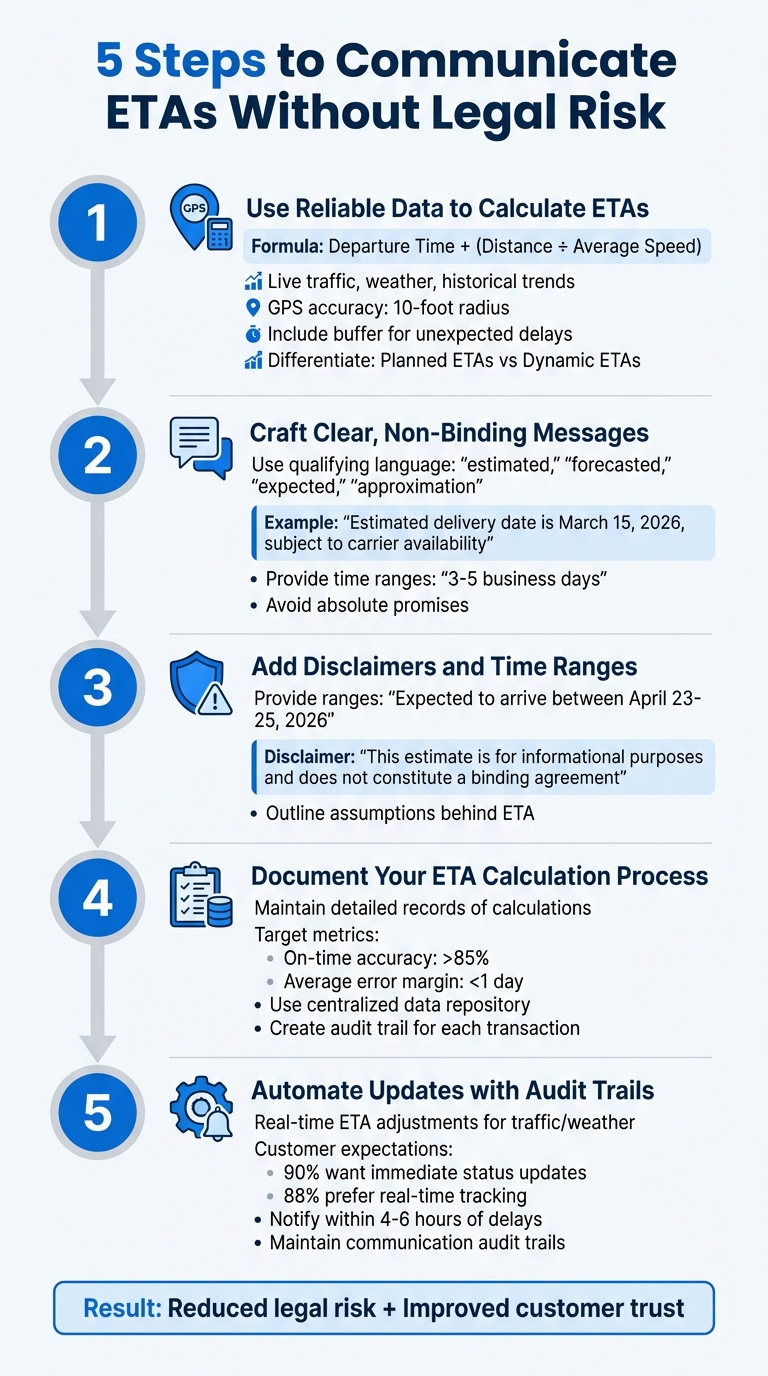
5 Steps to Communicate ETAs Without Legal Risk
You don’t need a law degree to create ETA messages that are both informative and legally safe. A clear, structured approach can help you keep customers updated while avoiding unnecessary risks. Here’s how.
Step 1: Use Reliable Data to Calculate ETAs
Accurate ETAs start with solid data. The basic formula is simple: Departure Time + (Distance ÷ Average Speed) [11][13]. However, real-world accuracy requires factoring in live traffic updates, weather conditions, and historical trends [12][16].
Modern GPS systems, for example, can pinpoint locations within a 10-foot radius [16]. Companies like UPS and DHL have leveraged such technology for major efficiency gains. UPS’s ORION platform saves 100 million miles and 10 million gallons of fuel annually, while DHL’s Smart Truck initiative cut miles driven by over 15% through automated route optimization [16].
It’s also essential to differentiate between "Planned ETAs" (based on ideal conditions) and "Dynamic ETAs" (adjusted in real time for issues like accidents or road closures) [13]. Always include a buffer for unexpected delays, such as vehicle breakdowns or customs holdups [12][14]. Using tools like Delivery Management Software (DMS) helps minimize errors that can arise from manual calculations [10][12].
Once you’ve got the numbers, focus on setting realistic expectations in your messaging.
Step 2: Craft Clear, Non-Binding Messages
Your ETA messages should inform customers without creating unintended legal obligations. Remember, electronic communications – like emails or texts – can sometimes be considered legally binding if they meet certain conditions [17][19].
Use language that emphasizes the estimate’s flexible nature. Phrases like "estimated", "forecasted", "expected," or "approximation" signal that the time is not guaranteed [12][4]. For instance, instead of promising, "Your order will arrive on March 15, 2026", say, "Your estimated delivery date is March 15, 2026, subject to carrier availability." Be specific yet flexible, offering a time range like "3–5 business days" to manage expectations better.
Here’s a quick guide to phrasing:
| Message Element | Recommended Phrasing | Why It Works |
|---|---|---|
| Arrival Time | "Estimated Time of Arrival", "Expected by…" | Avoids creating a fixed promise [12][4] |
| Delay Notice | "Your order hit an unexpected snag", "Revised ETA" | Keeps communication transparent without admitting fault [1] |
| Remedy | "As a token of appreciation", "Store credit applied" | Maintains goodwill without committing to refunds [4][1] |
| Status | "Live Tracking", "In Transit" | Reinforces that the ETA is subject to change [12] |
Step 3: Add Disclaimers and Time Ranges
Always clarify that ETAs are estimates, not guarantees. Providing a range – like "expected to arrive between April 23–25, 2026" – helps set realistic expectations while accounting for variables such as traffic, weather, or customs delays [15].
It’s also smart to outline the assumptions behind your ETA, such as standard carrier schedules or buffer times for unexpected issues. For B2B communications, include a disclaimer like: "This estimate is for informational purposes and does not constitute a binding agreement."
Once your ETA process is defined, document everything to ensure consistency.
Step 4: Document Your ETA Calculation Process
Keeping detailed records of how you calculate ETAs ensures consistency and accountability, especially if disputes arise. Documentation also helps refine future estimates by identifying patterns, such as recurring customs delays or bottlenecks at sorting facilities [12][20].
Delivery management software can make this easier by automatically capturing proof of delivery (ePOD) and creating an audit trail for each transaction [12]. A centralized data repository integrates information from websites, stores, and carriers, ensuring all customer touchpoints provide the same message [16].
"A centralized data repository is essential to aggregate shipment data from all customer touchpoints into a single source of truth. This eliminates data discrepancies and provides full transparency into shipment status." – Ryan Caldarone, Sr. Digital Marketing Manager, DeliverySolutions [16]
Regularly audit your ETA metrics to maintain quality. For example, aim for on-time accuracy above 85% and an average error margin below one day [20].
Step 5: Automate Updates with Audit Trails
Automation ensures you provide timely, consistent ETA updates while maintaining a record of all communications for compliance. Tools that offer real-time ETAs can adjust automatically for traffic, weather, or other dynamic factors [12]. APIs can sync this information across all channels, so customers and dispatchers see the same updates [16].
Customers expect immediate updates – 90% want to know as soon as their order status changes, and 88% prefer real-time tracking [4][12]. If delays occur, notify customers within 4–6 hours and provide a revised timeframe along with a gesture of goodwill, like a discount code [1].
Keep track of customer communication preferences in a CRM to ensure compliance with consent requirements for transactional updates. This is especially important, as regulatory bodies like the SEC have imposed hefty fines (over $1.1 billion in 2022) on companies that failed to maintain proper controls over business communications [18]. Audit trails not only protect your business but also demonstrate your commitment to transparency and accountability.
Common ETA Communication Mistakes to Avoid
Support teams can unintentionally turn straightforward delivery updates into potential legal issues. Here are some frequent mistakes and how they can affect your business.
Making Absolute Time Commitments
Promising a specific delivery date without considering unpredictable variables can put your business at risk. Statements like "Your order will arrive Friday" may sound reassuring, but they can quickly backfire. Factors like weather, carrier delays, or unexpected backlogs can cause missed deadlines, damaging customer trust and even leading to legal challenges if customers depend on those commitments for their operations[2].
A better approach? Use delivery windows, such as "3 to 5 business days." These ranges naturally account for variations and are less likely to disappoint customers[2]. In fact, customers often prefer time ranges over exact dates because they reflect the natural uncertainties of shipping[21].
"Single-date promises look confident, but they are fragile." – SpySeller[2]
When setting delivery expectations, make sure to incorporate all potential external factors, which we’ll explore next.
Ignoring External Variables
Many businesses only focus on transit times when calculating ETAs, overlooking critical elements like order processing times, warehouse cutoff schedules, and carrier pickups[2]. This narrow view can lead to underestimating the full delivery process. Seasonal surges, remote destinations, and customs delays can further complicate timelines.
Consider this: 70% of e-commerce shoppers report receiving late orders with no explanation[4]. This lack of communication leads to a surge in "Where Is My Order?" (WISMO) inquiries, which strain support teams and erode trust. To avoid this, build in buffers for peak seasons, international shipments, and carrier capacity limits. These adjustments ensure your ETA reflects the entire lead time[2].
When delays do occur, clear and timely communication becomes essential, as discussed in the next section.
Not Updating Customers When ETAs Change
Failing to notify customers promptly about delays can severely harm your relationship with them. Research shows that 90% of customers expect immediate updates when their order status changes[4]. Yet, many businesses either delay these updates for days or fail to send them altogether. This lack of communication creates uncertainty, increases WISMO inquiries, and can even lead to more chargebacks.
To mitigate these risks, document and automate your ETA updates. Send the first delay notification within 4 to 6 hours of identifying an issue[1]. Include a revised ETA window (avoid vague phrases like "as soon as possible"), explain the cause of the delay, and offer a remedy proportional to the inconvenience. For example:
- For delays of 1–2 days, consider offering free shipping on the next order.
- For delays of 6+ days or missed holidays, partial refunds or significant store credits might be more appropriate[1].
Proactive remedies like these have been shown to reduce return rates by 23%[1].
Lastly, keep delay notifications strictly transactional. Adding promotional content, such as "check out our sale", could classify the message as marketing under TCPA and CAN-SPAM regulations, exposing your business to legal risks and potential fines[1].
How AI Tools Reduce Risk in ETA Communication
Handling estimated time of arrival (ETA) communications manually can open up a Pandora’s box of legal risks. Under pressure, human agents might make firm promises, skip disclaimers, or fail to update customers when situations change. AI-native platforms tackle these issues head-on by standardizing communication, keeping detailed records, and adjusting to real-time changes. These systems align with earlier advice on using disclaimers and maintaining documentation, ensuring ETA communications remain legally sound.
AI-Powered ETA Calculation and Messaging
AI platforms excel at analyzing historical ticket data, offering far more accurate predictions for resolution times than traditional manual methods. Instead of relying on subjective judgment or outdated information, AI digs into thousands of similar cases to identify patterns related to complexity, agent availability, and external factors. This approach minimizes overpromising while keeping customer trust intact [24].
Take Supportbench‘s AI agent copilot, for example. It scours previous cases and taps into knowledge bases to propose realistic timeframes based on actual resolution histories. The system also flags potential risks, such as pending vendor responses or technical escalations, so agents can provide ETAs backed by solid evidence – not wishful thinking.
The results speak for themselves. Companies using AI for B2B support have reported a 30-40% reduction in time spent per ticket and a 15-25% boost in Customer Satisfaction (CSAT) scores [24]. These gains come from AI’s ability to maintain context over extended, complex B2B interactions, which is crucial for delivering precise ETAs in multi-stakeholder scenarios [24].
"AI can’t generate value out of thin air. It requires robust, technical knowledge bases that consumer AI implementations don’t necessarily need." – Sara Feldman, Consortium for Service Innovation [24]
AI’s ability to adapt to evolving conditions further strengthens its accuracy.
Dynamic SLA Integration with Real-Time Updates
AI doesn’t just predict ETAs once and call it a day – it continuously monitors conditions and revises expectations as needed. With dynamic SLA integration, AI can tighten response times for high-priority accounts or extend them when delays, like vendor hold-ups, occur. This adaptability ensures customers get accurate updates without requiring agents to manually intervene.
Automated orchestration and AI-powered triage also speed things up significantly, delivering 67% faster response times by categorizing tickets based on complexity and urgency [23][24]. When delays happen, the system sends out automated notifications, keeping communication consistent. Every update is documented, making it easy to track changes for compliance purposes and ensuring accountability.
Manual vs. AI-Driven ETA Processes
The difference between manual and AI-driven workflows is striking. Manual processes often fall victim to human error, delayed updates, and missed SLAs. An agent juggling multiple tickets might forget to notify a customer about a delay or promise a resolution date without confirming capacity. This not only exposes the company to legal risks but also damages trust.
AI-driven workflows, on the other hand, offer round-the-clock responsiveness, scalability, and data-backed precision [23][24]. By applying consistent algorithms across all cases, AI ensures uniform and repeatable results [28]. Unlike manual evaluations, which can vary depending on an agent’s experience or workload, AI delivers consistent outcomes.
| Feature | Manual Methods | AI-Driven Processes |
|---|---|---|
| Processing Speed | Slow; can take days for high volumes [28] | Fast; happens in minutes [28] |
| Reliability | Prone to human error [28] | Consistent; applies the same logic to all data [28] |
| Risk Management | Point-in-time (e.g., review at signing) [28] | Continuous; real-time monitoring [28] |
| Compliance Risk | High risk of "contractual gaps" [26] | Automated flagging of regulatory gaps [28] |
That said, AI should act as a decision-support tool, not a decision-maker. Legal expert Morgan Lewis emphasizes, "AI systems… are best understood as decision-support tools, not decision-makers." [25] Human oversight remains essential, especially for validating or overriding ETAs in high-stakes situations.
While 78% of organizations now use AI in at least one business function [28], only 36% of corporate Boards have implemented formal AI governance frameworks [26]. This highlights the importance of proper oversight, regular benchmarking, and vendor agreements that require disclosure of AI features and updates [26][27]. By replacing manual workflows with AI-driven systems, support teams can stay compliant while building stronger customer trust.
How to Monitor and Improve ETA Communication
To reduce legal risks and build trust with customers, it’s important to keep a close eye on ETA communications and refine them consistently. Compliance is just the starting point – ongoing monitoring ensures your ETA updates remain accurate, compliant, and reliable.
Audit ETA Messages and Processes Regularly
Automated systems powered by AI can streamline updates, but regular audits are necessary to ensure compliance and effectiveness. These audits help catch potential issues before they escalate. For instance, by 2026, ETA communications must disclose the use of "automated systems" or "artificial intelligence" at the beginning of each interaction [3]. Additionally, the FCC’s One-to-One Consent Rule requires explicit consent from customers for each specific sender, a rule that, if violated, has led to fines as high as $225 million [3].
Accuracy metrics are critical for effective ETAs. Aim for on-time accuracy above 85%, an average error of less than one day, and 95% accuracy for high-confidence predictions [20]. Keep an eye on "Where Is My Order" (WISMO) inquiries – these make up over 30% of e-commerce live chats and 50% of customer service calls [16]. A reduction in these inquiries indicates that your proactive communication strategies are working.
It’s also essential to maintain detailed audit logs. These should include consent timestamps, AI configurations, and carrier registrations [3]. Ensure your systems check federal and state Do Not Call (DNC) lists before sending automated updates [3]. Messages should only go out during legal hours, typically between 8:00 AM and 9:00 PM in the recipient’s local time zone [3][1]. Be aware of state-specific rules, such as Virginia’s requirement to honor text opt-outs for 10 years and Texas’s classification of text messages as "telephone solicitations" [3].
| Metric | Target | Description |
|---|---|---|
| On-time accuracy | > 85% | Deliveries arriving within the estimated window [20] |
| Average error | < 1 day | Mean absolute error between predicted and actual delivery dates [20] |
| Confidence calibration | 95%+ | Accuracy rate for estimates labeled as "High Confidence" [20] |
| WISMO inquiries | Decreasing | Volume of customer support tickets about order status [20] |
Use Feedback to Improve ETA Accuracy
Customer feedback plays a big role in refining ETA predictions. Since 68% of shoppers won’t return after a poor delivery experience [16], analyzing feedback is crucial to identify where messaging falls short. For example, tracking WISMO inquiry trends can highlight gaps in communication clarity [16]. Historical data comparing actual delivery times to initial predictions can also help fine-tune future estimates and add buffer time where needed [12].
Pay close attention to the language customers use when expressing dissatisfaction. If someone describes a delay as "chaos", using that term in your response can show empathy and understanding [22]. Implement a "Tone Calibration Framework" to adjust messaging based on the emotional tone of feedback – validating anger or recognizing disappointment, for instance [22]. Conduct customer interviews to uncover hidden concerns, like how delays impact end-of-month reporting, and address these proactively in future updates [22].
Real-world examples show how data-driven improvements can make a difference. UPS, through its ORION platform, uses GPS data to optimize routes, saving over 100 million miles and 10 million gallons of fuel annually [16]. Similarly, Lenovo reduced its response time to supply chain disruptions by 90%, cutting the time from days to minutes with advanced analytics [16]. These approaches demonstrate how recording actual delivery times and building historical databases can improve future predictions [20].
Proactive communication also yields measurable benefits. Companies that are transparent about delays find that 84% of customers are willing to shop again after a shipping issue [1]. Proactive solutions can lower return rates by 23% and boost Net Promoter Scores (NPS) by an average of 15 points [1]. Offering customers a choice of communication channels – like email, SMS, or mobile app – ensures updates are received and acknowledged [22][1]. During peak holiday seasons, when customers check tracking information an average of 4.6 times per order (compared to 2.1 times during off-peak periods), real-time accuracy becomes even more vital [1].
To ensure data accuracy, use automated scripts to detect discrepancies between carrier data and internal systems [16]. Standardize data formats (e.g., JSON, XML, EDIFACT) for consistent aggregation and to prevent errors caused by poor-quality inputs. Additionally, monitor social media and community forums for indirect feedback about delivery reliability that might not show up in formal surveys [9].
Conclusion
Sharing ETAs effectively requires a mix of clarity, precision, and automation. Use straightforward, non-binding language, provide realistic time ranges, and disclose any AI involvement to align with FCC rules set to take effect on January 27, 2026. Maintain detailed records – tracking consent timestamps, opt-outs, and delivery windows – to ensure compliance and transparency. These steps lay the groundwork for integrating AI tools that streamline and secure ETA communications. By doing so, businesses can avoid TCPA fines while fostering trust with B2B clients.
Proactive ETA updates make a significant impact: over 80% of customers remain loyal when kept informed, compared to just 17% when updates are lacking [1]. This difference could mean the contrast between a minor setback and losing a client entirely. Additionally, keeping customers in the loop reduces repetitive inquiries, allowing your team to focus on more complex, high-priority tasks.
Building on the five steps and legal guidelines discussed earlier, successful ETA communication hinges on automation and proactive engagement. AI-driven platforms like Supportbench help enforce compliance by managing quiet hours, filtering out Do Not Call list entries, and standardizing disclaimers across communications. These systems use historical data and real-time inputs to calculate accurate ETA ranges and notify customers of changes automatically. The payoff? Fewer legal risks, reduced support costs, and stronger client relationships.
"The retailers who win don’t hide from delays. They acknowledge them quickly, explain them honestly, compensate fairly, and keep communication channels open." – SmartSMSSolutions [1]
FAQs
What makes an ETA “reasonable” under FTC rules?
An Estimated Time of Arrival (ETA) is deemed reasonable under FTC guidelines when it’s grounded in accurate, dependable information and conveyed transparently. It should neither mislead customers nor create unrealistic expectations. Clear communication of ETAs not only aids in compliance but also strengthens customer trust.
How do I write ETA updates that aren’t legally binding?
To keep ETA updates from becoming legally binding, frame them as estimates rather than promises. Use language like "estimated," "expected," or "projected" instead of definitive phrases like "will arrive by" or "guaranteed."
Offering delivery windows – such as "3 to 5 business days" – is a safer approach than providing specific dates. Additionally, include disclaimers that highlight how ETAs may shift due to unforeseen circumstances. This way, you manage customer expectations without creating rigid commitments.
What should I do and say when an ETA slips?
When an ETA changes, it’s critical to communicate quickly and clearly. This helps maintain trust and minimizes potential legal issues. Start by acknowledging the delay right away. Be upfront about the reason for the change, keeping your explanation brief and to the point. Share a realistic revised ETA or outline the next steps customers can expect.
Show empathy by recognizing the inconvenience and thanking customers for their understanding. Avoid vague updates or going silent, as these can damage credibility. Instead, focus on consistent and transparent communication to manage expectations effectively.
Related Blog Posts
- How do you create a customer communication cadence during long investigations (update rules)?
- Customer portal SLAs: how to show response expectations without overpromising
- How to show ticket status updates to customers without creating confusion
- Incident communication templates for B2B support teams (portal + email)