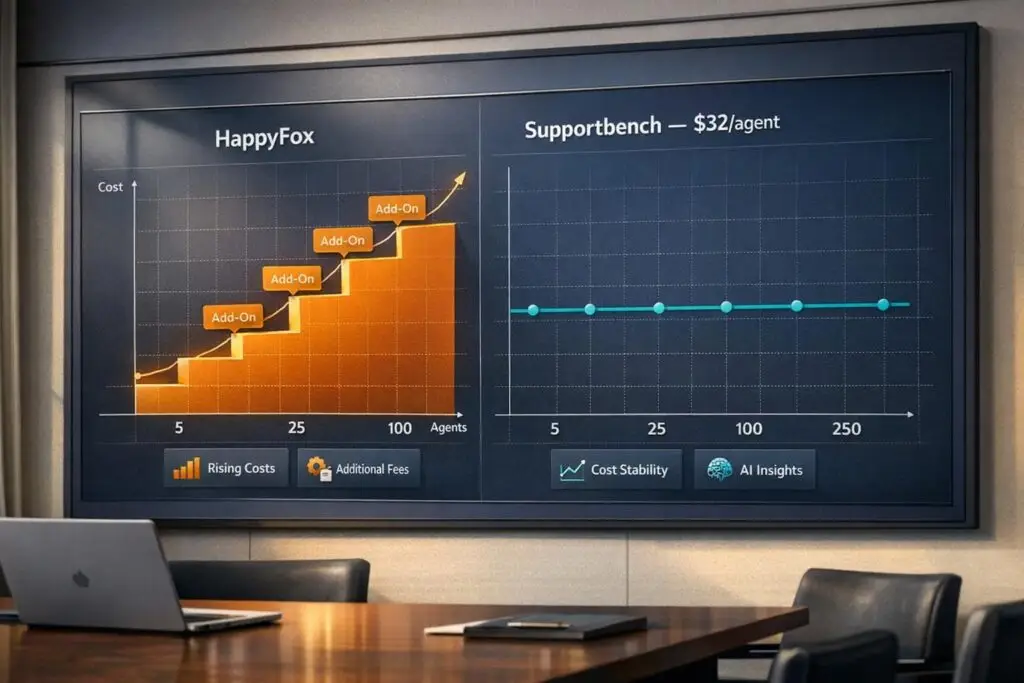
HappyFox offers a flexible pricing model, but scaling teams often face rising costs and feature limitations. Starting at $24 per agent/month (up to 5 agents), the price jumps to $49 per agent/month for larger teams. Key features like multi-brand support, advanced automation, and unlimited reporting are locked behind higher-priced plans or costly add-ons – ranging from $199 to $1,999/month. Support is also tiered, with 24/7 email and phone support restricted to premium plans.
Supportbench, by contrast, simplifies things with a flat $32 per agent/month. This includes all features – AI tools, automation, reporting, and support – without hidden fees or limits. For teams prioritizing predictable costs and advanced functionality, Supportbench offers a straightforward alternative to HappyFox.
Quick Comparison
| Feature | HappyFox | Supportbench |
|---|---|---|
| Starting Price | $24/agent/month (Basic plan) | $32/agent/month (flat rate) |
| Unlimited Agents | $2,999/month (100+ agents) | Not applicable |
| AI Features | Add-on ($1–$4/user/month) | Included |
| Automation Workflows | Add-on ($199–$1,999/month) | Included (no limits) |
| Support | Tiered (24/7 for Pro plans) | 24/7 included |
HappyFox suits smaller teams with simple needs but becomes expensive as teams grow. Supportbench avoids extra costs, making it a better fit for scaling operations.
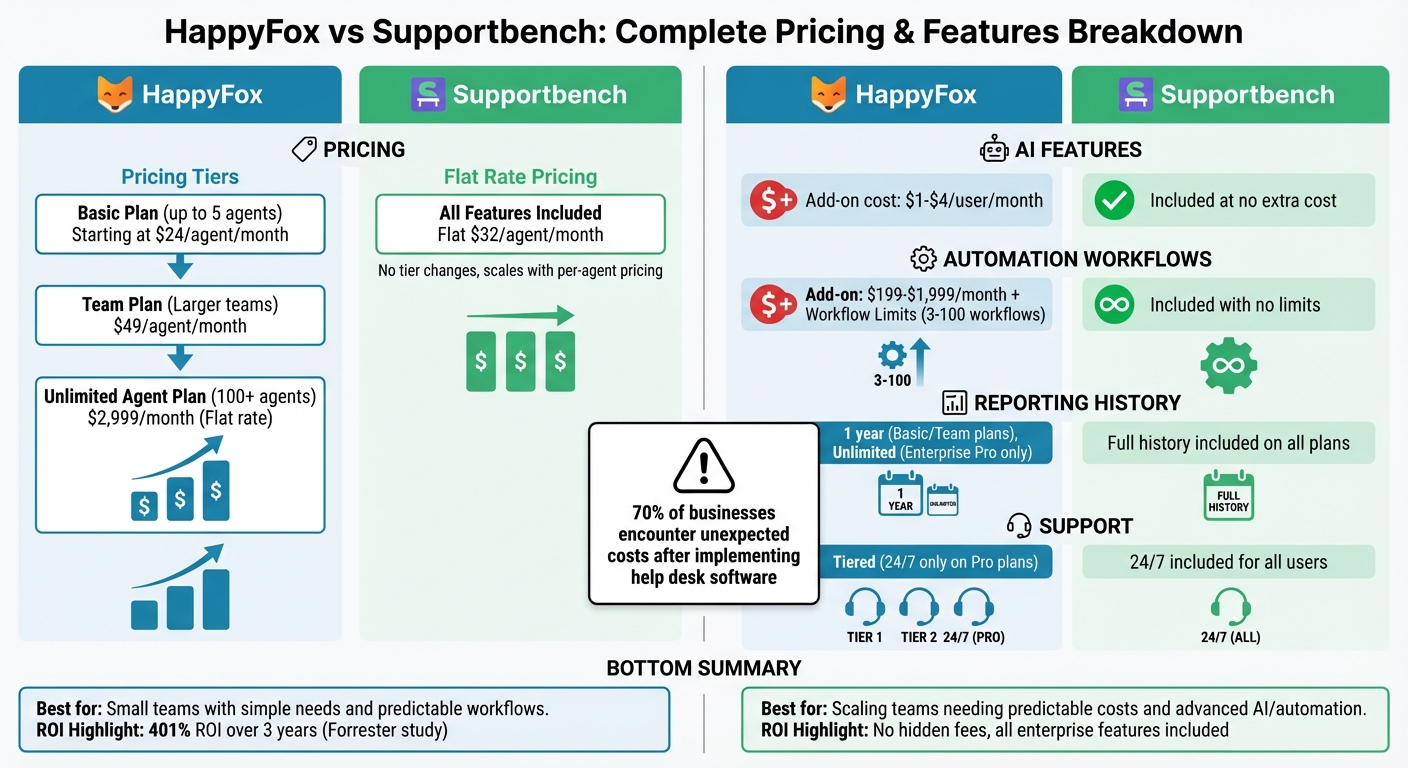
HappyFox vs Supportbench Pricing and Features Comparison
1. HappyFox
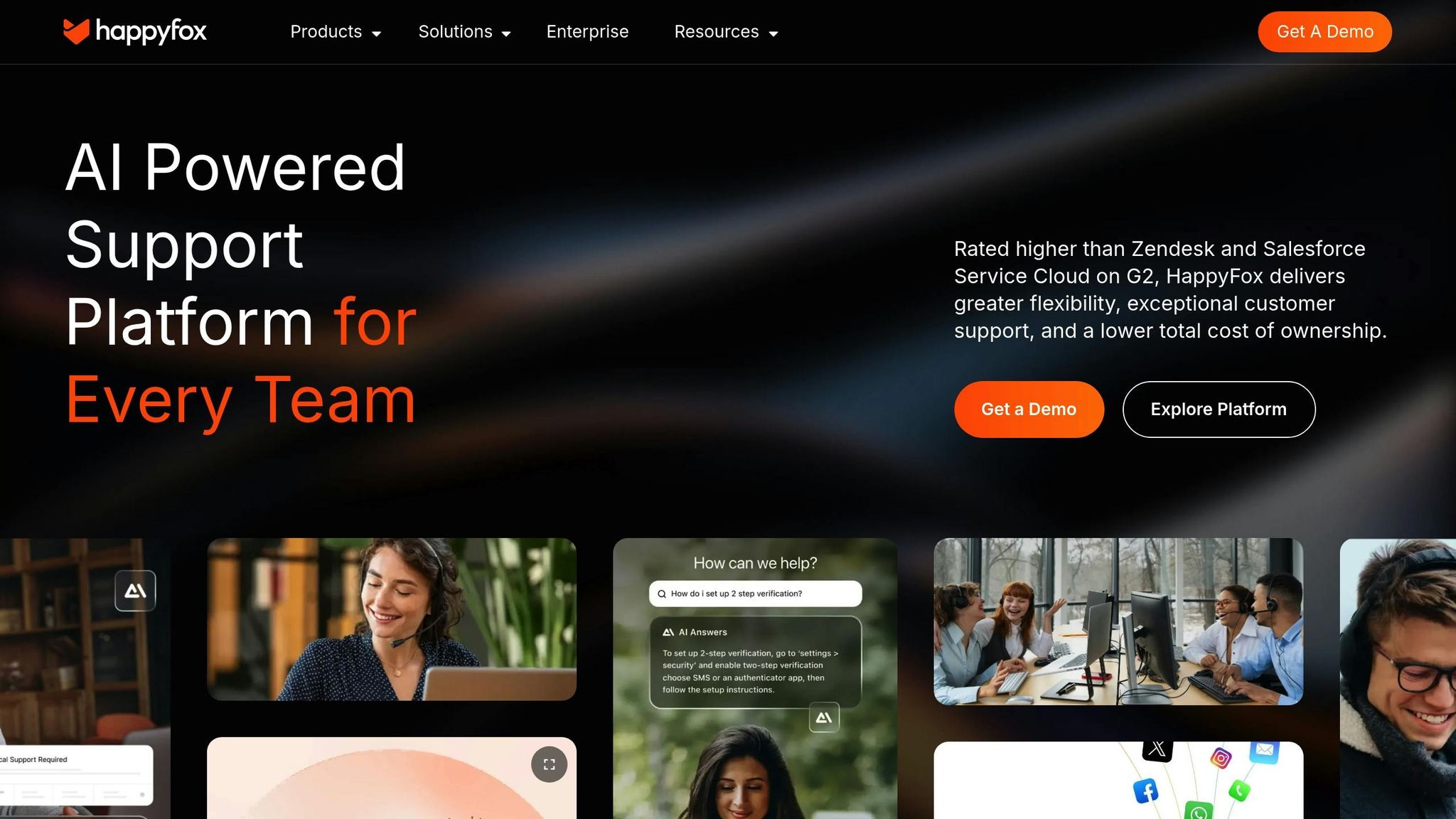
Pricing Structure
HappyFox’s pricing starts with the Basic plan at $24 per agent per month, accommodating up to five agents. For larger teams, the $49 Team plan is required. For operations with over 100 agents, the Unlimited Agent plan is available at approximately $2,999 per month, offering a predictable cost structure for extensive teams.
Additional features come with extra costs. Workflow automation add-ons range from $199 per month for three workflows to $1,999 per month for 100 workflows. Integration with Slack and Microsoft Teams through Assist AI adds $1 to $4 per user per month, depending on the chosen tier.
These pricing tiers highlight how costs can escalate as teams expand or require advanced functionalities.
Scalability and Limitations
HappyFox imposes specific limits that can impact scalability. For instance, attachment storage starts at 50 GB on lower-tier plans and maxes out at 2 TB on Enterprise Pro. Similarly, reporting history is limited to one year on lower plans, while Enterprise Pro offers unlimited access.
Multi-brand support is another consideration, capped at five brands on the Team plan and 25 brands on higher-tier plans.
API rate limits also vary significantly, with Basic plans allowing 100 requests per minute and Enterprise Pro supporting up to 800 requests per minute. For teams relying on custom integrations or frequent automations, these limits could present challenges as operations grow.
AI and Automation Capabilities
HappyFox offers AI features as optional add-ons rather than including them in core plans. The AI Copilot assists with ticket summarization and response suggestions, while Assist AI enables conversational ticketing within chat platforms like Slack and Microsoft Teams. According to HappyFox, these tools can lead to a 60% reduction in operational costs and a 70% improvement in response times within the first year.
Automation capabilities also come with execution limits. For example, the Basic plan allows 5,000 actions per month with a three-minute run interval, while the Enterprise tier supports up to 50,000 actions per month. Teams handling complex or high-volume workflows may find these limits restrictive as their needs evolve.
Balancing the benefits of AI and automation tools with their costs and constraints is essential for long-term scalability.
Cost-Effectiveness
A Forrester Total Economic Impact study reported a 401% ROI for HappyFox users over three years. For teams operating within the platform’s limitations, this represents a compelling return. The Unlimited Agent plan, priced at approximately $2,999 per month for 100+ agents, reduces the per-agent cost significantly compared to traditional per-seat pricing models.
For larger teams, this combination of predictable costs and scalable features makes HappyFox a cost-efficient option, provided its limitations align with operational needs.
sbb-itb-e60d259
2. Supportbench
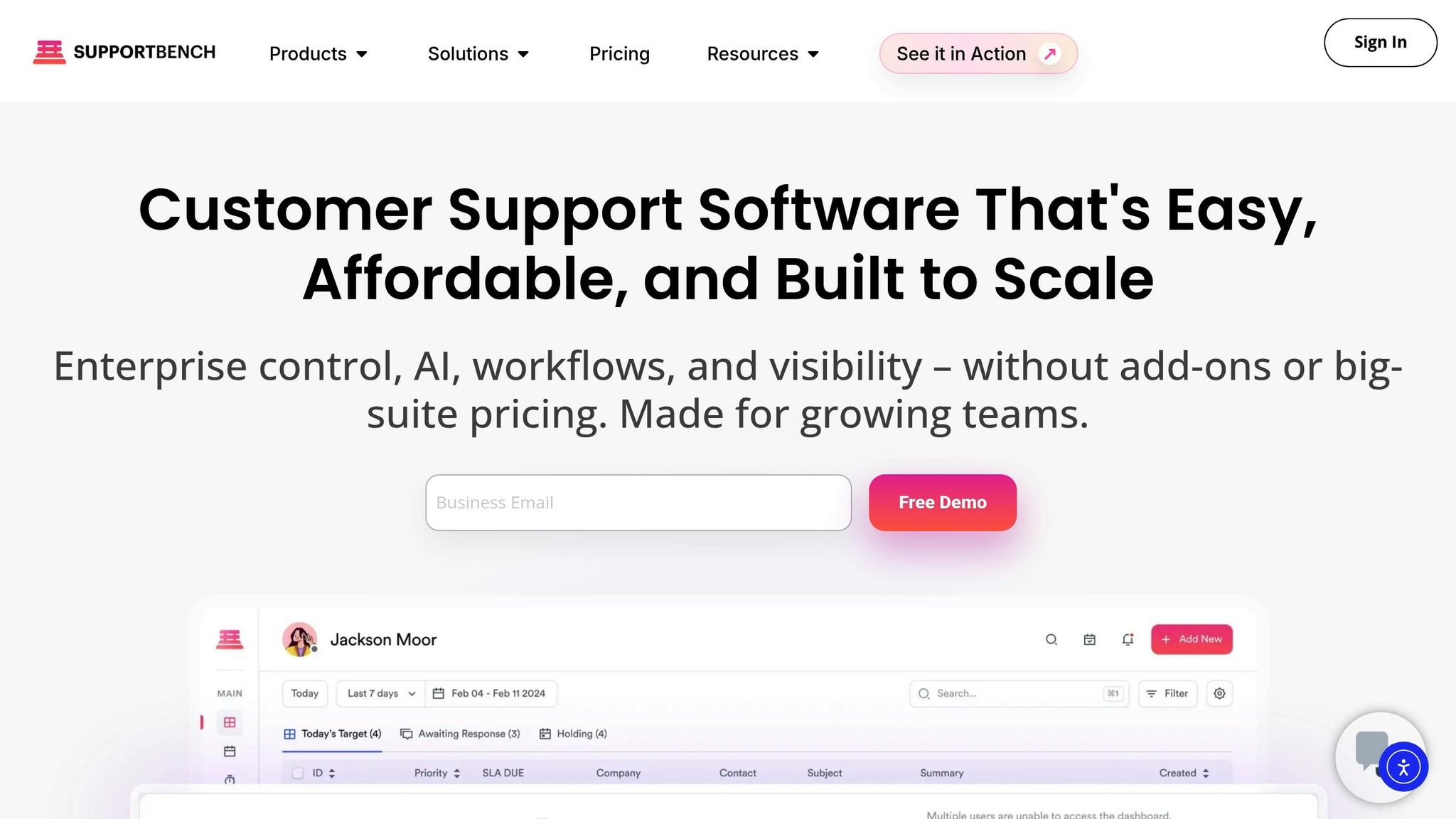
Supportbench takes a different approach from tiered pricing models, which often create challenges for growing teams. Instead, it provides a straightforward and predictable solution.
Pricing Structure
Supportbench keeps things simple with flat, all-inclusive pricing at $32 per agent per month. From the start, users get access to an enterprise-level platform with no hidden fees or extra costs. This includes AI tools, case management features, knowledge base capabilities, custom workflows, dashboards, and live human support – everything is included.
By offering enterprise-grade features upfront, Supportbench avoids the financial surprises that can come with scaling. Teams don’t face unexpected cost increases when they need more automation or advanced features. Plus, startups and non-profits can take advantage of discounts.
This pricing approach ensures teams can grow without worrying about escalating expenses.
Scalability and Limitations
Supportbench is designed to handle the challenges that come with scaling support operations. As ticket volumes rise and interactions become more complex, the platform ensures teams can maintain response times and service quality across multiple channels.
One standout feature is AI-powered ticket triage, which uses machine learning to automatically sort and prioritize tickets based on their content and customer SLAs. This reduces the need for manual sorting, helping teams manage higher volumes efficiently.
Another key feature is dynamic SLAs, which adapt to the context of each case. For example, if a ticket involves an upcoming renewal, response times are automatically tightened to protect key relationships. This ensures high-value accounts receive the attention they need, without requiring extra manual effort.
With these tools, Supportbench helps teams handle growth and complexity while keeping operations smooth.
AI and Automation Capabilities
AI is built directly into Supportbench’s workflows, offering advanced automation without the need for extra add-ons. For example, account-based automation ensures that tickets from high-value accounts are prioritized based on critical B2B metrics.
AI-driven sentiment analysis also plays a big role, tracking shifts in customer sentiment within tickets. This helps teams identify and address potential churn risks before they escalate. Additionally, agent assist tools analyze past cases and knowledge bases to offer real-time suggestions, speeding up issue resolution and reducing training time.
Other AI features include predictive CSAT and CES tools, which forecast customer satisfaction and effort scores before surveys are sent. This allows teams to take proactive steps with at-risk accounts. AI even tracks first contact resolution by analyzing case histories, solving a metric that’s traditionally been tough to measure accurately.
Cost-Effectiveness
Supportbench’s flat pricing eliminates the extra costs often associated with legacy systems. Teams don’t need to pay separately for automation, AI, advanced reporting, or integrations. At just $32 per agent per month, organizations get access to enterprise-grade functionality without worrying about additional setup or maintenance fees.
For B2B teams managing complex, long-term cases or renewal-driven relationships, this consolidated platform offers a cost-effective alternative. By replacing multiple tools and costly add-ons, Supportbench provides everything needed for predictable growth and streamlined operations.
Pros and Cons
Taking a closer look at the platforms’ pros and cons, it’s clear they cater to different needs through distinct pricing models and feature setups. Let’s break this down.
HappyFox offers a dual pricing model that can help control costs as teams grow. However, many advanced features are sold separately. For example, workflows are priced between $199/month and $1,999/month based on complexity, while Assist AI adds an extra $1 to $4 per user each month. Teams also face workflow caps – the Basic plan allows only 3 active workflows, and even the Enterprise plan tops out at 100 workflows. Additionally, lower-tier plans limit reporting history to just one year, which can be a challenge for teams needing long-term data to manage complex B2B relationships.
On the other hand, Supportbench takes a simpler approach with flat pricing at $32 per agent per month. This includes AI-powered features like triage, dynamic SLAs, predictive CSAT and CES, sentiment analysis, and automation. There are no workflow limits, separate AI subscriptions, or feature restrictions based on the plan. This flat-rate model makes budgeting straightforward and avoids surprise costs as teams scale.
Here’s a side-by-side comparison to make the differences clearer:
| Factor | HappyFox | Supportbench |
|---|---|---|
| Entry Price | $9/agent/month | $32/agent/month |
| Unlimited Agent Option | $2,999/month (100+ agents) | Not applicable (flat per-agent) |
| Advanced Automation | Add-on: $199–$1,999/month | Included |
| AI Capabilities | Add-on: $1–$4/user/month | Included |
| Workflow Limits | 3–100 active workflows (plan-dependent) | No limits |
| Reporting History | 1 year (Basic/Team plans) | Full history included |
This comparison underscores the importance of pricing clarity and feature inclusivity, especially for teams planning for long-term, AI-driven support.
For fast-growing teams, Supportbench’s all-inclusive pricing ensures predictable costs and ROI as they scale. Meanwhile, smaller teams with simpler needs might initially find HappyFox’s lower entry price appealing. However, once you factor in add-on costs for workflows and AI, the affordability diminishes. Pricing transparency matters – 70% of businesses report encountering unexpected costs after implementing help desk software.
Conclusion
The pricing model you choose should align with your team’s growth and operational needs. HappyFox offers a dual pricing structure that caters to distinct scenarios: smaller teams with consistent headcounts can opt for plans starting at $24 per agent per month, while larger organizations managing steady ticket volumes might prefer unlimited agent plans, where costs are tied to ticket numbers instead of headcount. However, it’s important to weigh these options against potential add-on costs, as highlighted earlier.
HappyFox can be a good fit for teams with predictable workflows, especially those needing multi-departmental setups or enterprise-grade compliance features like SOC 2 Type II certification. That said, teams often outgrow HappyFox when they require unlimited automation, access to full reporting history across all plans, or AI features without additional per-user fees.
For teams aiming to scale with AI-driven support operations, Supportbench offers a flat $32 per agent per month pricing that stands out for its clarity and predictability. There are no caps on workflows, no extra charges for AI tools, and no feature limitations based on the plan size. This is particularly important given that 70% of businesses encounter unplanned costs after implementation. As discussed, the all-inclusive approach ensures you avoid feature limitations, unexpected expenses, and budgeting headaches – making it easier to align your support strategy with cost-effective, AI-powered automation and long-term goals.
FAQs
What do teams usually outgrow first as they scale support?
As teams expand, they often bump into the limits of their automation and scalability tools. Some typical hurdles include restricted workflow automation, sluggish system performance when handling high ticket volumes, and a growing need for deeper integrations and tailored customizations. These challenges can slow down efficiency and make it tougher to keep up with changing operational needs.
How can we forecast our total cost when AI and automation are add-ons?
To estimate total costs when using AI and automation add-ons, start by accounting for both the base platform fees and any additional variable charges tied to these features. Look into the specific AI tools you plan to use, their pricing structures, and key usage metrics such as the number of interactions or automations you expect. Don’t overlook hidden costs like training your team, integrating the tools into your existing systems, and ongoing maintenance. By creating a thorough budget that combines fixed fees with projected usage, you can plan costs more accurately and ensure your setup can scale as your support demands increase.
Which scalability limits matter most for B2B support teams?
Key challenges in scaling B2B support teams often revolve around agent capacity, ticket volume, and feature restrictions. For instance, plans that limit the number of agents or the volume of tickets can create bottlenecks as demand grows. Similarly, restrictions on automation tools or AI capabilities can slow down workflows, making it harder to maintain efficiency. Recognizing these constraints early allows teams to strategize upgrades or adjustments, ensuring they can grow without sacrificing the quality of their support.
Related Blog Posts
- Zendesk vs Freshdesk vs Supportbench: Which Support Platform is Better and for who in 2026?
- Zendesk vs. AI Platforms: TCO Comparison
- Freshdesk total cost: what add-ons and plan upgrades do teams miss?
- HappyFox alternatives for B2B: what platforms support complex workflows best?
Evaluating help desks for a B2B team?
Supportbench is all-inclusive from $32 per agent per month, with migration and onboarding included. See pricing or book a 20-minute demo.