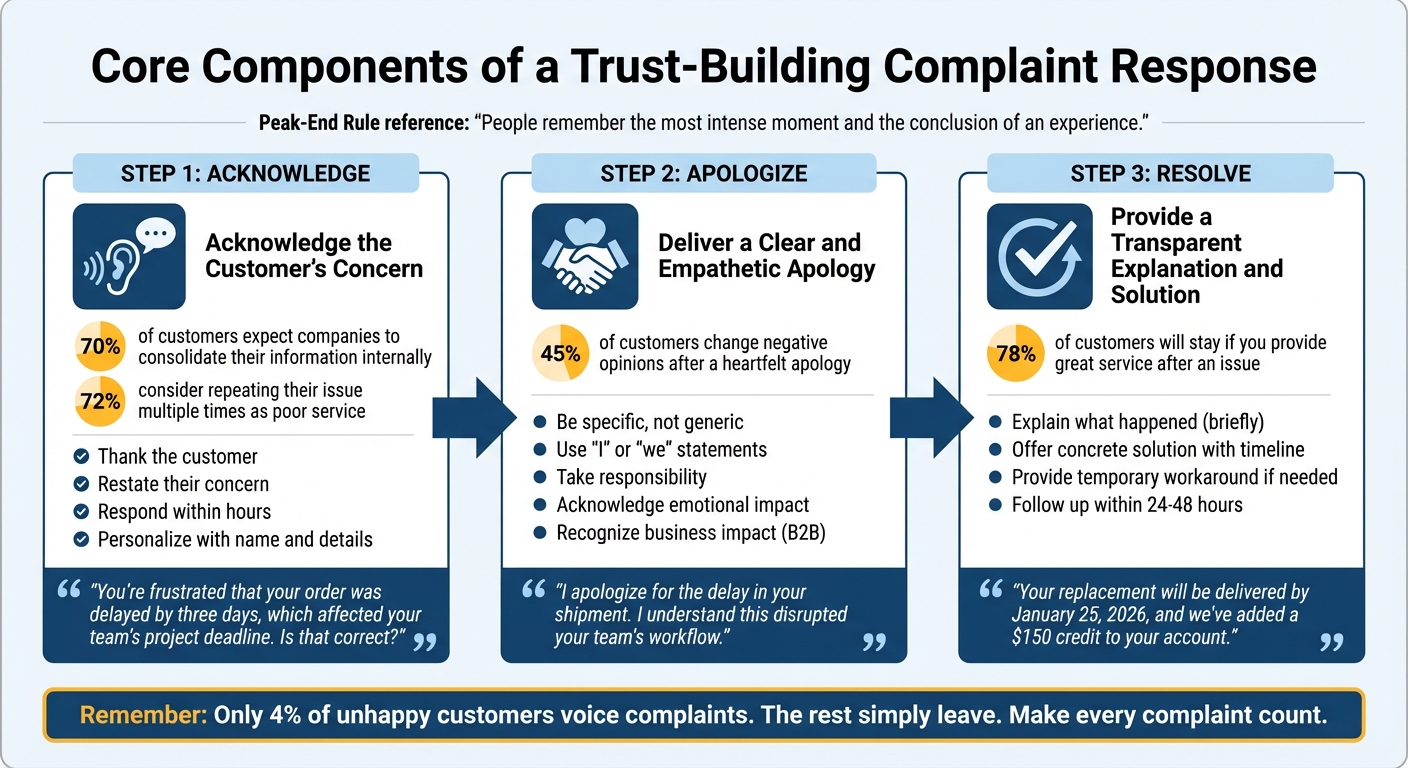
Only 4% of unhappy customers voice their complaints. The rest simply leave. But when a complaint does come in, it’s an opportunity to rebuild trust and keep the business relationship intact. Here’s what matters most when handling complaints:
- Acknowledge the issue to make customers feel heard.
- Apologize sincerely to show empathy and take responsibility.
- Resolve the problem with clear solutions and follow-ups.
For B2B companies, where one bad experience can disrupt entire operations, this approach is critical. Customers care more about how you handle the problem than the problem itself. In fact, 78% will stay if you provide great service after an issue, and 45% change negative opinions after a heartfelt apology.
AI tools can help by detecting sentiment, suggesting responses, and prioritizing urgent issues. But ultimately, success comes down to clear communication, empathy, and timely resolutions.
57 Phrases to De-escalate Any Angry Customer
Core Components of a Trust-Building Complaint Response
3-Step Framework for Handling Customer Complaints Effectively
Handling complaints effectively boils down to three essential steps: acknowledge, apologize, and resolve. These steps work together to repair trust when something goes wrong. If you skip any one of them, your response might come across as defensive, dismissive, or incomplete.
The sequence matters, too. You can’t jump straight to fixing the problem without first validating the customer’s experience, and an apology without a clear fix can feel insincere. Each step serves a specific purpose in calming tensions and showing the customer that their business matters. These principles lay the groundwork for addressing complaints, as explained below.
Acknowledge the Customer’s Concern
Acknowledging the issue is the first – and often the most important – step. When a customer voices a complaint, they want to feel heard. Studies show that 70% of customers expect companies to consolidate their information internally so they don’t have to repeat themselves, and 72% consider having to explain their issue multiple times as poor service.
Start by thanking the customer and restating their concern in your own words. For example:
"You’re frustrated that your order was delayed by three days, which affected your team’s project deadline. Is that correct?"
This step not only confirms your understanding but also reduces the chance of miscommunication.
Respond promptly – ideally within hours – by acknowledging receipt of the complaint. Personalize your reply by including the customer’s name and specific details about their issue.
"A listening ear is your first tool in the kit." – Groove
Always validate the complaint, even if the details seem minor. The goal is to calm the situation and maintain the relationship, not to argue.
"Anytime you argue with a customer you lose."
Deliver a Clear and Empathetic Apology
A genuine apology can go a long way in rebuilding trust. It needs to be specific, heartfelt, and acknowledge the impact of the issue. Avoid generic phrases like "sorry for any inconvenience," which can feel dismissive. Instead, address the problem directly:
"I apologize for the delay in your shipment."
Use “I” or “we” statements to take responsibility without deflecting blame. For instance:
"We clearly fell short of our standards in this situation."
In business-to-business (B2B) contexts, it’s especially important to recognize how the issue affected the customer’s operations. For example:
"I understand this delay disrupted your team’s workflow and caused missed deadlines."
Before diving into technical fixes, acknowledge the emotional impact with empathetic language like:
"I can imagine how frustrating this must have been for you."
"Empathy is the most powerful tool for taking back control of a conversation or talking a customer down from the ledge. Empathy is not an apology, nor is it agreeing with the customer; it is simply stating that you can understand what they are feeling."
- Alex Bulloch, Sr. Customer Support Manager, Quo
However, in high-stakes B2B situations, avoid over-apologizing as it may undermine your authority. Sometimes, starting with gratitude – such as, "Thank you for your patience while we looked into this," – can be more effective than repeatedly admitting fault.
Provide a Transparent Explanation and Solution
Once you’ve acknowledged and apologized, it’s time to explain what happened and how you’ll fix it. Transparency shows that you’re taking the issue seriously. Keep your explanation short and simple. For instance:
"The delay was caused by a temporary server malfunction on January 15, 2026."
Pair this explanation with a concrete solution and specific timelines. For example:
"Your replacement will be delivered by January 25, 2026, and we’ve added a $150 credit to your account."
If an immediate fix isn’t possible, offer a temporary workaround to help the customer move forward. For example:
"While we work on a permanent fix, here’s a temporary solution you can use today."
You can also ask, "What would work best for you?" to tailor your response to their needs.
After resolving the issue, follow up within a day or two to ensure everything is running smoothly and to thank the customer for their patience. This follow-up, supported by the Peak-End Rule – which suggests people remember the most intense moment and the conclusion of an experience – can help leave a positive impression despite the initial problem.
By using a structured approach, you not only rebuild trust but also prepare your team to handle future complaints effectively. This method can even enhance AI tools like sentiment analysis, ensuring consistent and accurate responses.
| Component | Purpose | Example |
|---|---|---|
| Acknowledgment | Shows the customer they are heard. | "Thank you for reaching out and letting us know." |
| Empathy | Validates emotions and de-escalates tension. | "I understand how frustrating this delay is for your team." |
| Accountability | Regains trust by taking ownership. | "We clearly fell short of our standards in this instance." |
| Explanation | Provides transparency about the issue. | "The issue was caused by a temporary server malfunction." |
| Resolution | Empowers the customer with clear next steps. | "I have waived your service fees for the next month." |
Common Customer Complaints and Response Examples
Every B2B support team faces recurring complaints. What sets a company apart is how these complaints are handled. A well-crafted response can turn a negative experience into an opportunity to strengthen customer loyalty. Below are five common types of complaints, with step-by-step guidance and adaptable response templates to help your team navigate them effectively.
Late or Delayed Deliveries
Delivery delays can disrupt entire workflows, causing significant frustration in B2B settings. Addressing these issues promptly is critical.
- Step 1: Verify the carrier’s tracking status to provide the most accurate update before responding.
- Step 2: Acknowledge the delay and apologize sincerely for the impact it caused. For instance:
"I’m sorry for the delay in your January 20, 2026 shipment. I understand this has disrupted your project timeline." - Step 3: Offer a revised delivery timeframe and a remedy, such as waiving shipping fees, issuing a credit, or upgrading to expedited shipping. Example:
"Your order is now in transit and will arrive by 3:00 PM on January 27, 2026." If the item is lost, ship a replacement immediately without waiting for the carrier’s investigation. - Step 4: Follow up within 24–48 hours after delivery to confirm receipt and express gratitude for the customer’s patience.
Example Response:
"Hi Sarah, I’ve checked on your order #4582 and apologize for the delay. The shipment was held up at our distribution center due to a weather-related closure on January 22, 2026. Your package is now on its way and will arrive by 2:00 PM on January 28, 2026. To make up for this, I’ve added a $100 credit to your account and waived the $25 shipping fee. I’ll personally follow up on January 29 to ensure everything arrived as expected. Thank you for your patience."
Defective or Incorrect Products
Receiving a damaged or incorrect product can be frustrating. The key is to act quickly and minimize the effort required from the customer.
- Step 1: Acknowledge the frustration and apologize. For example:
"I’m sorry you received a defective unit. That’s not the experience we want for you". - Step 2: If needed, request photos to expedite internal quality checks. For instance:
"If you can send a quick photo, it’ll help our quality team investigate. I’ve already started processing your replacement." - Step 3: Ship the correct or replacement item immediately without waiting for the original to be returned.
- Step 4: Provide a prepaid return label and clear instructions for returning the defective item.
- Step 5: Include a goodwill gesture, like a discount or free upgrade, to rebuild trust.
Example Response:
"Hi Marcus, I’m sorry you received the wrong model (SKU 7821 instead of SKU 7824). I’ve arranged for a replacement, which will ship today via overnight delivery at no cost. You should receive it by 10:00 AM on January 25, 2026. I’ve also emailed you a prepaid return label for the incorrect unit – just drop it off at any FedEx location when convenient. As an apology, I’ve applied a 15% discount to your next order. Please let me know if there’s anything else I can do."
Poor Customer Service Experiences
Complaints about service quality can feel personal, as they reflect on your team’s professionalism. Address these concerns with genuine care and clear action.
- Step 1: Apologize for the specific issue. For example:
"I’m sorry for the long wait time you experienced on January 21, 2026". - Step 2: Acknowledge any contributing factors, but keep it brief.
- Step 3: Explain the corrective steps being taken, such as staff retraining or process improvements. Example:
"I’ve shared your feedback with our team lead, and we’re reviewing this interaction to ensure it doesn’t happen again." - Step 4: Prioritize resolving the customer’s current issue with a clear timeline, and escalate if necessary.
- Step 5: Follow up within 24 hours to ensure the issue has been resolved.
Example Response:
"Hi Jennifer, I’m sorry about your experience with our support team on January 22, 2026. The tone and response time you described don’t reflect our standards, so I’ve escalated your feedback to our support manager for immediate review. I’ve personally taken over your case and will have a resolution for you by 5:00 PM today. To make amends, I’ve added a $75 credit to your account. Thank you for bringing this to our attention."
"Anytime you argue with a customer you lose." – Jesse Short, Help Scout
Product or Service Quality Issues
When a product or service falls short, it’s not just about fixing the issue – it’s about addressing the emotional impact as well.
- Step 1: Recognize the specific problem. For example:
"I understand slower load times have affected your team’s productivity." - Step 2: Provide a clear and simple explanation of what happened, avoiding technical jargon. Example:
"We experienced a temporary server malfunction on January 18, 2026, which caused performance issues for some users." - Step 3: Offer a concrete solution with a timeline, such as technical support, a refund, or an alternative product. If an immediate fix isn’t possible, suggest a temporary workaround.
- Step 4: If the issue is widespread, explain the steps being taken to prevent it from happening again (e.g., server upgrades or process audits).
Example Response:
"Hi David, I’m sorry the platform’s uptime hasn’t met the 99.9% SLA we promised. On January 19, 2026, we experienced an unexpected server issue, which caused intermittent outages for about 4 hours. We’ve since migrated to a more reliable infrastructure, and I’m confident this won’t happen again. I’ve credited your account with 30 days of service (a $500 value) and assigned a dedicated account manager to monitor your performance over the next 60 days. If you’d like to discuss further, I’m available for a call at your convenience."
Requests You Cannot Fulfill
Sometimes, you have to say no. Whether it’s due to policy restrictions or technical limitations, the key is to decline in a way that preserves the relationship.
- Step 1: Clearly state the policy or limitation upfront. For example:
"Our refund policy allows returns within 30 days of purchase, and your order was placed 45 days ago on December 10, 2025." - Step 2: Provide a link to the full terms for transparency, but don’t use the policy as an excuse to dismiss the customer’s concerns.
- Step 3: Acknowledge the customer’s perspective. For instance:
"I completely understand why you’d want to return this – it didn’t meet your expectations." - Step 4: Offer a goodwill gesture, like a discount or credit, to maintain a positive relationship.
Example Response:
"Hi [Customer Name], thank you for reaching out. I understand your request; however, since our refund policy covers returns within 30 days and your order was placed 45 days ago, we’re unable to process a refund. That said, I value your business and have applied a 10% discount on your next order as a gesture of goodwill. Please let me know if there’s anything else I can assist you with."
Each of these responses underscores a commitment to clear communication and effective problem-solving, ensuring every customer feels valued and supported.
sbb-itb-e60d259
Using AI to Improve Complaint Resolution
Handling complaints manually often leads to delays and inefficiencies. When support teams rely entirely on human judgment, urgent issues might go unnoticed while less critical requests get immediate attention. AI-driven workflows tackle this by analyzing complaints, routing them to the right channels, and predicting potential escalations. This approach aligns with the core strategy of acknowledging, apologizing, and resolving issues quickly and effectively.
Sentiment Detection and Prioritization
AI leverages Natural Language Processing (NLP) to assess the emotional tone of customer messages. Instead of treating all complaints the same, the system categorizes them as positive, negative, or neutral and prioritizes them based on their urgency.
This isn’t just about speeding up responses – it also helps prevent customer churn. AI-powered tools can identify negative sentiment even before a formal complaint is filed, allowing teams to step in proactively. For example, Upwork achieved 90% accuracy in categorizing new tickets with AI, while Kickfin reported an impressive 96% accuracy in predicting customer sentiment. This ensures that high-priority complaints get addressed promptly. With 31% of customers expecting a response within one hour, intelligent prioritization helps ensure that urgent issues don’t slip through the cracks.
AI-Powered Response Templates and Suggestions
AI doesn’t just pinpoint problems – it also helps resolve them. Advanced platforms analyze the context of each complaint and suggest tailored response templates. These templates factor in customer data, such as order history and previous interactions, allowing agents to customize their responses without starting from scratch. This approach ensures responses are both fast and personal, reinforcing trust with customers.
Cornbread Hemp, for instance, handled 400% more tickets during peak periods by using AI tools. The key lies in training the AI to match your brand’s tone, style, and level of formality, so every response feels genuine rather than robotic.
"While we love macros, canned responses, and phone scripts, these are times to add color to those responses so it feels personal and shows that someone cares." – Nykki Yeager, CEO and Co-founder, Flight CX
Escalation Prediction and Prevention
AI also plays a critical role in preventing escalations before they happen. By monitoring conversations in real-time, it detects emotional intensity and negative sentiment, flagging interactions that require immediate attention. Predictive models evaluate factors like issue complexity, historical resolution times, and customer sentiment to determine when human intervention is needed, automatically escalating those cases to senior agents.
This proactive approach reduces the frustration of customers having to repeat their issues – a common trigger for escalations. In fact, 78% of businesses have reported better customer experiences after adopting advanced chatbots and AI tools. By identifying and addressing potential problems early, your team can resolve issues before they spiral out of control.
Creating a Consistent Complaint Response Strategy
Providing consistent support across all channels is more than just a goal – it’s what customers now expect. In fact, over 70% of customers want seamless service that doesn’t require them to repeat their issues over and over again. Achieving this requires a unified strategy that combines standardized processes with the ability to tailor responses for different customer needs. This balance is especially important when addressing the unique challenges of B2B support.
Centralizing all customer interactions on a single platform is a great starting point. Why? It reduces the need for customers to repeat themselves and fosters trust. To complement this, develop standardized templates and internal playbooks that outline a clear resolution process: Acknowledge, Investigate, Resolve, and Follow-up. However, as Nykki Yeager points out, standardization works best when paired with personalization:
"While we love macros, canned responses, and phone scripts, these are times to add color to those responses so it feels personal and shows that someone cares".
Adapting Responses for B2B Customers
When it comes to B2B complaints, the stakes are often much higher than in consumer scenarios. For instance, a software glitch that disrupts a client’s operations or a billing error that impacts their revenue isn’t just an inconvenience – it’s a business-critical issue. Addressing these concerns requires more than a generic apology. You need to acknowledge the business implications and respond with professionalism, transparency, and a clear plan of action.
Your CRM can be a powerful tool here. Use it to access account history, contract details, and previous interactions, allowing you to craft responses that are highly relevant to the client’s situation. For issues that can’t be resolved immediately, offer specific timelines and next steps. For example, instead of saying, "We’re working on it", you could say, "Our engineering team is investigating the issue and will provide an update by 3:00 PM EST on January 24, 2026." This level of detail reassures clients that their issue is being taken seriously.
For particularly complex problems – like compliance-related account blocks or technical bugs – looping in specialists early on shows your commitment to resolving the issue thoroughly. This collaborative, tailored approach ensures B2B clients feel their unique needs are being addressed.
Maintaining Consistency Across Support Channels
Consistency across support channels doesn’t mean sounding robotic. It means delivering the same high-quality service and tone whether a customer reaches out via email, chat, or a customer portal. Start by adjusting your tone to suit the channel: use formal, detailed language for email, and a more direct yet empathetic style for chat. AI tools, like those mentioned earlier, can help fine-tune tone and ensure it aligns with your brand voice across all platforms.
Shared inboxes and collaborative drafting tools can further elevate consistency. These tools let team members review responses before they’re sent, catching tone mismatches and ensuring alignment with your brand standards. Additionally, intelligent routing can ensure the right people handle the right issues – for example, assigning high-frustration cases to senior staff and technical questions to product specialists. This approach minimizes variability in service quality.
And remember, consistency matters: 32% of customers would stop doing business with a brand they love after just one bad experience. That’s why maintaining a uniform, high-quality approach across all channels is non-negotiable. It’s not just about solving problems – it’s about keeping your customers’ trust intact.
Conclusion
Addressing customer complaints isn’t just about fixing problems – it’s about preserving trust and strengthening loyalty. People remember how they were treated during tough times, and while excellent service can keep most customers, one bad experience can quickly push them away.
To handle complaints effectively, it’s essential to focus on three key steps: acknowledgment, apology, and resolution. But to truly excel, you need to go further. Show empathy by recognizing the customer’s frustration before offering solutions. Communicate clearly – ditch the jargon and avoid excuses. Provide realistic timelines, stick to them, and deliver on your promises. Interestingly, a heartfelt apology often carries more weight than financial compensation. In fact, 45% of customers retracted negative reviews after receiving a genuine apology, compared to just 23% who did so after being offered compensation.
AI can take these principles to the next level by streamlining your support operations. Tools like sentiment detection and AI copilots reduce repetitive tasks and speed up responses, ensuring consistent service. Response templates are another game-changer – they help agents maintain a professional tone while allowing for a personal touch, giving your team more time to focus on what really matters: building stronger customer relationships.
For B2B teams, the stakes are even higher. Consistency across channels and personalized attention for critical accounts are non-negotiable. When a client’s business depends on your service, every interaction influences whether they’ll stick around or look elsewhere. With the right mix of processes, templates, and AI tools, you can deliver top-tier care efficiently and at scale.
FAQs
How does AI help resolve customer complaints faster and more accurately?
AI makes handling customer complaints faster and more precise by automating repetitive tasks and accurately interpreting customer concerns. AI-powered tools leverage natural language processing (NLP) and machine learning to analyze messages, enabling quick, context-aware responses. This can cut response times from minutes to mere seconds while delivering more tailored solutions.
These tools also help categorize complaints, assess customer sentiment, and predict potential escalation risks. This allows support teams to focus their attention on the most urgent issues. By automating routine inquiries, AI can resolve a large number of tickets without needing human input, freeing up agents to tackle more complex challenges. Over time, these systems learn from past interactions, refining their accuracy and aligning better with customer needs – ultimately building trust and enhancing overall satisfaction.
How should B2B and B2C customer complaints be handled differently?
Handling complaints in B2B and B2C settings calls for distinct approaches because the relationships and expectations differ significantly. In B2B scenarios, complaints often involve ongoing partnerships with multiple decision-makers. These cases require a more personalized touch, thorough problem-solving, and a focus on preserving trust with important accounts. Since the stakes are higher, responses need to be professional and tailored to address complex challenges effectively.
On the other hand, B2C complaints generally come from individual customers looking for quick fixes to their immediate concerns. Here, the priority is on speed, efficiency, and consistency to manage a large volume of inquiries. Streamlined processes and scalable solutions are essential for resolving issues while ensuring customer satisfaction across a diverse audience.
Recognizing these differences allows support teams to adjust their strategies, ensuring complaints are handled effectively and trust is built, whether in a B2B or B2C context.
Why is it important to acknowledge a customer’s complaint right away?
Acknowledging a customer’s complaint right away is crucial for building trust and handling issues effectively. It reassures the customer that their concerns matter and that their feedback is valued. This small but important step can help reduce their frustration, validate their feelings, and set a constructive tone for the discussion.
When a complaint is addressed promptly, the support team can quickly gather essential details, pinpoint the issue, and respond with empathy and professionalism. This not only helps resolve the problem efficiently but also shows a genuine commitment to customer care and ongoing improvement. Acknowledging concerns lays the groundwork for transforming a negative experience into a positive one.
Related Blog Posts
- 5 Ways Sentiment Analysis Predicts Churn
- Top 7 AI Tools for Tracking Support Agent Performance and Competency
- What Is Customer Service? Definition, Examples, and Best Practices
- Customer Service Phrases: 50 Helpful Scripts for Common Situations
Evaluating help desks for a B2B team?
Supportbench is all-inclusive from $32 per agent per month, with migration and onboarding included. See pricing or book a 20-minute demo.