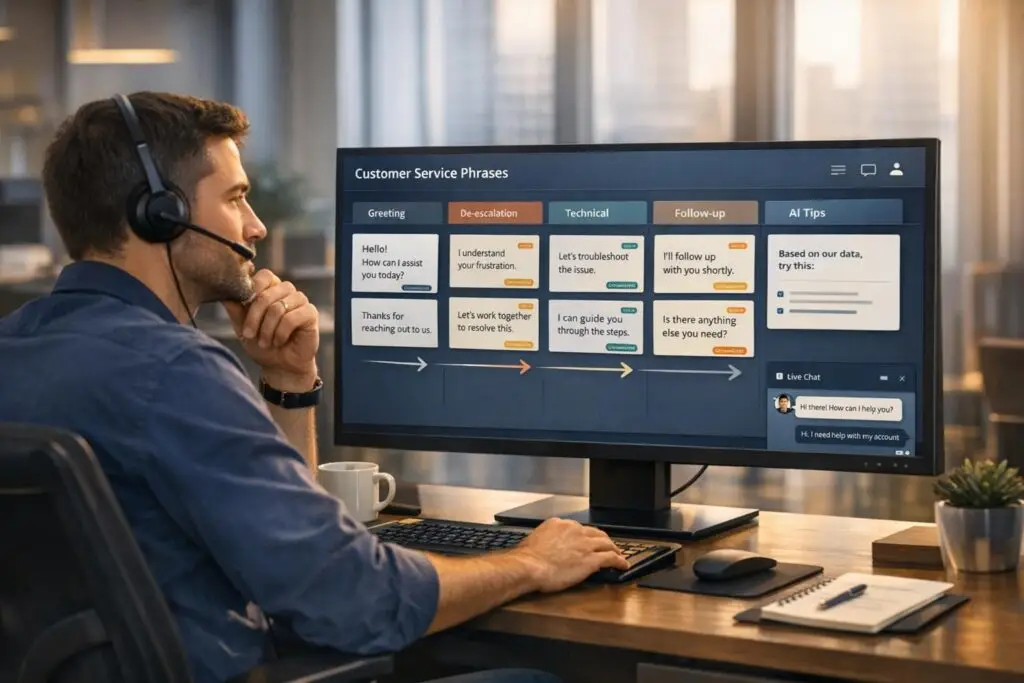
Customer service scripts save time, ensure consistency, and help resolve issues effectively – especially in high-pressure B2B environments. They guide agents in handling common challenges like complaints, delays, and technical issues while maintaining professionalism and empathy.
Key takeaways:
- 69% of customers expect consistent support across all channels. Scripts help meet this expectation.
- 61% of customers stop doing business after one poor service experience. Well-crafted responses can prevent this.
- Scripts with AI tools boost efficiency and personalization. For instance, real-time recommendations and customer-specific details improve outcomes.
From greetings to follow-ups, these scripts cover every stage of customer interaction. Use them as a starting point, customize for your brand, and pair with AI for scalable, human-centered support.
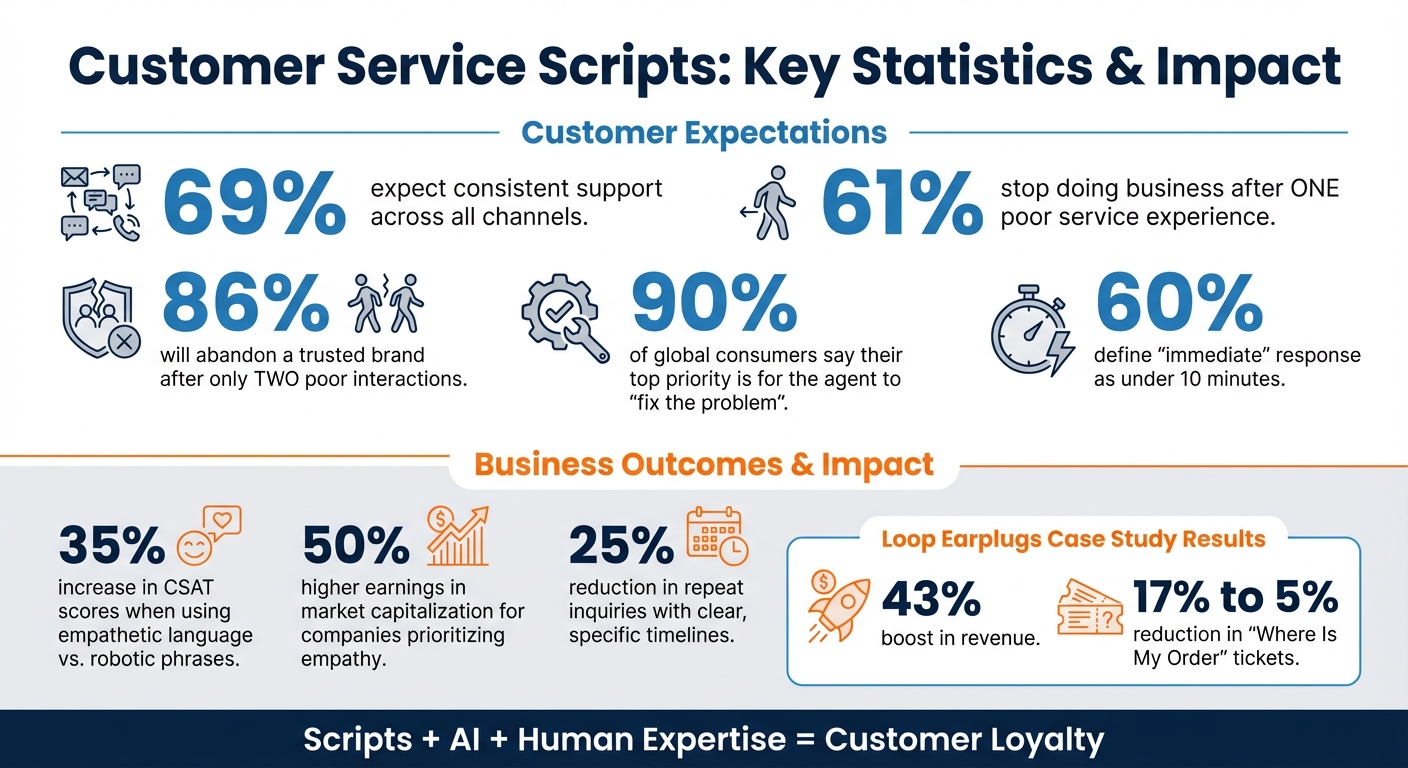
Customer Service Scripts: Key Statistics and Impact on Business Success
57 Phrases to De-escalate Any Angry Customer
1. Greeting and Opening Scripts
First impressions set the tone for everything that follows. In B2B support, the way you start a conversation can make a customer feel either valued or overlooked. A thoughtful, engaging greeting builds trust and shows you’re ready to take responsibility.
Personalization trumps perfection. While 69% of customers prefer personalized interactions over rigidly scripted ones, it’s all about finding the right balance. Include your name, your company, and – using CRM tools – the customer’s name. For returning clients, reference their account history right away. For instance:
"Welcome back, [Name]! I see we last discussed [Issue]. Is that what you’re reaching out about today?"
This simple step not only saves time but also demonstrates you’ve done your homework and care about their experience.
Start with confidence and clarity. Avoid weak phrases like "I’ll try" or "I don’t know." Instead, use assertive language such as, "I can absolutely help you with that." If a customer has been waiting, acknowledge it directly:
"Thank you for your patience; I’ll resolve this promptly."
When placing someone on hold or verifying details, always ask for permission: "Is it okay if I place you on a brief hold?" These small courtesies show respect for their time and help build goodwill. A confident opening sets the stage for adapting your tone based on the customer’s urgency.
Match your tone to the customer’s pace. In B2B settings, efficiency often takes priority over small talk. If a client sounds rushed, skip pleasantries like "How’s your day going?" and jump straight into gathering details or outlining solutions. However, when appropriate, a brief human touch – like saying, "I’m here to help. Let’s tackle this together" – can turn the interaction into a more collaborative experience. After all, 90% of global consumers say their top priority is for the agent to simply "fix the problem".
| Scenario | Opening Script | Why It Works |
|---|---|---|
| New Customer | "Hi, this is [Name] from [Company]. How can I help you today?" | Establishes your identity and readiness to assist. |
| Returning Client | "Welcome back, [Name]! Is this regarding [Previous Issue]?" | Shows you value their time by reviewing their history upfront. |
| After a Wait | "Thanks for your patience. Let’s get this sorted out right away." | Acknowledges the delay and signals immediate action. |
| Action-Oriented | "I can absolutely help you with that. Let me pull up your details." | Conveys confidence and takes ownership right away. |
| Multi-Stakeholder | "Before we begin, may I confirm your account details?" | Balances professionalism with security. |
| High-Pressure | "I’ve reviewed your case history – let’s pick up where we left off." | Avoids unnecessary repetition and shows you’re prepared. |
| First-Time Caller | "Welcome to [Company]! My name is [Name], and I’m excited to assist you today." | Creates a warm and welcoming first impression. |
| Technical Issue | "Not to worry, I’ve checked this on my end and I’ll walk you through the steps." | Reassures the customer while setting clear expectations. |
| Formal Client | "Good morning, [Name]. This is [Agent Name] with [Company]. How may I assist you?" | Matches a professional tone to meet client expectations. |
| Casual Client | "Hey [Name], it’s [Agent Name] from [Company]. What can I do for you today?" | Uses a relaxed tone while staying professional. |
These tailored greetings not only make a great first impression but also lay the groundwork for effective communication, active listening, and empathetic problem-solving throughout the interaction.
Scripts help. Systems scale.
Supportbench drafts on-tone replies with a native AI Co-Pilot and routes every conversation with full account context — so great phrasing happens by default.
See a 20-minute demo Compare Supportbench vs other helpdesks →
2. Active Listening and Empathy Scripts
After starting with a warm greeting, the next step is to show that you’re genuinely listening. In B2B support, making the customer feel heard comes before offering solutions. Frustrated customers are unlikely to absorb your suggestions until they feel their concerns have been acknowledged. Pairing personalized greetings with active listening sets the stage for a smoother interaction. Consider this: 61% of customers have stopped doing business with a brand after just one bad service experience, and 86% will abandon a trusted brand after only two poor interactions.
Paraphrasing the issue (e.g., "The problem is…") is an effective way to confirm you’ve understood their concern and avoid miscommunication. This is especially important in situations involving multiple stakeholders, where details can easily get lost. Similarly, saying something like "I’ve reviewed your case history" reassures the customer that you’ve done your homework and won’t waste their time by making them repeat themselves.
Using collaborative language – for instance, "Let’s fix this together" – fosters a sense of partnership. In high-stakes scenarios, taking ownership is crucial. Saying "I will make sure this gets resolved" demonstrates accountability, which is far more effective than vague, generic statements. Research even shows that companies prioritizing empathy can achieve 50% higher earnings in market capitalization compared to those that don’t.
Avoid phrases that escalate frustration, such as "Calm down", "That’s our policy", or "You’re mistaken." These dismiss the customer’s feelings and often make the situation worse. Instead, opt for expressions like "I understand how frustrating this must be" or "Let me clarify what happened here so we’re on the same page." Replacing cold, robotic phrases with warm, empathetic language has been shown to increase Customer Satisfaction (CSAT) scores by 35%.
Here are some key scripts that can help agents connect with customers more effectively:
| Script | When to Use It | Why It Works |
|---|---|---|
| "The problem is…" | After the customer explains their concern | Shows active listening and ensures accuracy by paraphrasing their issue. |
| "I’ve reviewed your case history." | When a returning customer contacts you | Demonstrates preparation and respect for their time. |
| "I understand how frustrating this must be." | When the customer expresses anger or disappointment | Acknowledges their feelings, helping to defuse tension. |
| "Let’s work on fixing it together." | For complex or multi-step resolutions | Establishes a collaborative tone. |
| "Could you walk me through what happened?" | When gathering details for troubleshooting | Invites specifics in a non-confrontational way. |
| "I can hear that this is important for you." | For high-stakes or urgent concerns | Validates the significance of the issue to the customer. |
| "I’d be asking these same questions." | When the customer is skeptical or defensive | Builds rapport by aligning with their perspective. |
| "Let me repeat that back to ensure I’ve got it right." | Before implementing a solution | Prevents errors through verification. |
| "I will make sure this gets resolved." | For escalations or VIP accounts | Shows accountability and commitment to resolution. |
| "You’re absolutely right." | When the customer identifies a mistake | A powerful way to validate their point and de-escalate tension. |
These phrases are more than just words – they’re tools that help agents align with customers, build trust, and create a positive experience.
3. Handling Complaints and Delays
In the world of B2B support, how you handle complaints and delays can make or break customer loyalty. The secret lies in blending empathy with transparency – acknowledging the customer’s frustration while clearly outlining next steps and providing realistic timelines.
When addressing complaints, empathetic listening is just the start. Clear communication and taking responsibility are equally important. Avoid vague non-apologies like "I apologize for any inconvenience." As Claire Littell from Support Driven points out:
"I specifically hate ‘I apologize for any inconvenience this may cause’ because it completely fails to acknowledge that there is an actual problem that is affecting you and causing trouble for you".
Instead, use language that validates the customer’s experience, such as, "I’m sorry your order is late; I know you were counting on it." This kind of acknowledgment can improve Customer Satisfaction (CSAT) scores by up to 35%.
Transparency is key to easing customer concerns. When delays occur, always provide a clear explanation – whether it’s due to high demand, system outages, or supply chain disruptions. Customers are far more understanding when they know the reason behind a delay. Replace vague timelines like "soon" with specific deadlines such as "within 24 hours" or "by 3:00 PM EST on January 25th." Research shows that 90% of customers value an "immediate" response when they have a service question, with 60% defining "immediate" as under 10 minutes.
Take ownership, even if the issue isn’t directly your fault. Phrases like "I will personally make sure this gets resolved" show accountability and build trust. Mathew Patterson from Help Scout explains:
"Acknowledgement of fault is a powerful act. It tells the customer: You are right. I see your perspective, and I understand it".
For significant delays, consider offering compensation – like expedited shipping or discounts – before the customer even asks. For example, in January 2024, Loop Earplugs reduced "Where is my order" inquiries from 17% to 5% of total support tickets by proactively sending shipping updates through automated tools. This strategy not only improved customer experience but also contributed to a 43% increase in revenue via support channels.
Here are some practical scripts to help you navigate complaints and delays effectively:
| Script | When to Use It | Why It Works |
|---|---|---|
| "I’m sorry your order is late; I know you were counting on it." | Acknowledging a shipping delay | Shows empathy and avoids a generic apology. |
| "Here’s what happened: [brief reason]. Here’s what I’m doing to fix it." | Explaining the cause of a delay | Builds trust through transparency. |
| "I’ll update you by 3:00 PM EST tomorrow with a resolution or next steps." | Ongoing issues needing investigation | Sets clear expectations and accountability. |
| "Would you prefer a refund or a replacement?" | Offering resolution options | Gives the customer control over the outcome. |
| "I’ve escalated this to our senior team, and I’ll update you every 30 minutes." | During critical issues or outages | Provides a clear update schedule to reduce anxiety. |
| "That product will be available next month; I can place the order now to ensure it’s sent the moment it reaches our warehouse." | Back-order situations | Turns a delay into a proactive solution. |
| "Here’s what I can do to help within our guidelines." | When dealing with company policy limitations | Shifts focus to actionable solutions. |
| "Great question! Let me find that out for you." | When you don’t have an immediate answer | Shows initiative instead of deflecting with "I don’t know". |
| "We’re aware of the issue and working on it. I’ll send you an update in 15 minutes even if there’s no change." | For widespread problems or outages | Keeps customers informed and reassured. |
| "I’ve added a $25 credit to your account for the inconvenience." | When a delay causes a clear impact | Proactive compensation softens the blow and builds goodwill. |
sbb-itb-e60d259
4. Delivering Bad News and Technical Issues
Breaking bad news can be a make-or-break moment for customer loyalty, especially when done right. In the fast-paced world of B2B interactions with multiple stakeholders, clear communication during tough situations is essential. The goal? Be honest, show empathy, and quickly pivot toward actionable solutions. This approach not only softens the blow but also sets the stage for productive, solution-oriented discussions – especially when tackling technical challenges.
Acknowledge the situation with thoughtful, specific language. For example, saying, "I understand how frustrating this must be," shows empathy and validates the customer’s experience. Pair this with a clear explanation of the issue: "Your service is down due to a server issue, and we’re working to resolve it by 2:00 PM EST." On the flip side, vague apologies like "I apologize for any inconvenience" often fall flat because they fail to connect with the customer’s actual concerns. People are far more understanding when they know what’s happening and why.
Once you’ve established transparency, focus on solutions. Avoid framing responses negatively. Instead of saying "Unfortunately", try using phrases like "As it turns out." Apple Geniuses use this exact technique to keep conversations positive and forward-thinking. If you can’t meet a request, immediately pivot to an alternative: "While we can’t [original request], here’s what we can do: [alternative solution]." For technical issues, simplify complex explanations into easy-to-follow steps and offer real-time support whenever possible.
Be clear and specific with timelines. A vague promise like "We’ll update you soon" can create uncertainty. Instead, set precise expectations: "You’ll have an update by Thursday at 12:00 PM EST." Using personal language, such as "I’ll personally ensure updates every 30 minutes until this is resolved," builds trust and reassures customers that their concerns are being handled seriously. For escalations, provide a clear update schedule to reduce anxiety and keep the customer informed every step of the way.
To make these interactions even smoother, here are 10 ready-to-use scripts for delivering bad news and handling technical issues effectively:
| Script | When to Use It | Why It Works |
|---|---|---|
| "I can see why you’d feel that way about this situation." | Acknowledging the impact of a technical issue | Validates the customer’s experience without deflecting. |
| "Here’s what happened: [brief technical explanation]. Here’s our plan to fix it by [specific time]." | Explaining a system outage or bug | Builds trust through transparency and clear timelines. |
| "While we can’t [original request], here’s what we can do: [alternative solution]." | When you need to say "no" to a feature request | Pivots from limitation to possibility. |
| "Let me find that out for you to ensure accuracy – I’ll have an answer within 30 minutes." | When you don’t know the technical answer | Shows ownership instead of deflecting with "I don’t know." |
| "I’ve checked this on my end and I’ll walk you through the steps to get it sorted." | Guiding a customer through troubleshooting | Provides reassurance and a collaborative approach. |
| "We’re aware of the issue and actively working to fix it. I’ll send you an update by 4:00 PM EST today, even if there’s no change." | During widespread outages | Keeps customers informed and helps prevent repeat queries. |
| "As it turns out, we can offer you [workaround or credit] while we work on a permanent fix." | When a feature is temporarily unavailable | Shifts the focus from limitations to actionable alternatives. |
| "I’ll escalate this to our engineering team immediately and personally follow up with you by end of day tomorrow." | For complex technical bugs requiring escalation | Demonstrates accountability and sets clear expectations. |
| "May I put you on a brief hold while I check with our technical team?" | Before transferring or researching technical details | Asks for permission and provides context for the wait. |
| "I’ve applied a $50 credit to your account for the service interruption." | After a significant technical failure | Proactive compensation shows goodwill before the customer even asks. |
These scripts and strategies ensure that even tough conversations leave customers feeling heard, valued, and confident in your ability to resolve their issues.
5. Closing, Follow-Up, and Feedback Scripts
After covering greetings, active listening, and handling complaints, it’s important to focus on how you wrap up interactions. The way you close a conversation can leave a lasting impression – either making customers feel valued or overlooked. A strong closing ties everything together, confirms the issue is resolved, sets clear expectations for what’s next, and invites future communication. Adding follow-ups and feedback requests takes the customer experience to the next level.
Timely follow-ups show customers that you care beyond just resolving the issue. Even a quick message like, "Just checking in to make sure everything is working fine," can make a big difference. If an issue requires more time to resolve, avoid vague promises like, "We’ll get back to you soon." Instead, be specific: "You’ll hear from us by 3:00 PM today." This clarity can reduce repeat inquiries and increase customer satisfaction by up to 25%.
Once the issue is resolved, asking for feedback helps you improve your service. Position feedback requests as a way for customers to contribute to better service, rather than a corporate formality. Highlighting that a survey takes less than 2 minutes can encourage participation. Before requesting feedback, ensure the customer is happy with the resolution – 61% of people have stopped doing business with a company after just one bad service experience. Closing the loop by sharing how their input is used, such as informing specific teams, reinforces that their voice matters.
Here are 10 scripts you can use for closing conversations, following up, and requesting feedback:
| Script | When to Use It | Why It Works |
|---|---|---|
| "Before we wrap up, is everything resolved?" | To confirm resolution before ending the interaction | Ensures there are no lingering issues and prevents follow-up tickets. |
| "Thank you for being our customer; we value your loyalty." | For closing a positive interaction | Shows appreciation, especially for long-term customers. |
| "I’ll follow up with you by 3:00 PM today with an update." | When an issue needs more time to resolve | Provides clear expectations and reduces uncertainty. |
| "If the issue recurs, contact us immediately." | At the end of a resolved conversation | Encourages customers to reach out again if needed, avoiding frustration. |
| "Checking in to confirm all is well." | For proactive follow-ups after a fix | Shows care and ensures the solution worked without being intrusive. |
| "Is there anything else I can help you with today?" | Before officially closing the interaction | Helps surface unresolved concerns, reducing the need for follow-ups. |
| "Your feedback guides our improvements. Please take a 2-minute survey." | After resolving an issue | Frames feedback as a collaborative effort, not a task. |
| "I’ve shared your feedback with our product team to help improve things." | After receiving suggestions from a customer | Shows their input is valued and acted upon. |
| "We’re still working on this, and I’ll keep you updated as soon as I have more information." | During ongoing investigations | Keeps customers informed and reassured they haven’t been forgotten. |
| "I see you’ve been with us since 2023 – thank you for your continued trust." | When personalizing a sign-off for long-term clients | Makes customers feel recognized and valued. |
Using these scripts ensures every interaction ends on a positive note – whether you’re closing a ticket, following up on a solution, or gathering feedback to improve your service.
Conclusion
Pre-crafted scripts are a game-changer for building consistent, efficient, and scalable customer support. By reducing Average Handle Time and minimizing compliance risks, they ensure every customer gets top-notch service. In fact, 69% of consumers expect consistent support across all platforms, and scripts make that level of consistency achievable without requiring agents to start from scratch for every interaction.
But the true strength of scripts lies in their ability to adapt to individual customer needs. They shine when tailored to match a customer’s tone, include personal details, and escalate complex issues appropriately. Take Loop Earplugs, for example – they managed to cut "Where Is My Order" tickets from 17% to just 5% of total inquiries in 2024 by using pre-crafted response scripts within automated workflows. This initiative contributed to a 43% boost in revenue attributed to their customer support team. Milan Vanmarcke, their Customer Service Manager, summed it up perfectly:
"Quick response flows give us the ability to build trust with our customers and that’s priceless. When customers get a quick and honest answer, they often end up buying more than one product in a short span of time".
In complex B2B settings, AI-powered tools amplify the effectiveness of scripts by automating repetitive tasks while seamlessly passing more nuanced issues to human agents. This balance not only improves efficiency but also strengthens customer loyalty. AI can handle straightforward tasks like order tracking, password resets, and FAQs, freeing up human agents to focus on high-stakes interactions that require empathy and problem-solving. And this balance is critical – 61% of consumers have stopped doing business with a company after just one poor service experience.
The future of customer support lies in combining scripts, human expertise, and AI to deliver faster, more accurate, and personalized interactions. Whether you’re onboarding new agents, scaling your team, or managing intricate B2B accounts, the 50 scripts included in this article provide a solid foundation. Customize them to reflect your brand’s voice, integrate them with AI-driven tools, and review them regularly to keep pace with your customers’ evolving needs.
Together, scripts, human insight, and AI don’t just cut costs – they help transform first-time buyers into loyal, long-term customers.
FAQs
How can AI improve customer service scripts?
AI has the ability to transform customer service scripts by making them more personalized and efficient. By analyzing customer data and past interactions, it can recommend tailored responses in real-time, helping agents address individual needs with precision.
Tools like chatbots and virtual assistants take this a step further by dynamically adjusting scripts during conversations. This ensures agents maintain consistent, empathetic, and context-aware communication. Beyond that, AI automates routine tasks, minimizing human error and giving agents more time to tackle complex issues. The result? Happier customers and smoother operations.
Why is personalizing customer service interactions important?
Personalizing customer service interactions is a game-changer for building trust and loyalty. When customers feel genuinely valued and understood, it creates a connection that goes beyond a simple transaction. Tailored communication shows empathy, making interactions more meaningful and memorable – especially when dealing with complex or high-pressure situations.
On top of that, personalized service helps support teams deliver solutions that are actually relevant to the customer’s needs. This not only speeds up issue resolution but also leads to higher satisfaction. With the smart use of customer data, modern AI-powered tools can even predict what a customer might need and provide proactive, seamless support. In the end, personalization isn’t just about making customers happy – it’s about strengthening relationships and giving businesses an edge in today’s competitive, customer-first world.
Why is being transparent important when addressing complaints or delays?
Transparency plays a key role in handling complaints or delays. It builds trust and lets customers know their concerns are being addressed. Providing clear, honest updates helps set realistic expectations, eases frustration, and shows that you respect their time and experience.
When customers are kept in the loop, they’re more likely to stay patient and understanding, even when things don’t go as planned. Open communication doesn’t just solve the problem at hand – it also strengthens relationships and leaves a lasting positive impression.
Related Blog Posts
- What Is Customer Service? Definition, Examples, and Best Practices
- 10 best ticketing systems for startups and how to choose one
- Customer Service Skills: 25 Skills Great Support Teams Hire For
- Customer Service Resume Examples (Plus a Hiring Scorecard)
Turn these scripts into consistent, on-brand replies your whole team can reuse — automatically.
Evaluating help desks for a B2B team?
Supportbench is all-inclusive from $32 per agent per month, with migration and onboarding included. See pricing or book a 20-minute demo.