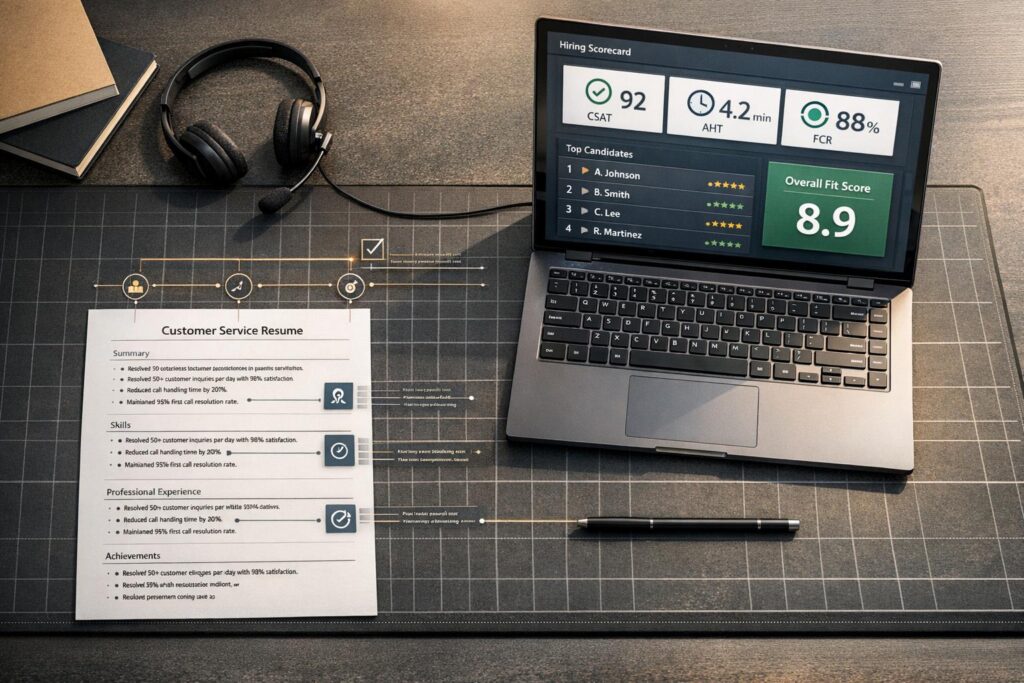
Crafting a standout customer service resume is essential in today’s competitive job market. With 75% of resumes filtered out by Applicant Tracking Systems (ATS) and recruiters spending only 6–8 seconds scanning each resume, you need to make a strong first impression. Here’s what matters most:
- Use a reverse-chronological format to highlight recent experience and ensure ATS compatibility.
- Quantify accomplishments with metrics like CSAT scores, first-contact resolution rates, and reduced ticket backlogs.
- Tailor your resume to match the job description, including specific tools (e.g., Salesforce, AI platforms) and skills.
- Focus on technical and interpersonal skills, such as CRM expertise, conflict de-escalation, and empathy.
- Avoid design elements that confuse ATS, like graphics or non-standard fonts.
For hiring managers, a structured hiring scorecard can help evaluate candidates objectively. Assess key areas like technical skills, communication, and growth potential to build a high-performing team.
Whether you’re applying for your next role or hiring top talent, these strategies will help you stand out and succeed.
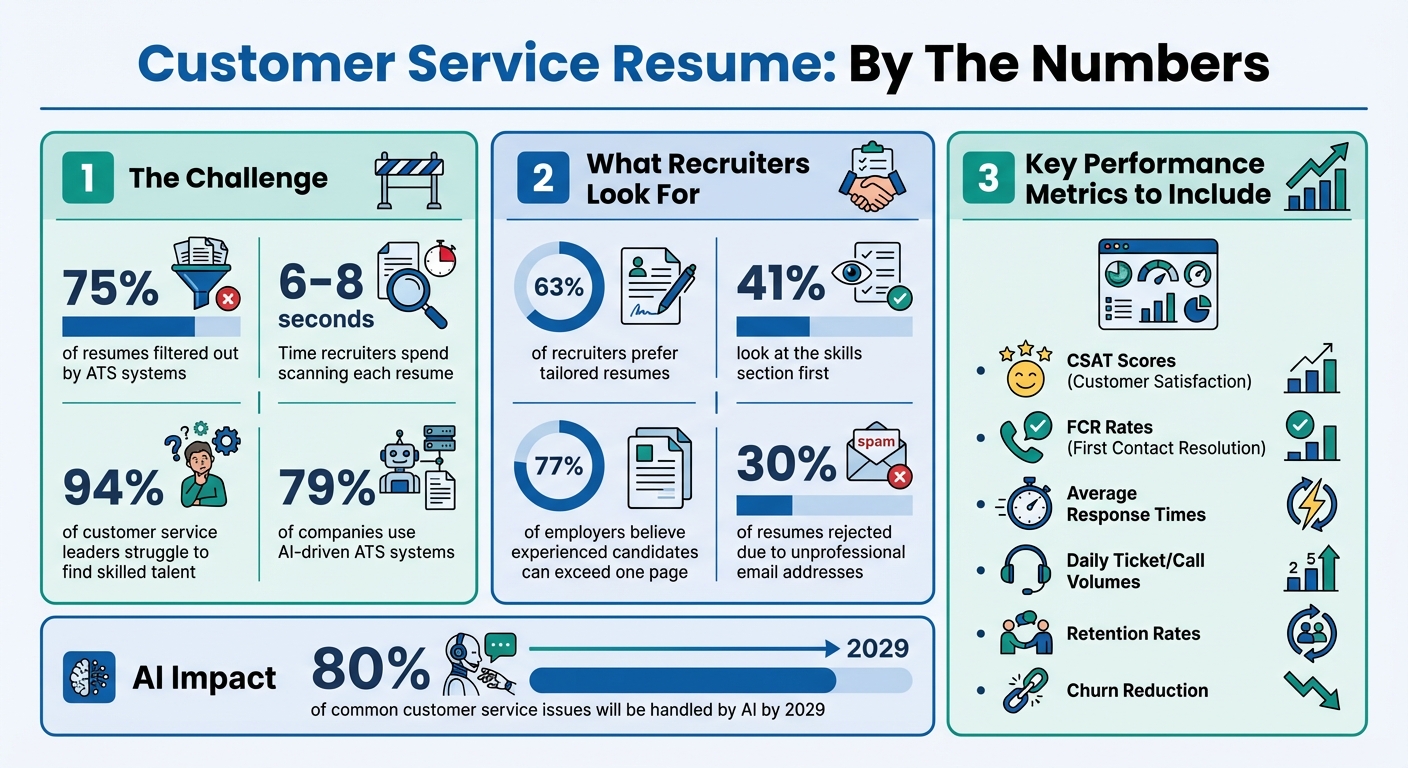
Customer Service Resume Statistics and Key Success Metrics
HOW TO WRITE A CUSTOMER SERVICE RESUME: 5 WAYS TO SHOWCASE YOUR SERVICE SKILLS
How to Structure Your Customer Service Resume
Your resume has to impress two critical audiences: the Applicant Tracking System (ATS) that scans it first and the recruiter who spends just six to seven seconds deciding if you’re worth a closer look. Structuring it correctly means catering to both.
Start with the reverse-chronological format – it’s the standard in the industry and works best with ATS software. This format places your most recent experience first, making it easy for hiring managers to gauge your current skills. The typical layout includes: Header (contact details) → Professional Summary or Objective → Core Skills → Work Experience → Education → Additional Sections (like certifications or languages).
Keep your layout clean and simple. Use one-inch margins, 1.15 line spacing, and professional fonts such as Roboto, Arial, or Helvetica. Avoid tables, text boxes, headers, footers, or graphics – these elements can confuse ATS systems and might lead to rejection. Stick to standard section titles like "Professional Experience" instead of creative alternatives like "My Journey".
Resume Formatting Basics
Choose web-safe fonts that are easy to read for both ATS and recruiters. Sans-serif options like Arial or Roboto offer a modern look, while serif fonts like Merriweather work well for longer text blocks. Save your resume as a PDF to preserve formatting – modern ATS systems can handle PDFs, and recruiters often prefer them. Use a professional file name, such as "FirstName_LastName_Resume", instead of something generic.
To make your resume scannable, use bullet points, bold headers, and ample white space to create a clear visual hierarchy. If you have less than 10 years of experience, keep your resume to one page. However, if you have extensive experience, don’t hesitate to go beyond one page – 77% of employers believe seasoned candidates shouldn’t feel confined to a single page.
One small but crucial detail: your email address. Unprofessional email addresses lead to rejection for three in 10 resumes. Stick to a simple format like firstname.lastname@email.com, and consider adding a link to your LinkedIn profile.
Using Numbers and Measurable Results
Instead of vague phrases like "handled customer complaints", provide specific, measurable outcomes. For example: "Resolved 50+ customer complaints daily with a 95% satisfaction rate". Follow the formula "Action Verb + Task + Quantifiable Result" for every bullet point. Highlight metrics that matter in customer service, such as CSAT scores, first-contact resolution (FCR) rates, average response times, and daily ticket or call volumes. These details give hiring managers a clear picture of your impact.
"A strong resume doesn’t just state what you did – it shows how well you did it."
Don’t forget financial achievements. If you contributed to revenue growth through upselling, lowered churn rates, or boosted customer retention, include those numbers. For operational improvements, mention reductions in ticket backlogs, faster onboarding times, or cost-saving initiatives you implemented. Tailor these achievements to match the specific requirements of each job.
Customizing Your Resume for Each Job
Gone are the days of one-size-fits-all resumes. With 63% of recruiters favoring resumes tailored to the role and 41% looking at the skills section first, customization is key to standing out.
Use the exact language and tools mentioned in the job description. If the role highlights "conflict de-escalation", include that phrase instead of a general term like "problem resolution". If specific tools like CRM software or AI-powered support platforms are listed, name them in your skills and experience sections.
Adjust your professional summary to align with the job’s focus. For technical troubleshooting roles, emphasize your technical support metrics. For customer success positions, highlight retention rates and account growth. The goal is to make it immediately clear – within those first six to eight seconds – that you’re a strong match for the role.
Key Skills to Include on a Customer Service Resume
The skills section of your resume is more than just a list – it’s your chance to stand out in a competitive job market. With 79% of companies using AI-driven applicant tracking systems (ATS) and 94% of customer service leaders struggling to find skilled talent, the right keywords can determine whether your application gets noticed.
To make your skills easy to scan, divide them into two categories: Technical Skills and Interpersonal Skills. Keep the list concise – no more than 10 targeted skills – and tailor them to match the job description.
Technical Skills
For B2B customer service roles, technical expertise is non-negotiable. Start by showcasing your proficiency in popular CRM platforms and helpdesk software like Salesforce, HubSpot, Zoho Desk, Jira Service Management, or Help Scout. These tools are staples in managing customer relationships.
Experience with AI tools is becoming a key differentiator. With AI projected to handle 80% of common customer service issues by 2029, familiarity with AI-powered systems is a must. Quantify your experience wherever possible. For example: "Reduced resolution time by 25% through AI-powered ticket triage and smart summaries". Highlight specific capabilities like auto-ticket routing, real-time tone suggestions, and sentiment analysis.
Data literacy is another critical area. Showcase your ability to track and improve key metrics like CSAT (Customer Satisfaction), First Contact Resolution (FCR), and Customer Effort Scores (CES). If you’ve used analytics tools to identify at-risk accounts or reduce churn, include those achievements. For example: "Identified at-risk accounts using analytics, preventing churn in 20% of cases". Additionally, if you’ve managed omnichannel customer interactions – spanning email, live chat, social media, and phone – make that clear.
While technical skills are crucial, they need to be paired with strong interpersonal abilities to complete the picture.
Interpersonal Skills
Technical expertise might get your resume through the ATS, but it’s your interpersonal skills that will win over hiring managers. According to Zendesk, soft skills are often prioritized because they’re harder to teach on the job.
Avoid generic terms like "communication" or "teamwork." Instead, back up your claims with measurable outcomes. For example: "Maintained a 95%+ customer satisfaction score across both English and Spanish support queues". Use action verbs like Streamlined, Resolved, and Mentored to demonstrate your impact.
For B2B roles, focus on skills that foster long-term client relationships rather than quick fixes. Highlight experiences like advisory roles, high-touch account management, and cross-departmental collaboration. If you’ve successfully reduced churn or improved retention, quantify those achievements: "Identified 15 at-risk accounts using sentiment analysis, leading to a 10% increase in retention". Show how you combine empathy with technology to tackle complex challenges.
Customer Service Resume Examples by Role and Experience
Your resume should evolve alongside your career, reflecting your growing expertise and aligning with the roles you’re targeting. What works for an entry-level position won’t necessarily help you secure a senior leadership role. The tone, structure, and metrics you highlight should match your experience level and the specific job you’re pursuing.
Entry-Level, Mid-Level, and Senior Resume Examples
Entry-level candidates should emphasize transferable skills gained from various experiences that demonstrate dependability and problem-solving abilities. Use a concise, ATS-friendly format and opt for a resume objective instead of a summary. This objective should focus on your transferable skills and career aspirations in just 2–3 sentences. Even without direct experience, you can showcase measurable achievements. For instance: "Handled 40+ customer calls daily in a retail role, exceeding sales targets by 5%".
As you gain experience, your resume should shift focus from transferable skills to leadership and process improvements. Mid-level professionals should highlight accomplishments like team leadership and operational efficiency. For example, between December 2019 and September 2022, Tonya A. Lopez, a Customer Service Representative at Selbst Inc., reduced average resolution time by 20% through better call triaging. She also maintained a knowledge base that shortened new hire onboarding by 21% and cut subscription cancellations by 10%. This level of experience should also showcase collaboration across departments, such as working with product teams to address recurring issues. Use strong action verbs like "Optimized", "Mentored", or "Streamlined" to start bullet points.
For seasoned professionals, a polished summary and metrics tailored to B2B environments become crucial. Senior-level candidates should include a 3–4 sentence professional summary that highlights qualifications and a proven track record, rather than using an objective statement. Focus on metrics like client retention rates, revenue growth, and successful contract negotiations. For instance, Melissa Ramirez, a Senior Customer Service Representative at TechSupport Solutions, achieved a 97.3% first-contact resolution rate between March 2021 and 2026. She worked with the product team to address recurring issues, leading to two major fixes that reduced support tickets by 17% and cut average call times from 8.5 minutes to 6.2 minutes. Adding certifications such as "Certified B2B Customer Service Specialist" or "Certified Customer Experience Professional (CCXP)" can further enhance credibility.
Resumes for Specific Customer Service Roles
Tailor your resume to the specific role you’re applying for by emphasizing the most relevant skills and achievements.
A Customer Service Representative should focus on metrics like Average Handle Time (AHT) and First-Contact Resolution (FCR). For example, Melissa R. Daniels, a Senior Customer Experience Specialist at BlueShield Health Partners, managed escalations for 127,000+ subscribers starting in January 2020. She implemented a new call documentation process that reduced follow-up calls by 26%, which was later adopted across the company. These metrics align with modern support practices that prioritize efficiency and accuracy.
For Customer Experience Specialist roles, highlight your ability to think strategically and improve the customer journey. Implementing systems like AI-driven chatbots can cut response times by 40% and boost customer satisfaction scores by 25%. Include examples of using sentiment analysis or customer feedback to drive product improvements, showcasing your ability to integrate customer insights with advanced support technologies.
Technical Support Specialist resumes should demonstrate strong technical skills. Mention specific platforms like Salesforce, Microsoft Dynamics, Zoho CRM, and tools like Jira, Asana, or Trello. Highlight your experience troubleshooting complex systems and managing Service Level Agreements (SLAs). For B2B roles, emphasize account management experience, such as overseeing 50+ key accounts and participating in full-cycle onboarding, from sales coordination to service delivery. Evidence shows that strategic B2B training programs can improve customer retention rates by 5%.
"Your resume is not a to-do list. It’s a results-focused document that shows how your work created business outcomes." – Farah Sharghi, Founder of Trusted Career Mentor
sbb-itb-e60d259
Writing a Professional Summary or Objective Statement
Your opening statement is one of the most critical parts of your resume. Why? Because recruiters typically spend just 7 seconds scanning a resume before deciding whether to keep reading or move on. This means your summary or objective needs to grab attention immediately and show the value you bring to the table. Avoid vague or generic phrases – be specific about how you align with the role.
If you have prior customer service experience, go with a professional summary. If you’re new to the field or switching careers, a resume objective is the better choice. A summary highlights your accomplishments, while an objective focuses on transferable skills and what you aim to contribute to the company.
For a strong professional summary, use this formula: Adjective + Title + Years of Experience + Key Achievements + Value Proposition. Here’s an example:
"Customer Service Specialist with 8 years of healthcare support experience, maintaining a 97% CSAT score and reducing resolution time by 22%." This format clearly communicates your impact and expertise.
Make sure to customize your summary with keywords from the job description. Use terms like "omnichannel support", "SLA design", or "AI-driven ticketing systems" to align with the role and improve your chances of passing applicant tracking systems (ATS). These systems reject about 75% of qualified candidates, so tailoring your resume is essential. Including the company’s name in your summary can also show that you’ve personalized your application.
Now, let’s look at how to craft summaries that stand out for different career stages.
Summary Examples for Different Career Stages
Here are examples tailored to entry-level, mid-level, and senior-level professionals to help you write an effective summary.
Entry-Level Candidates
If you’re just starting out, focus on transferable skills and your potential. Here’s an example of an objective statement:
"Enthusiastic and personable recent graduate with strong communication and problem-solving skills, seeking to leverage volunteer and academic experience in a customer service role. Adept at handling inquiries with patience and professionalism to ensure positive customer interactions".
This highlights qualities like reliability and a willingness to learn – key traits employers look for in candidates without much experience.
Mid-Level Professionals
For those with 3–7 years of experience, emphasize your performance metrics and specialized knowledge. A strong summary might look like this:
"Customer service professional with 5+ years of experience resolving complex client issues and improving satisfaction scores. Proven ability to manage high call volumes while maintaining a 95% customer satisfaction rating. Skilled in conflict resolution, active listening, and relationship building".
At this stage, you should also include tools or platforms you’re proficient in, such as CRM software, and back up your claims with numbers.
Senior-Level Candidates and Managers
If you’re in a leadership role, focus on strategic impact and team management. For example:
"Results-driven customer service manager with 8+ years of experience leading support teams of up to 20 representatives. Skilled in training staff, streamlining processes, and implementing performance metrics that improved customer satisfaction by 25%. Adept at balancing operational efficiency with exceptional customer care".
This type of summary showcases your ability to lead teams, improve processes, and make a measurable impact on the organization.
"A resume is not storytelling time, where you want to hide something from the reader. You’re writing your resume for hiring managers who are scanning a hundred resumes just like yours."
– Kerri Tielman, Groove Writer
Building a Hiring Scorecard for Customer Service Candidates
Hiring top-notch customer service professionals can be a real challenge. In fact, 94% of customer service leaders say they struggle to find skilled talent. That’s why having a structured and objective evaluation tool – like a hiring scorecard – can make all the difference. A scorecard helps turn subjective impressions into measurable data by assessing candidates on specific skills such as CRM expertise, empathy, and problem-solving. This approach is especially important for building teams equipped to handle modern, AI-powered support systems in a cost-effective way.
"A scorecard in hiring is like a roadmap for finding the ideal candidate. It’s a structured tool that outlines the specific skills and qualities you’re looking for." – Maxime Manseau, Birdie
The scorecard ensures every candidate is evaluated consistently, even when multiple interviewers are involved. Without it, one person might focus on technical skills, while another prioritizes personality traits, leading to inconsistent assessments. To help you get started, let’s explore a practical template for creating a hiring scorecard.
Scorecard Template and Evaluation Criteria
A well-designed scorecard should cover four key areas: technical skills, communication abilities, interpersonal qualities, and growth potential. Each category is weighted according to the role’s priorities. For example, if the position involves troubleshooting AI-driven ticketing systems, technical skills might carry more weight, such as 30% of the total score, while communication could account for 25%.
Use a 1–5 rating scale, where 1 means expectations are unmet and 5 represents excellence. To keep evaluations accurate, score each response immediately during the interview. Here’s a sample template:
| Evaluation Category | Key Criteria to Assess | Suggested Weight |
|---|---|---|
| Technical Skills | CRM proficiency, typing speed, AI tool familiarity, product knowledge | 25% |
| Communication | Grammar, tone, clarity, active listening, multilingual ability | 30% |
| Interpersonal | Empathy, patience, conflict resolution, emotional intelligence | 30% |
| Growth Potential | Adaptability, coachability, ambition for leadership roles | 15% |
Include a feedback section for qualitative notes. For instance, if a candidate scores a "3" on empathy because they seemed nervous but gave thoughtful answers, make a note of that context. These observations provide a fuller picture when making final decisions.
How to Use the Scorecard in Your Hiring Process
Once your evaluation criteria are set, follow these steps to incorporate the scorecard into your hiring process.
Start by defining the role. Identify the daily responsibilities and must-have skills so your scorecard reflects the actual demands of the job. If the role involves handling escalations, for example, include conflict de-escalation as a category and use behavioral questions like, "Can you share an experience where you managed an upset customer?"
Make sure your interviewers are trained to use the scorecard consistently. Conduct calibration sessions to align everyone on how to interpret and apply the scoring system. This step is crucial to avoid discrepancies, such as one interviewer giving overly high scores while another tends to be more conservative.
"The scorecard turns subjective impressions into objective evaluations. Instead of relying on gut feelings, you rate candidates on each listed competency." – Maxime Manseau, Birdie
After interviews, compare scores and address any differences. For instance, if one interviewer rates a candidate’s technical skills as a "5" and another gives a "2", discuss the reasoning behind each score. This collaborative process ensures stronger hiring decisions and reduces the risk of missing out on great candidates – or advancing ones who aren’t the best fit.
Over time, refine your scorecard based on the actual performance of your new hires. If you notice that candidates who score high on "coachability" tend to excel, consider giving that category more weight in future evaluations. Using these objective metrics not only improves your hiring process but also helps build a team ready to excel in modern, AI-driven customer service.
Conclusion
Crafting a strong customer service resume and adopting a well-structured hiring process are essential steps for thriving in today’s competitive B2B support environment. With 94% of leaders facing challenges in finding skilled talent and 75% of resumes being filtered out by ATS systems, your resume needs to stand out. Focus on showcasing measurable achievements – like boosting CSAT scores, cutting resolution times, or demonstrating expertise with AI tools.
This focus on results and technical precision isn’t just about the past; it’s about setting the stage for future success.
"Strong customer service resumes don’t just summarize your past – they highlight what you can do next." – Mozhdeh Rastegar-Panah, Senior Director, Product Marketing, Zendesk
A structured scorecard can help hiring managers objectively evaluate critical skills such as technical proficiency, communication, and emotional intelligence – qualities that are increasingly vital for AI-driven support teams. Given that recruiters typically spend only 6 to 8 seconds scanning a resume, tools that spotlight top candidates quickly are invaluable for both job seekers and hiring teams.
Whether you’re fine-tuning your resume or building a support team, focus on measurable impact, clear organization, and tailored content. Use action-oriented language and quantify your achievements to make your experience shine. For hiring managers, regularly updating your evaluation criteria based on real-world performance data can help you assemble stronger teams over time. By prioritizing these practices, you’ll streamline the hiring process and build a team equipped to excel in the ever-evolving, AI-driven customer service landscape.
FAQs
What’s the best way to make sure my resume gets through an ATS scan?
To make your resume stand out to an ATS (Applicant Tracking System), focus on incorporating specific keywords from the job description. These might include particular skills, certifications, or qualifications that the employer is looking for. Keep your formatting simple and straightforward – steer clear of graphics, images, or intricate layouts that could confuse the system.
Emphasize quantifiable achievements and customize your experience to align with the role. For instance, instead of writing "Handled customer inquiries", go for something like "Resolved 95% of customer inquiries on the first call, boosting satisfaction scores by 20%." This approach not only appeals to hiring managers but also ensures the ATS recognizes your key qualifications.
What metrics should I include on my customer service resume?
When putting together a customer service resume, emphasize measurable results that demonstrate your contributions. Include specifics like your ticket resolution rate, customer satisfaction score (CSAT), or any measurable improvements you’ve achieved – such as cutting response times or boosting customer retention.
For example, highlight accomplishments like, “Increased CSAT by 15% in six months” or “Resolved 95% of tickets within SLA.” Numbers like these give hiring managers a clear picture of your impact and show your ability to drive results.
How can I tailor my resume for different customer service positions?
To make your resume stand out for different customer service roles, focus on showcasing the skills, experiences, and achievements that match the job’s specific needs.
For entry-level positions, highlight essential soft skills like strong communication, active listening, and teamwork. If you have volunteer experience or participated in group projects, include them to demonstrate your dependability and ability to collaborate effectively.
For managerial or senior roles, emphasize quantifiable achievements such as increasing customer satisfaction ratings or cutting down response times. Pair these with leadership and team management experience to show your ability to handle advanced responsibilities. Be sure to weave in relevant keywords from the job description to optimize your resume for applicant tracking systems (ATS) and grab the attention of hiring managers.
Tailoring your resume to each role shows that you’re detail-oriented and genuinely interested in the position – qualities that can significantly boost your chances of getting that interview.