Looking to land a customer service job? Your cover letter is your first chance to stand out. While your resume shows what you’ve done, your cover letter explains why you’re the right fit. Here’s why it matters:
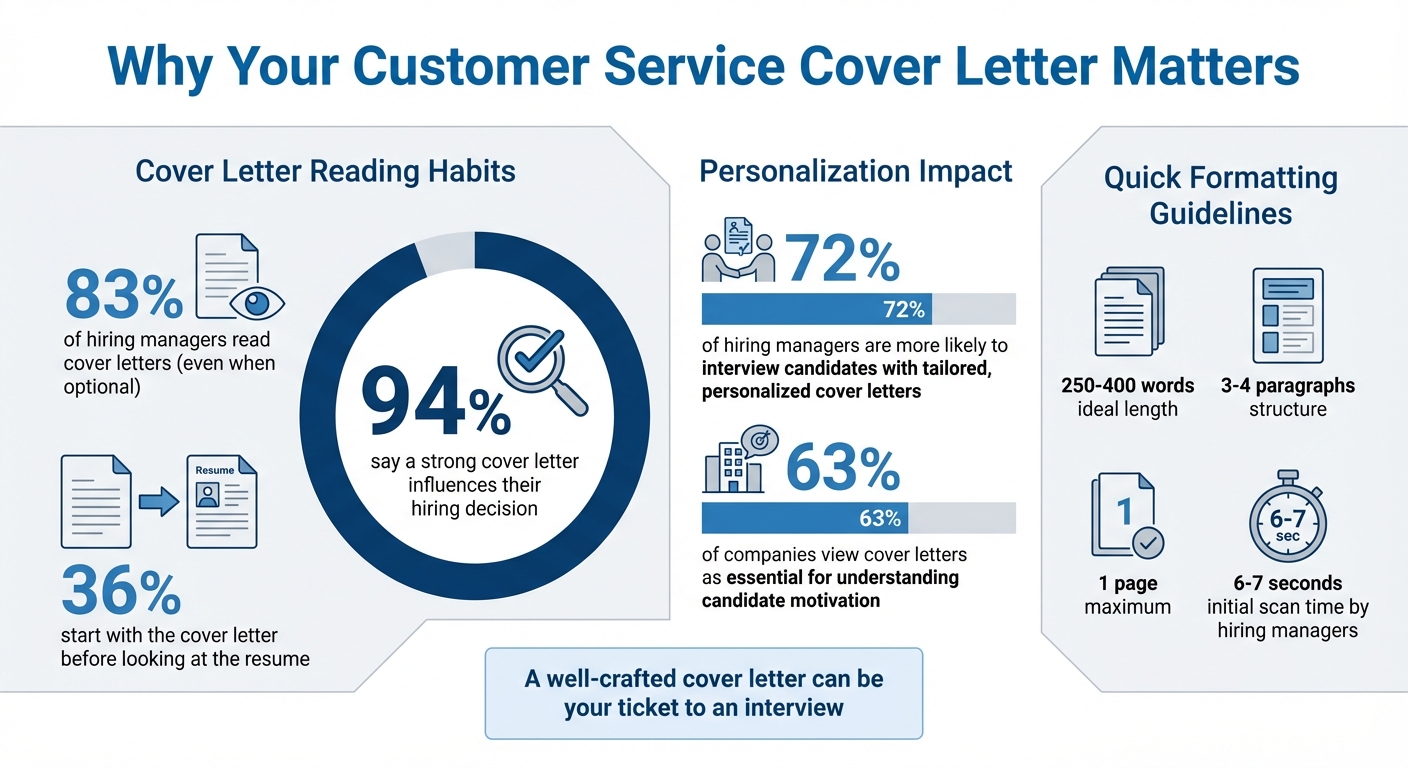
- 83% of hiring managers read cover letters, even when optional.
- 94% say a strong cover letter influences their decision.
- 36% start with the cover letter before even glancing at the resume.
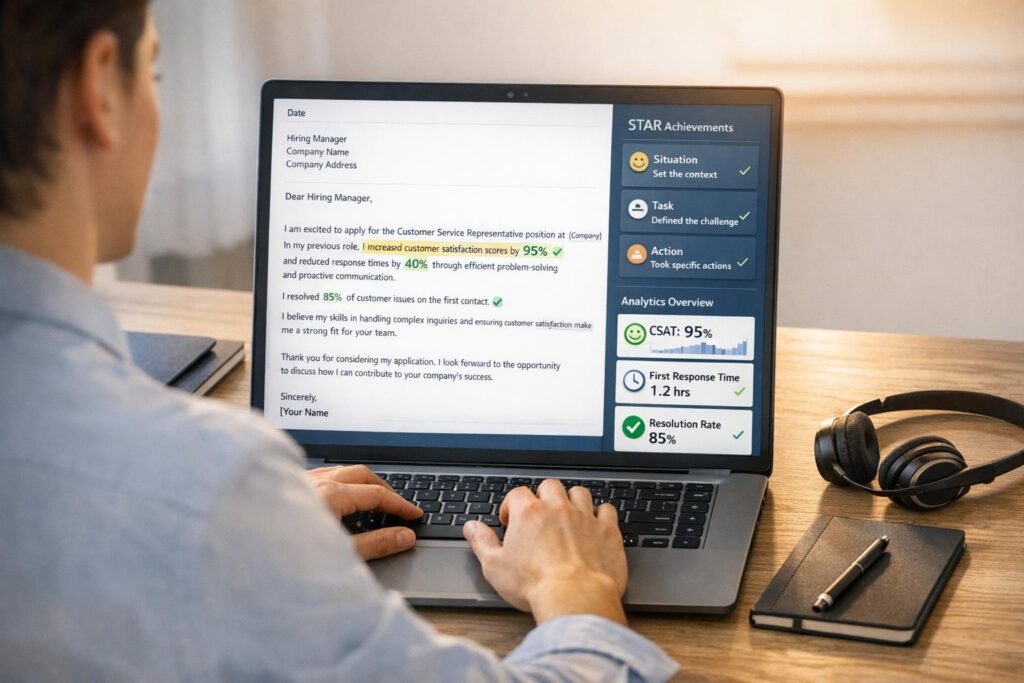
A great cover letter highlights your communication skills, empathy, and results. Use specific achievements, measurable metrics (e.g., boosting CSAT scores or reducing resolution times), and a tailored tone to match the company. Include tools you’re proficient in, like Zendesk or Salesforce, and structure examples using the STAR method (Situation, Task, Action, Result).
Avoid common mistakes like generic language, vague claims, or poor formatting. Stick to one page, proofread thoroughly, and make it easy to skim. Use the provided template to craft a personalized, professional letter that grabs attention and opens doors.
Customer Service Cover Letter Statistics and Impact
How To Write A Cover Letter For A Customer Service Job? | Example
What to Include in a Customer Service Cover Letter
A well-crafted cover letter follows a clear, familiar structure. Begin with a professional header featuring your full name, phone number, professional email, and LinkedIn profile link. As Andrei Kurtuy, Co-founder at Novoresume, advises:
"Start with your name, phone number, and email. No need for your address, but including your LinkedIn profile could be a nice touch".
Kick things off with a specific achievement or metric to grab attention. Instead of saying, "I’m passionate about customer service", try something like, "I reduced average resolution time by 28% while maintaining a 96% CSAT score." This approach works because hiring managers often spend just six to seven seconds scanning applications before forming an impression.
In the body of your letter, go beyond listing skills. Use the STAR method (Situation, Task, Action, Result) to tell concise stories that demonstrate your abilities. For instance, describe a situation where you resolved a tough customer issue, explain the steps you took, and highlight the outcome – like turning a one-star review into a glowing five-star testimonial or recovering an account worth $15,000 in annual revenue.
Incorporate specific metrics such as CSAT scores, First Response Time (FRT), or ticket resolution rates. Mention any experience with customer service tools or CRM platforms by name to showcase your technical skills. In today’s AI-driven support landscape, the ability to complement automation with human insight is especially valuable.
Close with a confident call to action that reflects your enthusiasm for the role and appreciation for the hiring manager’s time. Your closing should feel natural – more like an invitation to continue the conversation than a demand.
Tailoring Your Letter to the Company and Role
Generic cover letters often miss the mark because they lack a personal touch. In fact, 72% of hiring managers are more likely to interview candidates who submit tailored, personalized cover letters. Additionally, 63% of companies view cover letters as essential for understanding a candidate’s motivation to join their team.
Start by researching the company’s mission, values, and recent updates. If the organization prioritizes innovation in customer experience, emphasize your work with new technologies or process improvements. If their focus is on long-term customer relationships, share examples of how you’ve contributed to customer retention or loyalty programs.
Whenever possible, address the hiring manager by name. As Austin Belcak, Founder of Cultivated Culture, points out:
"It shows that you don’t know who you’re speaking to or worse, that you didn’t care to find out".
Check the job posting, LinkedIn, or the company website to find the right name.
Adapt your tone to match the company’s style. A tech startup may appreciate a conversational, enthusiastic tone, while a financial institution might expect something more formal. Review the company’s website, social media, or customer communications to gauge their tone – but always stay true to your voice.
Link your experience directly to the job’s requirements. For example, if the role involves managing high-volume support tickets, mention how you successfully handled 150+ daily tickets while maintaining a 94% satisfaction rate. This shows you understand their challenges and have the skills to address them.
After tailoring your tone and examples, back up your claims with measurable results.
Showcasing Your Skills and Results
To stand out, your cover letter should provide concrete evidence of your skills. Vague statements don’t carry much weight, but specific examples leave a lasting impression. For instance, instead of saying, "I improved customer satisfaction", write, "I increased our team’s CSAT score from 87% to 96% over six months by implementing a new follow-up protocol." Numbers like these grab attention and make your achievements clear.
When discussing technical skills, name the tools and systems you’ve used. If you’re experienced with ticketing systems, CRM platforms, or knowledge base software, mention them. Highlight any work you’ve done with automation, chatbot escalation, or data analysis to show how you’ve enhanced support operations.
Use the STAR method to structure your examples, keeping them concise and focused. Limit each example to 2–3 sentences to provide clear evidence without overwhelming the reader.
Formatting and Professional Standards
Poor formatting can hurt your credibility, so make sure your cover letter is easy to read and ATS-friendly. Avoid headers, footers, logos, or complex graphics.
Stick to one page – ideally 250 to 400 words across 3 to 4 paragraphs. Use standard fonts like Arial, Calibri, or Times New Roman in 10–12 point size. Maintain 1-inch margins on all sides, with 1.0 to 1.15 line spacing and double spaces between paragraphs for readability.
Follow U.S. business conventions by using the MM/DD/YYYY date format (e.g., 01/23/2026) and keeping all text left-aligned. If submitting a formal PDF, you might include the company’s address below your contact information, though this is optional for digital applications.
| Formatting Element | Standard Requirement |
|---|---|
| Margins | 1-inch on all sides |
| Alignment | Left-aligned (not justified) |
| Font Size | 10–12 points for body text |
| Line Spacing | 1.0 to 1.15 |
| File Format | .pdf or .docx |
| Date Format | MM/DD/YYYY (e.g., 01/23/2026) |
Make your letter easy to skim by using bold text sparingly to highlight key achievements or metrics. Recruiters should be able to quickly spot your most impressive results. Avoid excessive formatting that clutters the document.
Finally, proofread thoroughly before submitting. While tools like Grammarly can catch many errors, a manual review is essential to spot subtle issues. Attention to detail is a key customer service skill, and even minor mistakes can hurt your credibility. Read your letter aloud, review it on different devices, or ask someone else to check it before hitting send.
Copy-Paste Customer Service Cover Letter Template
Use this template as a starting point to create a personalized and impactful cover letter for your customer service applications. Simply replace the bracketed sections with your own details and tailor the examples to highlight your unique achievements.
[Your Full Name]
[Your City, State] | [Your Phone Number] | [Your Email Address] | [LinkedIn Profile URL]
[Date in MM/DD/YYYY format]
[Hiring Manager’s Name]
[Company Name]
[Company Address]
Dear [Hiring Manager’s Name],
I am excited to apply for the [Job Title] position at [Company Name], as advertised on [Source]. With [Number] years of experience in customer service, I have honed my ability to [mention a specific strength, e.g., provide exceptional support that fosters strong customer loyalty].
During my time at [Previous Company], I achieved [specific accomplishment with measurable results, e.g., improved customer satisfaction scores by 15% within a year by implementing a new feedback system]. My work is driven by three core strengths: Problem-Solving – I successfully resolved a complex issue impacting over 200 customers, avoiding $50,000 in potential losses; Efficiency – I consistently maintained a 98% first-contact resolution rate while managing 150+ tickets daily; and Technical Expertise – I am proficient in [specific tools, e.g., Zendesk and Salesforce], which has allowed me to streamline processes and improve response times.
What draws me to [Company Name] is its dedication to [specific value or mission, e.g., providing innovative customer experiences through cutting-edge technology]. I am eager to contribute my skills in [Skill 1] and [Skill 2] to support your team and help achieve [specific company objective].
Thank you for considering my application. I look forward to the opportunity to discuss how my experience can align with [Company Name]’s goals.
Sincerely,
[Your Full Name]
sbb-itb-e60d259
How to Customize Your Cover Letter for Different Situations
Building on the key elements of a strong cover letter, it’s crucial to tailor your approach depending on the career situation. To make your examples impactful, consider using the STAR method – Situation, Task, Action, Result – to present clear, concrete evidence of your skills.
Changing Careers from Another Industry
When transitioning into a new field, address the change head-on in your opening paragraph. Explain why the role aligns with your values and how your previous experience has prepared you for it. For instance, a former teacher might write: "After five years of explaining complex concepts to diverse learners and managing parent concerns, I’m eager to bring my communication and problem-solving skills to the customer service team at [Company Name]."
Focus on transferable skills from your previous roles, whether in teaching, hospitality, or retail. Highlight abilities like empathy, effective communication, and crisis management. For example, you might describe how you "resolved a billing dispute that retained a $15,000 annual account by carefully listening to the customer’s concerns and working with the accounting team to fix the error within 24 hours."
"When hiring, I look for storytelling ability, not just answers." – Greg Melia, Experience Matters podcast
A well-crafted cover letter can make a significant impact, especially during career transitions, by filling in gaps a resume might leave.
Next, let’s look at how to emphasize technical expertise when applying for specialized roles.
Applying for Technical or Specialized Support Roles
For technical or specialized roles, your cover letter should highlight hard skills and certifications right from the start. Mention credentials like CompTIA A+, Network+, or CCNA in your header or opening paragraph to immediately establish credibility.
Use metrics to showcase your technical impact. For instance, you could say: "Reduced system downtime by 30% by diagnosing and resolving network connectivity issues affecting 50+ users." Incorporate action-oriented language, using words like "diagnose", "configure", "troubleshoot", and "optimize" to convey your expertise. If you’re applying for cloud support roles, emphasize experience with AWS or Azure; for cybersecurity roles, focus on your knowledge of firewalls and security protocols.
Technical professionals often stand out by simplifying complex concepts for non-technical users. Highlight achievements like creating a knowledge base that cut support call volume by 50% or developing step-by-step video tutorials to empower users. Including links to your GitHub profile, technical blog, or portfolio can also provide tangible proof of your expertise.
Handling Employment Gaps or Entry-Level Applications
If you’ve had a career break, frame it as a time of growth. For example, you might write: "During my two-year break to care for a family member, I developed exceptional multitasking and crisis management skills that translate directly to high-pressure customer service environments." This approach allows you to control the narrative before the hiring manager even looks at your resume.
For those entering the workforce, highlight volunteer work, internships, or campus roles. A recent graduate could say: "While managing customer inquiries for my university’s student services office, I handled 50+ requests weekly and maintained a 95% satisfaction rating by responding within 24 hours." Even unpaid roles can demonstrate valuable skills when structured using the STAR method.
Don’t forget to emphasize relevant education and certifications. Mention specific coursework, like Consumer Behavior, or certifications such as Customer Service Manager to show your commitment to the field. With 94% of hiring managers stating that a well-written cover letter influences their decision, this is your chance to showcase your initiative and transferable skills, even if you lack direct experience.
Mistakes to Avoid in Your Cover Letter
A poorly written cover letter can close doors before they even open. With 83% of hiring managers reviewing cover letters, even when optional, and 36% starting with the cover letter before glancing at the resume, it’s clear that this document plays a key role in shaping first impressions. To stand out, your language needs to be sharp, specific, and impactful.
Using Generic or Unclear Language
When it comes to cover letters, vague phrases like "hard worker" or "team player" won’t cut it. Hiring managers are looking for clarity and results, not empty buzzwords. Similarly, avoid impersonal greetings. Always address the hiring manager by name. If their name isn’t available, try something more tailored like "Dear Customer Support Team" instead of a generic "To Whom It May Concern."
Replace clichés with action-oriented language and real examples. For instance, rather than saying you "helped customers", say you "resolved 120+ technical inquiries weekly with a 92% first-contact resolution rate." Brett Ellis, Talent Engagement Program Lead at Warner Bros. Discovery, advises skipping the fluff:
"You won’t get anyone excited to read your cover letter by talking about where you found the position or why you’re applying. Start with something real and relevant".
Missing Measurable Results
Numbers speak louder than generalities. Including measurable achievements like CSAT scores, average response times, or ticket volumes can immediately grab attention. For example, instead of saying you "improved customer satisfaction", you could say you "maintained a 96% CSAT score while managing 80+ calls daily." These specifics not only show your impact but also help hiring managers visualize the value you’d bring to their team.
Poor Formatting and Typos
Presentation matters. Dense paragraphs and typos can make even the most qualified applicant seem careless. Use short paragraphs, bullet points for key accomplishments, and plenty of white space to make your letter easy to read. Stick with professional fonts like Arial or Times New Roman in 11 or 12 points, and maintain standard one-inch margins.
Proofreading is non-negotiable. Review your letter multiple times, use tools like Grammarly, or ask a friend to give it a second look. With 94% of hiring managers saying a well-written cover letter influences their final decision, a simple mistake could cost you the job. Attention to detail is a skill – show it off in your cover letter.
Final Thoughts
A well-crafted cover letter can be your ticket to an interview. With 83% of hiring managers reviewing cover letters even when they’re optional and 94% stating that a well-written one influences their decision, it’s clear this document deserves your full attention. The secret? Personalization. Tailor each letter to the company and role, include measurable achievements, and steer clear of generic phrasing. Focus on showcasing what makes you stand out.
Start by customizing your letter with specific metrics that highlight your achievements. Address the hiring manager by name, and align your tone with the company’s culture. Whether you’re pivoting to a new industry or applying for a specialized role, your cover letter should tell a compelling story – one that your resume doesn’t fully capture. Don’t forget to proofread carefully and ensure the formatting is clean and professional. Even a small typo can cast doubt on your attention to detail. Wrap things up with a confident call to action that encourages a conversation, instead of simply ending with a polite thank you.
Think of the template as your foundation – it provides the structure, but your unique accomplishments and genuine interest in the company will set you apart. This thoughtful approach mirrors the precision and professionalism expected in today’s AI-driven customer support landscape.
FAQs
What is the STAR method, and how can it improve my cover letter?
The STAR method – Situation, Task, Action, Result – is a straightforward framework to effectively highlight your skills and accomplishments. It allows you to share specific examples of how you’ve tackled challenges or managed responsibilities in past roles, making your cover letter more engaging and relevant for hiring managers.
Here’s how it works: begin by setting the stage with the situation or context, then explain the task or objective you were assigned. Next, detail the actions you took to address the challenge, and wrap up by showcasing the results – the tangible outcomes of your efforts. This method transforms your cover letter from a simple list of skills into a narrative that demonstrates your problem-solving abilities and measurable achievements, directly aligning your experience with the employer’s priorities. Using the STAR method can help your application stand out in a crowded job market.
How do I customize my cover letter for a specific company?
To make your cover letter stand out, tailor it specifically to the company you’re applying to. Start by diving into their mission, values, products, and approach to customer service. Use what you learn to show that you genuinely understand their goals and are excited about the role.
Focus on skills and accomplishments that match what the company values most. For example, if they emphasize problem-solving or strong communication, share specific examples from your experience that highlight these traits. Whenever possible, address the hiring manager by name and mention recent projects or initiatives the company has undertaken to add a personal touch.
By aligning your expertise with their needs and expressing enthusiasm for their work, you’ll craft a cover letter that feels personalized and leaves a strong impression.
What mistakes should I avoid when writing a customer service cover letter?
When crafting a customer service cover letter, steer clear of using a generic template that isn’t tailored to the specific job or company. Employers appreciate when applicants take the time to personalize their application, and a cookie-cutter approach can come across as impersonal.
Instead of focusing solely on your achievements, highlight how your skills and experience align with the employer’s needs. Show them how you can address their challenges or contribute to their goals. Also, double-check your cover letter for any grammatical errors, typos, or formatting issues – these small mistakes can leave a poor impression. Whenever possible, address the hiring manager directly and demonstrate genuine enthusiasm for the position and the company. These thoughtful touches can make your application stand out in a competitive field.