Switching to a new support platform can disrupt workflows and frustrate customers, making it harder to maintain satisfaction. Traditional CSAT surveys often fail during this critical period due to low response rates and delayed feedback. Predictive CSAT, powered by AI, changes the game by analyzing 100% of customer interactions in real-time – emails, chats, and calls – offering instant satisfaction scores without requiring surveys.
Key Highlights:
- Real-Time Monitoring: AI evaluates sentiment, tone, and effort during every interaction.
- Proactive Risk Alerts: Flags at-risk customers before they escalate issues.
- Post-Migration Benefits: Identifies friction points quickly, reducing churn.
- Efficiency Boost: Cuts manual analysis time by 86%, improves CSAT by 18%, and reduces escalations by 30%.
Predictive CSAT provides actionable insights to improve customer retention and streamline support operations, especially during challenging transitions like platform migrations.
How AI is Changing Support KPIs in 2026 with Eric Nelson, Stylo
Problems with Traditional CSAT After Migration
Platform migrations often amplify the challenges of Customer Satisfaction (CSAT) measurement, especially when timely and accurate feedback is most critical. The issue isn’t just about fewer responses – it’s about getting a distorted view when you need clarity the most.
Low Survey Response Rates
Traditional CSAT relies heavily on customers taking the time to fill out surveys. But requesting more surveys? That only adds to customer fatigue. What happens next? Response rates drop even further, leaving teams with feedback that’s skewed toward the extremes – either highly dissatisfied or overly satisfied users. The result? A massive blind spot. The majority of customers, who may be quietly struggling, stay silent. Their frustrations remain hidden until it’s too late to address them.
This lack of visibility becomes a major hurdle. Without insights into the full customer experience, teams struggle to prioritize resources or identify which parts of the migration are causing the most friction. And manual analysis of limited survey data? That’s a time sink, taking anywhere from 9–13 hours compared to just 1–2 hours with AI. That’s an 86% time savings – time that’s critical for making quick adjustments.
This incomplete data leaves teams stuck in a reactive cycle, unable to anticipate or prevent issues effectively.
Reactive Feedback Instead of Predictive Insights
Even when customers do complete surveys, the feedback often comes too late. Traditional CSAT serves as a lagging indicator – it flags dissatisfaction only after a customer has already faced an issue, closed their case, and decided to share their frustration . By the time a low score shows up, the damage has already been done. This reactive model keeps teams perpetually in catch-up mode, giving negative sentiment time to grow unchecked.
Organizations using AI-driven sentiment analysis, on the other hand, have reported a 30% drop in escalation rates by stepping in before issues escalate. Traditional CSAT also misses another critical detail during platform migrations: customer effort. Transitions often force users to spend extra time navigating new systems or resolving problems that should be simple. Ignoring this metric leaves teams blind to a key pain point during these high-stakes periods.
"For too long, CSAT has been treated as a lagging indicator, a historical snapshot of performance." – Team Mosaic, Ask-AI
These delays highlight the urgent need for a proactive, AI-powered approach to CSAT.
How Predictive CSAT Uses AI to Generate Insights
Predictive CSAT flips the traditional support model on its head, moving from a reactive approach to a proactive one. Instead of waiting for customer feedback through surveys, AI steps in to analyze every interaction in real time. This means satisfaction levels can be forecasted before a case is even resolved. For support teams, this visibility is a game-changer, especially during challenging times like migration periods when customer friction tends to spike. Proactive monitoring like this sets the stage for the deeper insights AI can deliver.
AI Analysis of Historical and Real-Time Data
AI doesn’t just skim the surface – it evaluates 100% of customer interactions across email, chat, and voice channels. It scores these interactions based on factors like compliance, tone, response time, and overall effectiveness. What makes this even more powerful is that AI doesn’t work in isolation. It combines real-time insights with historical data, pulling in details like customer profiles, prior case severity, product context, and past resolution outcomes.
AI tracks 19 distinct signals to classify interactions as positive, negative, or neutral. It monitors sentiment changes, response delays, and interaction patterns to update risk scores in real time. This allows support teams to spot potential issues early and step in before they escalate.
The results speak for themselves. Companies using AI-driven sentiment analysis have seen a 30% drop in escalation rates. Manual analysis time also shrinks dramatically – from 9–13 hours down to just 1–2 hours, saving 86% of the time. Even better, addressing risks proactively can boost CSAT scores by 18%.
Predictive CSAT Features in Supportbench
Supportbench integrates predictive CSAT and Customer Effort Score (CES) directly into its platform, offering real-time forecasts for both satisfaction and effort. This provides teams with a clear view of how challenging a case was and whether a customer might be at risk of leaving.
The platform also includes Predictive First Contact Resolution (FCR) scoring. Traditionally, FCR has been tough to measure accurately, but AI now analyzes case histories to determine if issues were genuinely resolved on the first interaction. This eliminates the need for manual tagging or delayed post-case reviews, giving teams immediate insights into their efficiency.
Another standout feature is dynamic SLA adjustments. AI evaluates the content and emotional tone of a case and automatically tweaks response targets. For high-priority issues, this means faster attention, while routine cases follow standard workflows. Real-time alerts and visual dashboards notify support leaders the moment a predictive score dips, enabling quick intervention before dissatisfaction escalates.
"Predictive CSAT/CES scores identify potentially dissatisfied customers before they complain or churn, even if they don’t complete surveys." – Nooshin Alibhai, Founder and CEO of Supportbench
AI also simplifies case management with instant summaries. Instead of sifting through every past interaction, agents and managers get a quick overview of a dissatisfied customer’s history. This not only speeds up response times but also ensures that any action taken is well-informed – especially critical during high-stakes periods like post-migration, when every interaction counts.
sbb-itb-e60d259
Post-Migration Metrics Improved by Predictive CSAT
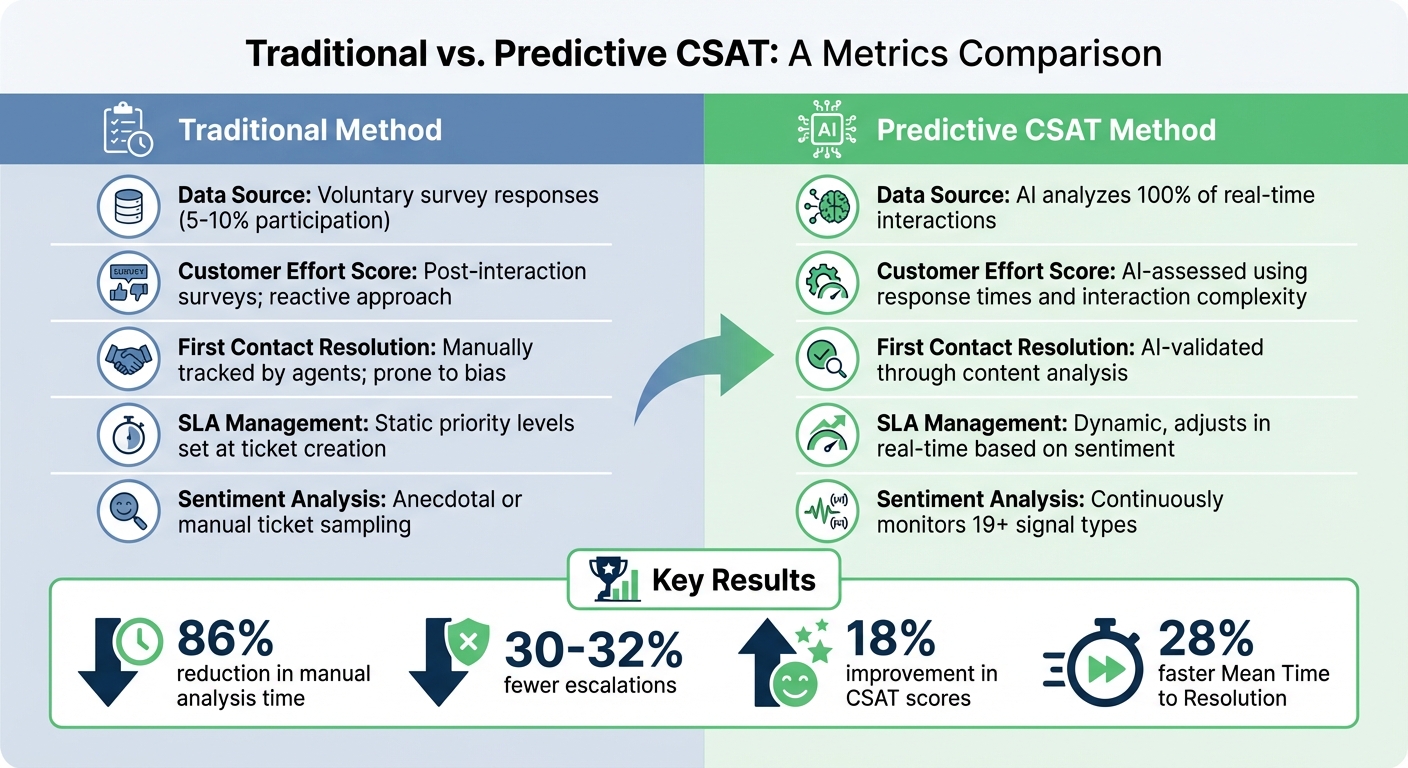
Traditional vs Predictive CSAT Metrics Comparison
Migration periods are often chaotic. With spikes in volume, teams adjusting to new systems, and customers adapting to changes, traditional metrics can struggle to paint an accurate picture. This is where Predictive CSAT steps in. By analyzing real-time customer interactions, Predictive CSAT cuts through the noise, revealing true customer sentiment. This helps teams separate temporary hiccups from deeper issues that could lead to churn, directly supporting goals like better customer retention and streamlined operations.
Traditional vs. Predictive Metrics Comparison
The differences between traditional and AI-driven metrics are stark, as shown in the comparison below:
| Metric | Traditional Method | Predictive CSAT Method |
|---|---|---|
| Data Source | Relies on lagging indicators, like voluntary survey responses (often less than 5-10% participation) | Uses AI to analyze 100% of real-time interactions |
| Customer Effort Score (CES) | Based on post-interaction surveys; reactive approach | AI-assessed using signals like response times and interaction complexity |
| First Contact Resolution (FCR) | Manually tracked by agents, often prone to bias or errors | AI-validated through content analysis and absence of follow-ups |
| SLA Management | Static, relying on priority levels set when tickets are created | Dynamic, with SLAs adjusting in real-time based on sentiment and escalation risks |
| Sentiment Analysis | Based on anecdotal or manual ticket sampling | Continuously monitors over 19 signal types across all queues |
These distinctions highlight how AI can redefine workflows and improve outcomes.
Using Insights to Optimize SLAs and Workflows
Predictive insights go beyond tracking performance – they transform how support teams operate. Instead of sticking to rigid priority rules determined at ticket creation, AI dynamically adjusts SLAs by analyzing case content and evolving customer sentiment. For example, a routine billing query stays on its standard timeline, while a frustrated customer expressing concerns about renewal is flagged and routed to a senior agent immediately.
Teams can also act on predictive scores to prevent issues from escalating. Whether it’s routing cases to specialists, offering goodwill credits, or initiating proactive customer success outreach, these interventions can make a big difference. The results speak for themselves: companies using predictive insights report 30% to 32% fewer escalations, and proactive risk management has been shown to improve CSAT scores by 18%.
"Whenever we witness a surge in negative sentiment, our team springs into coordinated action, and the outcomes we achieve are consistently on target." – Katherine Sullivan, SVP, Customer Success, Salesforce
The benefits extend beyond happier customers. AI-driven analysis of escalation trends slashes manual review time, giving support leaders more bandwidth for coaching and refining processes. During post-migration phases, when every interaction is under scrutiny and teams are working hard to prove the value of a new system, these operational improvements can make a world of difference.
Setting Up Predictive CSAT in Supportbench After Migration
Once migration is complete, setting up predictive CSAT in Supportbench ensures your operations remain responsive and effective. The transition process requires instant and clear insights into customer satisfaction, and Supportbench’s AI-powered predictive CSAT tools are designed to deliver just that. These features activate automatically after migration, giving teams real-time indicators to fine-tune strategies and maintain strong customer relationships. It’s an AI-driven approach that simplifies the setup process while enhancing efficiency.
Built-In AI Predictive CSAT in Supportbench
Supportbench takes the guesswork out of customer satisfaction by integrating predictive CSAT and CES directly into its platform. These features come ready to use, requiring no extra configuration. The embedded AI analyzes historical case data from your previous system and combines it with real-time customer interactions to generate predictive scores. This means your team can start using advanced insights immediately.
Through the Customer Experience Insights module, the AI evaluates sentiment and emotion across all customer interactions – not just survey responses. This comprehensive analysis helps identify at-risk customers early, well before they voice concerns or consider leaving.
Teams can also create no-code automations to prioritize and manage tickets based on these predictive scores. For instance, cases marked with high negative sentiment or increased effort can be routed directly to senior agents or prompt proactive outreach from customer success teams. This ensures potential issues are resolved quickly, preventing them from escalating further.
Dashboards and Case Insights for Real-Time Monitoring
Supportbench offers visual CSAT dashboards with automated alerts, giving leadership immediate insight into performance after migration. Customizable KPI scorecards provide a centralized view of critical metrics, making it easier to monitor progress. The platform also delivers a 360-degree customer view, consolidating data like escalation trends, sentiment shifts, and overall account health – all in one place.
AI-powered case summaries add another layer of efficiency by instantly summarizing past interactions. This allows leadership to focus on coaching and refining processes during the critical post-migration phase.
Additionally, real-time alerts for negative sentiment ensure teams can intervene quickly, addressing problems before they grow. This proactive monitoring approach has led to an 86% reduction in time spent on manual analysis and a 30–32% drop in escalations overall.
Conclusion: Improving Retention and Efficiency with Predictive CSAT
Predictive CSAT takes a proactive approach to reducing churn during post-migration operations. Instead of waiting for customers to voice dissatisfaction – or worse, leave – AI-powered platforms like Supportbench detect early signs of unhappiness, even when no surveys are completed. This proactive intervention can be a game-changer for B2B organizations, especially when research shows that improving customer retention by just 5% can boost profits by 25% to 95%.
The operational benefits are just as compelling. Teams leveraging AI for escalation prediction report an 86% drop in manual analysis time, cutting it from 9–13 hours to just 1–2 hours per cycle. Beyond time savings, AI-driven support platforms lead to a 32% reduction in escalation rates, a 28% quicker Mean Time to Resolution, and an 18% rise in CSAT for high-risk tickets. These improvements deliver immediate results in post-migration scenarios.
Supportbench’s AI-native solution addresses common issues with fragmented systems and costly add-ons found in older platforms. With built-in tools for predictive CSAT, sentiment analysis, and automated ticket triage, teams can start making data-driven decisions and taking action from day one – no lengthy implementations required.
The financial impact is equally impressive. Organizations have seen a 492% ROI in the first year and rapid payback. Real-world examples highlight these benefits: Salesforce reduced escalation rates by 56% using AI-driven insights, and People+Culture improved their CSAT score from 4.1 to 4.6 in under 90 days by using predictive CSAT as an early warning system. These results demonstrate the strategic value of integrating predictive CSAT into support operations.
For B2B teams, predictive CSAT offers an efficient way to safeguard customer retention, enhance operational performance, and fuel long-term growth. With Supportbench, these advantages come without the complexity or hidden costs of traditional platforms, making it easier to move from post-migration hurdles to sustained customer success.
FAQs
How can Predictive CSAT help improve customer satisfaction and retention after migration?
Predictive CSAT leverages AI-driven sentiment and behavior analysis to gauge customer satisfaction levels and spot potential churn risks following migration. By addressing concerns early – before they become bigger problems – support teams can respond faster, resolve issues more effectively, and improve the overall experience for customers.
Armed with these insights, teams can take precise actions to lift satisfaction scores, build stronger customer loyalty, and safeguard long-term retention – key priorities for businesses dealing with post-migration hurdles.
How does AI-powered sentiment analysis improve customer support outcomes?
AI-powered sentiment analysis allows support teams to gauge customer emotions in real time, helping them address concerns before they spiral into bigger problems. By catching negative tones early, teams can cut escalation rates by about 30% and resolve issues 28% faster. The result? Happier customers and improved satisfaction scores.
Beyond immediate problem-solving, this technology offers insights that drive long-term improvements. For instance, spotting negative sentiment can highlight potential customer churn, giving teams a chance to step in and retain those customers. Additionally, tracking sentiment trends tied to specific agents provides actionable feedback for coaching or recognizing top performers. Platforms like Supportbench seamlessly integrate sentiment analysis into workflows, eliminating the need for extra tools or custom setups. This ensures quicker resolutions, more satisfied customers, and stronger team performance overall.
What makes Predictive CSAT different from traditional methods?
Predictive CSAT uses AI-driven models to gauge customer satisfaction in real time by analyzing every interaction, eliminating the need for traditional post-interaction surveys. This method delivers ongoing insights across the entire customer base, offering a broader and more balanced perspective on satisfaction levels.
On the other hand, traditional CSAT depends on surveys completed after an interaction. These often have low response rates and mainly capture feedback from customers with particularly strong opinions, whether positive or negative. Predictive CSAT overcomes these limitations, enabling businesses to address concerns proactively and enhance customer experiences more effectively.
Related Blog Posts
- How to Measure Customer Support Performance in 2026: Key Metrics
- 5 Ways Sentiment Analysis Predicts Churn
- How AI Predicts Ticket Escalations
- AI vs. Legacy Tools for Account Management
Evaluating help desks for a B2B team?
Supportbench is all-inclusive from $32 per agent per month, with migration and onboarding included. See pricing or book a 20-minute demo.