Tool sprawl happens when teams use too many disconnected tools, causing inefficiencies, higher costs, and fragmented customer experiences. Unified platforms solve this by consolidating tools into one system, reducing complexity, improving productivity, and enabling better AI performance. Here’s the key takeaway:
- Tool Sprawl Issues: Scattered data, high integration costs, wasted time, and poor customer experience.
- Unified Platform Benefits: Centralized data, 40–60% efficiency gains, 20–30% cost savings, and better AI insights.
Quick Comparison:
| Dimension | Tool Sprawl | Unified Platform |
|---|---|---|
| Agent Productivity | Lost 3+ hrs/week to switching tools | 40–60% efficiency improvement |
| Customer Context | Scattered data, repeated info requests | 360-degree customer view |
| AI Effectiveness | 95% failure due to fragmented data | Accurate insights with centralized data |
| Cost | Hidden integration and vendor fees | 20–30% savings on licensing and maintenance |
When your tools create more problems than they solve, it’s time to consider consolidation. Unified platforms simplify workflows, cut costs, and deliver better customer experiences.
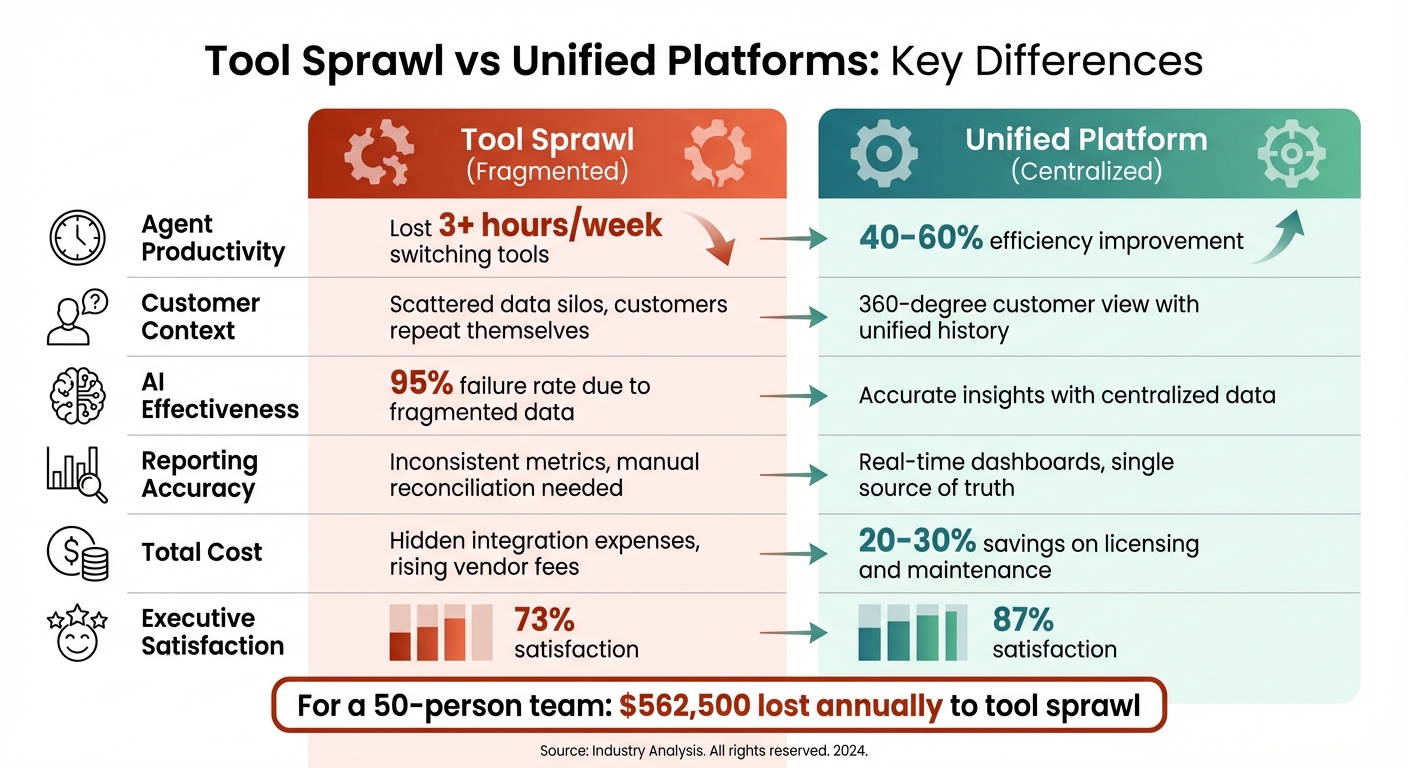
Tool Sprawl vs Unified Platform: Productivity, Cost, and AI Performance Comparison
The Hidden Costs of Tool Sprawl
Tool sprawl doesn’t just create operational headaches – it quietly eats away at resources and limits opportunities for growth. While software budgets often focus on licensing fees, the real expenses tied to fragmented systems run much deeper.
Integration Costs and Maintenance Overhead
RevOps and IT teams spend an overwhelming 70% of their time resolving data mismatches between disconnected systems [2]. Instead of focusing on streamlining workflows or enhancing customer experiences, they’re stuck building custom scripts and patching together tools that weren’t meant to work in harmony.
The ripple effects are significant. Onboarding new hires becomes a drawn-out process, stretching from weeks to months as employees struggle to navigate a maze of tools. Each additional system adds complexity, slowing down the pace at which teams can operate and grow.
Scaling Costs and Vendor Management
As operations scale, the financial strain of tool sprawl grows even heavier. Managing multiple vendors means juggling a mix of contracts, billing schedules, and renewal cycles, all of which increase administrative overhead.
The productivity loss is staggering. For a 50-person team, losing just three hours per week to manual data reconciliation and context switching – at an average rate of $75 per hour – amounts to $562,500 annually in lost productivity [2]. And that doesn’t even factor in the costs of software licenses, integration platforms, or IT support.
Lost Time and Technical Debt
When customer data is scattered across platforms, it creates a major roadblock for AI customer support systems, which rely on clean, interconnected data to provide actionable insights. Maria Akhter, Editor at Outreach, highlights this challenge:
95% of generative AI pilots are failing… because your data lives in silos across disconnected systems [2].
This lack of integration forces support teams to maintain fragile workflows, leading to mounting technical debt. Fixing this debt becomes more expensive over time, further straining resources. On the other hand, organizations adopting unified, AI-native platforms are seeing 20-30% reductions in SaaS licensing and maintenance costs [1]. These platforms eliminate data silos, enabling AI to provide consistent insights and reducing the long-term costs tied to technical debt.
sbb-itb-e60d259
Tool Sprawl vs Unified Platforms: Key Differences
Building on the hidden costs of tool sprawl, let’s dive into the operational differences between fragmented systems and unified platforms. These differences directly impact your bottom line, giving support leaders the insights they need to decide when consolidation makes financial and strategic sense.
Side-by-Side Comparison Table
| Dimension | Tool Sprawl (Fragmented) | Unified Platform (Centralized) |
|---|---|---|
| Agent Productivity | Frequent context switching; over 3 hours lost weekly per agent [2] | Streamlined workflows; 40-60% efficiency gains [1] |
| Customer Context | Scattered data silos; customers repeat themselves [1] | Unified history with 360-degree account summaries [1] |
| AI Effectiveness | 95% failure rate due to disconnected data [2] | Interconnected data enables accurate RAG and automation [1] |
| Reporting Accuracy | Inconsistent metrics; manual reconciliation needed | Real-time dashboards with a single source of truth |
| Total Cost | Hidden integration expenses; rising vendor fees | 20-30% savings on SaaS licensing and maintenance [1] |
| Executive Satisfaction | 73% satisfaction with standalone tools [3] | 87% satisfaction with integrated platforms [3] |
This table highlights how unified platforms address operational inefficiencies, turning challenges into measurable improvements.
Agent Productivity and Context Switching
When agents are forced to jump between disconnected systems – like essential tools for support teams – they lose valuable time and focus. This constant context switching doesn’t just waste seconds; it adds up to hours each week. Unified platforms solve this by consolidating everything into one interface. Case management, communication channels, knowledge bases, and customer data are all accessible without ever leaving the platform.
This streamlined approach lets agents focus on solving problems, not searching for information. Businesses that switch to AI-driven unified platforms report 40-60% gains in team efficiency, thanks to reduced context switching and smarter automation [1]. Beyond improving productivity, these platforms centralize customer information, paving the way for better support and faster resolutions.
Data Consistency and Customer Context
In fragmented systems, customer data lives in silos – support tickets, account details, and communication logs are scattered across different tools. This forces customers to repeat themselves and leaves agents without a full understanding of the situation.
Unified platforms change the game by providing a complete, consistent view of every customer interaction. When agents open a case, they see everything: purchase history, previous tickets, ongoing conversations, contract terms, and even trends in support needs – all in one place. This 360-degree view doesn’t just improve the quality of responses; it transforms how AI can assist.
Generative AI thrives on clean, structured data. Fragmented systems, with their disorganized and incomplete information, often hinder AI’s effectiveness. In contrast, centralized platforms provide the structured data AI needs to deliver accurate, context-aware recommendations, making support smarter and more proactive [1].
AI Performance: Fragmented vs Centralized Data
The success of AI largely depends on how well data is integrated. Fragmented systems create obstacles for AI, while centralized data enables it to deliver accurate and proactive results.
Why AI Struggles in Fragmented Systems
AI models, especially those using Retrieval-Augmented Generation (RAG), thrive on clean, organized, and interconnected data. When customer information is scattered across various tools – like ticketing systems, CRMs, and chat logs – the AI ends up trying to piece together incomplete and disjointed narratives. Imagine working with a pile of messy notes – it’s no surprise that the AI struggles to provide accurate answers [1].
Additionally, isolated AI features lack the ability to capture the full customer journey. Without consolidated data that spans across sales, support, and product feedback, the insights generated are often incomplete or irrelevant. On the flip side, unified platforms bring all this data together, enabling faster and more precise AI processing.
How AI Thrives in Unified Platforms
Unified platforms address the inefficiencies of fragmented systems by creating a single source of truth. By consolidating all customer data – such as support history, account details, communication logs, and product usage – into one cohesive system, AI gains the context it needs to perform at its best. This centralized approach allows AI to automate workflows with AI chatbots, identify issues proactively, and provide comprehensive customer summaries without relying on guesswork.
Unlike fragmented systems, which force AI to work with incomplete data, unified platforms give AI access to a complete picture. This opens the door to advanced capabilities like predictive AI, which can anticipate churn risk, and agentic AI, which can carry out tasks autonomously. Companies that combine AI with SaaS consolidation have reported efficiency improvements ranging from 40% to 60% [1].
Simplifying Operations Without Losing Flexibility
There’s a common fear among support leaders that moving to a unified platform means sacrificing control. Many worry that consolidating tools will force their teams into rigid workflows that can’t adapt to their specific needs. But here’s the reality: modern unified platforms are designed to simplify operations without stripping away the flexibility needed to serve customers effectively.
The secret lies in how these platforms approach simplification. Instead of requiring teams to juggle intricate technical configurations across multiple disconnected systems, unified platforms shift the focus to high-level priorities – like customer journeys or support workflows – while still allowing advanced customization [4]. By doing so, they eliminate “configuration drift,” a frustrating issue where settings across different tools become inconsistent, leading to errors and broken automations [4]. This streamlined approach creates workflows that are both standardized and customizable.
Consistent Workflows with Built-in Flexibility
Unified platforms make it possible to establish consistent processes across all support channels – email, chat, social media, and phone. This consistency prevents the fragmented customer experiences that often arise when different channels operate in silos. At the same time, these platforms are built with user-friendly customization tools, allowing support leaders to tweak workflows as needed, without waiting on engineering teams.
The trend toward consolidation is growing. Today, 53% of organizations are actively reducing redundant applications, up from 40% in previous years [5]. And the benefits are clear: companies that successfully implement integrated systems see 19% faster growth compared to those stuck managing fragmented tool stacks [5].
Cutting Back on IT Dependencies
One of the biggest advantages of unified platforms is how they reduce reliance on IT teams. By consolidating core functions – like ticketing, knowledge management, and customer data – into a modern support CRM, there’s no longer a need for middleware or custom “glue code” to keep everything running smoothly [2].
This shift empowers internal teams to take charge. Instead of submitting IT tickets or waiting for developers to fix integration issues, support teams can directly adjust macros, routing rules, or workflows. It’s part of a broader movement in platform engineering that prioritizes self-service and agility.
"The ‘glue code’ connecting [fragmented tools] is a constant maintenance burden… velocity tanks as engineers burn hours debugging the pipeline rather than shipping code." – Qovery [4]
Conclusion: When to Move from Tool Sprawl to a Unified Platform
What Support Leaders Should Know
The challenges of managing too many tools often signal it’s time to consolidate. When your tech stack shifts from being an asset to becoming a burden, it’s a red flag. For instance, software waste exceeding 20% of your budget or small companies losing around $2 million annually on unused SaaS licenses are clear indicators of inefficiency [6]. Add to that the daily grind of toggling between 15+ tools, which eats up 40 minutes per employee due to context switching [6], and you’re left with a "complexity tax" that slows down productivity – especially for new hires.
Data fragmentation tends to be the tipping point. When customer information is scattered across multiple tools – like CRM systems, ticketing platforms, and analytics dashboards – it becomes nearly impossible to maintain a clear, cohesive view. This not only frustrates agents trying to deliver consistent service but also hampers AI initiatives, as fragmented data leads to incomplete insights [2]. The ripple effects don’t stop there. High complexity often leads to employee dissatisfaction and turnover, as workers spend more time managing tools than building customer relationships. Meanwhile, RevOps and IT teams can find themselves stuck in a loop of managing integrations and reconciling data manually – wasting up to 70% of their time on tasks that should be automated. That’s a clear sign your infrastructure is holding you back.
How Unified Platforms Improve Efficiency and Customer Experience
Unified platforms tackle these issues head-on by simplifying workflows and eliminating redundancies. Consolidating SaaS tools can cut licensing and maintenance costs by 20–30% [1], while boosting operational efficiency by 40–60% [1]. These platforms offer a single source of truth for customer data, enabling AI to provide accurate, context-aware insights instead of incomplete guesses. They also reduce IT dependencies by removing the need for constant upkeep of "glue code" that holds disconnected tools together. This shift allows support teams to focus on what really matters: resolving customer issues instead of wrestling with clunky, fragmented systems.
"AI adoption and SaaS consolidation are not two separate initiatives. They are two halves of the same strategic imperative." [1]
FAQs
How do unified platforms improve efficiency by 40-60%?
Unified AI-driven support platforms deliver a striking 40-60% boost in efficiency by removing the hassles of juggling multiple disconnected tools. When ticketing, live chat, knowledge management, automation, AI, and reporting come together in one system, teams experience smoother workflows and far less complexity.
With everything in one place, agents no longer have to jump between tools, re-enter information, or deal with clunky, broken integrations. Instead, they get all the customer context and automation they need right at their fingertips. This not only slashes handling times but also ramps up productivity. Plus, having centralized data ensures AI-powered tools – like predictions and real-time responses – are both accurate and dependable.
These platforms don’t just save time; they also cut costs. By consolidating tools, businesses reduce licensing fees, integration costs, and maintenance headaches. The result? Greater efficiency, better customer experiences, and a more scalable operation.
What are the hidden costs of using too many disconnected tools (tool sprawl)?
Tool sprawl often carries hidden costs that go well beyond the price of software subscriptions. Many businesses unknowingly bleed money through underused licenses, unsuccessful implementations, and unplanned expenses. In fact, studies indicate that up to 20% of software budgets can be wasted due to these inefficiencies.
On top of that, managing a variety of tools brings its own set of headaches, like integration and maintenance challenges. From juggling multiple logins and billing cycles to dealing with incompatible data formats, these issues eat into valuable admin time. They also increase the risk of errors and drive up operational costs. Teams often find themselves troubleshooting broken integrations or manually piecing together data, which drains productivity and limits growth potential.
All of these hidden costs – whether from wasted budgets, inefficiencies, or reduced productivity – can take a serious toll on a B2B support team’s profitability and ability to scale effectively.
How does fragmented data affect AI performance in customer support?
Fragmented data – like tickets, chat logs, knowledge articles, and customer profiles scattered across various tools – can seriously undermine the potential of AI in B2B customer support. AI thrives on consistent and complete data to deliver accurate predictions, offer relevant suggestions, and efficiently automate tasks. When information is siloed, AI systems lack the full picture, leading to unreliable insights and disjointed features that fail to integrate smoothly into workflows.
Using a unified, AI-focused platform solves this problem by bringing all support interactions into one centralized system. This approach ensures that every customer interaction is linked to a complete and consistent record. With access to this rich data, AI can make sharper predictions, automate tasks effortlessly, and equip agents with actionable insights. The result? Faster response times and a smoother customer experience.