
Choosing between tiered and swarming support models depends on your team’s needs, ticket complexity, and customer expectations. Here’s a quick breakdown:
- Tiered Support: A hierarchical system where tickets move through levels (Tier 1, Tier 2, Tier 3) based on complexity. Best for handling high volumes of repetitive, predictable issues. Cost-effective but can lead to delays and customer frustration due to escalations.
- Swarming Support: A collaborative approach where the first agent takes ownership and pulls in experts as needed. Ideal for complex, unique, or high-priority issues. Faster resolutions and better customer experience but requires strong coordination and tools.
Key Factors to Consider:
- Team Size: Tiered works well for large teams; swarming suits smaller or specialized groups.
- Ticket Type: Tiered is better for simple, repetitive issues; swarming excels with complex or technical problems.
- Product Updates: Swarming fits fast-changing products; tiered suits stable ones.
- Customer Focus: Swarming offers direct, tailored solutions; tiered ensures efficiency for straightforward tasks.
Quick Comparison:
| Factor | Tiered Support | Swarming Support |
|---|---|---|
| Workflow | Structured escalation through tiers | Collaborative, real-time problem-solving |
| Best For | High volumes of repetitive issues | Complex, unique, or urgent tickets |
| Resolution Time | Slower due to handoffs | Faster with fewer delays |
| Team Impact | Clear roles but repetitive for lower tiers | Engages agents through collaboration |
| Customer Experience | Frustration with escalations | Better for complex issues, fewer handoffs |
Both models can benefit from AI-powered ticket routing and prioritization to optimize workflows, reduce delays, and improve customer satisfaction. The right choice depends on your team’s structure, ticket complexity, and business goals.
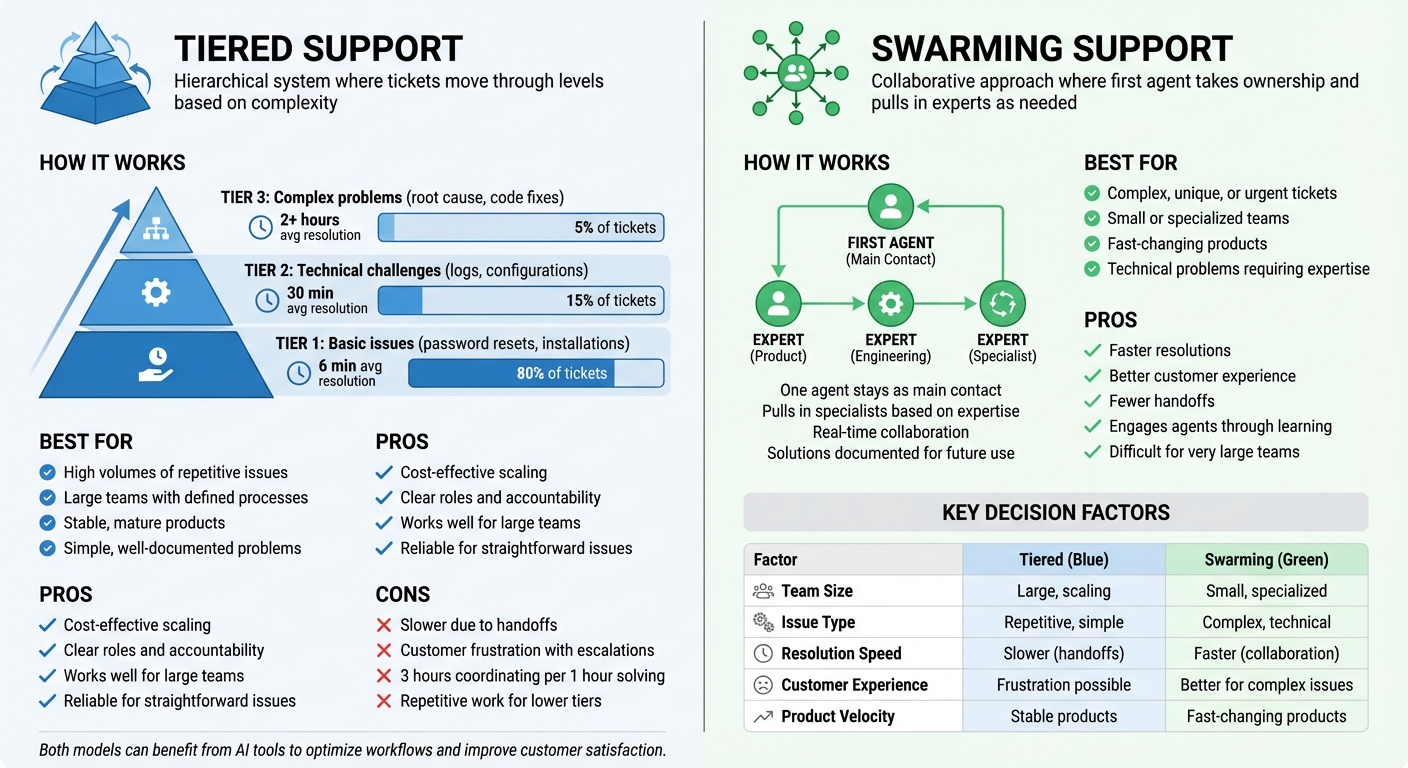
Tiered vs Swarming Support Models Comparison for B2B Teams
Intelligent Swarming 101: Better Customer Support Through Smarter Collaboration
sbb-itb-e60d259
What is Tiered Support?
Tiered support is a hierarchical system designed to handle customer inquiries by categorizing and escalating them through different levels of expertise based on complexity. Picture it as a pyramid: the base handles the majority of simple issues, while the top deals with the most challenging ones.
Here’s how it works: Tier 1 (L1) manages basic problems like password resets, software installations, or straightforward troubleshooting. Tier 2 (L2) steps in for more technical challenges, such as analyzing logs, updating drivers, or reconfiguring systems. Finally, Tier 3 (L3) represents your most skilled internal teams – developers, engineers, or specialized IT staff – who dive into root cause analysis, perform system diagnostics, and even implement code fixes for critical issues.
"Tier 1 Help Desk Support is considered to be the first line of defense when it comes to user support." – Red River [2]
This structure keeps costs in check by assigning simpler tasks to generalists, while reserving senior engineers for the most complex problems.
How Tiered Support Works
The tiered model relies on specialization and escalation. Tier 1 agents handle incoming tickets, performing initial triage and resolving routine issues using standardized resources like knowledge bases. If the problem is beyond their expertise, it moves up to Tier 2. These technicians have deeper expertise and tackle issues like system configurations, software bugs, or hardware malfunctions. Only when Tier 2 reaches its limits does the ticket escalate to Tier 3.
Modern systems often incorporate AI-powered ticket routing to improve efficiency. These tools can automatically categorize and assign tickets based on intent and urgency, cutting down manual effort and speeding up resolutions. Each tier must have the right tools, resources, and authority to ensure smooth workflows and avoid bottlenecks.
Understanding this process helps identify when a tiered model is the right fit for your organization.
When to Use Tiered Support
Tiered support is ideal for B2B companies that handle large volumes of repetitive, predictable inquiries that can be resolved with standardized documentation. For example, tasks like account setups or basic troubleshooting are well-suited to this model, as it allows for scaling with a team of quickly trained generalists.
Another advantage is its ability to protect the time of highly skilled specialists. By filtering out simpler issues, senior engineers can focus on critical, high-impact problems requiring their expertise.
However, the hierarchical nature of this model isn’t without its challenges. Escalations can create bottlenecks, leading to longer resolution times if Tier 2 or Tier 3 queues aren’t managed effectively. This is particularly critical in B2B settings with complex Service Level Agreements (SLAs), where unresolved issues can have serious financial consequences. To avoid these pitfalls, it’s essential to maintain clear escalation paths, robust documentation, and provide ongoing training to ensure Tier 1 agents add value rather than simply passing tickets up the chain.
What is Swarming Support?
Swarming support takes a fresh approach to customer service by ditching the traditional hierarchy. Instead of escalating tickets through multiple tiers, it brings together the right experts in real time to collaborate and solve problems. In this setup, the focus is on expertise, not job titles – whoever is best suited to handle the issue steps in to resolve it.
This approach empowers agents to tackle problems directly, removing unnecessary layers of escalation. As Greg Oxton, Former Executive Director at the Consortium for Service Innovation, famously said:
"The idea that anyone in support could ‘earn the right not to have to talk with customers’ (a common attitude in higher tiers) is a ridiculous notion. Customer support is, after all, about supporting customers."
Swarming is especially useful for new or complex problems – situations where standard solutions fall short and brainstorming across teams is essential [3]. Instead of bouncing tickets between departments, this method brings the right people together quickly, cutting down on delays and eliminating the frustration of multiple hand-offs.
Let’s break down how swarming support works and where it’s most effective.
How Swarming Support Works
Swarming follows a simple yet powerful process: pick up the issue, collaborate, and solve it. Here’s how it unfolds:
- When a ticket comes in, one agent takes responsibility and stays as the customer’s main point of contact until the issue is resolved.
- That agent can call in specialists based on their expertise and availability. Expert profiles make it easy to identify the right person for the job.
- Once the team resolves a new or tricky problem, the solution is documented in a knowledge base. This helps prevent the same issue from becoming a headache in the future.
In this model, managers shift their focus. Instead of acting as gatekeepers, they become coaches who ensure smooth collaboration and remove roadblocks for their team.
When to Use Swarming Support
Swarming shines in B2B settings, especially when dealing with complex, one-of-a-kind, or high-priority issues. It’s particularly suited for problems that don’t fit into standard workflows. Research highlights why this approach works: customers often lose patience after just 10 minutes of waiting [3]. Plus, 33% of consumers say their biggest frustrations are being put on hold or having to repeat themselves to multiple agents [3].
Beyond solving problems faster, swarming also boosts team morale. With over 70% of the workforce feeling disengaged at work [3], the collaborative and learning-focused nature of swarming can re-energize teams. By keeping a single point of contact for customers and encouraging real-time teamwork, this model not only resolves issues efficiently but also fosters a stronger sense of community and shared purpose.
Tiered vs Swarming: A Direct Comparison
Both tiered and swarming support models aim to resolve customer issues, but they take very different paths to get there. Tiered support relies on a structured, hierarchical system where tickets move from generalists to specialists as needed. Swarming support, on the other hand, skips the hierarchy and focuses on collaboration, bringing experts together in real time to solve problems as a team. Knowing the strengths and weaknesses of each model can help you decide which approach suits your B2B needs, especially if you’re aiming for cost efficiency and quicker resolutions.
Tiered Support: Pros and Cons
Think of the tiered model as an assembly line. It’s predictable and works well for handling large volumes of repetitive inquiries. In fact, about 80% of tickets are resolved at Tier 1, 15% at Tier 2, and only 5% at Tier 3 [4]. Resolution times vary significantly: Tier 1 issues are typically resolved in 6 minutes, Tier 2 in 30 minutes, and Tier 3 cases can take 2 hours or more [4].
But this efficiency comes with trade-offs. Customers often grow frustrated with repeated handoffs, and resolution times can stretch out. Teams also spend 3 hours coordinating for every 1 hour spent solving problems [4]. For agents, the system can feel limiting – lower-tier staff often face repetitive tasks with little room for growth, while specialists in higher tiers deal with ticket backlogs.
| Feature | Pros | Cons |
|---|---|---|
| Workflow | Works well for large teams with defined processes. | Delays caused by multiple handoffs. |
| Cost | Cost-efficient by using generalists for simpler tasks. | Higher tiers can become bottlenecks. |
| Team Impact | Offers clear roles and accountability. | Can feel monotonous for lower-tier agents. |
| Customer Experience | Reliable for straightforward issues. | Frustration when customers need to repeat details. |
Now, let’s see how the swarming model compares.
Swarming Support: Pros and Cons
Swarming flips the script by removing the escalation ladder entirely. The first agent stays with the ticket and pulls in experts as needed. This eliminates delays caused by tiered handoffs and often results in faster answers. It also keeps agents more engaged – they learn from specialists and see issues through to resolution rather than simply passing them along.
However, swarming isn’t without challenges. It demands strong coordination, and without proper documentation or tools, things can quickly spiral into chaos. There’s also the risk of agents cherry-picking easier tickets, leaving the tougher ones unresolved. For very large teams, swarming can become unwieldy unless divided into smaller, focused groups.
| Feature | Pros | Cons |
|---|---|---|
| Workflow | Resolves issues quickly without tier escalation. | Can become chaotic without proper tools and processes. |
| Collaboration | Encourages learning and teamwork. | Requires careful coordination to avoid inefficiencies. |
| Skill Utilization | Experts address critical issues immediately. | Tougher tickets may be neglected without oversight. |
| Customer Experience | Faster solutions with knowledgeable responses. | Difficult to manage for large, unstructured teams. |
Metrics That Matter for Each Model
Each model requires its own set of performance metrics. Tiered support prioritizes metrics like First-Contact Resolution (FCR) at Tier 1, ticket escalation rates, and resolution times at each level [4]. The goal is to resolve as many tickets as possible at the lower tiers, where costs are lower.
For swarming support, the focus shifts. Resolution time becomes a key metric since the model is designed to eliminate delays from handoffs. FCR rates tend to be higher in swarming because agents collaborate with experts to resolve issues immediately. Customer satisfaction (CSAT) also tends to improve, especially for complex problems, as customers avoid repeating themselves to multiple agents.
| Metric | Importance in Tiered Model | Importance in Swarming Model |
|---|---|---|
| Resolution Time | Affected by handoffs; crucial for higher-tier backlogs. | Lower due to fewer delays; a key efficiency measure. |
| First-Contact Resolution (FCR) | Lower for complex issues that require escalation. | Higher since agents work with experts right away. |
| Queue Size | Managed by tiers, with Tier 1 being the focus. | Managed as a single pool, requiring oversight to avoid abandoned tickets. |
| Customer Satisfaction (CSAT) | Can drop during escalations if customers repeat information. | Higher for complex issues due to quicker, expert-led solutions. |
Next, we’ll explore the factors to consider when deciding which model is best for your team.
How to Choose the Right Model for Your Team
What to Consider Before Choosing
Deciding between tiered and swarming support isn’t about determining which model is "better." It’s about identifying what works best for your team’s current setup. A key factor is team size. For smaller teams (fewer than 20 members), swarming tends to feel more intuitive since it avoids the complexity of multiple layers of escalation. Larger organizations can still use swarming, but they’ll need to divide their teams into smaller, more focused groups to keep things manageable.
The nature of the issues your team handles is just as important. If most tickets are repetitive and straightforward, tiered support could be the way to go. However, tiered support is only efficient when at least 95% of issues are simple, well-documented, and resolved on the first attempt [5]. Many companies now rely on AI chatbots and knowledge bases to handle basic inquiries, with some reporting self-service resolution rates as high as 80% [5]. This leaves agents to tackle more complex issues, which can shift the balance toward swarming, where collaboration is key to solving "new" or unique problems.
Product velocity is another consideration. If your company frequently launches updates or new features, swarming may be a better fit, as it keeps support teams closely connected to engineering and product development. Lastly, think about your company culture. Swarming thrives in environments with flat hierarchies and a strong emphasis on teamwork. If your organization values clearly defined roles and structured accountability, tiered support might feel like a better match.
These factors can help guide your decision, as outlined in the framework below.
Decision Framework
Use this table to determine which model aligns better with your operational needs:
| Factor | Choose Tiered Support If… | Choose Swarming Support If… |
|---|---|---|
| Team Size | Large, rapidly scaling teams. | Small teams or specialized sub-groups. |
| Issue Type | Repetitive, simple, "known" issues. | Complex, technical, or "new" issues. |
| Self-Service | Limited or basic self-service. | Strong self-service deflecting simple tasks. |
| Product Stability | Stable, mature product. | High-velocity, rapidly changing product. |
| Primary Goal | Internal efficiency and clear hierarchy. | Customer experience and agent learning. |
| Hiring Needs | Need for generalists. | Preference for specialist expertise. |
Start by analyzing your "known vs. new" ratio. If most tickets are straightforward and repetitive, tiered support might be the better choice. But if the majority are complex or technical, swarming could be a better fit for your team.
When to Switch Models
After evaluating your team’s needs, it’s important to recognize when a shift in your support model might be necessary. For instance, switching from tiered to swarming can make sense in situations where urgent incidents or high-value customer escalations require rapid, multi-disciplinary collaboration to avoid churn [6]. Teams embracing DevOps methodologies often find that swarming aligns better with their collaborative workflows.
On the flip side, moving from swarming to tiered – or adding more structure – might be necessary if subject matter experts are constantly overwhelmed by being pulled into too many conversations [6]. Another warning sign is when solutions discussed in real-time platforms like Slack aren’t properly documented in your ticketing system, leading to repeated handling of the same issues [6]. Additionally, if junior agents rely too heavily on swarming instead of developing their own expertise, it might be time to rethink your approach [6].
If you’re considering switching to swarming, start small. Test the model on a specific category, like VIP escalations or incident management, before rolling it out across the board [6]. Even in a swarming setup, one agent should take ownership of customer communication to avoid mixed messages [6].
"Tiered support has its place, but it often slows customers down and frustrates agents." – Mark Sherwood, CX Strategist [6]
Using AI to Improve Your Support Model
AI is making waves in the world of customer support by speeding up resolutions, giving experts more time to handle complex issues, and identifying potential problems before they escalate. Here’s how AI fits into two popular support models: tiered and swarming.
AI for Tiered Support
In a tiered model, AI shines by taking over routine Tier 1 tasks, reducing the need for manual work. AI-powered triage systems can classify and route tickets with up to 92% accuracy, ensuring that simple requests are handled by generalists while more challenging cases reach specialists faster [8]. In fact, AI can tackle between 20% and 60% of Tier 1 requests [10].
For example, in July 2025, Fundrise implemented Risotto to automate nearly 60% of IT support requests. The tool managed tasks like software access approvals and answered knowledge-based questions directly in Slack. Phillip Rickett, Fundrise‘s VP of IT, shared:
"The killer feature for us was that it could effortlessly learn and capture knowledge that our team creates every day in Slack… our team can simply answer questions, and Risotto learns as we go" [10].
AI also uses predictive analytics to monitor sentiment and account health, flagging at-risk customers before issues escalate [8][9]. This allows Tier 2 and Tier 3 teams to focus on high-value accounts. Additionally, AI-generated knowledge base articles from resolved tickets keep documentation up to date, making it easier to handle routine inquiries efficiently.
This approach not only speeds up resolutions but also ensures specialists can focus on the most critical tasks.
AI for Swarming Support
Swarming support thrives on collaboration, and AI takes it to the next level. When multiple specialists join a swarm to tackle an issue, AI-powered case summarization provides instant context. This means experts can quickly get up to speed without combing through long ticket histories.
AI tools like Agentic AI go beyond simple Q&A. They can carry out multi-step workflows, such as investigating logs or databases, which are essential for higher-tier swarming [7]. As the Inkeep team puts it:
"RAG can answer from knowledge. It cannot run an investigation across systems. So the workflow stays manual, and progress stalls" [7].
AI also personalizes support by integrating customer-specific data. For instance, it can fetch account configurations or contract details to provide tailored diagnostics, answering questions like, "Why is this invoice $X?" [7]. In July 2025, ezCater used Level AI’s Real-Time Agent and Manager Assist during peak lunch hours. This led to a 13% drop in overall call handling time, a 23% decrease in hold time, and 94% of calls being answered within 30 seconds [11].
The focus for AI in swarming isn’t just on cutting costs. It’s about reallocating resources strategically, allowing senior engineers to step away from routine tasks and concentrate on solving complex problems [7].
How Supportbench Supports Both Models
Supportbench integrates AI seamlessly into both tiered and swarming support models, streamlining operations across the board. In tiered models, AI case summarization speeds up handoffs between Tier 1 and Tier 2, while in swarming, it provides new team members with instant context. Automated triage ensures tickets are routed to the right experts, and it flags when swarming is necessary for more complex issues.
Predictive CSAT tools identify at-risk customers early, helping tiered teams address urgent problems and guiding swarming teams on which issues need immediate collaboration. Dynamic SLAs adapt based on customer needs – like upcoming renewals or shifts in account health – ensuring consistent support across both models. AI also turns resolved cases into updated knowledge base articles, whether they come from individual specialists or collaborative swarms.
Supportbench simplifies prioritization, auto-assigns issue types, and auto-tags tickets, significantly cutting down on manual work. Best of all, its AI features come built-in, so you can easily test and switch between support models without worrying about extra licensing fees or integration hassles.
Conclusion
Deciding between tiered and swarming support comes down to aligning the model with your team’s structure, customer expectations, and operational goals. Tiered support thrives in environments with high volumes and clear escalation paths, while swarming shines when tackling complex technical challenges through real-time collaboration among experts.
AI is reshaping both models in powerful ways. In tiered support, AI can handle repetitive tasks through knowledge-centric solutions and intelligently route requests, allowing specialists to focus on more intricate issues. For swarming, AI enhances efficiency by providing instant case summaries and skill-matching, ensuring the right expert is engaged without delay. As a support manager at BMC insightfully asked:
"Why were we putting our best people at the back of the process?" [1]
This highlights how AI can streamline workflows by prioritizing expertise from the outset.
Many successful B2B support teams are embracing flexibility, frequently reassessing their approach to meet changing customer needs, product complexities, and team dynamics. A hybrid model is often the solution, combining tiered support for routine inquiries with swarming for critical or highly technical issues.
Your support platform must be as adaptable as your business. Supportbench’s AI-driven tools make it easy to test, switch, or blend models without additional licensing or integration headaches. This ensures your team resolves issues faster, keeps customers satisfied, and operates more efficiently.
FAQs
How do I know when to switch from tiered support to swarming?
When your team faces delays, bottlenecks, or struggles with silos while tackling complex issues, it might be time to consider swarming. This approach shines in situations where cross-functional expertise is essential, but traditional escalation processes slow things down. If inefficiencies are piling up or customer satisfaction is taking a hit due to sluggish response times, swarming offers a way forward.
Swarming is especially effective in environments that demand fast collaboration and adaptability. It’s particularly valuable in complex B2B support scenarios, where resolving issues quickly and working as a cohesive team is absolutely critical.
What’s the simplest hybrid setup for tiered support plus swarming?
A hybrid approach blends tiered escalation with swarming to tackle both routine and complex challenges effectively. Here’s how it works: straightforward questions are handled through traditional tiered support, while more urgent or intricate problems are escalated to swarming teams. These teams work collaboratively to resolve high-priority cases quickly.
To make this system work, you’ll need to set clear criteria for when swarming should be triggered – such as the complexity of the issue or its potential impact on customers. Additionally, ensure that your tools enable smooth, real-time collaboration among team members. This setup strikes a balance between efficiently managing everyday concerns and delivering fast solutions for critical situations.
What metrics best prove swarming is working in B2B support?
Key metrics that show how well swarming works in B2B support are resolution time, customer satisfaction scores, and first-contact resolution rates. These numbers highlight how quickly and effectively the team works together to solve problems, creating a smooth and positive experience for customers.