In the rapidly evolving landscape of B2B customer support, organizations are constantly seeking ways to reduce costs, increase efficiency, and improve customer satisfaction. The introduction of advanced AI capabilities – combined with visual intelligence tools – is transforming the way customer interactions are handled. A recent discussion with Zach Scholsey, Director of Sales at Cobra, and Ian Roberts, Director of Care Operations at Quicken Inc., sheds light on how these innovations are delivering measurable impact for businesses.
This article delves into the transformative potential of visual intelligence and AI in customer support, the journey of Quicken as an early adopter of Cobra’s co-browse and AI solutions, and the strategic lessons for leaders exploring AI-powered platforms.
The Power of Visual Intelligence: What Is Co-Browse?
At its core, co-browsing (collaborative browsing) is a customer support technology that allows support agents to see exactly what end users are experiencing on their devices in real time. Zach Scholsey explained that co-browsing eliminates the guesswork in customer interactions by giving agents visibility into website or app interfaces, configurations, and error states.
For example, when customers call their bank or insurance provider, co-browse tools enable agents to instantly understand and resolve their issues without lengthy discovery questions. The technology simplifies troubleshooting, improves clarity, and increases resolution speed.
sbb-itb-e60d259
Bringing AI into the Equation: Cobra’s AI-Powered Evolution
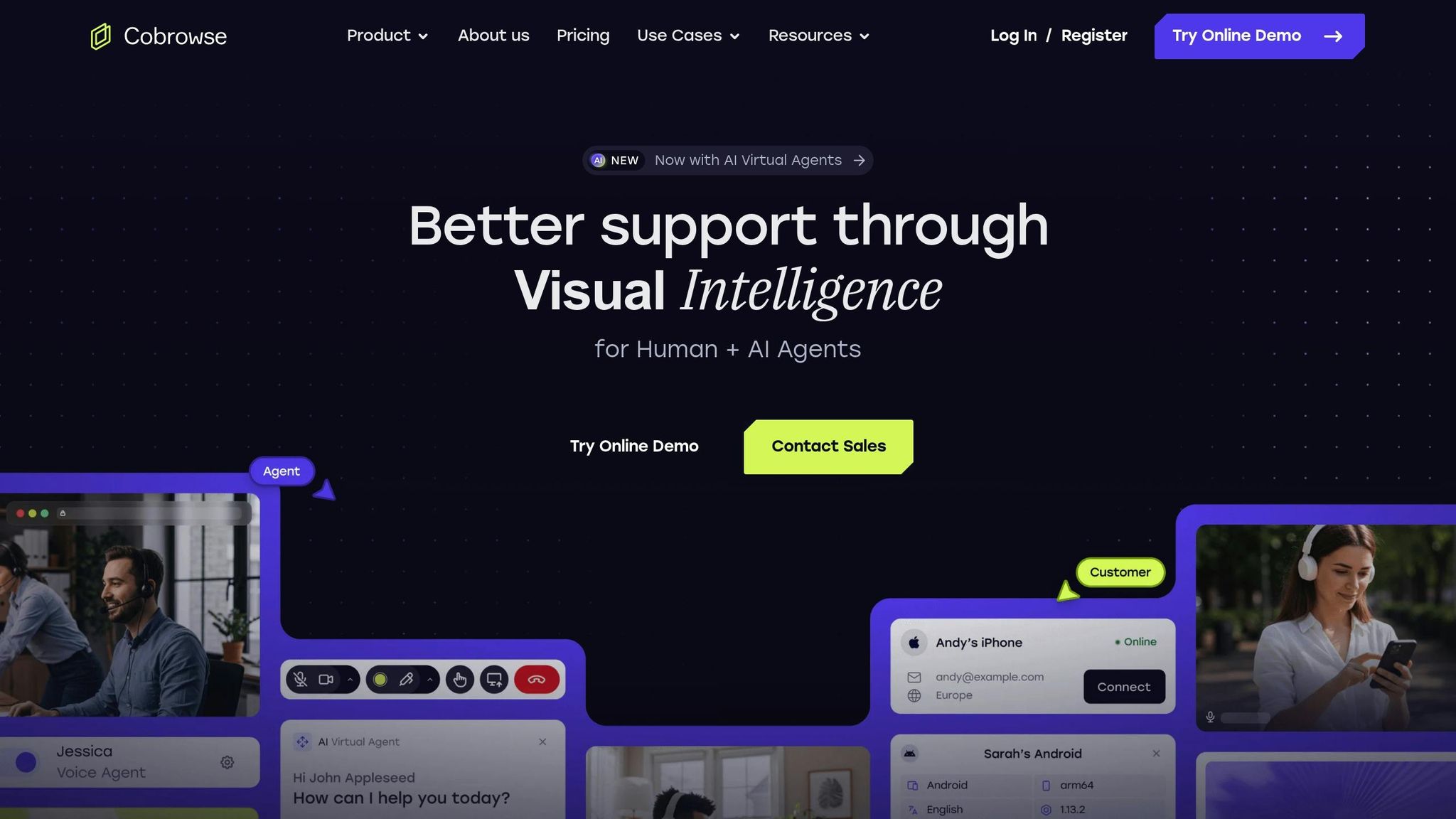
Cobra has taken this capability one step further with their AI-enhanced co-browse solution. Instead of merely assisting human agents, the same visual intelligence is being integrated into virtual agents. As Scholsey noted, Cobra’s AI embeds what they call "visual intelligence", enabling virtual agents to process and react to real-time screen data. This empowers bots to solve complex issues with far greater accuracy and relevance than traditional AI models that rely solely on static knowledge bases or ticket histories.
This approach ensures that virtual agents aren’t just referencing information but are actively understanding user interfaces. For enterprises, this means faster resolutions, fewer escalations, and significantly reduced costs – all without uprooting existing systems.
Real-World Impact: Quicken’s Seven-Year Partnership with Cobra
Quicken, a long-standing leader in personal finance software, has partnered with Cobra for over seven years. Ian Roberts shared how Cobra’s technology has revolutionized their customer support operations, reducing average handle time from 27–28 minutes to 21–22 minutes – a significant improvement when scaled across hundreds of thousands of interactions.
The results were equally impressive in customer satisfaction, as measured by transactional Net Promoter Score (TNPS). With Cobra’s co-browse solution, Quicken achieved notable increases in TNPS, reflecting a better overall customer experience.
Roberts emphasized that these improvements weren’t just about efficiency but also about delivering meaningful, empathetic support. "It’s not just how fast we can help customers – it’s how well we’re satisfying them", he noted.
Strategic Integration of AI at Quicken
Quicken’s approach to AI adoption has been deliberate and customer-centric. While their board of directors pushes for broader AI applications, the company focuses on tangible use cases that enhance customer confidence and satisfaction.
Roberts described how Quicken has tiptoed into AI, integrating it into their chat and phone systems in ways that prioritize seamless service. For example, their AI never traps customers in endless loops; instead, it escalates to a human agent when needed. This ensures that automation enhances, rather than frustrates, the customer experience.
Beyond customer support, Quicken is embedding AI into its software. By analyzing financial data, the AI guides users on managing their finances more effectively, showcasing the potential for AI to add value across multiple touchpoints.
The Future of AI in Customer Support: Insights and Predictions
When asked about the future of AI in customer experience, both Scholsey and Roberts highlighted the importance of contextual understanding. As Scholsey explained, most AI solutions today are limited to referencing static information. Without insight into what customers are seeing or experiencing, these tools fall short of delivering meaningful resolutions.
Cobra’s AI aims to address this gap by grounding its models in real-time user interfaces. For example, when a company updates its UI, Cobra’s AI adapts instantly, reducing the need for retraining or manual updates. This contextual awareness positions visual intelligence as a critical enabler of next-generation customer support.
Roberts added that AI must strive to be "as good or better than a human" in resolving routine issues. While human agents will always play a role in high-empathy interactions, AI can handle repetitive, low-complexity tasks, freeing agents to focus on more impactful work.
Lessons for Leaders: Adopting AI with Purpose
For enterprises evaluating AI solutions, both experts offered actionable advice:
- Start Small, Think Big: Scholsey recommended identifying high-impact, repetitive issues and using AI to address them incrementally. This allows companies to gather insights, refine strategies, and build momentum without overextending resources.
- Prioritize Customer Satisfaction: Roberts emphasized that customer experience must remain the top priority. Saving costs at the expense of customer trust can undermine long-term business success.
- Leverage Cross-Department Collaboration: Scholsey highlighted the importance of involving multiple teams – such as success, product, and operations – when developing AI strategies. Cross-pollination ensures that AI initiatives align with broader business goals and customer needs.
- Focus on Education, Not Just Resolution: Cobra’s philosophy centers on using every interaction as an opportunity to educate customers, fostering self-service and reducing future support demand.
Key Takeaways
- Co-Browsing Technology: Enables agents to see and resolve customer issues in real time, reducing discovery questions and improving clarity.
- AI and Visual Intelligence: Empower virtual agents to process and react to real-time screen data, closing gaps in traditional AI systems.
- Measurable Results: Quicken reduced average handle time by 6–7 minutes and achieved higher TNPS scores by implementing Cobra’s co-browse solution.
- Customer-Centric AI Strategies: Successful AI adoption requires a deliberate focus on enhancing the customer experience, avoiding endless loops, and escalating to humans when necessary.
- Adaptability and Context: Visual intelligence ensures AI remains effective even as UIs and customer needs evolve.
- Small Steps, Big Impact: Incremental implementation of AI allows companies to learn, adapt, and scale effectively while managing risks.
- Agent Experience Matters: AI not only benefits customers but can also reduce agent workload, as seen with Quicken’s automated CRM documentation.
- Future of Digital Support: AI should shift from merely solving issues to educating customers, fostering self-service, and driving long-term engagement.
Conclusion
Visual intelligence and AI have the potential to revolutionize B2B customer support by reducing costs, improving satisfaction, and scaling operations efficiently. Companies like Quicken are already reaping the rewards of adopting these cutting-edge solutions, proving that thoughtful, customer-focused AI strategies can deliver measurable business results.
As AI continues to evolve, the key will be balancing automation with empathy, ensuring that every customer interaction is not just a resolution but a step toward deeper trust and loyalty. For customer support leaders, the time to embrace AI thoughtfully – and strategically – is now.
Source: "The Future of Customer Support Gets Visual – and Real" – CX Today, YouTube, Dec 24, 2025 – https://www.youtube.com/watch?v=c_WakVZg5B8