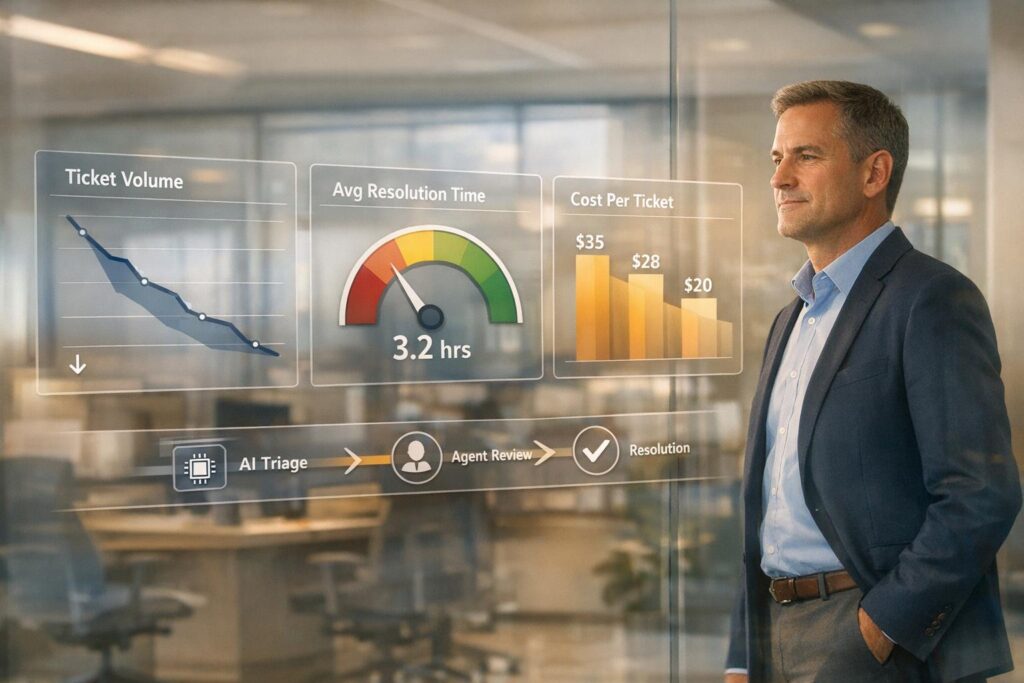
Customer service is more critical than ever. With 32% of customers leaving brands after just one bad experience, businesses must meet rising expectations for fast and personalized support. Yet, only 29% of customers feel they receive consistent service across channels. The challenge? Balancing customer demands with rising costs and limited resources.
AI-driven solutions are helping companies overcome these issues by automating repetitive tasks, improving response times, and enabling teams to focus on complex problems. For example:
- Intuit QuickBooks reduced resolution times by 36% with an AI bot, saving 9,000 agent hours annually.
- Rio, a startup, cut repetitive inquiries by 43% and saved $40,000 by deploying an AI assistant.
- Verizon Retailer reduced live agent calls by 50% using AI voice bots.
- Oracle deflected 25–30% of tickets during peak periods with an AI service desk.
Key Lessons for B2B Teams:
- Automate simple, high-volume tasks like password resets or order updates.
- Use AI for ticket triage, routing, and summarization to save time.
- Integrate AI into existing workflows to reduce friction.
- Maintain clear escalation paths for unresolved or sensitive issues.
AI isn’t replacing human agents – it’s enabling them to work smarter. By focusing on automation, accurate knowledge bases, and proactive support, businesses can cut costs, improve efficiency, and boost customer satisfaction.
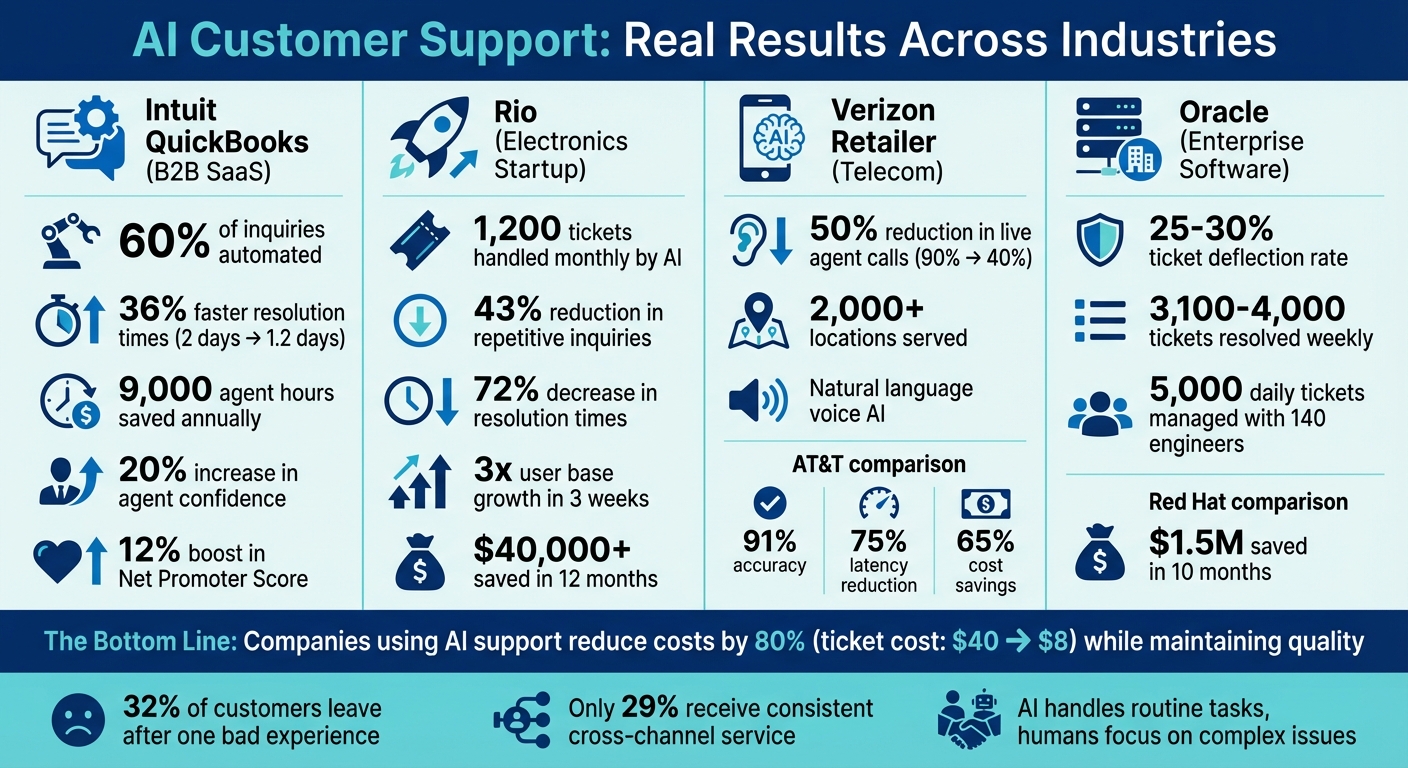
AI Customer Support ROI: Cost Savings and Efficiency Gains Across Industries
Build an AI Phone Agent for Customer Support (Full Demo)
Case Study 1: B2B SaaS Company Cuts Costs with AI Chatbots
Intuit QuickBooks encountered a familiar challenge: their support agents were overwhelmed with repetitive questions. This constant back-and-forth between applications to find answers led to delays, with an average resolution time of about two days. To tackle this, under the leadership of Omer Khan, QuickBooks developed "Quincy", a custom AI bot integrated directly into Slack.
Quincy took over 60% of agent inquiries, cutting resolution times by 36% – from two days to just 1.2 days. This change saved 9,000 agent hours annually and increased agent confidence by 20%. Additionally, within six months, QuickBooks saw a 12% boost in its Net Promoter Score.
"It used to take us two days to resolve a case. With the help of Quincy bot in Slack, we’re now 36% faster. If you put that annually, we saved our agents 9,000 hours."
- Omer Khan, Former Digital Lead for Customer Success, QuickBooks
This integration not only simplified workflows but also set the stage for meaningful operational improvements.
Why This Worked
The success of QuickBooks’ approach lies in its smart integration strategy. By embedding Quincy directly into Slack – where agents were already working – the company eliminated the need for constant tool-switching, creating a smoother workflow. They concentrated on automating Level 1 support tasks, such as handling repetitive and straightforward inquiries, allowing human agents to focus on more complex issues.
Another key factor was the introduction of micro-coaching. Quincy identified knowledge gaps and provided short, targeted training sessions, continuously improving agent performance.
What B2B Teams Can Learn
B2B support teams can take a page from QuickBooks’ playbook by starting with automation for high-volume, low-complexity tasks like password resets, order status updates, and basic account questions. Automating these simple but frequent tasks can significantly enhance efficiency without adding unnecessary complexity.
To ensure your AI delivers consistent responses, train it using ticket logs, help center articles, and product documentation. It’s equally important to establish a clear process for escalating issues to human agents. Setting confidence thresholds ensures that any uncertain or potentially frustrating interactions are promptly handed off to a person.
Finally, consider deploying both customer-facing and agent-facing AI tools. Internal bots like Quincy, which assist agents in finding answers quickly, can drastically improve productivity, as shown by QuickBooks’ 9,000-hour savings in agent time.
Case Study 2: Electronics Startup Automates Pre-Sales Queries
When Rio, a consumer electronics startup, launched its Kickstarter campaign, they encountered an overwhelming challenge: managing a surge of pre-sales and technical inquiries with their small support team and limited budget. To tackle this, Rio implemented an AI-powered Customer Experience (CX) Assistant integrated with a robust knowledge base. Remarkably, a working prototype was developed in just one week, and the entire system was fully operational within a few weeks.
By the third month, the AI system was handling around 1,200 tickets per month, reducing repetitive inquiries by 43% and slashing average resolution times by 72%. This efficiency allowed Rio to triple its user base in just three weeks – without hiring additional staff – and saved the company over $40,000 in costs.
"By month three, the AI was deflecting around 1,200 tickets monthly… Over 12 months, that saved us more than $40,000 in hiring, onboarding, and operational costs." – Durapid Case Study
The AI assistant managed a wide range of questions, from product specifications to shipping timelines, which freed up Rio’s small team to concentrate on complex customer issues and product development.
Why This Worked
Rio’s success came down to smart use of Retrieval-Augmented Generation (RAG). This AI approach relied solely on the company’s internal documentation and included sentiment analysis to gauge customer frustration. This setup ensured the AI didn’t guess or provide incorrect information. If a customer expressed frustration or repeatedly requested to speak with a person, the system escalated the issue to a live agent.
What B2B Teams Can Learn
Rio’s experience offers valuable lessons for B2B support teams. The first step is to automate simple, repetitive inquiries – like product details, shipping updates, or basic troubleshooting. Focusing on these straightforward tasks can deliver significant results without the added complexity of managing more nuanced issues right away.
A well-organized knowledge base is essential. Thorough documentation ensures the AI can quickly and accurately address common questions, making deployment faster and more effective. Additionally, setting up clear escalation protocols – such as confidence thresholds and triggers for human involvement – helps maintain customer trust as your support operations expand.
Case Study 3: Telecom Provider Reduces Wait Times with AI Voice Bots
This case study highlights how AI-powered voice automation is transforming customer support in the telecom industry, offering faster, more efficient solutions for handling high call volumes.
A major U.S. Verizon premium retailer, overwhelmed by calls across more than 2,000 locations, replaced its outdated IVR system with a voice assistant powered by Azure OpenAI, developed by Insight. The new system reduced the need to route calls to live agents from 90% to just 40%. By managing routine inquiries on its own, the AI voice bot allowed human agents to focus on more complex customer issues. This change also sparked broader innovation within the company.
"This wasn’t just about technology for the client. They used this initiative to build internal confidence and momentum for innovation across the entire business." – Meagan Gentry, National AI Practice Manager and Distinguished Technologist, Insight
AT&T tackled a similar challenge on a larger scale. Handling 15 million calls annually, the company partnered with H2O.ai to fine-tune smaller AI models. This approach achieved 91% accuracy across 80 labels, cut costs to 35% of the previous system, and improved processing speed threefold while reducing latency by 75%.
Why This Worked
The success of these AI voice bots lies in their ability to understand natural speech, including accents and interruptions, moving beyond the rigid menus of traditional systems. When issues require escalation, they use "contextual handover", providing live agents with full transcripts of the interaction. Vodafone Germany implemented a similar solution with Google Cloud Contact Center AI, enabling their system to handle 40% of customer service calls entirely through AI while cutting average handling time by 20% for escalated calls.
A shift to Small Language Models (SLMs) played a key role in managing high call volumes efficiently. AT&T demonstrated that fine-tuned SLMs can achieve the same level of accuracy as larger models for tasks like call classification, but at a much lower computational cost.
What B2B Teams Can Learn
AI voice automation works best when applied to high-volume, repetitive queries that don’t require deep reasoning. Tasks like billing inquiries, account authentication, data usage checks, and store location requests are ideal starting points, as they make up a significant portion of call volume and are relatively straightforward to automate.
To create a seamless experience, design systems that can handle natural conversations. This includes recognizing interruptions, topic shifts, and various accents. Training the AI on real customer interactions, rather than generic datasets, ensures it delivers a more relatable and conversational experience.
Set clear thresholds for escalating calls. If the AI detects uncertainty or emotional cues like frustration, it should immediately transfer the call to a human agent, complete with all relevant context. This "human-in-the-loop" approach helps maintain customer confidence.
For companies managing large call volumes, fine-tuning Small Language Models for specific tasks can lead to significant cost savings. AT&T’s strategy reduced costs to just 35% of its previous solution while improving latency by 75%. Smaller models are not only more cost-effective but also faster and easier to maintain at scale.
These examples highlight how AI voice automation can streamline customer interactions and significantly reduce call volumes, offering practical insights for B2B teams looking to enhance their customer support systems.
sbb-itb-e60d259
Case Study 4: Enterprise Software Provider Scales Support During Peak Periods
This case study highlights how enterprise software providers can manage increased support demands during high-traffic periods by leveraging AI technologies.
In March 2024, Oracle’s IT Employee Support team faced a daunting challenge: managing 5,000 daily tickets with just 140 engineers. The surge in ticket volume during peak times risked overwhelming their resources. To address this, Sudhir Dureja, Senior Director of Enterprise Engineering, led the implementation of an AI-powered "AI Service Desk" integrated directly into Slack. The system utilized a Retrieval-Augmented Generation (RAG) architecture to deliver precise, step-by-step answers, drawing from 13 internal service databases to ensure accuracy.
The results were impressive. The AI Service Desk achieved a ticket deflection rate of 25–30%, resolving 3,100–4,000 tickets weekly. This allowed engineers to shift their focus from routine tasks like password resets to more complex Tier 2 technical issues requiring specialized expertise.
"With Generative AI powered self-service features in the AI Service Desk, we noticed ticket deflection rates of 25–30%." – Sudhir Dureja, Senior Director of Enterprise Engineering, Oracle
A similar approach was adopted by Red Hat, which manages approximately 30,000 new cases monthly with 1,100 technical associates. Their Experience Engineering team deployed AI-powered textual reranking using a fine-tuned IBM Slate Retriever model. This optimized how knowledge articles were ranked, ensuring the most relevant ones appeared first. Additionally, they piloted an AI tool to automatically draft Knowledge-Centered Service (KCS) articles from resolved case comments. The results were substantial: troubleshooting optimization alone saved $1.5 million in 10 months, and automating KCS article drafting is projected to save $8 million annually through cost avoidance.
Why This Worked
Two key factors drove the success of these AI-powered solutions. First, the RAG architecture and automated updates ensured responses were accurate and up-to-date, pulling directly from technical manuals and past cases while continuously improving the knowledge base with patterns from resolved tickets. Second, intelligent triage and escalation used natural language processing to assess ticket urgency and customer SLA requirements. This allowed high-priority issues to be routed to senior engineers while routine queries were handled through self-service.
AI summarization also played a pivotal role during case handovers. When tickets escalated or shifted between "follow-the-sun" support teams, AI-generated summaries condensed complex ticket histories into concise updates. This feature saved time during peak periods, enabling agents to quickly understand the context without wading through long conversation threads.
What B2B Teams Can Learn
To replicate these outcomes, start by identifying high-volume, repetitive ticket categories that consume significant agent time during busy periods. Oracle, for example, targeted IT requests like password resets and software access – tasks with predictable patterns that could be automated using structured knowledge retrieval. These types of tickets are ideal for AI deflection since they don’t require deep reasoning or emotional intelligence.
Integrate AI tools into existing workflows to minimize friction and encourage adoption. Employees are more likely to embrace AI solutions when they complement familiar systems rather than introducing entirely new ones.
Establish clear escalation protocols for situations where the AI encounters uncertainty or detects negative sentiment. These protocols should route cases to human agents with full context, ensuring a smooth transition.
Lastly, use analytics dashboards to monitor gaps in AI performance. Identify ticket categories the AI struggles to resolve and prioritize updates to the knowledge base. Red Hat’s strategy of refining their knowledge base using real case data ensured their AI tools became more effective over time.
These examples illustrate how AI-driven support can streamline operations, reduce costs, and enable teams to focus on more complex challenges.
How to Apply These Lessons to Your B2B Support Team
Strategies That Work
Research shows that AI-driven automation delivers the best results when applied to repetitive, high-volume tasks first. Think of tasks like password resets, order status updates, or basic troubleshooting. These are quick wins that not only provide a fast return on investment but also free up your team to handle more complex, high-impact issues.
Next, prioritize intelligent triage and routing. AI can analyze incoming tickets by intent, sentiment, and language, then route them to the right agent. This process can save about 45 seconds per ticket, which adds up to around 120 hours saved per month for larger teams. Liberty London implemented this in early 2024 and saw a 73% reduction in first reply times along with a 9% increase in customer satisfaction scores.
Another critical tactic is active knowledge management. AI can assess conversations to find gaps in your knowledge base. When agents handle complex tickets, the system can draft new knowledge base articles from the interaction history, significantly speeding up the content creation process. Red Hat successfully used this approach to streamline their Knowledge-Centered Service (KCS) article creation, leading to notable cost savings.
Proactive support is also key. AI can monitor customer usage patterns, subscription details, and sentiment changes to flag potential issues before they become problems. For instance, if a spike in failed API calls is detected for a specific customer, your team can reach out with a solution before a support ticket is even created. This not only reduces inbound ticket volume but also strengthens customer trust and loyalty.
Finally, it’s essential to establish clear escalation protocols. AI systems shouldn’t operate like mysterious black boxes. When the system encounters uncertainty or detects customer frustration, it should seamlessly escalate the case to a human agent with all the necessary context. One company reduced handle times by 50% by combining automated routing with human escalation.
By adopting these strategies, your support team can integrate intelligent automation into daily operations, ensuring you meet the ever-increasing expectations of B2B customers.
How Supportbench Delivers Cost-Efficient AI Solutions
Supportbench was designed specifically for B2B teams that need powerful AI tools without the complexity of legacy systems. Unlike other platforms that add AI as a costly extra, Supportbench integrates AI directly into workflows like case management, knowledge creation, and operational processes from the start.
The platform tackles inefficiencies head-on. For example, its AI-powered triage eliminates the need for manual ticket categorization, automatically assigning issues to the right channels. Meanwhile, the AI Agent-Copilot provides real-time insights and knowledge recommendations to help agents resolve cases faster.
Supportbench also excels in knowledge management. Its AI-driven tools can convert resolved cases into ready-to-use help center articles with just one click. The Customer QA AI Bot takes this a step further by answering routine customer queries directly from your knowledge base, escalating only when a solution isn’t found. This reduces ticket volume while ensuring customers get accurate answers 24/7.
The platform includes predictive analytics as well. Supportbench’s AI can forecast customer satisfaction (CSAT) and customer effort scores (CES) even before survey responses are submitted. Plus, it automatically tracks first contact resolution (FCR), a traditionally hard-to-measure metric, giving managers the insights they need to act on at-risk cases.
With all these features included, Supportbench is priced at $32 per agent per month. This straightforward pricing model scales with your team, making it accessible for smaller teams while offering the robust functionality required by larger enterprises.
Conclusion
The data is clear: AI-driven customer support is no longer optional – it’s a necessity. Companies like Red Hat have demonstrated this by saving $1.5 million in costs within just 10 months through AI-powered self-service. Similarly, Intuit QuickBooks cut resolution times by 36% and increased their Net Promoter Score by 12% with the help of their AI assistant, "Quincy". These examples highlight how integrating AI into support isn’t just about efficiency – it’s a strategic advantage.
Adopting proactive support powered by AI can completely redefine operations. Instead of waiting for issues to arise, AI tools can identify and address them before customers even file a ticket. MavenAGI set a compelling example by slashing the average cost per ticket from $40 to $8 – an impressive 80% reduction – while autonomously resolving 93% of inquiries.
But the benefits of AI go beyond speed and cost. When paired with human expertise, AI becomes a powerful tool for enhancing service quality. Rather than replacing human agents, AI can take over repetitive tasks, freeing up teams to focus on more complex and meaningful customer interactions. Mandy Elliott from Red Hat summed it up perfectly:
"AI augmentation doesn’t just improve efficiency; it also enhances content creation and may contribute to job satisfaction. This will be crucial as Red Hat scales to handle increasing case volumes without overburdening associates".
This balance allows teams to prioritize high-value conversations while AI handles routine tasks like password resets, order tracking, and basic troubleshooting.
The impact of AI integration is undeniable. It cuts costs, improves efficiency, and enhances customer satisfaction. With forecasts suggesting that AI will play a role in every customer interaction within three years, the time to act is now. Platforms like Supportbench, priced at just $32 per agent per month, make enterprise-grade AI accessible to businesses of all sizes – without the need for costly add-ons or complicated integrations.
To stay ahead, businesses should focus on adopting AI-native workflows. Start with simple, high-impact tasks, ensure your knowledge base is optimized for AI, and maintain human oversight where it counts. The results – cost savings, operational efficiency, and happier customers – are simply too compelling to overlook. Winning teams in the near future will be those that embrace AI today.
FAQs
How does AI make customer service more efficient?
AI is transforming customer service by taking over repetitive tasks, speeding up response times, and equipping agents with real-time insights. For instance, generative AI can quickly produce tailored responses and recommendations, cutting down on manual work and helping teams manage a higher volume of inquiries more efficiently.
Tools powered by AI, such as chatbots and agent-assist systems, can organize tickets, propose solutions, and handle routine jobs. This not only reduces costs but also ensures quicker resolutions. These systems also support agents by providing real-time suggestions and context, enabling them to address customer issues faster and with greater confidence. By simplifying workflows and boosting accuracy, AI fosters a more efficient and customer-centric support environment.
What are the cost-saving benefits of using AI in customer support?
Using AI in customer support can help businesses save a lot of money. By automating repetitive tasks and addressing common questions, AI reduces the need for extra staff and cuts down on operational costs. For example, AI can handle up to 35% of incoming tickets and shorten handling times by about 40%, translating to substantial annual savings.
AI doesn’t just save money – it also makes support teams more efficient. It streamlines workflows and provides smart recommendations, helping agents resolve issues faster. This means companies can keep customers happy while managing high demand more effectively. In short, AI allows businesses to expand their support capabilities without breaking the bank, all while delivering better results.
What’s the best way for B2B teams to start using AI in customer support?
B2B teams looking to improve customer support can begin leveraging AI by focusing on tools designed to simplify workflows and boost customer satisfaction. A smart starting point is implementing AI-powered automation. These systems can automatically sort, direct, and resolve common inquiries, cutting down on manual work and speeding up response times. This efficiency allows teams to manage more requests without overwhelming their resources.
Another practical solution is deploying AI chatbots and self-service portals. These tools give customers the ability to address routine questions on their own, reducing the number of support tickets and enabling agents to concentrate on more complex issues. On top of that, AI can analyze customer interactions to identify trends and flag urgent cases, helping teams offer more tailored and proactive support.
By beginning with small, manageable steps and gradually expanding, B2B teams can seamlessly incorporate AI into their support processes, trim expenses, and improve the customer experience.