Thinking about a founding Customer Success Manager (CSM) role? Here’s the deal: It can either set you up for success or leave you overwhelmed. Before you commit, make sure the role is well-defined, resourced, and aligned with realistic expectations.
Here’s what you need to know upfront:
- Scope clarity is critical. Understand what you’ll own (e.g., retention metrics) versus what you’ll influence (e.g., product changes). If ownership is vague or responsibilities feel endless, that’s a red flag.
- Resources matter. Ask about hiring plans, tools, and cross-functional support. If there’s no roadmap for scaling the team or no budget for tools, you’ll likely be stretched thin.
- Success metrics should be realistic. Clear goals for 90, 180, and 365 days are essential. If expectations are overly ambitious or undefined, the role might lack structure.
- AI expectations must be reasonable. Using AI tools for efficiency? Great. Expected to build or manage AI systems solo? That’s a problem.
- Red flags to watch for: No hiring plan, unclear priorities, or being treated as a reactive support role instead of a proactive strategist.
Key takeaway: Ask the right questions during interviews to ensure the role aligns with your skills, resources, and career goals. This guide breaks down the questions you need, warning signs to avoid, and how to negotiate scope without sounding difficult.
What’s Normal vs What’s a Red Flag in Early-Stage Customer Success
What to Expect as the First Customer Success Hire
Stepping into a founding Customer Success Manager (CSM) role is less about putting out fires and more about laying the groundwork for processes, customer insights, and cross-department collaboration. Within your first 30 days, you should expect to meet with 20–30 customers to uncover their pain points and identify value milestones. As Jason Lemkin, founder of SaaStr, bluntly states:
"If you don’t hear ‘meeting with dozens of customers’ [as a first 30-day priority] – pass."
After those initial conversations, your focus shifts to auditing onboarding and renewal workflows, spotting time-to-value gaps, and establishing a basic health scoring framework. At this stage (typically for companies under $10M ARR), you’ll need to dive deep into the product, learning its nuances and even implementing temporary fixes for missing features. Collaboration is key: you’ll work with Sales to ensure smooth handoffs and realistic customer expectations while partnering with Product to prioritize roadmap adjustments based on customer feedback. Expect to manage around $1M–$2M in ARR during this phase.
These tasks form the bedrock of your role, but any deviation from this clear structure could signal deeper issues.
Warning Signs That Signal Future Problems
Some warning signs are easy to spot during interviews and can indicate a disconnect between expectations and reality. One major red flag is when companies misinterpret the "passionate generalist" mindset as a green light to overload you with responsibilities indefinitely.
For instance, if you ask about your top priority in the first 30 days and the answer isn’t “meeting customers,” that’s a problem. Similarly, if the company can’t clearly articulate its churn drivers or if different interviewers provide inconsistent data on Net Revenue Retention (NRR), their metrics might not be reliable. Jon Johnson, a CSM and contributor to CS Insider, puts it plainly:
"If you ask about CULTURE and THEY talk about PERKS?? Boom."
Other red flags include the absence of a hiring plan despite aggressive growth goals, Sales reps managing post-sale relationships (they’re built to close deals, not ensure ongoing success), and treating Customer Success as a reactive support function with no influence over product or process decisions. If discussions about compensation or ownership are contentious at every turn, it’s another sign of trouble.
How to Avoid Being Stretched Too Thin
Clarity around your role is crucial to avoid being pulled in too many directions. The issue isn’t about working hard – it’s about juggling unclear priorities that dilute your impact. If you’re simultaneously handling support tickets, writing playbooks, managing renewals, and overseeing implementations, it’s easy to end up doing all of them poorly.
During interviews, ask questions like: “What are the top three outcomes you want in the first 90 days?” and “How will we prioritize when multiple urgent needs arise?” If the interviewer can’t outline clear priorities or suggests you’ll “figure it out as you go,” you’re likely walking into a reactive role rather than a strategic one. Another critical question: “What’s the plan for hiring the next CS team member, and what will trigger that hire?” If they haven’t considered staffing relative to the sales pipeline, you’re likely to be overwhelmed from day one.
Customer Success shouldn’t operate in isolation. If the team isn’t integrated with Sales and Product, you won’t have the support needed to succeed. Ideally, Customer Success should be one of the first 5–10 hires at a startup. If you’re being brought in later without the necessary infrastructure, proceed carefully. Without clear boundaries and support, you risk a role that spreads you too thin, undermines your strategic contributions, and leads to burnout.
25 Customer Success Manager Interview Questions That Will Get You Hired
3-Part Framework for Evaluating Any Founding CSM Role
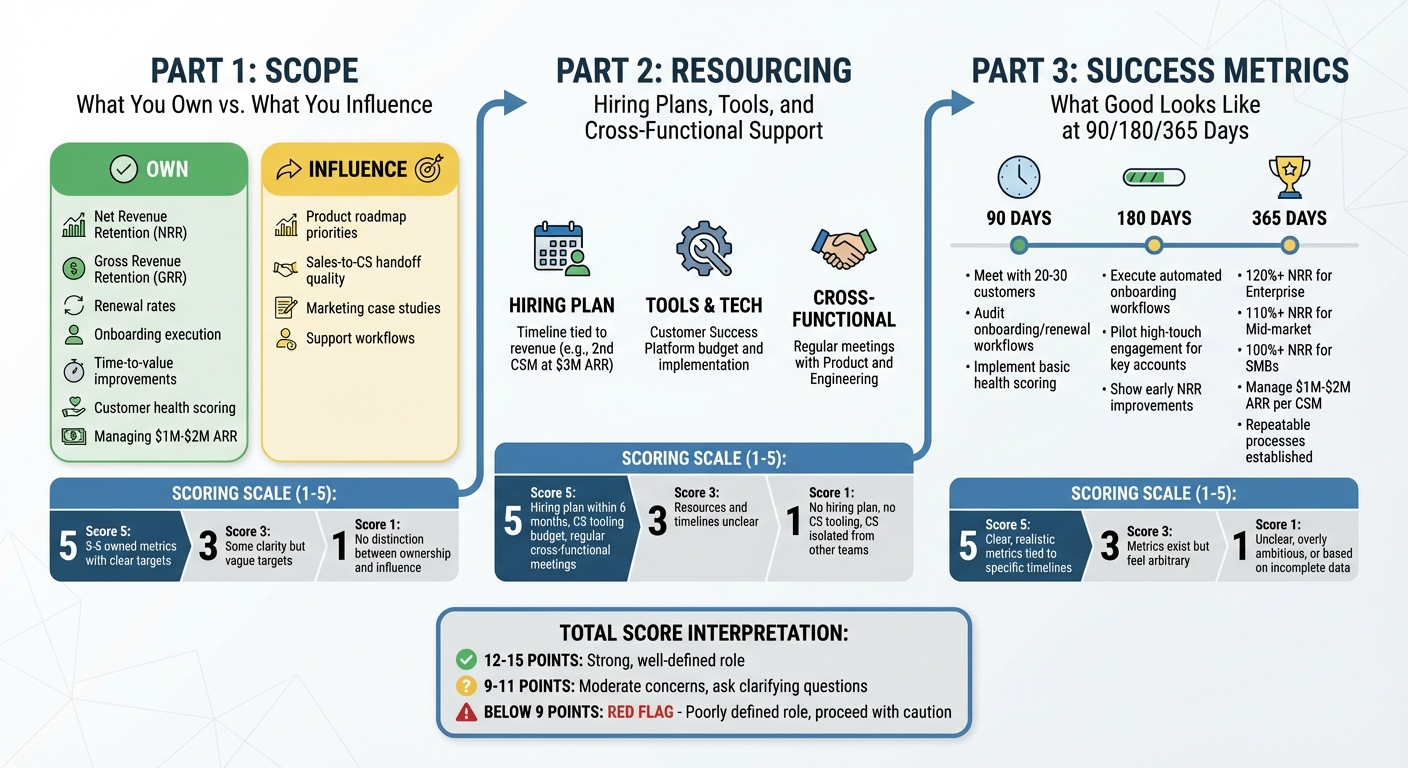
3-Part Framework for Evaluating Founding CSM Roles: Scope, Resourcing, and Success Metrics
When considering a founding Customer Success Manager (CSM) role, it’s critical to assess it systematically to avoid stepping into a position that sets you up for failure. This framework focuses on three key areas: scope (what you control), resourcing (the support you’ll receive), and success metrics (how your performance will be measured). Each area uses a straightforward 1-5 scoring system, helping you objectively evaluate the role during interviews. Let’s break it down.
Part 1: Scope – What You Own vs. What You Influence
Understanding the difference between ownership and influence is fundamental. Ownership means you’re directly responsible for specific outcomes. Influence, on the other hand, allows you to advocate for changes but not control the results.
Key distinctions between ownership and influence:
- Own: Metrics like Net Revenue Retention (NRR), Gross Revenue Retention (GRR), renewal rates, onboarding execution, time-to-value improvements, and customer health scoring systems. For example, if you’re tasked with managing $1M–$2M in Annual Recurring Revenue (ARR) and achieving a 110% NRR for mid-market customers, that’s clear ownership.
- Influence: Areas like product roadmap priorities, sales-to-CS handoff quality, marketing case studies, and support workflows. While you can drive product changes through customer feedback, you won’t control whether those changes are implemented.
Ask "What specific outcomes will I be accountable for in my first 90 days?" or "How much authority will I have to address root causes of churn, like product gaps or onboarding issues?". If the company can’t clearly define what you own versus what you influence, or expects you to "own" outcomes beyond your control, that’s a red flag.
Scoring this area (1-5):
- 5: The company defines 3-5 owned metrics with realistic targets.
- 3: Ownership is somewhat clear but lacks specific targets.
- 1: Everything feels like "influence", or you’re expected to own outcomes without the authority to make changes.
Once you’ve clarified your responsibilities, it’s time to evaluate whether the necessary resources are in place to meet those expectations.
Part 2: Resourcing – Hiring Plans, Tools, and Cross-Functional Support
Even the most skilled CSM can’t succeed without the right resources. This part of the framework assesses whether the company has a plan for building the team, providing tools, and fostering collaboration.
Hiring plan: Ask "How do you plan to grow the CS team over the next 12 months, especially if budgets are tight?". A solid answer includes a timeline tied to revenue goals, such as hiring a second CSM at $3M ARR, and clarity on whether the next hire will be a generalist or specialist. If there’s no hiring plan, you may end up juggling everything solo for far too long.
Tools and tech stack: Find out if there’s a Customer Success Platform (CSP) in place or a budget for one. Ask "What tools are being used to track customer engagement and health? Is there a budget for a dedicated platform?". Without proper tools, you could be stuck manually managing data in spreadsheets, which wastes time better spent on customers.
Cross-functional support: Customer Success doesn’t work in isolation. Ask "How often does CS meet with Product and Engineering to align on priorities?" or "Can you give an example of a recent product update driven by CS feedback?". If there’s no collaboration between teams, you’ll struggle to influence churn drivers effectively.
Scoring this area (1-5):
- 5: There’s a hiring plan within six months, a budget for tools, and regular cross-functional collaboration.
- 3: Resources and timelines are unclear.
- 1: No hiring plan, no tools, and CS operates in isolation.
Part 3: Success Metrics – What Good Looks Like at 90/180/365 Days
Success metrics should match the company’s stage, resources, and customer base. Realistic goals depend on having the authority and support to drive the outcomes tied to those metrics.
90-day expectations: Early goals focus on quick wins, such as meeting with 20-30 customers to identify pain points, auditing onboarding and renewal workflows, and implementing a basic health scoring system. If they expect you to hit aggressive NRR targets or overhaul the tech stack in 90 days, that’s unrealistic. As Jason Lemkin puts it:
"If you don’t hear ‘meeting with dozens of customers’ [as the #1 priority for the first 30 days] – pass."
180-day expectations: By this point, you should be executing the framework built in the first 90 days. This might include rolling out automated onboarding workflows, piloting high-touch engagement for key accounts, and showing early NRR improvements. You should also have a hiring or training plan in place to scale the team.
365-day expectations: At the one-year mark, targets vary by customer segment: 120%+ NRR for enterprise, 110%+ for mid-market, and 100%+ for SMBs. You should also be managing $1M–$2M ARR per CSM and have repeatable processes for onboarding, adoption, and expansion.
Ask "What are the top three customers we lost last year, and why?". If they can’t answer, it signals a lack of data infrastructure. Also, ask "What does success look like at 90, 180, and 365 days?" If their answer seems vague or overly ambitious, the role may lack proper definition.
Scoring this area (1-5):
- 5: Metrics are clear, realistic, and tied to specific timelines.
- 3: Metrics exist but feel arbitrary or disconnected from available resources.
- 1: Metrics are unclear, overly ambitious, or based on incomplete data.
| Framework Area | Score 5 (Strong) | Score 3 (Moderate) | Score 1 (Red Flag) |
|---|---|---|---|
| Scope | 3-5 owned metrics with clear targets; authority to influence churn drivers | Some clarity on ownership but vague targets | No distinction between ownership and influence; expected to own outcomes without authority |
| Resourcing | Hiring plan within 6 months; CS tooling budget; regular cross-functional meetings | Resources and timelines are unclear | No hiring plan exists; no CS tooling is budgeted; CS is isolated from Product and Engineering |
| Success Metrics | Clear 90/180/365-day goals; segment-specific NRR targets; data-driven churn analysis | Metrics exist but feel arbitrary or disconnected from resources | No clear metrics; unrealistic expectations; can’t explain churn drivers |
If any area scores a 1 or 2, proceed with caution. A total score below 9 (out of 15) indicates a poorly defined role. This framework ensures you go into interviews prepared to assess the role objectively, paving the way for targeted follow-up questions.
30+ Interview Questions That Reveal the Real Job
When stepping into a founding Customer Success Manager (CSM) role, having the right questions is essential. These questions help uncover the true scope of the position, ensuring you understand role expectations and can set boundaries to avoid burnout. They also help you identify potential red flags, like unclear goals or misaligned priorities among stakeholders.
It’s smart to ask these questions across multiple interviews with different team members. If answers about churn rates or hiring plans don’t align, it could signal internal miscommunication or a lack of clarity about the role. Pay attention to both the content of the answers and the confidence with which they’re delivered.
Questions About Company Stage and Growth Rate
The company’s growth rate directly impacts your workload. A business scaling rapidly from $5M to $15M Annual Recurring Revenue (ARR) in a year will demand much more than one growing steadily from $8M to $10M ARR. Before hitting $10M–$20M ARR, you might spend significant time addressing product limitations. Beyond that, the focus often shifts to refining established processes.
- "What is your current ARR, and what’s the growth target for the next 12 months?"
Look for specific numbers and how they translate into workload expectations. - "What’s your current Net Revenue Retention (NRR) rate, and how does it vary by customer segment?"
Healthy NRR benchmarks are around 120%+ for Enterprise, 110%+ for Mid-market, and 100%+ for SMBs. Discrepancies in answers across interviews may indicate transparency issues. - "How many customers do you have today, and what’s the average contract value (ACV) by segment?"
This helps clarify whether you’ll be managing a few high-touch clients or many smaller accounts. For example, an ACV of $250k+ typically requires a "white-glove" approach. - "What are your current customer-to-CSM ratios, and what’s the target ratio after I join?"
A common benchmark is managing $1M–$2M in ARR per CSM. - "Can you explain why your top three customers churned last year?"
If they can’t answer, it might reveal a lack of data or insight into customer challenges. Look for patterns like product gaps, onboarding issues, or misaligned sales promises.
Questions About Customer Profile and Technical Work
The complexity of the customer base determines whether your day-to-day will involve strategic planning or technical problem-solving. It’s crucial to understand who handles technical tasks like migrations and integrations to avoid overstepping your role.
- "What does a typical customer onboarding process look like, and how long does it take?"
A clear answer should include specific milestones and timelines. Vague responses may signal an undefined process. - "Who is responsible for technical implementations, migrations, and integrations?"
If the answer is "you’ll figure it out", it suggests a lack of structure. A well-run team should clearly define responsibilities. - "What percentage of customers require custom integrations or data mapping during onboarding?"
This gives insight into the technical workload. If there’s no dedicated technical support, expect to take on extra tasks. - "How technical is your product, and what expertise do customers need to succeed?"
This helps clarify whether you’ll focus on training customers on complex features or more strategic initiatives. - "What’s the most common reason customers struggle during onboarding?"
Thoughtful answers might include issues like incomplete API documentation or overselling during the sales process. If they claim there are no problems, it could indicate a lack of visibility or honesty.
Questions About Support vs. Success Responsibilities
In early-stage companies, the lines between Support and Customer Success often blur. Without clear boundaries, you might find yourself handling reactive support tasks instead of focusing on proactive customer outcomes.
- "How does the company define the difference between Support and Customer Success?"
A clear answer should separate reactive troubleshooting (Support) from proactive relationship management (CS). If they say, "It’s all customer success", you may be expected to do both. - "Who manages break/fix tickets, escalations, and bug reports?"
Ideally, you should influence the process by identifying trends, not own the ticket queue. - "What’s the escalation path when a customer issue requires engineering support?"
A well-structured process with defined timelines is a good sign. Without one, you might waste time chasing solutions. - "How many support tickets does the average customer submit monthly, and how often does CS get involved?"
This helps gauge whether you’ll be pulled into support tasks too often. - "Can you share an example of a recent issue that required collaboration between Support and CS?"
This reveals how well the teams work together in practice.
Questions About AI Expectations and Tools
AI tools are becoming standard in Customer Success, but there’s a big difference between using existing tools and building them from scratch. Clarify what’s expected of you in this area.
- "What AI tools does the company provide for Customer Success workflows?"
A strong answer might mention tools for health scoring, sentiment analysis, or automated playbooks. If they’re "exploring options", you may need to start from scratch. - "Am I expected to build AI workflows, or will I use existing tools?"
Using AI for tasks like drafting emails is reasonable, but building production-grade AI systems requires dedicated resources. - "Is AI usage part of my performance metrics?"
Ensure the response clarifies resource allocation and support for AI-related tasks. - "Who owns the AI infrastructure – CS, Engineering, or a dedicated AI Operations role?"
Companies serious about AI often have dedicated roles for managing these systems. If it’s entirely on you, that’s a red flag. - "What does success with AI look like in the first 90 days?"
A reasonable goal might involve adopting existing tools, not creating complex systems.
Questions About Hiring Plans and Performance Metrics
A clear hiring plan and defined success metrics show whether the company has realistic expectations for the founding CSM role.
- "What’s the hiring plan for the Customer Success team over the next 12 months?"
Look for a timeline tied to revenue milestones. For example, hiring a second CSM might align with reaching $3M ARR. - "Will the next hire be a generalist CSM, a CS Ops specialist, or an implementation expert?"
This reveals whether the company recognizes the need for specialized roles as the team grows. - "What are the top three outcomes you expect me to achieve in my first 90 days?"
The focus should be on engaging with customers and understanding their needs. As Jason Lemkin notes:"If you don’t hear ‘meeting with dozens of customers’ as the #1 priority for the first 30 days – pass".
sbb-itb-e60d259
How to Negotiate Scope Without Sounding Difficult
When approaching scope discussions, it’s important to balance assertiveness with collaboration. The founding Customer Success Manager (CSM) role often combines tasks that ideally belong to multiple positions. The key is to set boundaries in a way that aligns with company goals and outcomes.
Start by showing your commitment to delivering results. Instead of saying, "This is too much for one person", try framing your concerns around priorities. For example: "To deliver the most value early on, which top three KPIs should I focus on in the first 90 days? If I need to prioritize between immediate renewals and auditing our onboarding flow for long-term retention, which should come first?" This shifts the decision-making to leadership, requiring them to clarify their priorities.
If their expectations seem unrealistic – like expecting you to handle both strategic and high-volume tasks – propose a phased plan. Focus first on critical outcomes, such as meeting with key customers and identifying churn drivers, and then move to scaling systems for other tasks.
Scripts for Clarifying Priorities and Boundaries
When setting boundaries, use language that highlights teamwork and business impact. Here are some adaptable examples:
Clarifying support versus success responsibilities:
"I’ve noticed a lot of reactive support tickets. As we establish the success function, what’s the plan for transitioning technical support to a dedicated resource so I can focus on proactive health scoring and driving NRR growth?"
Negotiating resources when scope expands:
"I’m ready to take ownership of expansion and product training. How might the hiring plan or compensation structure adjust as these responsibilities shift from influence to direct ownership?"
Confirming cross-functional support:
"What’s the escalation process when a customer issue requires engineering support, and what’s the expected turnaround time? I want to ensure I can meet customer commitments without delays."
Post-interview email template for clarification:
Subject: Follow-up: Alignment on [Company Name] Success Strategy
Hi [Interviewer Name], thank you for the insights today. You mentioned churn is driven by [Product Gaps/Bad Fit Sales]. Could you clarify how much influence the founding CSM will have over the product roadmap or the sales-to-CS handoff to address these challenges?
These scripts are effective because they assume positive intent while surfacing potential issues. If the hiring manager reacts defensively or dismissively, it could signal broader challenges with the company’s culture or readiness for a Customer Success function.
Using a Tradeoff Menu to Adjust Scope
A tradeoff menu is a powerful tool to visually demonstrate the need to reprioritize when new responsibilities are added. This method helps prevent scope creep by making the impact of additional tasks clear. Present it as a collaborative planning resource, not as a demand.
Here’s how to introduce it: "I want to ensure we’re aligned on priorities. If we add [new responsibility], we’ll need to adjust [existing responsibility]. Here’s an example of how we might rebalance these tasks." Then share a table like this:
| If we add this responsibility… | We must delay or reduce focus on… | Reason for Tradeoff |
|---|---|---|
| Direct Ownership of Renewals | Deep-dive Technical Onboarding | Transactional tasks require high volume; onboarding needs high-touch interactions. |
| Manual Data/Health Reporting | Proactive Customer Strategy | Manual reporting consumes time needed for outreach. |
| Technical Support Triage | Strategic Business Reviews (QBRs) | Reactive tasks limit preparation for high-value meetings. |
| Building AI/Automation Tools | Immediate Book of Business Growth | Developing tools requires upfront time investment. |
This approach reframes new tasks as a matter of priorities. As Stephanie Berner, SVP of Customer Success at Atlassian, explains:
"It’s really important to be clear about where you want CSMs spending their time and you design your compensation systems to match that".
For example, if you’re expected to manage expansion quotas, you should negotiate for resources to handle technical escalations. The tradeoff menu also guards against the "just one more thing" problem, where responsibilities pile up over time. When leadership adds new tasks, you can refer back to this framework and ask, "Which of our original priorities should we adjust to accommodate this?"
Mastering these strategies will prepare you to handle another growing challenge in Customer Success roles: managing AI-driven expectations.
AI Expectations in 2026: What’s Reasonable vs What’s Not
By 2026, AI has become a core part of Customer Success, driving efficiency in onboarding, health scoring, and customer communications. If you’re interviewing for a founding Customer Success Manager (CSM) role, you’ll likely hear phrases like "AI-first framework" or "scalable automation." The tricky part? Figuring out where AI fits into your responsibilities and where it crosses into unrealistic territory – like maintaining production AI systems without proper support.
Jason Lemkin, Founder of SaaStr, puts it plainly:
"Everyone will be expecting it [the CS framework] to be AI-first today".
This doesn’t mean you need to become a machine learning engineer. Instead, it’s about using AI tools strategically to enhance workflows. The key is knowing what’s practical for a CSM to handle and what requires a dedicated engineering team. Let’s break down the difference.
Reasonable Ways CSMs Should Use AI
A founding CSM should be comfortable leveraging AI to boost productivity and streamline processes. Think of AI as an assistant that helps with tasks like summarizing customer calls, drafting tailored emails, creating playbooks from past interactions, and automating repetitive data entry. These tools are designed for users, not builders – you’re instructing the system, not creating it.
AI can also simplify onboarding and uncover growth opportunities by analyzing customer health data. Experimenting with different AI models and prompts to see what aligns with your workflows is part of the job. As Alex Duffy, Contributing Writer at Every, explains:
"AI is more like playing an instrument than using a tool. It takes practice, and everyone’s experience is going to be different".
In your first 90 days, you should focus on identifying automation gaps in current processes and rolling out workflows that incorporate AI, such as automated onboarding emails or self-service guides. However, this is only feasible if the company provides both the budget for AI tools and the time to experiment. If they demand an "AI-first" approach but don’t allow time for testing and refinement, that’s a warning sign. Things become unmanageable when AI expectations go beyond productivity tools.
Unreasonable AI Expectations to Watch For
Problems arise when companies expect you to deploy large-scale AI systems without proper resources. Katie Parrott, AI Editorial Operations Lead at Every, highlights this issue:
"If you’re looking to operationalize AI at scale, it takes full-time resources. You need someone whose job it is to build systems for the people who are too busy doing otherwise".
Be wary if you’re expected to act as the company’s "Chief AI Officer" while simultaneously managing a full client portfolio. Tasks like selecting AI tools, building workflows, measuring ROI, and maintaining systems require constant attention. Parrott stresses:
"People think it’s a one-and-done process… That you can build something, launch it, and that’ll be it. And it’s not".
Another red flag is when companies use AI as a justification to under-hire. Meta’s 2025 report claimed AI-driven productivity allowed individuals to take on the workload of entire teams. By 2026, Mark Zuckerberg stated:
"We’re starting to see projects that used to require big teams now be accomplished by a single very talented person".
While this might work for tech giants with massive AI budgets – Meta increased its AI spending by 60–87% in 2026 – most startups lack those resources. If they expect you to replace a team without providing advanced AI tools and infrastructure, burnout is inevitable.
How to Set Boundaries on AI Work
During interviews, ask direct questions like: "Who is the centralized owner for AI systems?" If the answer is "everyone" or "you", it signals that you might be left to manage systems without support. Follow up with: "Is there a dedicated budget for AI tools and time for training and experimentation?" Serious companies will have both in place.
When discussing your 30-60-90 day plan, clarify expectations around AI responsibilities. For example, ask whether you’re expected to hire an AI team or function as the AI team. If the role involves building AI agents or production systems, you can respond with something like: "I can pilot lightweight automations, but production AI systems require dedicated engineering support. How will these resources be provided?"
This approach reframes the conversation as a practical discussion about execution rather than a refusal to engage with AI. Your strength as a founding CSM lies in setting the groundwork for AI systems through your expertise and workflows – not in building the technical infrastructure. By prioritizing outcomes and clarifying resource needs, you can manage AI expectations effectively, whether they involve traditional Customer Success tasks or new AI-driven initiatives.
Next Steps: Your Founding CSM Interview Checklist
Use this checklist to make sure any founding CSM role aligns with your expectations before accepting the offer. These steps build on the evaluation framework discussed earlier.
Start with the 30-day litmus test. Ask your potential manager: "What would be your #1 priority in the first 30 days?" If their answer doesn’t emphasize meeting a significant number of customers, it could be a red flag. This might suggest a greater focus on internal processes over developing customer relationships. Jason Lemkin, Founder of SaaStr, advises:
"If you don’t hear ‘meeting with dozens of customers’ – pass".
Next, check for data consistency across interviewers. Write down key metrics like churn rate, Net Revenue Retention (NRR), and growth numbers shared by the founder. Then, ask other team members the same questions. If the answers don’t match or seem overly optimistic, it could indicate a lack of transparency. Jon Johnson, a Senior CSM at UserTesting, puts it this way:
"If they believe they can ‘do no wrong’ they are probably ‘doing copious amounts of wrong’".
Once you’ve verified the data, dig into the hiring plan for future team members. Ask, "At what ARR milestone, customer count, or workload threshold will we hire the next CSM or CS Ops person?" If the response is vague – like "when we have budget" – it might mean you’ll be handling the workload solo longer than anticipated. Also, confirm whether you’ll have a direct line of influence on product changes based on customer insights. Without this authority, you could end up being blamed for churn that’s out of your control.
Finally, set your deal-breakers before entering the interview process. Make a list of tasks you’re unwilling to take on, such as 24/7 support or cold calling for sales. Use targeted questions to uncover whether these responsibilities are part of the role but not explicitly mentioned. Pay attention to how company culture is described – if the conversation focuses on surface-level perks rather than meaningful values or conflict resolution strategies, it might signal a "faux culture." The right role will push you to grow but won’t set you up for failure.
FAQs
What are the essential questions to ask during an interview for a founding CSM role?
When you’re interviewing for a founding Customer Success Manager (CSM) role, it’s vital to ask the right questions to understand the role’s scope, priorities, and available resources. This not only helps you assess whether the position aligns with your skills but also ensures you’re not stepping into a situation with unclear or overwhelming expectations. Here are some key questions to consider:
- What are the top goals and KPIs for Customer Success at this stage? This will help you identify whether the focus is on retention, expansion, or other metrics, and if the expectations are clearly defined.
- What is the hiring plan for Customer Success, and when will additional roles be added? This gives you insight into the company’s timeline for scaling the team, so you’re not left handling everything solo for an indefinite period.
- What does success look like in the first 90, 180, and 365 days? This question helps you determine if the expectations for the role are realistic and focused on measurable outcomes.
- What technical or implementation tasks will I handle, and what support will I have? Understanding your responsibilities around onboarding and product adoption ensures you’re clear on the scope of your role and the resources available to you.
- How do you see Customer Success collaborating with Sales, Product, and Support? In early-stage environments, roles often overlap. It’s important to understand how cross-functional teams will work together and where responsibilities may intersect.
By addressing these areas during the interview, you can gain a clearer picture of the role’s demands, the support you’ll receive, and whether it aligns with your strengths and career goals.
How can I spot red flags during a CSM job interview to avoid unrealistic roles?
To spot potential warning signs in a CSM role during an interview, pay close attention to any signs of unclear priorities, overpromising, or expectations that seem impossible to meet. For instance, if the company struggles to explain why the role exists, what success looks like, or the specific problems a CSM is expected to address, it could mean the role isn’t well-defined. Similarly, if you’re expected to handle everything – from onboarding to renewals – without additional support or if hiring plans are vague, these are red flags.
Ask specific questions about the company’s growth rate, customer base, current processes, and how success is measured. If the answers point to a lack of planning, unattainable goals, or insufficient resources, it’s a sign the role could be overwhelming or poorly thought out. Be particularly wary of roles where leadership focuses more on perks than on providing clear plans or where management seems ego-driven. These situations can easily lead to burnout and dissatisfaction over time.
Look for positions with clearly defined priorities, measurable success criteria, and a manageable workload to ensure a role that’s both sustainable and fulfilling.
What should I realistically expect when it comes to AI responsibilities in a founding CSM role?
In a founding Customer Success Manager (CSM) role, realistic AI-related tasks often include leveraging AI tools to make everyday responsibilities more efficient. This might mean using AI to draft customer emails, summarize meeting notes, or develop playbooks. These tools are meant to save time and allow you to focus on strategic priorities, not replace the core responsibilities of a CSM.
That said, if you’re expected to develop or manage AI systems – like building and maintaining AI agents – without access to the right resources, tools, or engineering support, it’s worth pausing. This could signal unrealistic expectations for the role. Founding CSMs should clarify whether the role involves simple AI experiments or managing full-scale, production-level systems, as the latter typically requires specialized technical skills and dedicated support.
When interviewing, consider asking questions such as: What AI tools are currently in use? Who is in charge of maintaining them? Are AI-related projects tied to performance goals? These questions can help you gauge the scope of AI expectations and determine if they align with the role’s resources and objectives.