
Nobody likes repeating their issue to multiple teams. Yet, 67% of escalations force customers to do exactly that, leading to frustration and a 43% drop in satisfaction. Worse, poor handoffs cost businesses $62 billion annually due to lost context, slower resolutions, and churn.
Here’s how to fix it:
- Transfer the right information: Share issue history, customer sentiment, urgency, and business impact details.
- Organize data for quick access: Use AI-generated summaries, standardized fields, and unified timelines to ensure nothing is missed.
- Automate workflows: Set triggers for escalations, assign clear ownership, and enforce internal SLAs to keep transitions smooth.
- Leverage AI tools: Use sentiment analysis, automated alerts, and case-routing to ensure teams have full context.
- Avoid common mistakes: Create checklists, assign clear responsibilities, and personalize transitions to maintain trust.
The goal? Ensure 78% of critical context isn’t lost during transitions, reduce delays, and keep customers loyal. When done right, smooth handoffs improve resolution speeds by 63% and make customers 3.5x more likely to stay.
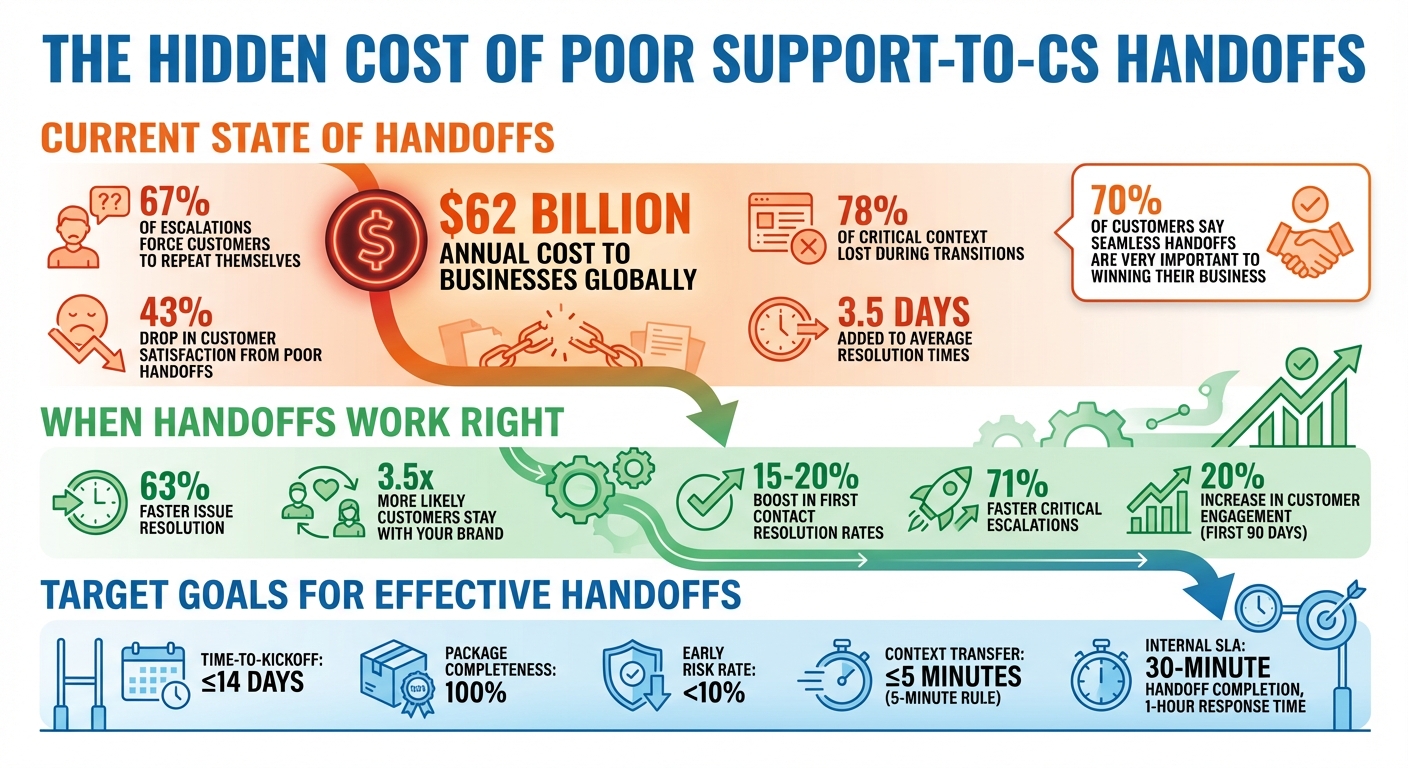
The Cost of Poor Support-to-CS Handoffs: Key Statistics and Impact
Mastering the Perfect Customer Success Handover
What You Need for Effective Support-to-CS Handoffs
Smooth handoffs rely on capturing essential data, organizing it for quick access, and maintaining a unified view of the customer. Without these elements, your CS team is left to piece things together from scratch – wasting time and frustrating customers. Let’s break down the essentials.
What Information to Capture and Transfer
To ensure a seamless handoff, focus on transferring the most critical details. Start with an issue summary and timeline: what happened, when it happened, and what’s already been done. Add customer sentiment and urgency – is the customer frustrated, confused, or simply curious? Don’t forget the business impact assessment, such as revenue at risk (e.g., "$50,000/day"), and technical environment specifics like API versions or integrations.
Human factors are just as important. Include a stakeholder map identifying decision-makers, technical contacts, and other key players. Document any commitments or deadlines, such as promised resolution times or follow-up schedules. For added context, share usage and adoption data: which features they rely on, their main use cases, and any technical architecture diagrams.
Here’s an example: Hireology, a SaaS company, introduced a standardized handoff process in 2024, requiring specific Salesforce fields to capture critical customer info. The results? A 20% boost in customer engagement during the first 90 days, 15% better revenue retention, and a 25% cut in onboarding time.
"Having the right customer information from the start is one of the keys to unlocking a successful onboarding experience. It allows you to personalize the journey and proactively address any obstacles." – Donna Weber, Author of Onboarding Matters
How to Organize Customer Data for Quick Action
Don’t make your CS team dig through endless tickets to find what they need. That’s where the 5-Minute Rule comes in: if it takes longer than five minutes to transfer context, automate it with AI summaries. Use standardized inputs like dropdowns, tags, and mapped fields instead of free-text notes to keep data consistent and easy to search.
Once the data is captured, it needs to be organized for immediate action. AI-generated handoff briefs can condense issue history, sentiment analysis, and technical details into a format your CS team can absorb in minutes, not hours. Visual tools like ticket pipelines can further streamline the process by breaking down handoffs into clear stages – Kickoff, Training, Go-Live – so teams can monitor progress and identify bottlenecks at a glance. To ensure nothing falls through the cracks, set up systems that block case progression if mandatory fields are missing.
Why Unified Customer Context Matters
When systems are disconnected, 78% of context can get lost during transitions. A unified customer view solves this by consolidating support tickets, call recordings, chat logs, and CRM data into a single chronological timeline. This approach not only speeds up issue resolution by 63% but also helps teams collaborate more effectively.
The benefits go beyond efficiency. Unified context allows support teams to spot early warning signs – like ticket spikes or negative sentiment – so CS teams can step in before customers churn. For example, if support notices the same issue cropping up repeatedly, they can alert the product team for a permanent fix while keeping customers informed. This kind of coordination bridges gaps between teams, ensuring immediate problems are resolved while long-term success is managed.
"Exposing information gaps to the customer signals incompetence, laziness, and perhaps worst, indifference." – Morgan Carson, ChurnZero
A well-executed handoff can make customers 3.5 times more likely to stay with your brand. On the flip side, poor transitions add an average of 3.5 days to resolution times and can slash customer satisfaction by 43%. The solution isn’t more documentation – it’s creating a structured process that transfers ownership, accountability, and complete context in one seamless move.
Building Workflows and Triggers for Team Handoffs
The difference between a seamless handoff and a chaotic one often boils down to timing and clear ownership. Without defined triggers and responsibilities, cases can linger unresolved, frustrating customers and wasting team resources. Automating workflows with precise triggers ensures cases are routed promptly and with accountability.
When to Move a Case From Support to CS
Not every support ticket needs to escalate to Customer Success (CS). The key lies in setting system-driven criteria to eliminate guesswork. For example, cases can escalate automatically when AI detects repeated customer frustration or a sentiment score of -40 or lower. Similarly, a 3x surge in ticket volume over seven days may indicate onboarding issues or product misalignment – problems that demand a CS check-in within 24 hours.
Certain technical issues, like "API errors" or "integration failures", should trigger routing to engineering or specialized support within 30 minutes. For high-value accounts, negative sentiment should prompt an immediate check-in from an executive sponsor, while standard protocols can handle lower-value accounts. If a case remains unresolved after 24 hours, an automated alert should notify CS.
Another often-missed warning sign is "radio silence" – accounts with no support interactions for over 60 days. While this might seem like a positive, it could signal disengagement. A proactive outreach from CS at this stage can help identify and address churn risks before they escalate.
How to Assign Clear Ownership and Responsibilities
Clear ownership is the backbone of effective handoffs. Every stage of the customer journey should have a single accountable role. When ownership is ambiguous, handoffs fail 73% more often. For example, support teams should manage active tickets, CS teams handle onboarding and renewals, and engineering should take over escalations requiring product fixes.
To maintain accountability, use role-specific CRM fields like "Support Owner", "AE Owner", and "CSM Owner" instead of overwriting a generic "Owner" field. This approach preserves historical data and avoids confusion when accounts change hands. For instance, when a CSM takes over from support, the system should update the "CSM Owner" field while retaining the original "Support Owner" for attribution purposes.
Assigning a Directly Responsible Individual (DRI), such as a RevOps manager, ensures handoffs happen on time and follow protocols. System guardrails can also prevent case progression if critical information, like the "Primary Point of Contact", is missing. Finally, always conduct "warm handoffs" by introducing the new team member to the customer by name and role to maintain trust during the transition.
"When ‘Who is responsible for this account right now?’ is anyone’s guess, no one does." – SlyOrange
Setting SLAs Between Support and CS Teams
Service-level agreements (SLAs) aren’t just for customers – they’re essential for internal handoffs too. Without clear timelines, cases can stall, leaving customers feeling neglected. Defined roles paired with strict SLAs ensure responsibilities are met and cases move efficiently. A strong SLA framework might include a 30-minute window for completing handoffs and a 1-hour response time from the receiving team.
Automation is crucial for enforcing SLAs. For instance, if Support fails to transfer context within 30 minutes, a notification should alert the Support lead. Similarly, if CS doesn’t respond within an hour, the CS manager should be notified. Automating these alerts eliminates manual follow-ups and keeps the process moving smoothly.
AI-driven triggers can also prioritize high-stakes accounts based on urgency, sentiment, and business impact. And don’t forget the 5-Minute Rule for context transfer: the faster you can transition customers between teams without losing important details, the better their experience – and your retention rates will reflect it.
Using AI to Automate and Improve Handoffs
AI is changing the way teams handle transitions, turning what used to be manual and time-consuming into smooth, automated workflows. By capturing detailed case histories, analyzing customer sentiment, and intelligently routing cases, AI ensures that customers don’t have to repeat themselves and teams can jump in with full context.
AI Case Summaries and Sentiment Analysis
AI-generated summaries make handoffs faster and more effective. These summaries include key details like issue timelines, previous solutions, technical specifics, and the overall business impact. Instead of spending hours piecing together a case history, teams get a 3.2-minute brief, dramatically reducing the delays that typically stretch resolution times by an additional 3.5 days. This matters because, without these tools, 78% of important context is often lost during transitions.
Sentiment analysis takes this a step further by gauging customer emotions. AI systems can pick up on frustration in messages. For instance, when a high-value account’s sentiment score drops below -40, the system immediately escalates the case to a Customer Success (CS) leader. This proactive approach helps prevent churn, especially since 67% of escalations currently require customers to repeat their issues to a new representative.
"Great service is about how you make customers feel. The head is where we started, but now we’re teaching Agentforce to have heart." – Bernard Slowey, Senior Vice President of Digital Customer Success, Salesforce
This combination of speed and insight ensures escalations are handled intelligently, with no critical details slipping through the cracks.
Automated Escalation and Handoff Alerts
AI doesn’t just summarize – it acts. By monitoring multiple factors like sentiment, elapsed time, account value, and issue complexity, AI ensures urgent cases are flagged and escalated precisely when needed. For example, if a case remains unresolved for 24 hours, shows three instances of negative sentiment, and involves an enterprise account, the system automatically marks it as critical and alerts the appropriate CS manager.
AI also improves case routing by matching tickets to the most qualified expert based on past performance. If the issue involves API integration, the system identifies which technical Customer Success Manager (CSM) has solved similar problems most efficiently and routes the case accordingly. This targeted approach boosts First Contact Resolution rates by 15-20% and speeds up critical escalations by 71%.
How AI Flags Critical Customer Details
AI doesn’t just focus on the big picture – it hones in on the details that matter most. It tracks specific promises made by agents and highlights business impacts, like the number of users affected ("500 users impacted"). These details are automatically included in handoff briefs, ensuring nothing gets overlooked.
In more specialized scenarios, like regulatory compliance or financial advice, AI knows when to step back. It triggers a handoff to a human expert before providing incomplete or insufficient information. This prevents the frustrating cycle where customers have to repeat their concerns. Companies that use unified customer context during handoffs resolve issues 63% faster. Considering poor handoffs cost businesses around $62 billion annually, the value of these AI-driven improvements is undeniable.
sbb-itb-e60d259
Common Handoff Mistakes and How to Fix Them
Handoffs often run into predictable issues, even when everyone has the best intentions. The upside? Most of these problems can be addressed with the right tools and processes.
Incomplete or Missing Documentation
When important details are left out – like client preferences, technical setups, or unresolved needs – Customer Success (CS) teams often find themselves starting from scratch. This forces them to ask questions the customer has already answered.
The solution? Use standardized checklists to ensure all critical information is captured. This includes customer goals, challenges, technical configurations, contract details, and overall sentiment. If your CRM supports it, add validation rules that flag incomplete handoffs and stop the process until all required fields are filled. For more nuanced details – like whether a primary contact is frustrated or optimistic – integrate a sentiment field into your handoff template. Here’s a staggering stat: 78% of customer context is typically lost during transitions.
"Nobody likes to repeat themselves. … If your customers had extensive discussions with Sales about their needs, goals, and expectations, they (reasonably!) expect their CSM to know a little about it too." – Kate McBee, Senior Director of Customer Success, ESG
Unclear Next Steps or Ownership
Another common issue is a lack of clarity about what happens next. Handoffs often fail when no one knows who’s responsible for the next step. This "handoff drop" – where one team essentially says, "It’s your job now" – leaves customers feeling uncertain and erodes trust. In fact, 70% of customers who value seamless processes feel disappointed when this happens.
The fix? Assign a Directly Responsible Individual (DRI) for every handoff. Instead of overwriting a single "Owner" field in your CRM, use separate fields like "Support Owner" and "CS Owner" to maintain accountability. Establish internal SLAs (service-level agreements) to keep things on track – like transferring context within 30 minutes and contacting the customer within 24 hours. Automate task assignments in your CRM so that as soon as a case moves to CS, onboarding or follow-up tasks are triggered automatically.
Ignoring Customer-Specific Context
Generic handoffs that ignore individual customer needs are another major pitfall. When teams operate in silos, they lose "tribal knowledge" – the informal but vital insights about stakeholder preferences, communication styles, and specific challenges that don’t always make it into CRM fields. This is a costly oversight: 53% of businesses cite silos as a top barrier to improving customer experience, and 85% of customers expect consistent communication across teams.
To address this, create account maps that highlight key stakeholders, including decision-makers and product advocates. This gives the CS team a clear understanding of the customer’s internal structure without needing to ask. Before the customer-facing kickoff, schedule a quick internal sync where the outgoing team shares undocumented insights – like a key contact’s preferred communication style or any unspoken concerns. Personalized, informed handoffs go a long way, especially when 83% of customers are more loyal to companies that maintain consistency across departments.
Here are some key customer details to capture:
| Information Category | Key Details to Capture |
|---|---|
| Customer Overview | Name, title, sentiment, business size |
| Solution Context | Pain points addressed, tools being replaced, features of interest |
| Goals & Milestones | Desired outcomes, success metrics, ideal timelines |
| Technical Details | Product integrations, configurations, opt-outs |
| Stakeholders | Decision-makers, champions, technical contacts |
How to Measure and Improve Handoff Quality
Once you’ve set up smooth handoff processes, the next step is figuring out how well they’re working. Measuring the quality of your handoffs is key to refining them over time. Start by monitoring Time-to-Kickoff – the time it takes from initiating a handoff to when the Customer Success (CS) team takes their first action. Aim for this to be 14 days or less. Another critical metric is Handoff Data Completeness, which tracks whether all required fields are filled out. Many teams enforce 100% completion as a rule, meaning the next step can’t proceed until every field is populated. These metrics lay the groundwork for improving your process.
Customer feedback is just as important. Use post-handoff CSAT surveys to ask customers directly if they had to repeat information or felt like they were starting over. Also, keep an eye on First Contact Resolution (FCR) rates after handoffs. Teams that excel at transferring context often see a 15-20% boost in FCR because agents have all the details they need to address issues right away. Another key metric is the Early Risk Rate, which flags accounts showing signs of trouble – like health concerns or churn risks – within the first 30 days after a handoff. Keeping this rate below 10% is a strong indicator your process is on track.
"You cannot improve what you do not measure. Good human agent handoff plans are based on data." – Jegan Selvaraj
To keep improving, set up weekly feedback loops between Support and CS teams to identify recurring issues, such as missing documentation or unclear responsibilities. Assign a RevOps owner to review 3–5 handoffs per week to check for SLA compliance and ensure data quality. Leverage AI tools like sentiment analysis to scan Slack messages, emails, and tickets for tone changes that might signal a failed handoff. For example, if 67% of escalations involve customers repeating themselves, you’ve uncovered a gap that needs fixing.
Handoffs should be treated as a living process. Schedule monthly retrospectives to review metrics like Agent Handle Time (AHT) post-handoff and SLA adherence. If your Early Risk Rate starts climbing, investigate what’s missing in the handoff package. The goal isn’t to get everything perfect right away – it’s to build a system of constant measurement, feedback, and improvement that evolves alongside your team and customers.
| Metric | Purpose | Target Goal |
|---|---|---|
| Time-to-Kickoff | Measures speed of transition | ≤ 14 days |
| Package Completeness | Confirms all essential customer data is transferred | 100% |
| Early Risk Rate | Identifies handoff failures | < 10% |
| AHT Post-Handoff | Shows if context was transferred effectively | Low AHT = effective handoff |
| CSAT on Handed-Off Interactions | Tracks customer satisfaction after transition | High scores = seamless experience |
If you notice an increase in AHT, it’s often a sign that the context wasn’t transferred effectively.
Conclusion
Smooth handoffs between Support and Customer Success are essential for keeping customers happy and protecting revenue. Poorly managed transitions can cost businesses a staggering $62 billion annually. When context is lost, customers are left repeating themselves – right when you should be earning their trust. Thoughtfully designed handoffs avoid this frustration, keep things moving during critical transitions, and show customers that their time is valued.
The solution? Use AI to automate context transfer, preserve customer sentiment, and ensure no detail slips through the cracks. Tools like AI-driven case summaries, sentiment analysis, and automated escalation alerts cut down on repetitive tasks and safeguard essential information. Pair these technologies with clear ownership rules, internal SLAs, and a unified customer view, and you’ll create a system that not only resolves issues 63% faster but also strengthens the relationships that drive retention and growth. Unified customer context and clear ownership, as covered earlier, are the foundation of these efficient handoffs.
"70% of customers say connected processes – such as seamless handoffs – are very important to winning their business." – Custify
AI doesn’t just streamline operations; it lays the groundwork for ongoing improvement. Track post-handoff CSAT scores and set up weekly feedback loops to quickly spot and fix any issues. Let data – not guesswork – guide the evolution of your handoff processes.
Teams that master this approach don’t just work faster; they turn handoffs into opportunities to build trust, showcase expertise, and create customer experiences that inspire loyalty. And if transferring context takes more than 5 minutes, let AI take over.
FAQs
How can AI streamline handoffs between Support and Customer Success teams?
AI makes the handoff process between Support and Customer Success (CS) teams much smoother by automating the transfer of essential customer information. Instead of customers having to repeat themselves, AI ensures CS teams have access to key details like support history, sentiment analysis, and account activity – all delivered seamlessly.
It doesn’t stop there. AI can sync with existing systems to provide real-time updates, including full conversation histories and actionable insights. This helps maintain context and fosters better collaboration between teams. Plus, AI can flag accounts that might be at risk, prioritizing them based on support-related signals. This allows CS teams to step in proactively, improving efficiency while offering a more tailored and positive experience for customers.
What details should be included in a handoff to ensure customers don’t have to repeat themselves?
To ensure a smooth transition between Support and Customer Success teams, it’s crucial to provide all the necessary customer details to maintain context and avoid making the customer repeat themselves. Include the customer’s name, contact information, account history, and a brief summary of their current issue or request. Don’t forget to highlight any recent interactions, stated preferences, or unresolved concerns.
Including escalation notes, sentiment insights, and a summary of actions already taken or suggested ensures the next team member can pick up right where the last left off. Using AI tools can simplify and automate this process, ensuring the information is accurate and shared effortlessly. A well-executed handoff not only saves time but also improves the customer experience by sparing them from unnecessary repetition.
How can automated workflows and triggers improve handoffs between Support and Customer Success teams?
Automated workflows and triggers make team handoffs smoother by ensuring all essential customer information flows effortlessly between teams. This prevents situations where customers have to repeat themselves, creating a better experience for them while saving your team valuable time.
Tasks like sharing data, tracking sentiment, or summarizing escalations can be automated, keeping the next agent or team in the loop. This approach not only increases efficiency but also helps deliver a consistent and tailored customer experience.