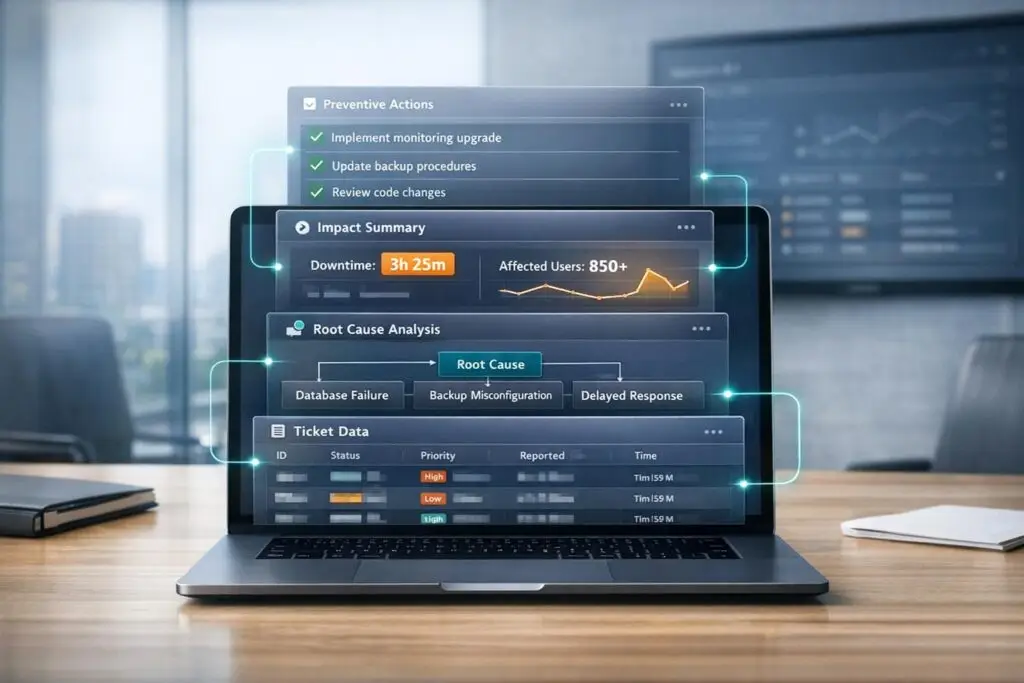
When something goes wrong, customers want more than a solution – they want answers. A Root Cause Analysis (RCA) document explains why an issue occurred and outlines steps to prevent it from happening again. By turning raw ticket data into a polished RCA, you can build trust and show accountability.
Key Steps to Create a Customer-Ready RCA:
- Start with Ticket Data: Use fields like issue type, severity, timestamps, and conversation logs to understand the problem.
- Clean and Organize: Standardize tags, remove duplicates, and normalize data for accurate analysis.
- Analyze for Root Causes: Use methods like the "Five Whys" or AI tools to identify patterns and underlying issues.
- Structure the RCA Document: Include sections like an executive summary, customer impact, root cause analysis, and action plan.
- Keep It Clear: Use simple language, avoid technical jargon, and incorporate visuals like timelines or diagrams for clarity.
Pro Tip: AI tools can speed up data preparation, detect patterns early, and automate parts of the RCA process, saving time and improving accuracy.
An RCA document isn’t just about resolving issues – it’s a tool to communicate accountability and prevent future problems.
AWS re:Invent 2025 – Mastering Root Cause Analysis: Rebuilding trust after outages (ARC211)
sbb-itb-e60d259
Preparing and Normalizing Ticket Data
To analyze ticket data effectively, you first need to clean up inconsistencies. Raw data often contains messy tags, duplicate entries, and vague free-text fields – all of which can skew your analysis.
Extracting the Right Ticket Data Fields
Focus on pulling fields that explain what happened, who was impacted, and when. The most useful fields usually include:
- Issue type
- Customer account and segment
- Ticket severity
- Timestamps (opened, first response, resolved)
- Conversation logs
- CSAT scores
- Linked problem IDs [6][5]
Pay special attention to the free-text log. While it’s often overlooked, this field captures the customer’s exact wording, which is crucial for "bottom-up" analysis. Similarly, linked problem IDs are key for grouping tickets that may appear unrelated but stem from the same underlying issue [6][2].
Clean, well-structured data is the backbone of accurate root cause analysis.
Cleaning and Normalizing Your Data
After extracting the necessary fields, the next step is to make the data consistent. This involves standardizing tags, merging duplicate entries, and aligning severity ratings that might have been applied differently by various agents or over time. Without this step, your metrics can become misleading and obscure meaningful trends [6].
From the outset, align your tagging system with your root cause analysis (RCA) goals. The table below highlights how different goals influence your data preparation focus:
| RCA Goal | Data Normalization Focus |
|---|---|
| Reduce costs | Pinpoint topics driving refunds or cancellations [6] |
| Improve CSAT | Examine themes in customer satisfaction feedback [6] |
| Minimize ticket volume | Identify FAQs and common struggles for knowledge bases [6] |
| Product improvement | Monitor customer reactions to new features [6] |
Avoid forcing data into overly broad categories like "billing issue" or "feature request." These buckets often mask the specific sub-themes driving ticket volume. A discovery-based approach – letting themes emerge from the data – reveals issues you might not have anticipated [2].
Once your tagging taxonomy is standardized, you can explore automating the data preparation process.
Using AI to Speed Up Data Preparation
Automation can significantly cut down the time spent on data preparation. For example, Matthew Schoolfield, Senior Customer Insights Analyst at Greyhound, shared that before adopting automated ticket analysis, manual work consumed 80% of his time. After integrating automation, his team reduced overall time spent by 50% and slashed analytics time tenfold. This efficiency allowed them to tackle a backlog of four research projects [2].
AI tools can handle the most time-intensive tasks, such as:
- Tagging tickets by topic and sentiment
- Clustering similar issues
- Summarizing conversation threads
For reliability, ensure these tools link themes back to the original text. This traceability is crucial for building trust in AI-prepared data, especially when it serves as the foundation for a customer-facing RCA [2][7].
"By identifying the true root cause of support conversations and CSAT feedback, you’re able to better train agents and better equip them to quickly and diligently solve the issue." – Sharad Khandelwal, Founder & CEO, SentiSum [6]
Analyzing Ticket Data to Find Root Causes
Digging into ticket data can reveal the underlying issues that drive customer complaints. This step builds on the normalized data you’ve prepared earlier and lays the groundwork for creating a polished, customer-ready Root Cause Analysis (RCA) document.
Defining the Problem and Its Scope
Before diving into analysis, you need a clear problem statement. Are you investigating a major outage, or are you looking into a recurring pattern of complaints? Each requires a tailored approach to uncover the root cause.
Set a specific goal to guide your analysis. For example, instead of vaguely aiming to reduce ticket volume, focus on something like: "Identify the top three drivers of login-related contacts among new users in Q1." This level of focus ensures your RCA methods align with actionable outcomes. Segment your data to zero in on problem areas – break it down by customer tenure, region, or support channel. For instance, new users might struggle with onboarding or navigation, while long-term customers could face integration or API-related challenges [4][5].
To spot real trends, analyze at least six months of ticket history. Shorter timeframes can exaggerate anomalies – what looks like a systemic issue might just be a bad week [4].
"Every repeated ticket is a failure of product, docs, or onboarding. You’re treating symptoms, not root causes." – BuildBetter Documentation [4]
Involve stakeholders from product or engineering teams early in the process. As Ed Deason, former Director of Experience at Pret A Manger, advises:
"The number one rule of getting other teams to listen and act on your findings is to bring them in early and make them feel like their needs are being met." [6]
Once you’ve clearly defined the problem, you can use structured frameworks to guide your analysis.
RCA Frameworks You Can Apply
The Five Whys method is a simple yet effective tool for ticket-based RCA. Start with a surface-level symptom – like "customers can’t log in" – and dig deeper by asking why repeatedly. For example, this process might reveal that a recent homepage redesign moved the login button without adequate user testing. This kind of insight pinpoints actionable root causes [6].
Using AI to Detect Patterns in Ticket Data
While manual analysis is valuable, AI can take your insights to another level by identifying patterns you might miss. Traditional methods often detect issues only after they become widespread. AI-driven semantic clustering, however, groups tickets by meaning rather than keywords. For example, "authentication failure" and "can’t log in" would automatically be grouped together, helping you identify emerging trends faster [2].
AI has a practical edge: it can flag issues when they’re mentioned by just 0.5% of users, long before traditional dashboards, which often require a 5% threshold to register the problem. By the time manual methods catch up, the damage to customer experience might already be done [2].
| AI Capability | Benefit for RCA | Impact |
|---|---|---|
| Semantic Clustering | Groups tickets by intent rather than keywords | Detects issues at a 0.5% mention rate [2] |
| Automated Tagging | Eliminates manual categorization bias | Saves ~4,250 manual hours/year [2] |
| Deflection Matrix | Ranks fixes based on volume and effort | 20–30% ticket volume reduction in 60–90 days [4] |
Tools like Supportbench’s AI automation streamline the process by handling tagging, issue classification, and case summaries. This frees your team to focus on solving problems instead of sorting through data. When patterns emerge, the detailed ticket history is ready to help you trace issues to their origins, making it easier to act quickly and effectively.
How to Structure a Customer-Ready RCA Document
Once your analysis uncovers actionable findings, the next step is presenting them in a clear, customer-friendly format. A well-structured report transforms raw data into a reliable and effective communication tool.
The Key Sections of an RCA Document
A customer-ready RCA document should address three critical questions: What happened? Why did it happen? What steps are being taken to resolve it? [8].
"If a reader cannot answer three questions quickly, it is too vague: what happened, why it happened, and what is being done about it." – Sologic [8]
Here’s a suggested structure to follow:
| Section | Purpose | What to Include |
|---|---|---|
| Metadata | Sets the investigation context | Incident date, investigation dates, team members, and their roles |
| Executive Summary | Summarizes the issue and resolution | A brief overview of the problem and key solutions |
| Customer Impact | Outlines the real-world consequences | Documentation of the actual impact and any potential disruptions |
| Root Cause & Contributing Factors | Explains the underlying issues | A fact-based narrative tracing the causal chain, avoiding superficial symptom descriptions |
| Action Plan | Details corrective measures | Specific tasks to prevent recurrence, including responsible parties, deadlines, and measurable success criteria |
Each section should logically lead into the next. For example, the Action Plan must directly tie each corrective action to the corresponding root cause. This structure helps ensure transparency and builds trust with your customers.
Writing with Clarity and the Right Tone
Keep the language clear, objective, and free of technical jargon or defensive phrasing. Instead of saying, "the engineering team made a mistake during deployment," opt for something like, "the system failed to handle the surge due to a logic error in the rate-limiting configuration." This approach separates facts from opinions, which is essential for maintaining the report’s credibility [8].
Before sharing the document, have your investigation team review it. This ensures the tone is consistent, the grammar is polished, and the facts are accurate. A well-reviewed report strengthens your communication and reinforces customer confidence [8].
Adding Visual Aids to Support Your Findings
Visual elements can make complex information easier to understand and more engaging. Consider using tools like timelines, Fishbone diagrams, or trend-quote visuals to illustrate the sequence of events and their impact [3][1][6]. For leadership summaries, include a cause-and-effect chart in the main body and provide more detailed visuals in an appendix. This keeps the report concise while preserving in-depth analysis for those who need it.
Using AI-Native Support Tools to Build RCAs Faster
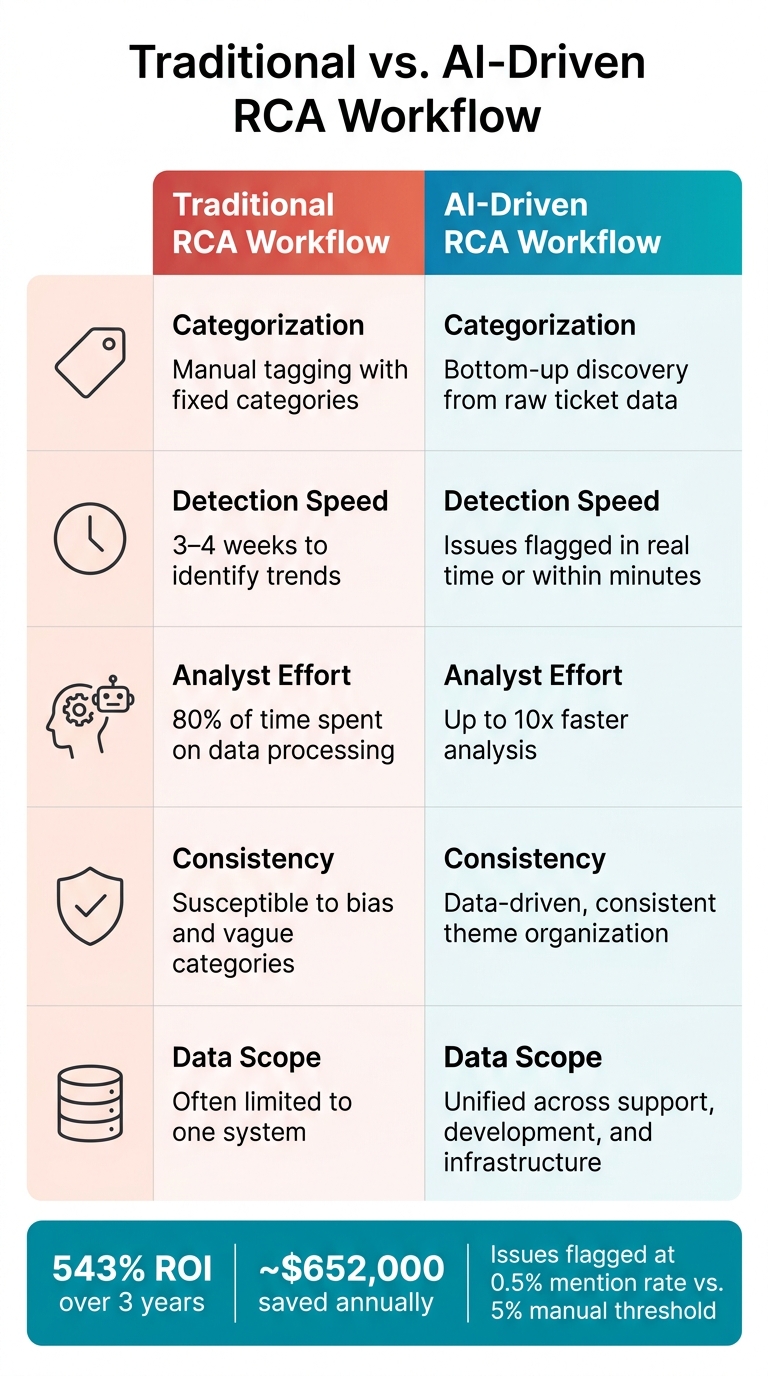
Traditional vs. AI-Driven RCA Workflow: Speed, Accuracy & Efficiency
How AI Automates Key Parts of the RCA Workflow
Creating a Root Cause Analysis (RCA) manually can take up to 80% of an analyst’s time, leaving less room to actually address the issues at hand [2]. AI-native platforms are changing the game by automating the most time-intensive parts of the process, providing faster and more actionable insights.
AI enhances streamlined data preparation by offering bottom-up theme discovery – analyzing every ticket and identifying patterns based on the language customers use. This means you can uncover problems you didn’t even know existed. With AI, emerging issues can be flagged much earlier than traditional dashboards, which often require a significant volume of mentions before detection is possible [2].
"By the time a problem reaches 5% in a manual system, you’ve already lost customers over it." – Kyo Zapanta, Thematic [2]
AI doesn’t stop at detection. It can also automatically piece together incident timelines by synchronizing data from various systems. For example, it can link deployment events to spikes in complaints, making it easier to trace symptoms back to their root causes [3]. This level of automation ensures your data is organized and ready for analysis, speeding up the RCA process while fostering greater transparency – an essential factor for maintaining customer trust.
Traditional RCA Workflows vs. AI-Driven RCA Workflows
The gap between manual and AI-driven RCA workflows is striking, with AI offering significant improvements in speed, accuracy, and efficiency:
| Dimension | Traditional RCA Workflow | AI-Driven RCA Workflow |
|---|---|---|
| Categorization | Manual tagging with fixed categories [2] | Bottom-up discovery from raw ticket data [2] |
| Detection Speed | 3–4 weeks to identify trends [2] | Issues flagged in real time or within minutes [2] |
| Analyst Effort | 80% of time spent on data processing [2] | Drastically reduced analysis time – up to 10x faster [2] |
| Consistency | Susceptible to bias and vague categories [2] | Data-driven, consistent theme organization [2] |
| Data Scope | Often limited to one system [3] | Unified across support, development, and infrastructure [3] |
These improvements highlight how AI can fundamentally change the way RCAs are performed. According to a Forrester study, AI-powered feedback analytics platforms can achieve a 543% ROI over three years, saving about $652,000 annually by automating thousands of hours of manual work [2]. This isn’t just an incremental improvement – it’s a complete rethinking of how RCA tasks are handled.
Feeding RCA Findings Back into Your Support Operations
AI doesn’t just speed up RCA creation; it ensures the insights gained are put to good use. The real advantage lies in applying these findings to prevent similar issues from recurring.
Once the RCA is complete, its insights should seamlessly integrate into your support operations. For example, you can update your knowledge base with articles addressing the root causes. Tools like Supportbench’s AI can even draft these articles for you, automatically filling in details like the subject, summary, and keywords based on case history. You can also refine ticket workflows and set up automation rules to detect similar patterns earlier. If a specific issue type caused a surge in tickets, you can create a detection rule to alert your team the next time it starts trending.
"The person who recognizes a pattern often isn’t the person who documented the previous incident. It’s someone who worked on a related problem in a different part of the stack." – Unito [3]
This process – moving from incident to RCA to actionable change – is what separates teams that repeatedly face the same problems from those that actively reduce them. AI-native platforms make this transition faster and more reliable by keeping RCA findings tied to their original data. This ensures every operational update is based on evidence, not assumptions.
Conclusion: How Accurate RCA Documentation Builds Customer Trust
An effective RCA document does more than just detail what went wrong – it shows customers that your team is committed to making sure it doesn’t happen again. This shift from simply closing tickets to taking accountability is what sets apart support teams that keep customers loyal from those that don’t.
Creating accurate RCA statements starts with clean, reliable ticket data and a well-defined problem. Frameworks like the Five Whys help dig deeper, moving past surface-level symptoms to uncover the real issue. The strength of your root cause statement hinges on the quality of your evidence – every conclusion should connect directly to actual ticket data, not assumptions or pre-set categories.
"If you can’t see how a theme was constructed or which tickets contributed to it, it’s hard to defend a root cause finding to a product team or an executive." – Thematic [2]
AI-powered tools can identify issues at a 0.5% mention rate – long before manual systems would catch them. This ensures clear, evidence-based documentation that reaches customers quickly. Such a proactive approach strengthens the trust customers place in your support team.
Moments of crisis are opportunities to build trust. By relying on precise data and thoughtful analysis, your RCA becomes a vital tool for reinforcing customer relationships. A transparent, data-driven RCA document reflects true accountability and a commitment to preventing future problems.
FAQs
What ticket fields do I need for an RCA?
To craft an effective RCA document, gather data from 6–12 months of closed tickets with standardized fields. Focus on including both the ticket content – such as descriptions, messages, and responses – and metadata like creation dates, resolution times, customer IDs, and customer segments.
Be sure to incorporate categorical data like tags, priority levels, and product areas, alongside technical details such as device type, operating system, browser, and error codes. Don’t forget to include attachments or logs, as these provide crucial evidence for a thorough analysis.
How do I prove the root cause with ticket evidence?
To establish a root cause using ticket evidence, rely on raw data as your primary source of truth and make sure every claim can be traced back to it. Compile an evidence bundle that includes log excerpts, ticket records, and chat history. Construct a timeline that connects incident spikes to system changes. Ensure every critical statement in your root cause analysis (RCA) references a specific artifact, such as a log query. Any claims without direct citations should be clearly identified as hypotheses.
When should I use AI for RCA vs manual analysis?
AI can streamline tasks such as recognizing ticket patterns, detecting emerging trends, and creating RCA (Root Cause Analysis) summaries from raw data. Its strength lies in processing information quickly and identifying semantic links that might be overlooked with manual methods.
However, manual analysis still plays a critical role in ensuring accuracy. Always review AI-generated outputs, validate its findings with concrete evidence like logs or chat records, and use techniques like the 5 Whys to arrive at conclusions that are both practical and systemic.