Customer portals and email support each serve different needs in B2B customer service. Here’s the bottom line:
- Customer portals are cost-effective (as low as $0.25 per interaction) and great for routine tasks like tracking orders, retrieving invoices, or updating account details. They scale easily and reduce workload for support teams.
- Email support is better for complex issues requiring human judgment, like negotiating contracts, handling custom pricing, or solving intricate problems. It offers flexibility, preserves conversation history, and enables personalized communication.
The challenge? Picking the right channel for the right situation. While portals save money, they can frustrate users if poorly designed or overloaded with irrelevant content. On the other hand, email provides a human touch but is far more expensive ($15–$25 per interaction).
Quick Tip: Combining both channels with AI tools – like predictive satisfaction scoring, automated ticket summaries, and real-time data integration – can improve efficiency and customer satisfaction. The key is balancing automation for simple queries with human expertise for nuanced problems.
Quick Comparison:
| Feature | Customer Portals | Email Support |
|---|---|---|
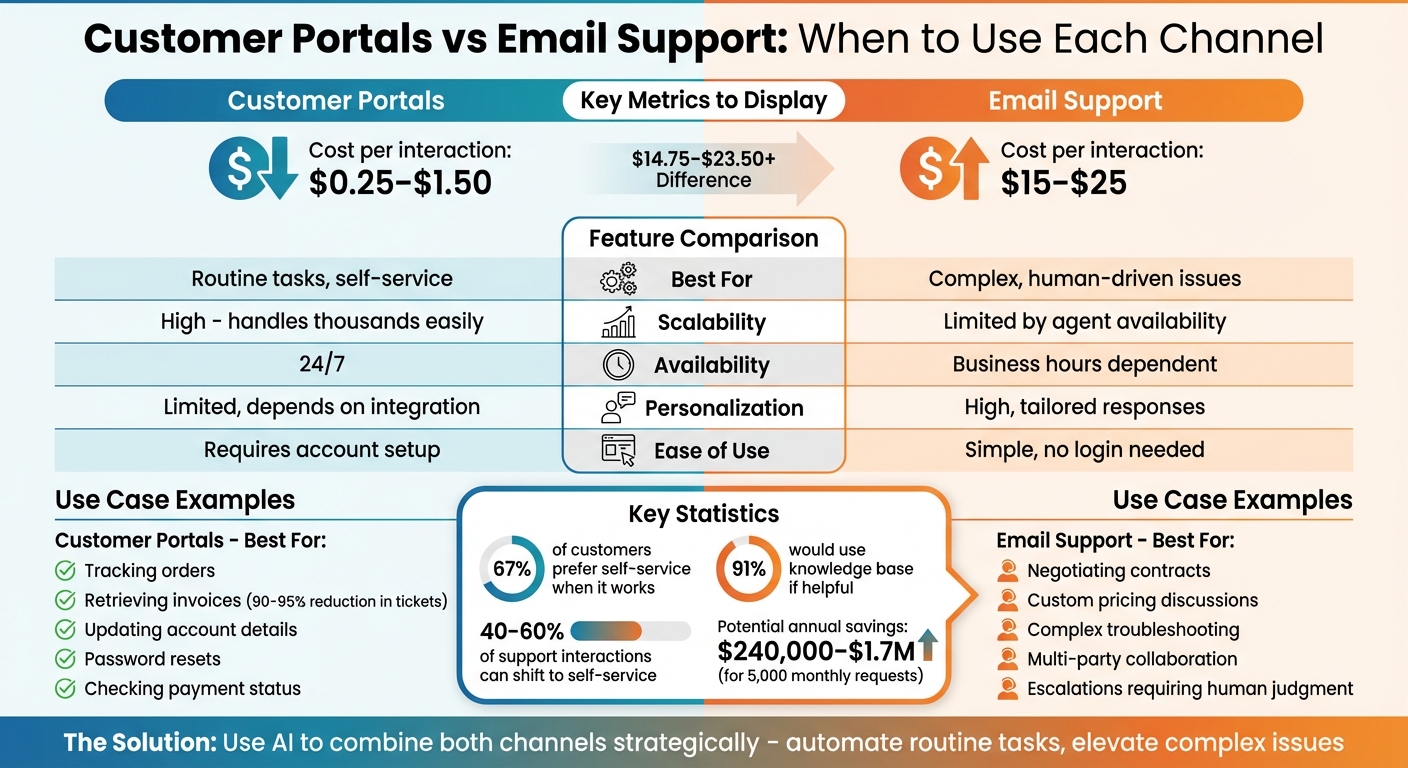
| Cost per interaction | $0.25–$1.50 | $15–$25 |
| Best for | Routine tasks, self-service | Complex, human-driven issues |
| Scalability | High, handles thousands easily | Limited by agent availability |
| Personalization | Limited, depends on integration | High, tailored responses |
| Availability | 24/7 | Depends on business hours |
| Ease of use | Requires account setup | Simple, no login needed |
Using both channels strategically ensures cost savings without sacrificing quality. AI can help bridge the gap, making both options more effective.
Customer Portals vs Email Support: Cost, Scalability, and Use Cases Comparison
Customer Portals vs Email Support: Definitions
What Are Customer Portals?
A customer portal is a secure, web-based platform designed to give users a personalized, centralized way to interact with a company. Instead of relying on email exchanges, customers can log in to handle tasks like managing accounts, tracking support tickets, and accessing self-service tools. In B2B settings, portals become even more essential, offering features like tracking project milestones, managing tier-based pricing, downloading invoices, and securely accessing critical documents such as contracts and reports. A standout feature for businesses is "Customer Groups", which lets multiple employees from the same company view shared tickets and account details. This ensures smooth collaboration, even when different team members are involved.
What makes portals so effective is their integration with systems like CRM, ERP, and billing platforms. These connections provide real-time updates on things like order status, inventory levels, and account balances. For instance, customers can check the progress of an order or review their credit limits without waiting for assistance. Modern portals are evolving beyond simple navigation menus, focusing instead on task-specific functionality – like tracking shipments or updating account preferences.
While portals excel in providing seamless, integrated account management, they are best paired with email support for more nuanced, human-driven interactions.
What Is Email Support?
Email support complements customer portals by offering a flexible, asynchronous way for customers to communicate with a business. Customers send inquiries to a designated email address, and support agents respond with solutions or requests for further details. Unlike live chat or phone calls, email doesn’t require immediate back-and-forth, allowing customers to reach out on their own schedule while agents work through requests in the order they’re received.
This method is ideal for detailed troubleshooting, as it enables a one-on-one exchange where agents can address specific issues thoroughly. Plus, email creates a permanent, searchable record of conversations, which helps reduce misunderstandings and provides a clear history of commitments and resolutions. Agents can also collaborate internally to craft more complete responses before replying. Another advantage? Email is simple for customers – there’s no need to create an account or remember a password. They just hit "reply" and explain their problem.
Knowing how customer portals and email support function helps businesses determine the right balance between automated, immediate assistance and personalized, human-led problem-solving in B2B operations.
sbb-itb-e60d259
When Customer Portals Beat Email Support
Lower Costs and Better Scalability
Customer portals offer a clear edge over email support when it comes to cutting costs. Self-service interactions cost between $0.25 and $1.50 each, while email support – often requiring 3-5 back-and-forth messages, plus agent preparation and quality checks – can cost $15 to $25 per ticket [5]. For a B2B company managing 5,000 support requests a month, moving just 40% of those to a self-service portal could save anywhere from $240,000 to $1.7 million annually [5]. Portals streamline the process by allowing customers direct access to their own data, eliminating the need for agent intervention.
"Every question that self-service resolves saves $10-$70 compared to the same question reaching an agent." – MatrixFlows [5]
Portals also excel at scaling. Unlike email support, which requires adding more agents as ticket volume grows, portals can handle thousands of users simultaneously without increasing staffing. For businesses operating across multiple time zones, the 24/7 availability of portals is a game changer. Features like Customer Groups further reduce ticket loads by letting employees from the same client company view shared tickets, cutting down on duplicate inquiries. Beyond saving money, portals deliver speed and efficiency, reducing operational bottlenecks.
It’s no wonder customer portals are becoming a key part of modern, AI-driven B2B support strategies.
Instant Answers for Simple Questions
One of the biggest perks of customer portals is their ability to provide instant solutions to routine issues. Tasks like resetting passwords, checking order statuses, or downloading invoices can be completed in seconds – no waiting on an email response. Research shows that 91% of customers would use an online knowledge base if it’s helpful [7], and 67% actually prefer self-service over contacting a representative [4].
Take invoice requests, for example – one of the most common B2B support inquiries. Portals can reduce these tickets by 90-95% by giving customers permanent access to their past invoices [2]. Customers can also check payment statuses, update credit card details, or download tax receipts instantly. One billing portal provider reported that automated payment features reduced the average payment time from 23 days to under 8 days [2], while saving staff 8-12 hours of work per week.
Modern portals often use passwordless authentication, like magic links sent via email, to make access seamless. This approach boosts adoption rates from 30-40% to over 75% [2], ensuring more customers actually use the portal instead of reverting to email. With routine questions handled automatically, support teams can dedicate their time to solving more complex, high-value issues.
These benefits highlight why customer portals are essential for efficient, AI-powered B2B support operations.
When Email Support Beats Customer Portals
Complex Issues That Need Human Judgment
Customer portals are great for routine inquiries, but when it comes to complex B2B scenarios, email support takes the lead. Why? Because these situations demand personalized insights and nuanced judgment. Tasks like negotiating quotes, discussing unique pricing structures, or navigating renewal terms require a human touch that portals just can’t replicate [9]. As SellersCommerce aptly puts it, "B2B e-commerce is more than just selling products online; it’s about building strong company relationships" [9].
B2B transactions often involve lengthy processes and intricate workflows, which call for more than just automated responses [9]. While portals are excellent for tasks like tracking shipments or displaying order history, they fall short when it comes to dynamic pricing or B2B account management tailored to individual clients [9].
Email fits seamlessly into customers’ daily routines without the hassle of additional logins, offering a direct and familiar way to communicate [8]. Cathy Reisenwitz, a former Capterra analyst, highlights this advantage:
"Email is faster and easier for customers to use, requiring no additional logins" [8].
This ease of use becomes particularly valuable in B2B relationships, where clients often need to escalate issues, loop in colleagues via CC, or keep their teams updated – all without switching to a new tool. And this brings us to another major strength of email support: its ability to preserve a complete conversation history.
Preserving Full Conversation History
One of email support’s standout features is its ability to maintain a detailed record of all interactions, which is crucial for managing complex, long-term issues [1]. Whether it’s resolving billing disputes or coordinating technical projects that stretch over weeks or months, email keeps every piece of context intact. Both agents and customers can easily refer back to past conversations, ensuring no critical detail is lost [1].
This continuity is vital for nurturing long-term B2B relationships, which are often described as "a lifetime of the relationship" [2]. From managing monthly retainers to handling milestone payments or renewal discussions, having access to a comprehensive email history ensures every interaction is informed by prior communications.
Email also enables seamless behind-the-scenes collaboration. Agents can forward messages to colleagues, escalate issues to specialists, or consult technical teams – all while keeping the conversation unified [8]. As customer service expert Shep Hyken points out:
"Customers today want the very best service at their fingertips. They demand quick, efficient, and personalized service" [4].
For intricate B2B issues, email delivers on this expectation by offering the personalization and continuity that portals can’t match. While portals are perfect for streamlining routine tasks, email ensures that the complexities of B2B relationships are handled with the care and attention they deserve.
Why Email Still Matters in Customer Service
When Customer Portals Fail: Common Problems
Customer portals can offer great potential, but they often stumble when they fail to align with the realities of user needs.
Frustration from Complex Account Requirements
One of the biggest pitfalls of customer portals is their inability to handle real-world complexity effectively. Statistics reveal that only 19% of customers successfully resolve issues through self-service portals, while 44% end up resorting to calling support after trying the portal first. This highlights a major design flaw that wastes both time and resources [10].
A common issue is the way portals are structured. Many are organized around internal company departments rather than the actual workflows customers need. For example, resolving a billing problem might force users to navigate between unrelated sections like "Billing", "Technical Support", and "Account Management." This setup assumes customers understand the company’s internal structure, which is rarely the case, and adds unnecessary frustration.
Another challenge is the overwhelming amount of unstructured content presented in many portals. Instead of helping, this "information overload" confuses users, especially when basic search functions only match keywords in titles or tags. For those managing enterprise accounts with multiple products and compliance requirements, finding relevant answers can feel nearly impossible.
Additionally, poor integration with CRM systems often leaves portals unable to differentiate between new users and long-term enterprise clients. This lack of personalization means they fail to recognize critical details like plan types, renewal dates, or past interactions. For accounts with multiple users or products, complex identity and access rules often lead to edge cases requiring manual intervention. These flaws not only frustrate users but also undercut the cost-saving goals of self-service portals in B2B environments.
Escalations from Generic, Impersonal Support
Generic responses from customer portals don’t just annoy users – they actively encourage escalations. When portals function as static content libraries rather than dynamic tools designed to guide users through workflows, they fail to resolve issues effectively. As Gartner notes:
"Low self-service containment often stems from portals that operate as static content repositories instead of dynamic, workflow-driven tools that guide users to resolution." [10]
The lack of personalization further damages trust, especially in B2B relationships. For instance, showing "Getting Started" guides to experienced users or ignoring specific product versions makes the portal feel irrelevant. This is a missed opportunity, especially since 91% of customers say they would use an online knowledge base if it were actually helpful [7].
Another major frustration is when portals require users to leave the platform for tasks like checking order statuses or registering for events. This disconnect often leads to abandonment, with 37% of customers calling for support before even attempting to use the portal [10]. Such experiences leave users skeptical about the portal’s ability to provide real solutions.
The consequences are clear: higher escalation rates, longer resolution times, and strained customer relationships. Instead of streamlining support, these shortcomings undermine the very purpose of self-service tools. Fixing these issues is essential to improving customer satisfaction and making better use of AI in both portal and email support systems.
Using AI to Improve Both Channels
AI is transforming customer support by refining both portals and email systems, enhancing their effectiveness without requiring businesses to choose between them. The key lies in strategically applying AI where it can make the biggest impact.
AI Tools for Better Customer Portals
AI is turning static customer portals into interactive problem-solving hubs. One standout tool is Predictive CSAT, which analyzes customer interactions to predict satisfaction scores – no surveys needed. This helps businesses identify when portal experiences might be falling short [4]. And it’s a big deal: 90% of consumers expect self-service portals [4], but many fall short of expectations. AI-driven improvements are critical to closing this gap.
Another game-changer is AI-driven knowledge creation, which automatically transforms resolved support tickets into fresh knowledge base articles. This ensures portal content stays up-to-date without requiring manual updates [4]. Keeping content current is essential for maintaining a useful and reliable knowledge base.
AI also excels at connecting data silos. By integrating with platforms like Google Docs, Notion, and Slack, AI agents can provide comprehensive answers that would typically take human agents much longer to compile [7]. Before rolling out these tools, it’s smart to simulate AI performance using past support tickets to ensure accuracy and estimate deflection rates [7]. Additionally, real-time access to ERP and CRM data is crucial – information even a day out of date can erode customer trust, driving them back to traditional support channels [3]. While AI enhances self-service portals, it also plays a pivotal role in improving email support.
AI Tools for Better Email Support
Email support benefits from AI tools that assist rather than replace human judgment. For instance, AI ticket summarization condenses lengthy email threads into clear summaries, while sentiment analysis identifies frustrated customers who may need urgent attention [11]. Intent detection further streamlines workflows by tagging and routing emails to the appropriate department automatically [7].
AI copilots are another powerful tool, offering agents suggested responses and quick access to internal knowledge bases. This significantly reduces resolution times without compromising the human touch required for complex B2B issues [7]. For industries with strict compliance requirements like GDPR, SOC 2, or HIPAA, AI ensures agents rely on a single, accurate "source of truth", minimizing errors during troubleshooting [11].
The impact of these tools is measurable. For example, a Fortune 500 retailer that implemented AI-powered knowledge management reduced handling times by 13% [11]. The ideal approach for 2026 combines a standard helpdesk with specialized AI knowledge tools, ensuring accuracy and efficiency in even the most complex support scenarios [11]. This blend of automation and human insight strengthens support operations and delivers better outcomes for customers.
Conclusion: Finding the Right Mix for B2B Support
Choosing between customer portals and email support isn’t about picking one over the other – it’s about aligning the right tool with the right challenge. Research indicates that businesses can shift 40–60% of support interactions to self-service portals by addressing routine queries, freeing up human agents to tackle the more complex B2B issues that require judgment and expertise [5].
Here’s why this balance matters: self-service resolutions cost just $0.25–$1.50 per interaction, compared to $15–$25 for email support [5]. By leveraging AI, companies can use AI-powered ticket routing to direct straightforward questions to portals while reserving skilled agents for nuanced problems. However, cost savings are meaningless if customers grow frustrated and leave.
To make this work, focus on strategic adjustments. Start by identifying your top 20 customer issues, create targeted portal content, and use analytics to smooth out friction points [6]. Don’t just measure cost per contact; instead, track cost per resolution – since email threads often require 3–5 follow-ups, which can significantly increase the actual cost [5].
The most effective B2B support systems by 2026 won’t force customers into a single channel. Instead, they’ll use AI to determine which issues need human attention, provide agents with context and suggested responses, and optimize both portals and email based on real-world usage. While 67% of customers prefer self-service when it works [4], they’ll quickly revert to email if portals fail to meet their needs. Both channels must consistently deliver on expectations.
Integrated, AI-driven solutions are the key to balancing cost efficiency with customer satisfaction. For example, Supportbench combines portal and email support with AI tools like ticket summarization, predictive CSAT, and automated knowledge creation. This eliminates the need to choose between saving money and delivering great service. The formula is simple: automate routine tasks, elevate complex issues, and let AI bridge the gap between the two.
FAQs
What should go in the portal vs email?
Customer portals are best suited for self-service needs, providing tools like order tracking, account details, troubleshooting guides, and FAQs. These resources help customers handle routine questions quickly and independently.
On the other hand, email support shines when dealing with more complex or sensitive issues. Whether it’s a technical glitch, an account dispute, or a matter requiring confidentiality, email allows for personalized responses that need human insight and judgment.
In short, use the portal for streamlined, automated solutions, and turn to email for situations that demand a thoughtful, tailored approach.
How do you prevent portal escalations?
Preventing portal escalations starts with crafting an intuitive self-service experience that customers can rely on. Here’s how you can make it happen:
- Simplify navigation: Ensure users can easily find what they need without unnecessary clicks or confusion. A clean, straightforward layout goes a long way.
- Create role-specific content: Tailor your resources to match the needs of different customer roles. This ensures the information provided feels relevant and useful.
- Leverage AI-powered search: Use tools that improve natural language understanding, making it easier for users to get accurate results from their queries.
Don’t stop there. Regularly updating content based on user needs and monitoring metrics like deflection rates can help you identify areas for improvement. Listening to user feedback is equally important – it’s a goldmine for insights into what might be causing frustration.
By maintaining a well-structured and up-to-date portal, you can reduce customer frustration and keep escalations to a minimum.
Which AI features improve both channels fastest?
AI-driven search and automation are game-changers for improving customer portals and email support. With AI search, users can type natural language queries, even with typos, and still find relevant solutions. This makes self-service more effective and user-friendly. On the other hand, automation simplifies workflows, handles repetitive queries, and minimizes manual tasks. It can deflect nearly 29% of cases while reducing support costs by around 24%. Together, these tools speed up resolutions and create a smoother experience for users across both channels.