
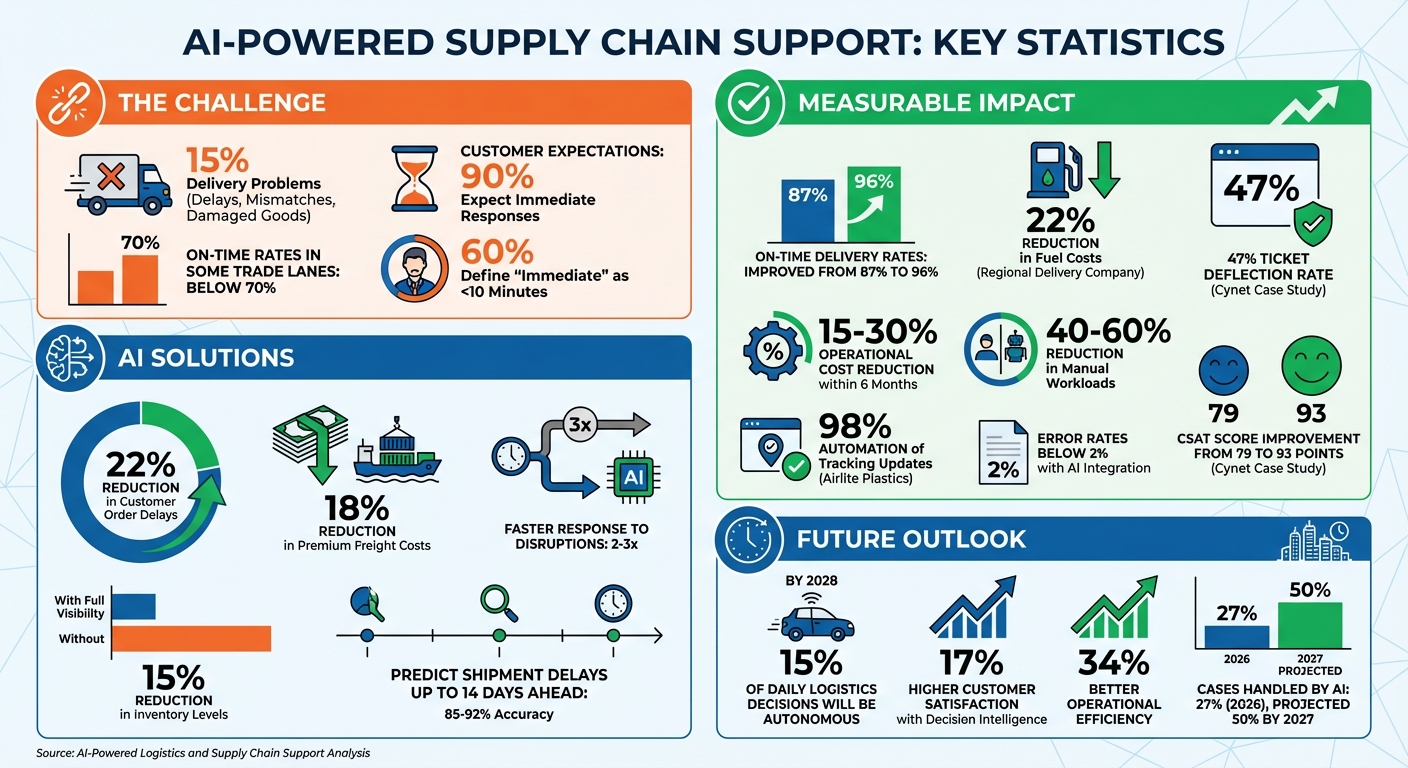
In logistics, disruptions are inevitable, with 15% of deliveries facing problems like delays, inventory mismatches, or damaged goods. These issues can halt operations, strain relationships, and increase costs. However, AI-powered tools are transforming how companies manage supply chain challenges, enabling faster responses, better prioritization, and reduced manual workloads.
Key takeaways:
- Delays and decision latency are major challenges, with some trade lanes seeing on-time rates below 70%.
- AI-driven tracking systems reduce customer order delays by 22% and premium freight costs by 18%.
- Real-time tracking, IoT sensors, and centralized dashboards improve visibility and response times.
- AI tools prioritize critical issues, analyze sentiment, and automate tasks like "Where Is My Order" queries, saving up to 40% of support team time.
- Predictive analytics prevent escalations by flagging potential risks early.
AI Impact on Supply Chain Performance: Key Statistics and Benefits
10 AI Features That Will REVOLUTIONIZE Your Supply Chain
How to Identify and Categorize High-Velocity Issues
When dealing with high-velocity issues, early detection is critical to avoid a domino effect of complications. These problems don’t usually announce themselves with flashing warning signs. Instead, they often begin as subtle indicators – like a sudden surge in order inquiries, geofence alerts for missed appointments, or mismatched shipment IDs [3] [5]. These "visibility gaps" are often the first hints of trouble brewing.
"Visibility gaps are the primary cause of supply chain disruptions: Companies without real-time tracking operate in reactive mode – discovering problems after they become crises." – Digital Applied [9]
AI plays a key role by adding context to these signals. It can analyze sentiment, picking up on frustration or urgency in customer interactions, flagging words like "outage" or "critical failure", and identifying patterns such as rapid follow-ups from a single customer [4]. This kind of analysis helps support teams spot potential problems that manual processes might miss.
Metrics That Signal Critical Issues
Certain metrics can act as red flags for high-velocity issues, giving teams the chance to act before small problems escalate. Operational metrics like supplier lead time variability, inventory turnover rates, order cycle times, on-time delivery percentages, and quality rejection rates serve as vital indicators of supply chain health [9].
For instance:
- Inventory levels for top-50 SKUs dropping below 10 days demand immediate attention.
- A supplier’s on-time delivery rate falling below 85% could signal a potential bottleneck.
- Shipments projected to be delayed by 24–48 hours might indicate deeper logistical challenges [9].
Companies equipped with real-time visibility tools can respond to disruptions up to three times faster. Full supply chain visibility has also been shown to reduce inventory levels by 15% [9]. Modern AI models can predict shipment delays with an accuracy of 85–92% as far as 14 days ahead, giving teams a crucial window to intervene. To prevent alert fatigue, systems should limit notifications to 5–15 actionable alerts daily by filtering out noise using machine learning [9].
Once these signals are identified, the next step is to assess their severity and impact.
How to Prioritize Issues by Severity and Impact
Not every disruption demands the same level of urgency. The key is determining which issues need immediate action based on their potential impact on customers, finances, and operations. For example:
- A shipment delayed by over 48 hours for a SKU nearing an out-of-stock situation requires action within 15 minutes and a detailed plan within two hours.
- On the other hand, a routine update to an estimated time of arrival might only need review during normal business hours [9].
AI-powered systems can further streamline this process by integrating CRM data. For example, they can automatically prioritize issues for high-value "Premier" customers [4] [11]. In eCommerce logistics, tasks like address changes or order cancellations must be handled urgently, as they need resolution before the order status changes to "shipped" [10].
Setting Up Real-Time Tracking Systems
After pinpointing the issues that demand attention, real-time tracking systems step in to help teams identify and resolve problems before they snowball into larger crises. Without this kind of visibility, support teams are left scrambling in reactive mode, always one step behind.
By integrating data from IoT sensors, GPS devices, RFID tags, and telematics hardware into a centralized platform, companies can speed up their response times significantly. Studies show that businesses with effective tracking systems can address disruptions up to 2–3 times faster [9].
IoT and Telematics for Shipment Monitoring
IoT sensors and telematics devices are the backbone of real-time tracking, delivering the raw data needed for visibility. Take GPS fleet tracking devices, for instance. Costing between $15 and $40 per month per unit, these tools provide live location updates, monitor route compliance, and even offer geofencing capabilities [9]. If a vehicle strays off course or a shipment experiences unusual delays, the system sends alerts for immediate action.
For goods that are sensitive to temperature – like pharmaceuticals or fresh produce – cold chain loggers are indispensable. These devices, priced between $8 and $25 per month per unit, track conditions such as temperature, humidity, shock, and vibration. Should any of these metrics exceed the set limits, instant alerts are sent, enabling teams to reroute shipments or work with carriers to prevent spoilage [9]. RFID tags, which cost between $0.10 and $2.00 per tag, are another key tool, commonly used in warehouses for automated stock counts and to flag misplaced or stolen items [9].
Modern systems go a step further by combining GPS data with real-time traffic and weather updates to calculate dynamic ETAs. This feature allows teams to anticipate delays hours in advance and notify customers proactively. AI models enhance this process by predicting shipment delays with an accuracy rate of 85–92% up to 14 days ahead, giving teams a critical window to act [9]. To keep workflows manageable, alert thresholds should be set to surface only 5–15 actionable alerts daily, focusing on significant exceptions like delays exceeding two hours that require human attention [9].
All this data funnels into a centralized dashboard, ensuring faster and more informed decision-making.
Centralized Dashboards for Supply Chain Visibility
The raw data collected by IoT devices only becomes valuable when it’s presented in a way that facilitates quick action. Centralized dashboards solve this by bringing together data from various sources – ERP systems, warehouse management systems (WMS), transportation management systems (TMS), and carrier APIs – into a single, user-friendly interface. This eliminates the need for teams to juggle multiple platforms.
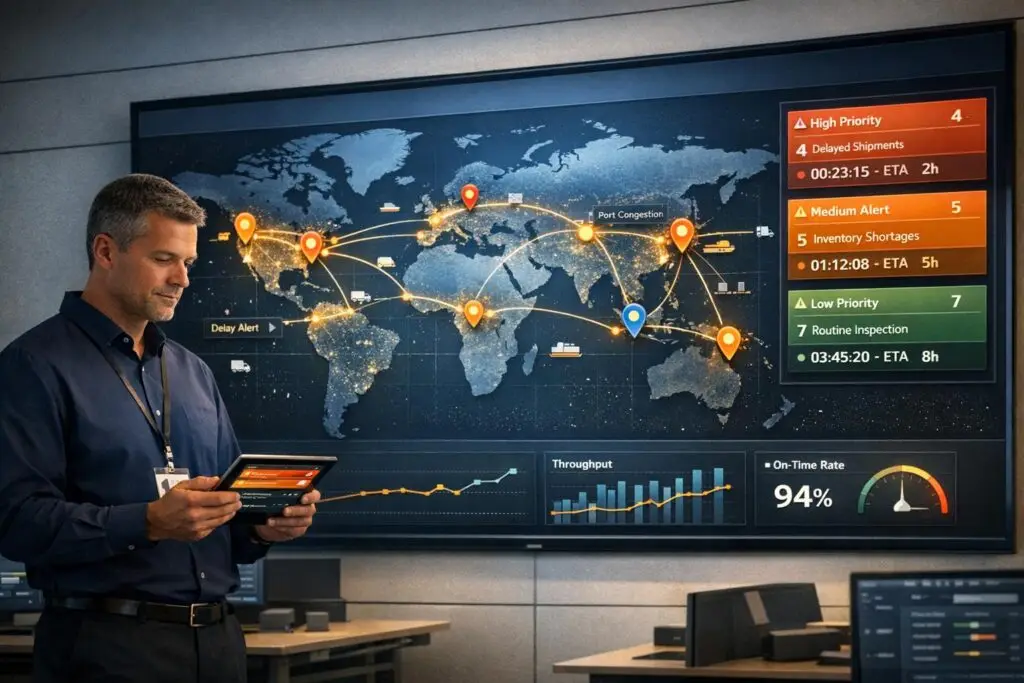
Dashboards typically feature key metrics, situational map views, and panels that compare predicted arrival times to promised ones [16]. For example, a dispatcher might notice that a shipment initially scheduled for 1:00 PM is now expected at 3:00 PM, prompting an immediate escalation process. Companies leveraging real-time visibility tools are able to respond to disruptions 2–3 times faster than those relying on manual tracking methods [9].
Another crucial aspect is data normalization. Carriers often use inconsistent terminology for delays, such as "Exception" or "Delayed", which can confuse support teams. AI-driven systems streamline these inputs into a standardized format, creating a unified operational view. Additionally, integrating data from carrier APIs and EDI feeds ensures a single source of truth for tracking shipments across multiple providers [13] [14].
Ultimately, these systems do more than just show where shipments are – they indicate where they should be, flag deviations, and route critical exceptions to the right team members for resolution. This transition from passive monitoring to actionable insights separates top-performing supply chain teams from those constantly trying to catch up [15].
Using AI for Automated Triage and Prioritization
When real-time tracking systems flag potential issues, the next hurdle is figuring out which problems need immediate attention and which can wait. Manual triage often slows things down – support teams waste valuable time sorting alerts and assigning tickets. AI steps in here, automatically analyzing urgency and assigning priorities to tasks.
This shift from rigid rule-based systems to AI-powered workflows marks a big change for logistics teams. Traditional "IF-THEN" logic struggles with real-life complexities. It can’t interpret a vague "traffic delay" email from a carrier or sense frustration in a customer’s message that avoids using the word "urgent." AI, using natural language processing (NLP), reads between the lines – understanding context, tone, and intent – making it far more effective than keyword-based systems that fail when phrasing doesn’t match expected patterns [4][11].
"AI determines priority not just based on a selected field or a single keyword, but by analyzing a confluence of factors." – Nooshin Alibhai, Founder and CEO of Supportbench [4]
The implementation process is straightforward: it starts with gathering data from all communication channels, analyzing urgency and sentiment, scoring priorities based on business needs, routing tasks to the right agents, and continually learning from outcomes [11]. AI can even handle "WISMO" (Where Is My Order) inquiries autonomously by pulling real-time data from carrier APIs, reducing manual inquiries by up to 90% [3]. This automation sets the stage for how AI can efficiently prioritize issues and streamline resolutions.
How AI Automates Issue Prioritization
AI evaluates priorities by weighing multiple factors at once – something manual processes just can’t handle at scale. For example, the system looks for urgency keywords like "outage" or "shipment lost", checks customer tier and account value from CRM records, and analyzes historical patterns to detect escalating situations [4][11]. If a customer sends several follow-up emails or writes something like "Quick question about my order" but uses negative language, AI picks up on the sentiment and adjusts the priority accordingly [4].
Dynamic scoring ensures that critical issues for high-value customers get top attention. For instance, if a Tier 1 customer with an upcoming contract renewal experiences a delay, the system will prioritize their issue over a standard account’s similar delay [11]. AI also tracks SLA deadlines in real time, reprioritizing tickets as deadlines approach to avoid penalties. This can improve SLA compliance and First Contact Resolution (FCR) rates by 20–30% [11].
Here’s a breakdown of the factors AI considers in prioritization:
| Prioritization Factor | AI Method | Impact on Logistics |
|---|---|---|
| Urgency | NLP Keyword & Sentiment Detection | Flags critical issues like "system down" or "shipment lost" immediately [11][4] |
| Severity | Historical Pattern Analysis | Identifies recurring critical issues based on past data [4] |
| Impact | CRM & Account Value Integration | Elevates high-value accounts or top-tier customers [11][4] |
| SLA Risk | Real-time Deadline Tracking | Escalates tickets nearing SLA breaches [11][17] |
Unlike rule-based systems that rely on exact keyword matches or predefined categories (which customers often mislabel), AI-powered systems adapt to varied language and complex situations using NLP [4].
Improving First-Contact Resolution with AI
Once issues are prioritized, resolving them quickly becomes the focus. AI copilots make this easier by pulling relevant solutions from past cases, internal documentation, and external knowledge bases. For example, if a ticket involves a customs documentation error, the AI can instantly provide similar resolved cases, standard procedures, and suggested responses, saving agents significant time [11][17].
Supportbench’s AI Agent-Copilot goes a step further by analyzing all prior interactions related to a case. It helps agents craft precise replies without starting from scratch. For routine issues like tracking inquiries, the AI can even draft complete responses for agents to review and send, drastically cutting response times.
AI agents also handle tasks that go beyond basic automation. For instance, they can navigate carrier portals, extract updated shipment statuses, and push the information to Warehouse Management Systems (WMS) without human involvement [3]. If a carrier updates an estimated delivery time, the AI agent detects the change and updates the WMS automatically, resolving delivery exceptions 50% faster and freeing up to 40% of logistics managers’ time previously spent on repetitive tasks [3].
"AI agents can perceive, reason, and act. Unlike standard automation that follows a rigid script, AI agents can… interpret ‘traffic delay’ as a risk, and update the WMS autonomously." – Logishift [3]
These agents also process unstructured data, like invoices or Bills of Lading (BOL) attached to emails. They extract tracking numbers and update systems without manual intervention, eliminating the hours teams often spend searching through PDF attachments or email chains [3].
Predictive Analytics for Preventing Escalations
The smartest way to handle high-pressure issues is to stop them from escalating in the first place. Predictive analytics, powered by AI, can analyze ticket histories and resolution patterns to flag potential bottlenecks and identify accounts at risk before problems grow [7][17].
Supportbench’s AI Predictive CSAT and CES features take this a step further. They predict customer satisfaction levels based on case history, even before surveys are sent. Agents can see which customers are likely dissatisfied and how difficult their experience was, allowing teams to address issues proactively [7]. This prevents minor frustrations from turning into major disputes or jeopardizing contract renewals.
AI also identifies recurring problems that signal underlying issues. For example, if there’s a spike in tickets related to a specific carrier or warehouse, the system alerts managers to investigate. This shift from reactive problem-solving to proactive management helps prevent small issues from escalating into larger disruptions. In logistics, even a 30-minute delay in resolving a critical issue can mean the difference between retaining a client and losing them to a competitor [11].
AI can also categorize shipments into priority levels and set "watchdog" protocols for status updates. For instance:
- Tier 1 critical shipments might be checked every 30 minutes, with delays over 15 minutes triggering an alert to the manager and a customer email.
- Tier 2 standard shipments could be checked every four hours, with delays updating the WMS only.
- Tier 3 low-priority shipments may be reviewed once daily, with failed deliveries flagged for follow-up [3].
This structured approach ensures that attention goes where it’s most needed without overwhelming teams with unnecessary alerts. These AI-driven systems are transforming logistics from reactive firefighting to proactive, efficient operations.
sbb-itb-e60d259
Creating Escalation and Resolution Workflows
Efficient escalation and resolution workflows are essential for resolving supply chain issues swiftly, especially in today’s intricate and fast-paced logistics networks. The goal is to move beyond simply assigning tickets and instead focus on outcome-driven workflows. These workflows ensure agents have the right tools, documentation, and context to address issues effectively. For instance, if a frontline agent encounters a customs documentation error but lacks access to the broker portal, the workflow should automatically route the case to someone with the necessary permissions to resolve it.
"A haphazard approach to escalations directly undermines your team’s ability to deliver exceptional B2B service." – Nooshin Alibhai, Founder and CEO, Supportbench [19]
To create effective workflows, it’s vital to establish clear escalation triggers. These triggers might include time-based factors (e.g., unresolved after 24 hours), severity-based situations (e.g., a complete production outage), SLA-based deadlines (e.g., a resolution window closing in 30 minutes), or cases requiring specialized skills. Defining these triggers upfront eliminates confusion and ensures that issues are routed to the right person at the right time. This structured approach leads seamlessly into the use of dynamic SLAs and AI-powered case routing, which are explored further in the next sections.
Dynamic SLAs for High-Velocity Scenarios
Static SLAs simply don’t cut it in the logistics world. A delayed shipment for a top-tier client cannot be treated the same as a routine tracking inquiry. Dynamic SLAs adapt response and resolution times based on real-time factors like customer priority, sentiment, or urgency keywords [4].
For example, Supportbench’s dynamic SLA feature can tighten deadlines when a renewal is approaching or when AI detects frustration in a customer’s tone [4]. Subtle cues, like negative language in a message, might trigger shorter response windows, helping to address potential issues before they escalate further.
Traditional SLA tracking often overlooks "handoff delays", the time tickets spend waiting between teams. A case transferred late on a Friday might sit idle until Monday, leaving customers frustrated. To fix this, workflows can incorporate an "In Transfer" status to monitor how long a ticket remains unclaimed. If the receiving team doesn’t acknowledge the ticket within 2–4 hours, a secondary escalation to management can be triggered [21].
Tracking three key timestamps – Escalated Time (when the handoff starts), Claimed Time (when the ticket is acknowledged), and Started Time (when work begins) – provides full visibility. This ensures no ticket falls through the cracks, giving teams the accountability needed to keep cases moving.
AI-Driven Routing and Knowledge Base Automation
Dynamic SLAs set the stage for smarter ticket routing, and AI takes this to the next level by ensuring continuity and context across interactions. AI-driven routing matches tickets to the most suitable agent by considering multiple factors, such as required expertise (e.g., API knowledge or access to carrier systems), language skills, current workload, and past success with similar cases [4][18]. This ensures tickets land with the right person from the start.
A great example of this approach comes from Cynet, a cybersecurity firm that revamped its support strategy in 2024. By integrating AI, Cynet boosted its CSAT score from 79 to 93 points and achieved a 47% ticket deflection rate. Their AI system provided frontline agents with expert-level troubleshooting guidance in real time, enabling them to resolve nearly half of all tickets at Tier 1 without needing escalation. This also cut overall resolution times by nearly 50% [8].
"Escalations have a much more significant impact than they realize. It’s a bottleneck that can be removed rather easily." – Tina Grubisa, Value Consultant, Mosaic AI [8]
To avoid repeated escalations, consider a cooldown period of 15–30 minutes after human intervention. This prevents cases from immediately re-entering automation workflows, giving agents time to fully address the issue [20]. Additionally, consistent agent assignment ensures that the same agent handles a case throughout its lifecycle, preserving context and eliminating the need for customers to repeat themselves [20].
Knowledge base automation further streamlines operations by turning resolved cases into helpful articles. For example, Supportbench’s AI can analyze case histories, extract solutions, and draft knowledge base articles complete with a subject, summary, and keywords. This not only prevents recurring escalations but also equips frontline agents to tackle complex issues on their own [8].
Tracking Metrics and Improving Performance
Once you’ve set up dynamic escalation workflows, it’s time to track performance metrics that validate your AI-driven strategies. Monitoring key KPIs helps identify bottlenecks, highlight high-performing team members, and address recurring issues. In the fast-paced world of supply chain support, where 90% of customers expect immediate responses and 60% define "immediate" as within 10 minutes, these metrics become essential indicators of operational health [22].
Some metrics provide a clearer view of your operations’ efficiency. For example, time to first meaningful response (not just automated replies), queue aging distribution (to identify stuck tickets), and reopen rates (to flag incomplete resolutions) are critical for assessing speed and quality [22]. For supply chain teams, tracking incidents by partner can reveal which carriers or vendors repeatedly cause delays, while incidents by site can pinpoint warehouses or distribution centers that need extra resources [1].
"Your support is healthy when it is fast, accurate, and preventative." – Florian Baptiste, Isara [22]
AI analytics simplify the process by offering real-time insights into agent performance and operational bottlenecks. For instance, Novartis used an AI-powered review agent in 2026 to process thousands of purchase requests, cutting review times from five days to just 16 minutes [24]. Similarly, Penske Logistics adopted an AI platform from Augment in 2026, projecting a 30–40% boost in productivity [24].
Monitoring Resolution Times and Agent Performance
Real-time dashboards act as your early warning system, helping you track resolution times and identify delays. Metrics like queue aging distribution highlight tickets that have been idle too long, while backlog growth shows if new issues are piling up faster than they can be resolved [22]. These insights allow you to address potential problems before they escalate.
When evaluating agent performance, go beyond simple ticket counts. Metrics such as first contact resolution (FCR) rates are essential for gauging how effectively agents resolve issues during the first interaction [22]. AI tools now make it easier to measure FCR by analyzing case histories – something that was previously challenging to track accurately [22]. Additionally, monitoring tickets per agent per day, segmented by complexity, ensures workloads remain manageable and helps prevent burnout, which can directly impact resolution times [22].
| KPI Category | Specific Metric | Purpose in Supply Chain |
|---|---|---|
| Speed | Time to First Meaningful Response | Meets customer expectations for 10-minute response windows [22] |
| Speed | Queue Aging Distribution | Identifies tickets stuck in the system longer than average [22] |
| Quality | Reopen Rate | Highlights incomplete resolutions for shipment or inventory issues [22] |
| Operational | Incidents by Partner | Pinpoints carriers or suppliers with recurring failures [1] |
| Operational | Backlog Growth Rate | Signals when incoming issues are outpacing team capacity [22] |
| Prevention | Deflection Rate | Measures how well the AI knowledge base resolves issues without agent help [22] |
AI insights also help spot bottlenecks in real-time. By 2028, it’s estimated that 15% of daily logistics decisions will be made autonomously by AI agents, with companies using decision intelligence already outperforming peers by 17% in customer satisfaction and 34% in operational efficiency [24]. AI can even detect "customer effort signals", such as phrases like "I already tried this", to flag high-risk tickets that need immediate attention to avoid losing customers [22].
"AI-driven analytics allow warehouse managers to track key performance indicators such as picking speed, fulfillment accuracy, and throughput in real time. With that visibility, companies can quickly identify bottlenecks and continuously improve operational performance." – Tal Holtzer, CEO, VPSServer [23]
To further refine operations, consider segmenting response targets by account type. For example, strategic accounts might require responses within minutes on real-time channels, while commercial accounts could have a one-hour target [22]. Using AI copilots to summarize complex issues, like multi-leg shipment problems or customs delays, can also reduce handle times and improve first-contact resolution [7].
Converting Resolved Cases into Knowledge Articles
Turning resolved cases into knowledge articles is a powerful way to improve future resolutions. Tools like Supportbench’s AI can analyze case histories, extract solutions, and draft articles complete with a subject, summary, and keywords – transforming resolved cases into reusable resources [8].
AI tools also identify recurring patterns and flag documentation gaps, ensuring the knowledge base stays relevant and useful [22]. This approach not only deflects future tickets but also equips frontline agents to handle more complex issues without escalating. By 2026, some teams reported that 27% of cases were handled by AI, with projections that AI could manage 50% of cases by 2027 [22]. The deflection rate, which measures the percentage of issues resolved without agent involvement, becomes a critical metric for evaluating the effectiveness of your AI-powered knowledge base [22].
Automated tagging further improves the process by categorizing resolved cases consistently based on content rather than manual input. This clean data allows teams to identify recurring issues and create new knowledge base articles that address real customer challenges [4]. The result? A self-improving system that grows smarter with every case resolved, supporting continuous performance tracking and operational improvements.
Conclusion
Addressing high-velocity supply chain challenges requires a proactive approach, rather than constantly reacting to problems as they arise. AI-powered tools and real-time tracking systems help teams shift from "firefighting" to making informed, proactive decisions. For instance, a regional delivery company that adopted AI route optimization saw a 22% reduction in fuel costs during the first quarter and increased on-time delivery rates from 87% to 96% [2][6]. These outcomes highlight how intelligent automation can drive both cost savings and improved customer satisfaction.
To manage issues effectively, clear strategies are essential. Three key pillars – prioritization, automation, and continuous improvement – form the backbone of success. AI-driven prioritization uses natural language processing to identify the urgency of each request, ensuring critical problems are addressed promptly [4]. Automated routing and triage streamline workflows by directing issues to the right team members based on their expertise and workload, minimizing unnecessary handoffs [4][12]. Additionally, converting resolved cases into knowledge base articles fosters a self-sustaining system that reduces future escalations [7].
"AI is not replacing human response. It is enabling smarter, faster, and fewer interventions." – AI in the Chain [2]
The financial benefits of AI adoption are both immediate and measurable. Companies often see operational costs drop by 15–30% within six months, while reducing manual workloads by 40–60% [6]. A compelling example comes from Airlite Plastics, which introduced a track-and-trace AI system in February 2026 under the guidance of Senior Director of Supply Chain Jeremy Forster. This initiative automated 98% of tracking updates, saving employees an hour each day by eliminating manual carrier emails [25]. Moreover, error rates in order processing and inventory tracking frequently fall below 2% with AI integration [6].
FAQs
What should we automate first for high-velocity issues?
The first step in handling high-velocity issues is automating ticket triage and routing. AI-powered systems can swiftly analyze incoming tickets, picking up on crucial details like urgency and sentiment. From there, they can assign tickets to the appropriate agents or direct them into automated workflows. This approach cuts down on manual work, prioritizes critical issues, and speeds up response times – all of which help streamline operations and boost efficiency.
How can we avoid alert fatigue with real-time tracking?
To combat alert fatigue, it’s crucial to implement smart alert management strategies. Start by creating rules that prioritize and filter alerts based on urgency, ensuring teams are notified only about critical issues. Trim down non-essential alerts – like minor fluctuations in temperature – so they don’t overwhelm or desensitize your team. Leveraging AI-driven systems can also make a big difference. These tools analyze patterns, predict potential problems, and cut down on unnecessary notifications, allowing teams to stay focused on the most pressing concerns without losing their responsiveness.
Which KPIs show AI is improving supply chain support?
AI has shown a measurable impact on supply chain support, with some impressive key performance indicators (KPIs). For instance, it can lead to up to 58% fewer delays, a 99% reduction in detention fees, and 70% faster response times. On top of that, there’s a 76% drop in ticket volume, which significantly lightens the workload for support teams.
Beyond these numbers, AI enhances the accuracy of issue resolution and provides real-time tracking of problems. This means teams can handle challenges more effectively, even in high-pressure situations, ensuring smoother operations overall.
Related Blog Posts
- Dynamic SLAs with AI Prioritization
- How AI Improves Time Management in Support
- How do you build an incident management process for B2B support (not just engineering)?
- What are the signs you’ve outgrown Help Scout (SLAs, tiers, escalations, reporting)?
Related: Support Operations Playbook · The Supportbench platform · Hardware & IoT support