


Freshdesk works well for simple, high-volume B2C customer support. But for complex B2B teams, it struggles to handle the demands of multi-stakeholder relationships, long-term issue tracking, and tailored workflows. Key limitations include:
- Rigid SLAs: Limited ability to adjust based on client-specific contracts.
- Customization Issues: Fixed ticket fields and basic automation can’t handle complex workflows.
- High Costs: Advanced features like custom reporting and skill-based routing are locked behind expensive plans.
- Short Trial Period: The 14-day trial isn’t enough for testing advanced setups.
- Reporting Gaps: Lacks predictive analytics and deep insights for B2B needs.
- Scalability Problems: Performance issues under high ticket volumes and limited collaboration tools.
For B2B teams, these issues often lead to inefficiencies, higher costs, and difficulty scaling operations. While workarounds exist, exploring AI-native platforms with more flexible features may be a better long-term solution.
Pricing Structure and Feature Restrictions
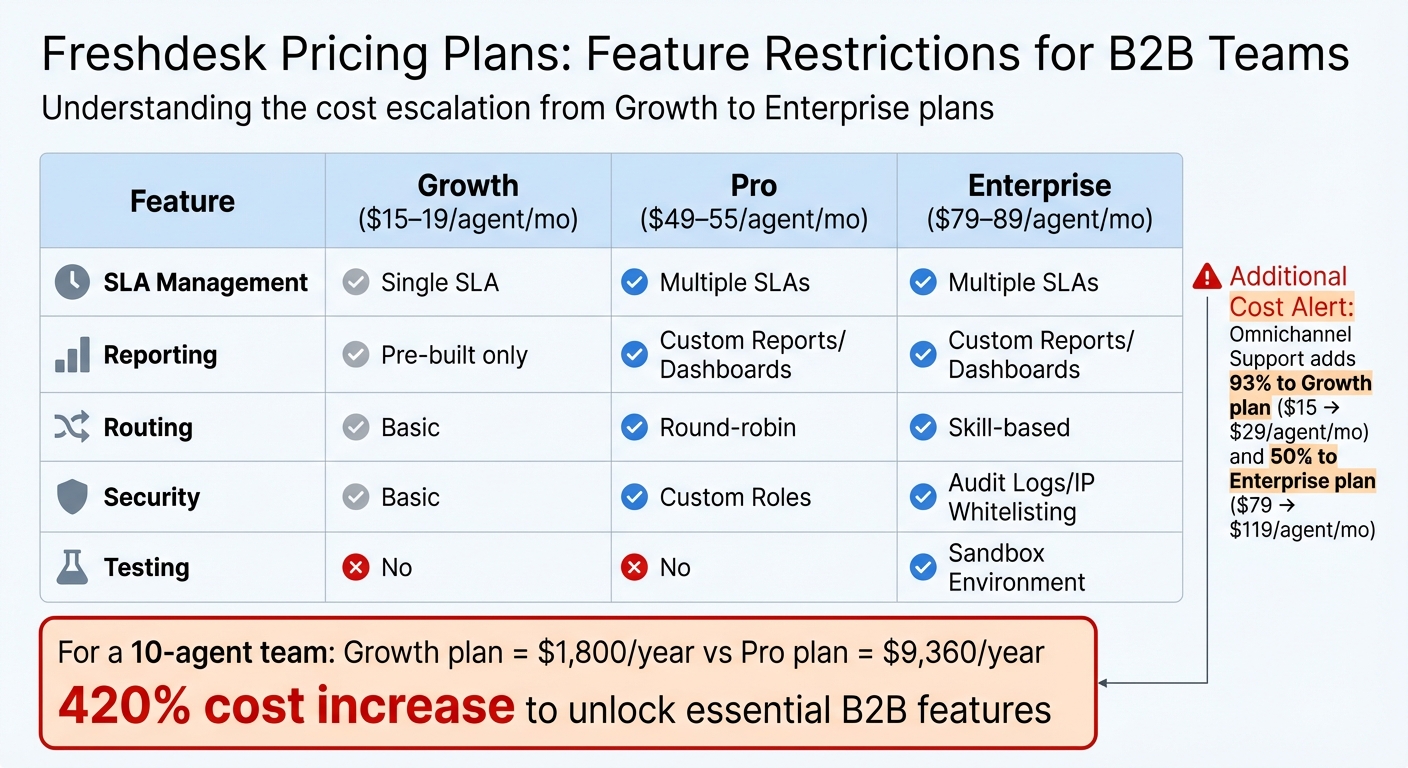
Freshdesk Pricing Plans Comparison for B2B Support Teams
Freshdesk’s pricing setup presents hurdles for B2B teams, as key features like custom reporting, multiple SLAs, and advanced routing are only available in higher-priced plans. The Growth plan starts at $15–$19 per agent per month but excludes these advanced tools. To unlock them, teams must move up to the Pro plan, which costs $49–$55 per agent per month. For a team of 10 agents, this shift increases annual costs from approximately $1,800 on Growth to $9,360 on Pro – a staggering 420% jump.
Here’s a breakdown of features by plan:
| Feature | Growth ($15–19) | Pro ($49–55) | Enterprise ($79–89) |
|---|---|---|---|
| SLA Management | Single SLA | Multiple SLAs | Multiple SLAs |
| Reporting | Pre-built only | Custom Reports/Dashboards | Custom Reports/Dashboards |
| Routing | Basic | Round-robin | Skill-based |
| Security | Basic | Custom Roles | Audit Logs/IP Whitelisting |
| Testing | No | No | Sandbox Environment |
For teams that need omnichannel support tools, the costs escalate further. Switching from email-only to Freshdesk Omni increases the Growth plan from $15 to $29 per agent per month (a 93% jump) and the Enterprise plan from $79 to $119 per agent per month (a 50% hike).
Some essential tools – like custom reporting for monitoring account health and multi-SLA management – remain locked behind higher-tier plans. While the Pro plan introduces round-robin routing, skill-based routing is only available in the Enterprise plan. Adding advanced AI features also adds to the complexity: Freddy AI Copilot costs $78 per agent per month when bundled with the Pro + AI plan or $29 per agent per month as an add-on. This includes 500 AI sessions per billing cycle, but unused sessions expire at the end of each cycle. Additional sessions cost $100 per 1,000 sessions.
To avoid unexpected costs, especially with AI tools, careful monitoring of session usage is essential – something that becomes even more challenging with the complexities of B2B operations.
14-Day Trial Limitations for Complex Setups
Freshdesk’s short 14-day trial further complicates things for teams with intricate needs. A two-week window is often insufficient for properly evaluating complex B2B setups. For instance, omnichannel deployments can take 2–3 weeks to configure, while multi-department setups may require 4–8 weeks. This leaves teams rushing to make purchasing decisions before they’ve had a chance to fully test the platform’s capabilities.
The trial also doesn’t provide enough time to accurately model Freddy AI session usage or potential overage costs. Larger teams, where each member needs 4–8 hours of training, often run out of trial time before they can validate critical workflows.
"Always run a 2-week trial with real ticket volume to validate session consumption before signing an annual contract." – SaaS CRM Review
While Freshdesk does allow trial extensions by contacting their account managers or sales team at sales@freshdesk.com, this adds another layer of complexity. For teams that need to test dynamic SLAs or other advanced workflows, this extra step can slow down the decision-making process.
These pricing and trial constraints make it harder for B2B teams to evaluate and implement Freshdesk effectively, adding to the operational challenges they already face. Further details on these challenges are explored in the following sections.
sbb-itb-e60d259
Customization Limits for Advanced Workflows
Freshdesk’s limitations in customization present significant challenges for B2B support teams, especially when managing complex workflows. While the platform is well-suited for high-volume B2C interactions – think straightforward customer queries – it struggles to handle the intricate processes that B2B support often demands. These processes typically involve multiple stakeholders, detailed escalation paths, and seamless coordination across departments. Unfortunately, Freshdesk’s architecture introduces friction in these scenarios, restricting ticket organization and automation capabilities that are critical for multi-department workflows.
Restricted Ticket Views and Custom Fields
One of the key issues lies in Freshdesk’s rigid ticket field structure. The platform relies on fixed ticket field types, which makes it difficult to capture and organize the multi-dimensional data required for managing enterprise clients. For example, tracking unique contract terms, service levels, or compliance requirements becomes a challenge. This rigidity limits the ability to properly route and escalate tickets, particularly when dealing with large-scale operations.
Performance issues further complicate matters. Teams managing over 100,000 tickets per month have reported system slowdowns and unreliable ticket search functionality. These limitations can negatively impact customer satisfaction, as reflected in a disparity between large organizations (10,000+ employees) achieving an 86.56% satisfaction score versus smaller companies (fewer than 10 employees) achieving 91.13%. Additionally, Freshdesk’s automation capabilities fall short of handling the complex business logic often required in B2B environments.
Business Logic and Automation Constraints
Freshdesk’s automation tools are overly simplistic for nuanced business scenarios. Its basic "if-this-then-that" automation cannot account for factors like contract terms or stakeholder roles. For example, the platform’s Hourly Triggers scan tickets only once per hour, introducing delays for time-sensitive escalations. These rules also apply solely to tickets updated within the past 30 days, further limiting their usefulness. Automation rules are executed in a fixed sequence, which restricts the ability to create workflows with complex conditional logic.
When external data verification is required – such as checking CRM order histories before updating tickets – Freshdesk’s webhooks support only basic, one-way data pushes. This falls short of the multi-step logic needed for more advanced workflows. Features like approval workflows or skills-based routing are available only in the Enterprise tier, which costs $89 per agent per month. This pricing barrier makes it difficult for mid-sized teams to implement the managing customer support escalations they need.
"What looked like a comprehensive ticketing system quickly revealed its limits. Essential enterprise functionalities – custom reporting, advanced automation, and essential integrations – were locked behind higher-tier plans." – HappyFox Help Desk
Further automation limitations include the inability to send attachments – only URLs can be shared. This is a significant drawback for escalation workflows that require sharing technical logs, screenshots, or legal documents. Additionally, email attachments are capped at 20 MB, forcing teams to rely on external tools for larger files. For B2B teams, where 32.9% of customers consider automation a critical efficiency driver, these restrictions often lead to manual interventions, undermining the very purpose of automation.
Reporting and Analytics Gaps
Freshdesk’s reporting features reveal notable shortcomings for B2B teams aiming to analyze and improve their support operations. Designed primarily for high-volume, transactional B2C environments, the platform struggles to meet the deeper, more nuanced needs of complex B2B relationships.
Limited Custom Reporting Options
A key issue lies in the restricted access to custom reporting tools. On the Free and Growth plans, features like custom reports, widget customization, and data exports are entirely unavailable. Teams must upgrade to the Pro plan ($49 per agent/month) to unlock these capabilities. Even then, limitations persist. For example, when tickets are merged, Freshdesk Analytics only tracks the primary ticket, disregarding secondary ones. Similarly, SLA tracking is ticket-based rather than note-based, meaning a single delayed response in a multi-response ticket can flag the entire ticket as non-compliant.
Adding to these challenges, Freshdesk focuses heavily on historical data, offering insights into past events but lacking proactive or predictive analytics for future planning. This is a significant drawback for larger companies, especially those with over 10,000 employees, who already face lower CSAT scores (86.56% compared to 91.13% for smaller teams). The absence of forward-looking analytics leaves B2B teams without the tools they need to adapt and optimize their strategies effectively.
Integrating Freshdesk data with external tools like Tableau or Power BI further complicates matters. Teams must export ticket activities in JSON format, which is only available for 30 days and often requires developer assistance. This technical hurdle makes it difficult to combine support data with other business analytics, limiting the ability to gain comprehensive insights.
Dashboard Customization Challenges
While reporting limitations hinder operational analysis, the lack of flexible dashboards compounds the problem by restricting strategic insights. Freshdesk’s dashboards are confined to its ecosystem, making it challenging to align support metrics with broader business goals. As Stevia Putri from eesel AI explains:
"Freshdesk reports are experts at Freshdesk data. While they focus on your ticketing environment, you can always supplement this with other tools if you need to look at data from sources like Confluence or Google Docs".
For B2B teams, this siloed approach often results in dashboards that fail to provide the full context needed for informed decision-making. Performance issues under high ticket volumes only worsen the situation – enterprise teams report unreliable system performance and ticket searches during peak times, sometimes requiring manual refreshes. Additionally, limited visibility into multi-department workflows and customer context makes it harder to track the intricate processes typical of B2B support.
| Plan | Price (Billed Annually) | Custom Reporting | Data Export | Widget Customization |
|---|---|---|---|---|
| Free | $0/agent/month | No | No | No |
| Growth | $15/agent/month | No | No | No |
| Pro | $49/agent/month | Yes | Yes | Yes |
| Enterprise | $79/agent/month | Yes | Yes | Yes |
For B2B teams, where 32.9% of customers prioritize automation and AI in support, these analytics and dashboard gaps often lead to time-consuming manual workarounds. Instead of relying on integrated dashboards to guide their strategy, support leaders frequently spend hours exporting data, resolving discrepancies, and building external reports just to piece together a clear view of their operations.
Scalability and Team Collaboration Issues
Freshdesk’s design struggles to keep up with the demands of growing B2B operations, especially for teams handling multi-stakeholder accounts and long-term cases. As businesses scale, these limitations become more apparent, impacting both efficiency and collaboration.
Limited Account and Stakeholder Visibility
Scalability challenges add to the existing difficulties with customization and reporting. High ticket volumes often require manual refreshes to update ticket statuses, which can slow down workflows significantly. For instance, one company experiencing a 400% growth in just six months saw its response times jump from 2 hours to 14 hours due to the platform’s inability to scale effectively.
Another major issue is the lack of B2B-specific metrics, such as Customer Health Scores or Account Risk indicators. Without these tools, agents have a hard time accessing a complete interaction history through centralized customer management, spanning email, chat, and phone. This often leads to repetitive conversations, which in turn increases customer effort. Consider this: 53% of support agents say that switching between multiple tools cuts into their productivity, with teams often juggling 6 to 8 different systems during a single customer conversation. For B2B teams managing accounts with multiple decision-makers and technical contacts, this fragmented approach creates unnecessary friction. The result? Inefficient workflows that fail to deliver the seamless, informed interactions these clients expect.
Cross-Team Collaboration Gaps
Freshdesk’s collaboration model also creates silos that hinder smooth cross-department workflows. For example, ‘Collaborators’ – users with restricted access – lack key permissions, and SLA policies don’t apply to them. This setup limits their ability to contribute effectively to time-sensitive tasks.
Integration challenges and API rate limits further complicate collaboration. Shared Sales agents without full licenses, for example, can’t post public notes. Additionally, API rate limits – capped at 200 calls/min for Growth plans, 400 for Pro, and 700 for Enterprise – can lead to errors that disrupt essential workflows. Features like Parent/Child ticketing, which helps break down complex issues, and Shared Ownership for multi-team visibility are only available on higher-tier plans: Pro at $49/agent/month and Enterprise at $79/agent/month. These restrictions make it harder for teams to coordinate effectively, especially when dealing with the intricate needs of B2B support operations.
Altogether, these limitations highlight Freshdesk’s difficulty in addressing the complex workflows and collaboration needs that are critical for scaling B2B businesses.
Workarounds and How to Evaluate Alternatives
Temporary Solutions for B2B Teams
Freshdesk’s limitations in automation and customization for B2B support can be challenging, but there are some practical workarounds to consider. For instance, native automation rules relying on "if-this-then-that" logic can help with repetitive tasks like auto-assigning tickets, prioritizing VIP customers, and filtering spam. These rules work through triggers based on ticket creation, updates, or hourly schedules. For more advanced routing needs, tools like Omniroute and IntelliAssign can temporarily fill the gap. However, keep in mind that these features are only available with paid Growth, Pro, or Enterprise plans.
You can also configure webhooks to send instant notifications to Slack or Teams, sync data with CRMs, or automate actions in e-commerce platforms. While useful, webhooks require precise manual setup, including configuring URLs and JSON payloads. To avoid issues during team expansion, ensure you maintain detailed external documentation. For more complex workflows, third-party tools like Zapier can automate multi-step processes, such as turning bug reports into engineering tasks. But remember, task-based pricing can add up quickly for teams handling a high volume of tasks.
Another option is integrating a third-party AI agent like eesel AI, which can interpret customer intent and context more effectively than basic keyword rules. AI tools can also generate knowledge base articles from resolved tickets, helping reduce future ticket volume while addressing documentation gaps. Before implementing new AI workflows, test them using historical ticket data to assess their effectiveness. Importantly, ensure every automated process includes an easy way for customers to connect with a human agent to avoid frustrating interactions with bots.
These temporary solutions can help you manage current challenges while you search for a platform designed with AI integration at its core.
What to Look for in an AI-Native Support Platform
While short-term fixes can help bridge gaps, a fully AI-native platform offers a more reliable, long-term solution. Teams should focus on platforms where AI is built into the core features, avoiding costly add-ons. Look for systems that provide intelligent automation and routing based on customer context, sentiment, and business impact – going beyond simple keyword-based rules to handle ticket triage and assignment effectively.
Dynamic SLAs are a must for B2B environments. These allow SLAs to be tailored to specific client contracts and adjusted dynamically based on case details, rather than relying on rigid, one-size-fits-all policies.
"B2B relationships necessitate a more nuanced approach to data, requiring customized reports that can track and analyze long-term trends, contract compliance, and intricate customer interactions." – Nooshin Alibhai, Founder and CEO, Supportbench
A strong platform should provide a unified view of the customer journey, including assets, entitlements, renewals, and sentiment history. Features like predictive analytics are becoming standard, enabling teams to forecast CSAT and CES scores before surveys are sent and track churn risks in real time using sentiment analysis. Additionally, AI-powered agent assistance – such as tools that suggest responses, summarize past interactions, or auto-generate knowledge base articles – can significantly reduce resolution times without adding to your team’s workload.
Effective platforms also enable cross-team collaboration, allowing Support, Success, Product, and Operations teams to work together seamlessly through shared visibility and threaded internal notes, all while preserving historical context. Look for low-code or no-code platforms that let support teams configure workflows and AI rules independently, reducing reliance on IT or external consultants. Prioritize platforms that ensure full data ownership and offer easy data import tools to avoid vendor lock-in during migrations. Finally, opt for platforms with transparent, all-inclusive pricing that covers advanced features like analytics and AI upfront, avoiding modular pricing models that can drive up costs as you scale.
Conclusion
Main Limitations for B2B Support Teams
Freshdesk’s origins as a B2C-focused platform present significant challenges for complex B2B operations. Designed for high-volume, transactional interactions, it struggles to meet the needs of deep, multi-stakeholder relationships that are common in enterprise support settings. This fundamental mismatch impacts essential areas like scalability, customization, reporting, and collaboration.
The platform treats tickets as isolated events, limiting access to critical contract details and historical insights. Many enterprise-grade features are locked behind higher-tier plans, leading to escalating costs as teams grow. Performance issues also arise under heavy ticket volumes, with unreliable search functions and slower response times during peak demand.
"Trying to use a B2C system for the complexities of a B2B world will always leave you with costly inefficiencies." – Nooshin Alibhai, Founder and CEO, Supportbench
Collaboration tools like parent/child cases or case swarming often require third-party integrations or the most expensive plans. Additionally, rigid workflows make it difficult to implement dynamic SLAs that adjust based on factors like account value or upcoming renewals. This is compounded by the fact that 53% of support agents identify context switching between tools as their biggest productivity drain. These inefficiencies highlight the need for a specialized B2B helpdesk.
Next Steps for Complex B2B Operations
To overcome these challenges, B2B support teams should consider platforms specifically designed for their needs. Look for systems that offer built-in AI, dynamic SLAs, unified reporting, and predictive analytics. Focus on solutions with transparent, all-inclusive pricing to avoid unexpected expenses as your team expands. A platform that provides a complete view of customer relationships – including assets, entitlements, and renewal timelines – is essential.
Adopting AI-powered platforms can lower operational costs while delivering personalized, context-aware support. With 32.9% of B2B customers identifying automation and AI as critical support features, choosing the right platform now can make the difference between thriving in complexity or being overwhelmed by it.
FAQs
What challenges do B2B support teams face with Freshdesk’s customization options, and how can they address them?
B2B support teams often struggle with Freshdesk’s limited customization options, especially when dealing with complex workflows, long-term issues, or accounts involving multiple stakeholders. The platform’s built-in automation tools tend to focus on straightforward, repetitive tasks, which can fall short when addressing advanced requirements like predictive escalation, multi-tier routing, or detailed account coordination.
To tackle these shortcomings, teams can enhance Freshdesk by integrating AI-powered tools and tapping into external APIs. These additions enable smarter workflows, such as predictive routing and automated escalation management, cutting down on manual tasks and boosting overall efficiency. Custom integrations can also adapt the platform to meet specific B2B needs, like offering deeper analytics or tracking long-term issues more effectively. By blending automation, AI, and external customizations, support teams can create a more adaptable and scalable system that overcomes Freshdesk’s built-in limitations.
What are the cost challenges of upgrading Freshdesk plans for complex B2B support teams?
Upgrading to higher-tier Freshdesk plans can result in a noticeable jump in costs, particularly for B2B support teams with complex needs. Since Freshdesk pricing is per agent per month, adding advanced features like AI tools, custom workflows, or integrations can significantly increase expenses. Depending on the plan and features, prices can range from $15 to $94 per agent monthly, which can become a hefty expense for larger teams.
If your business requires intricate workflows or extensive customizations, it’s essential to weigh the additional costs against the value these features bring. Take the time to evaluate whether the platform’s scalability and included tools align with your team’s specific needs before committing to a higher-tier plan.
Why is Freshdesk’s 14-day trial too short for complex B2B support teams?
For B2B support teams managing complex operations, a 14-day trial often isn’t enough. Why? It doesn’t allow sufficient time to thoroughly evaluate key features like scalability, automation, and customization – all crucial for enterprise-level workflows.
These operations typically involve intricate processes, multiple stakeholders, and long-term issue management, requiring more time to truly test how the platform performs under realistic conditions. A shorter trial makes it harder to simulate critical scenarios, like multi-tier routing or escalation handling, which are essential for evaluating advanced setups. Without this extended evaluation period, teams may find it challenging to determine whether the platform can meet their operational demands or align with their future goals.
Related Blog Posts
- Zendesk vs Freshdesk vs Supportbench: Which Support Platform is Better and for who in 2026?
- What are the best non-US Zendesk alternatives for B2B support teams?
- Which non-US helpdesk platforms include advanced SLAs, portals, and knowledge base without add-ons?
- What’s the best alternative to Salesforce Service Cloud for B2B support teams?