Coaching agents effectively using QA data can be challenging, but it doesn’t have to harm morale. The key is shifting from punitive methods to supportive, data-driven feedback. Traditional QA often reviews just 1–2% of calls, leading to cherry-picking, inconsistent scoring, and delayed feedback that erodes trust. AI-powered QA tools solve these problems by analyzing 100% of interactions, removing bias, and providing real-time, actionable insights.
Key takeaways:
- Use AI tools to evaluate all interactions, ensuring fairness and consistency.
- Balance feedback by highlighting strengths alongside areas for improvement.
- Avoid focusing solely on mistakes; include positive reinforcement to keep agents motivated.
- Replace vague feedback with specific, measurable goals (e.g., improving First Contact Resolution rates).
- Deliver feedback privately and respectfully to maintain trust and team culture.
- Leverage real-time AI assistance to guide agents during live interactions, reducing errors before they occur.
This approach transforms QA into a tool for growth, improving agent performance, retention, and customer satisfaction.
Positive QA: Embrace Strengths-Based Coaching in Your Contact Center
Why Traditional QA Coaching Fails
Traditional QA coaching often falls short of its goals, leaving agents feeling demotivated and disconnected. Instead of fostering growth, these methods can create anxiety, resentment, and disengagement. Many conventional approaches feel more like surveillance than support, leading to perceptions of arbitrary oversight. This not only impacts individual performance but also weakens the collaborative culture essential for modern B2B customer support. These challenges highlight the need for better solutions, such as AI-powered QA, which can deliver fair, actionable insights.
Vague Feedback Erodes Agent Trust
Generic feedback is one of the biggest pitfalls of traditional QA coaching. Suggestions like "work faster" or "be more thorough" lack the clarity agents need to improve. Without specific, data-driven examples, feedback sessions feel inconsistent and unhelpful. This lack of direction leaves agents feeling misunderstood, especially when the complexities of their daily interactions aren’t accounted for.
"Having a clear, compelling goal mobilizes your focus toward actionable behavior." – Jeff Boss, Author
When feedback isn’t tied to measurable data – like First Contact Resolution rates – it risks being dismissed as a "check-the-box" exercise rather than a tool for meaningful development. This erodes trust in the QA process and makes improvement seem unattainable.
Focusing Only on Mistakes Creates Fear
Another common issue is the overemphasis on errors during QA sessions. When coaching revolves around pointing out failures, agents can become defensive and overly cautious. This fear-based approach stifles creativity and problem-solving. In fact, 77.9% of employees say they’d be more productive if their efforts were regularly recognized. Without positive reinforcement, motivation dwindles.
A great example comes from Tails.com in 2021. Agents were penalized for high handle times caused by technical issues. Instead of continuing to criticize, Quality & Training Team Leader Daniel Jensen implemented screen capture technology to identify 17 specific process improvements, such as better keyboard shortcuts and monitor setups. This shift halved Average Handle Time and eliminated feelings of unfair targeting.
"Relying on check-the-box training modules doesn’t prepare agents for those nuanced challenges. On the other hand, micromanaging every interaction can lead to agents feeling resentful and resistant to change." – MaestroQA
Public Criticism Damages Team Culture
Publicly pointing out mistakes or comparing agents harms morale and teamwork. This approach often embarrasses agents instead of guiding them toward improvement, leading to defensiveness and a toxic work environment. It’s no surprise that 75% of employees cite poor management as a key reason for leaving their jobs. On the flip side, 86% of agents believe constructive feedback positively impacts their performance when delivered privately and respectfully.
"When feedback is framed as guidance rather than criticism, it encourages transparency and fairness and promotes better performance." – Jane Irene Kelly, Author, Invoca
Public criticism can also create perceptions of bias, further eroding trust between agents and management. Modern QA platforms stress the importance of private coaching sessions to ensure feedback feels supportive and fair. By fostering a culture of respect and privacy, companies can create an environment where agents thrive.
How AI Analyzes QA Data Without Bias
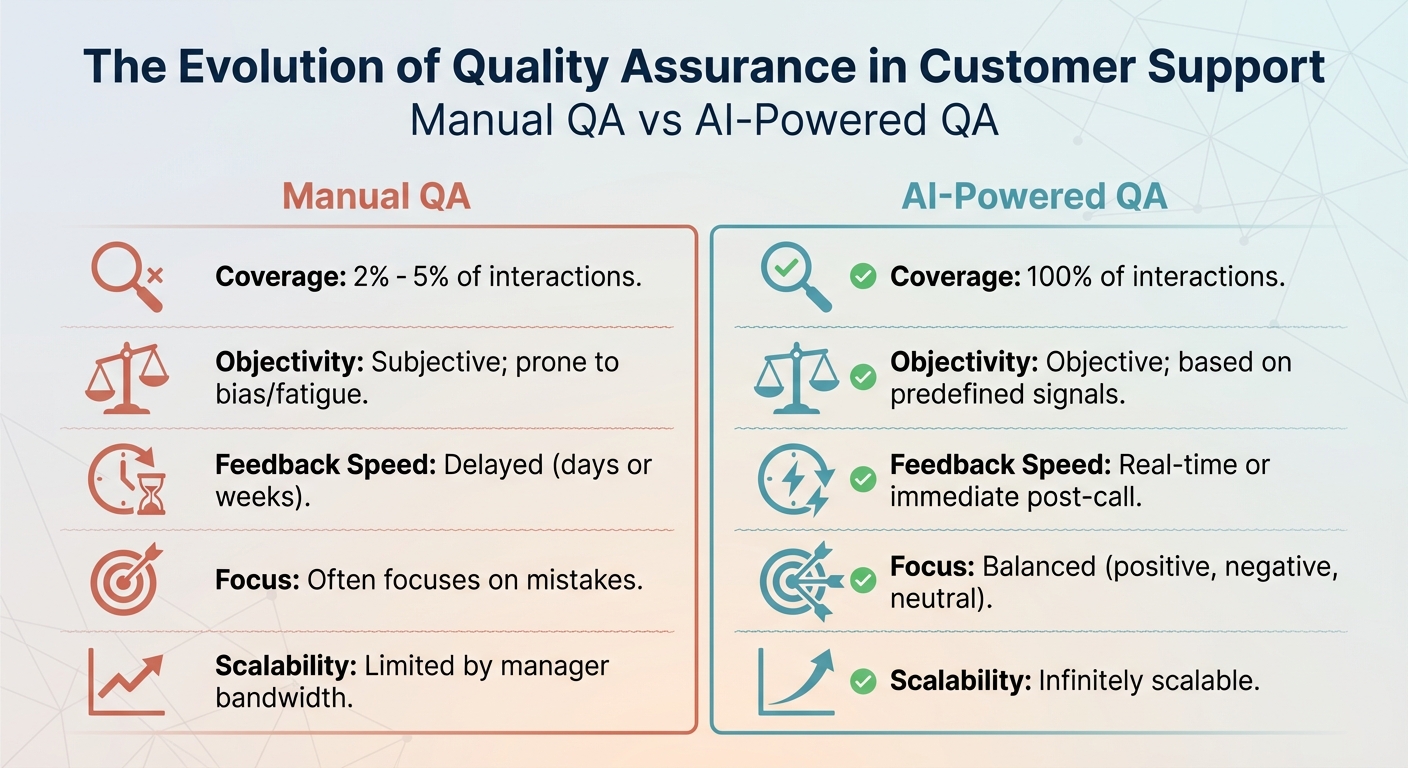
Manual QA vs AI-Powered QA: Key Differences in Agent Coaching
AI takes the guesswork out of traditional QA coaching by reviewing every single interaction, whether it’s via email, chat, or voice. This is a game-changer compared to manual reviews, which typically cover just 2% to 5% of interactions. By eliminating "sampling bias", AI ensures that agents aren’t unfairly judged based on one-off cases that happen to be reviewed.
It works by evaluating interactions using objective, predefined criteria like compliance, tone, response time, and overall effectiveness. This removes the variability caused by reviewer fatigue or personal interpretations, which can sometimes make feedback feel inconsistent or unfair. Instead of relying on one person’s perspective, agents receive feedback rooted in measurable, data-backed insights.
AI also ensures a balanced mix of feedback, capturing positive, negative, and neutral interactions. Advanced systems go beyond simple keyword analysis to assess behaviors like empathy and expectation-setting, offering a more nuanced view of agent performance. This approach builds trust by moving conversations from subjective opinions to fact-based discussions, backed by "irrefutable evidence" drawn from actual interactions.
Using Predictive CSAT and CES for Coaching
AI’s unbiased analysis doesn’t just stop at reviewing past interactions – it also predicts future customer satisfaction. Predictive metrics like Customer Satisfaction (CSAT) and Customer Effort Score (CES) allow managers to gauge how customers might rate their experience before surveys are sent. By analyzing patterns in interactions, AI predicts whether a customer is likely to be satisfied or frustrated, as well as how much effort they had to put in to resolve their issue. These insights are integrated directly into case lists, making it easy for managers to spot recurring issues that drive dissatisfaction or high effort.
This predictive approach shifts coaching from being reactive to proactive. For instance, if password reset requests consistently score poorly on effort, managers can coach agents to simplify that process. Predictive CES is especially useful for identifying resource-heavy cases, enabling managers to coach agents on reducing friction during interactions. Tackling high-effort cases in real time can help prevent customer dissatisfaction from escalating into churn.
Detecting First Contact Resolution Gaps
AI also excels at identifying gaps in First Contact Resolution (FCR), a metric that’s notoriously hard to measure accurately without automation. An agent might close a case as resolved, but if the customer returns days later with the same issue, that’s a missed FCR opportunity. AI analyzes case histories to detect these patterns, allowing managers to focus coaching on improving thoroughness and diagnosing root causes – without relying on agents to self-report or managers to comb through cases manually.
Take 2023 as an example: Coveo introduced AI-powered Auto QA to monitor 100% of interactions and pinpoint coaching opportunities. This led to a 53% reduction in Mean Time to Resolution (MTTR) and a 31% boost in same-day resolutions. The AI spotlighted where agents were falling short on resolving issues during the first contact, enabling highly targeted coaching that directly improved outcomes.
Similarly, Databricks used AI to monitor quality and flag cases needing intervention. This proactive strategy resulted in a 20% increase in CSAT and a 40% reduction in SLA misses by addressing issues before they escalated. By focusing on specific FCR gaps rather than vague feedback like "be more thorough", managers helped agents make meaningful changes that directly impacted customer satisfaction.
| Feature | Manual QA | AI-Powered QA |
|---|---|---|
| Coverage | 2% – 5% of interactions | 100% of interactions |
| Objectivity | Subjective; prone to bias/fatigue | Objective; based on predefined signals |
| Feedback Speed | Delayed (days or weeks) | Real-time or immediate post-call |
| Focus | Often focuses on mistakes | Balanced (positive, negative, neutral) |
| Scalability | Limited by manager bandwidth | Infinitely scalable |
How to Deliver Feedback That Improves Performance
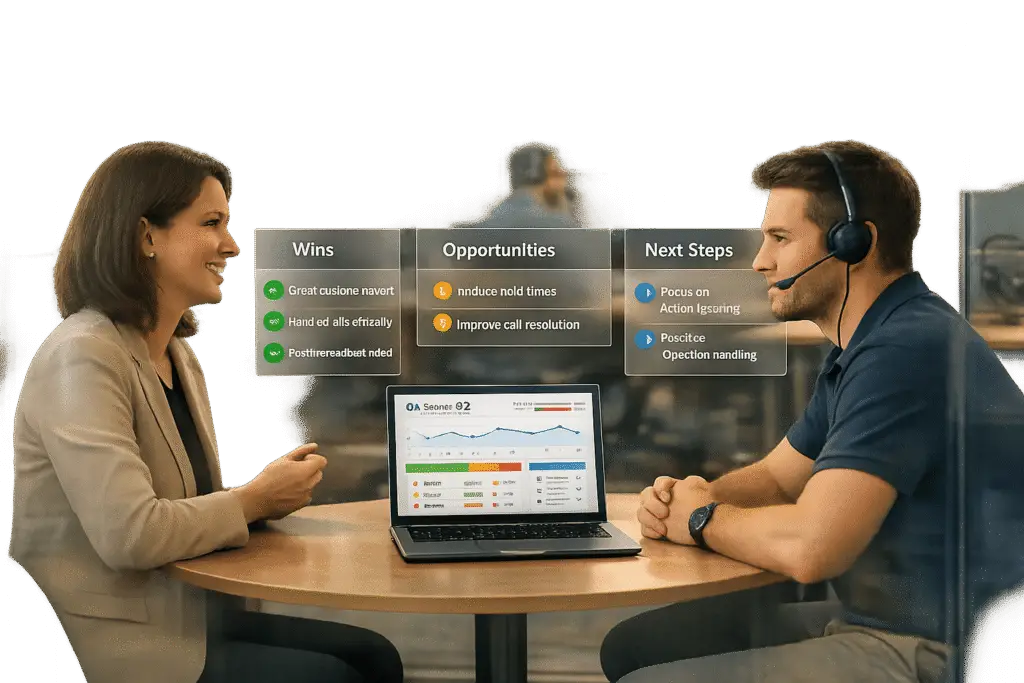
A well-structured coaching session can turn QA data from discouraging criticism into a roadmap for growth. By focusing on strengths, collaborating on improvement plans, and ending with recognition, managers can create an environment where employees feel supported. Considering that managers influence about 70% of the variance in employee engagement, using these strategies can make a significant difference.
Begin with Specific Strengths
Start by highlighting clear examples of what the employee is doing well. Recognizing "wins" and achievements early in the conversation helps set a positive tone and makes employees more open to feedback. Instead of vague praise like "You’re doing great", offer specific examples:
"Your response to the billing inquiry on January 15th was excellent – you acknowledged the customer’s frustration, explained the charge clearly, and offered a proactive solution."
Leverage QA scores, CSAT data, and FCR metrics to showcase successes. You can also encourage agents to self-assess their performance using the QA rubric. This approach turns the session into a two-way conversation rather than a top-down critique.
Create Improvement Plans Together
Once strengths have been acknowledged, shift the focus to areas for growth. The key to effective coaching is gaining the employee’s buy-in. Instead of handing down directives, work together to identify challenges and solutions. For example, you could ask, "What obstacles are you encountering with first contact resolution?" or "How can I support you in working more productively?"
Set clear, actionable goals using the SMART framework. Avoid vague feedback like "work on your tone" and replace it with something actionable:
"Review the empathy training module by Friday and practice acknowledging customer frustration in your next five interactions."
Collaborating on specific objectives ensures that employees feel involved and supported in their development.
Close with Recognition and Next Steps
How you wrap up a coaching session can determine whether employees leave feeling motivated or discouraged. End on a positive note by recognizing their effort and potential, and then outline clear next steps along with a follow-up date. For instance:
"I’m confident you can improve your FCR based on how quickly you’ve mastered empathy. Let’s review your progress on these three action items during our session on February 12th."
Setting a follow-up timeline not only creates accountability but also signals that their growth is a priority. Regular feedback has been shown to reduce employee turnover by about 14.9%.
In fast-paced environments, consider micro-coaching – short, focused sessions lasting 5–10 minutes that address a single skill. These brief check-ins help maintain momentum and provide frequent opportunities to celebrate small victories. This ongoing feedback loop fosters continuous improvement and real-time skill development. As Bob Nelson, author, puts it:
"While money is important to employees, what tends to motivate them to perform and to perform at higher levels is the thoughtful, personal kind of recognition that signifies true appreciation for a job well done."
sbb-itb-e60d259
Preventing QA Issues with Real-Time AI Assistance
Supportbench‘s AI Agent-Copilot takes a proactive approach by guiding agents during live interactions. This eliminates the need for after-the-fact coaching and ensures agents feel supported and confident while handling customer queries.
Instead of relying on QA reviews to catch mistakes later, the Copilot instantly pulls up relevant knowledge base articles, past cases, and CRM data. This means agents no longer waste time on manual searches and can access the most current information right when they need it.
"AI Agent Copilots proactively search knowledge bases, past cases, and CRM data, instantly surfacing relevant information. This drastically reduces the time agents spend manually searching for answers".
- Eric Klimuk, Founder and CTO of Supportbench
This real-time support also helps detect and address shifts in customer sentiment early on. For instance, sentiment analysis tools can alert agents when a customer’s tone turns negative, giving them the opportunity to adjust their approach immediately. At Databricks, Matt Blair, SVP of Support and Customer Success, leveraged AI-driven signals to intervene in customer interactions. This led to a 40% drop in SLA misses and a 20% boost in CSAT.
"[SupportLogic can] look at the actual content, process it intelligently, and generate alerts and signals to intercept and intervene at the right time".
- Matt Blair, SVP of Support and Customer Success at Databricks
This shift to real-time guidance does more than just resolve issues on the spot – it builds agent confidence. By providing support during interactions rather than critiquing them afterward, agents develop better habits in the moment. This approach transforms QA from a system that "catches mistakes" into one that prevents them altogether, fostering a culture of collaboration and boosting both morale and performance.
Automating QA Coaching Workflows
Manual QA reviews can drain a manager’s time. Traditional coaching often involves reviewing just one or two calls per agent each week, leaving room for bias and missed opportunities.
Automated workflows flip this process on its head. With AI analyzing every interaction – whether it’s voice, chat, or email – sampling bias disappears. Every agent gets a thorough, consistent evaluation. Instead of spending hours searching for coaching moments, managers receive AI-generated summaries that highlight key details like sentiment changes and actionable next steps. This shift lets managers focus on meaningful, development-driven conversations with their team rather than data collection.
Supportbench’s AI tools take this further by creating personalized feedback templates based on behavioral analysis. These templates pinpoint moments where agents excelled – like showing empathy or setting clear expectations – or where they could improve, such as skipping discovery questions. This approach ensures feedback is grounded in evidence rather than subjective opinions. For example, monday.com saw a 48% increase in quality audits and cut Average Handle Time by 30% using such methods.
AI-Generated Summaries and Feedback Templates
AI-generated summaries streamline paperwork. Supportbench’s AI Agent-Copilot captures key details from every interaction, including customer sentiment, resolution steps, and follow-ups. This eliminates the need for managers to listen to full recordings or sift through lengthy chat logs when preparing feedback.
Behavior-based feedback templates help standardize evaluations across teams. Instead of each manager interpreting standards differently, AI-assisted scorecards provide consistent criteria – like compliance, tone, and effectiveness – based on call transcripts. Managers can then adjust as needed, saving time and ensuring fairness. This consistency ensures agents are evaluated equally, no matter who performs the review.
At Tails.com, Daniel Jensen, a CX Quality and Training Team Leader, used AI-generated summaries alongside screen captures to identify 17 specific improvement areas for one agent. These included better use of keyboard shortcuts and navigation techniques, which ultimately cut the agent’s Average Handle Time by 50%. Jensen highlighted the trust this approach builds:
"Instead of just giving someone a hard number, I can have a more complete conversation with them about everything that factored into their QA score. We’re building agent confidence and rapport".
Additionally, a centralized coaching inbox ensures feedback is distributed fairly across the team. This system not only provides instant, actionable feedback but also helps managers assess how coaching affects overall morale.
Measuring Coaching Impact on Morale
Tracking the right metrics can reveal whether your coaching program is boosting or hurting team morale. Metrics like agent satisfaction and feedback review rates show whether agents are engaging with the coaching process. If feedback is ignored or satisfaction scores drop, it may be time to rethink your approach.
Fair and consistent coaching frequency is also key. Monitoring how often each manager gives feedback – and which agents are overdue for coaching – can prevent perceptions of bias. At Salesforce, using AI-powered coaching and sentiment analysis led to a 56% drop in escalation rates and a 13% productivity boost for managers and swarm leads.
| Metric to Track | Purpose for Morale & Performance |
|---|---|
| Predictive CSAT | Identifies performance dips before they affect surveys |
| Agent Satisfaction | Gauges how agents feel about the coaching process |
| Coaching Frequency | Ensures consistent feedback for all agents |
| Feedback Review Rate | Tracks agent engagement with feedback |
| First Contact Resolution | Measures whether agents can resolve issues effectively |
Dominic Christiano, Vice President of Support at Rubrik, summed up the mindset shift AI-powered coaching enables:
"We’re using SupportLogic not as a tool to punish, but as a coaching tool. To be proactive. Now we have the right behaviors understood by the whole team".
When coaching is fair, consistent, and backed by clear evidence, agents begin to see QA as a tool for growth rather than a source of stress.
Conclusion
Coaching with QA data doesn’t have to erode morale – it just requires a shift from punishment to support. By leveraging AI to analyze every interaction, you can eliminate bias and provide complete, trustworthy data. This creates a "single source of truth" that managers and agents alike can rely on.
AI brings value by identifying behaviors such as empathy or missed discovery questions, delivering personalized feedback that feels actionable rather than arbitrary. This approach helps build confidence and trust in the coaching process.
Using unbiased data as a foundation, effective coaching strikes a balance between constructive critique and recognition. By celebrating key wins alongside areas for improvement, QA evolves from being a stressor into a tool for collaborative growth. This shift enhances both performance and job satisfaction.
Taking it further, real-time AI assistance provides on-the-spot guidance during live interactions. This allows agents to tackle challenges immediately instead of waiting for delayed feedback. Paired with automated workflows that ensure consistent support for every agent, this method fosters continuous development and confidence.
FAQs
How can AI tools make QA evaluations more fair and unbiased?
AI tools bring a new level of objectivity to QA evaluations by removing much of the bias and subjectivity that can come with human judgment. These tools rely on measurable, data-driven insights to assess customer interactions, ensuring that evaluations are consistent across the board. By analyzing every interaction using specific criteria, AI ensures no detail is overlooked, and personal opinions don’t skew the results.
Features like sentiment analysis and automated workflows add even more depth. They help pinpoint trends and uncover performance issues across all interactions, giving a clear and comprehensive picture of how agents are performing.
AI also supports calibration efforts by allowing evaluators to compare scores across agents, ensuring consistency in assessments. This standardization promotes transparency and fairness, making the coaching process more equitable. With unbiased data guiding evaluations, these tools not only help improve performance but also build trust and motivation among agents.
How can I use QA feedback to coach agents without lowering morale?
To make QA feedback effective while keeping morale high, focus on constructive and supportive communication. Approach feedback as a chance for growth by offering clear, actionable suggestions instead of merely pointing out mistakes. Center the discussion on behaviors that can be adjusted, steering away from personal criticisms. This approach helps agents view feedback as a pathway to improvement, not as a judgment.
Encouraging a collaborative and open atmosphere can make a big difference. When agents feel safe discussing challenges and asking questions, feedback becomes a shared process. Tools like peer reviews or self-assessments can give agents a sense of ownership and reduce the top-down nature of feedback. Regular coaching sessions that celebrate progress and highlight achievements can further motivate agents, reinforcing the idea that they are growing in their roles.
You might also explore AI-driven tools for delivering feedback. These tools can automate and personalize the process, ensuring consistency and removing some of the emotional strain that critiques can bring. By combining positive reinforcement, ongoing support, and smart automation, you can build a coaching culture that energizes rather than discourages your team.
How can real-time AI tools boost agent performance and morale during customer interactions?
Real-time AI tools play a crucial role in improving agent performance by delivering instant, actionable insights during customer interactions. These tools can assess customer sentiment, recommend personalized responses, and even anticipate the next steps. The result? Agents can resolve issues more quickly and efficiently, creating a smoother experience for customers while boosting agents’ confidence by minimizing uncertainty in high-pressure scenarios.
On top of that, AI-powered coaching features provide real-time, tailored guidance, enabling agents to stick to best practices without having to wait for post-call feedback. By addressing challenges as they arise, these tools create a supportive atmosphere that promotes growth, reduces the need for escalations, and helps maintain strong team morale.