Data sovereignty matters. For Canadian and EU businesses, it’s not just about where data is stored – it’s about who controls it. Regulations like GDPR and PIPEDA demand strict compliance, and failure can mean hefty fines or lost trust. This is especially critical as AI becomes more integrated into helpdesk solutions.
Here’s a quick look at five helpdesks designed for compliance and efficiency:
- Supportbench: Strong compliance with GDPR/PIPEDA, AI-powered automation, and pricing starting at $32/agent/month.
- Oracle Service (EU Sovereign Cloud): EU-hosted with advanced AI tools and strict legal safeguards against non-EU access.
- Kiteworks Platform: Focuses on encryption and private data networks, offering secure file sharing and collaboration.
- OVHcloud: EU and Canadian data centers with scalable AI support and no exposure to U.S. laws.
- Hetzner Cloud: German-based, GDPR-compliant with options for self-hosted AI models and competitive pricing.
These platforms ensure data stays within legal boundaries while offering tools to streamline support operations.
Quick Comparison:
| Helpdesk | Data Residency | AI Features | Starting Price | Compliance |
|---|---|---|---|---|
| Supportbench | Canada/EU | [AI ticket routing], knowledge base, alerts | $32/agent/month | GDPR, PIPEDA |
| Oracle Service | EU (Frankfurt, Madrid) | Generative AI, no-code workflows | Enterprise pricing | GDPR |
| Kiteworks | On-prem/private cloud | Secure file transfer, encryption | Enterprise pricing | GDPR, PIPEDA |
| OVHcloud | EU, Canada | AI-ready infrastructure | Varies | GDPR |
| Hetzner Cloud | Germany, Finland | Self-hosted AI models | ~$3.59/month | GDPR |
These solutions balance compliance with AI-driven support tools to meet the needs of regulated businesses.
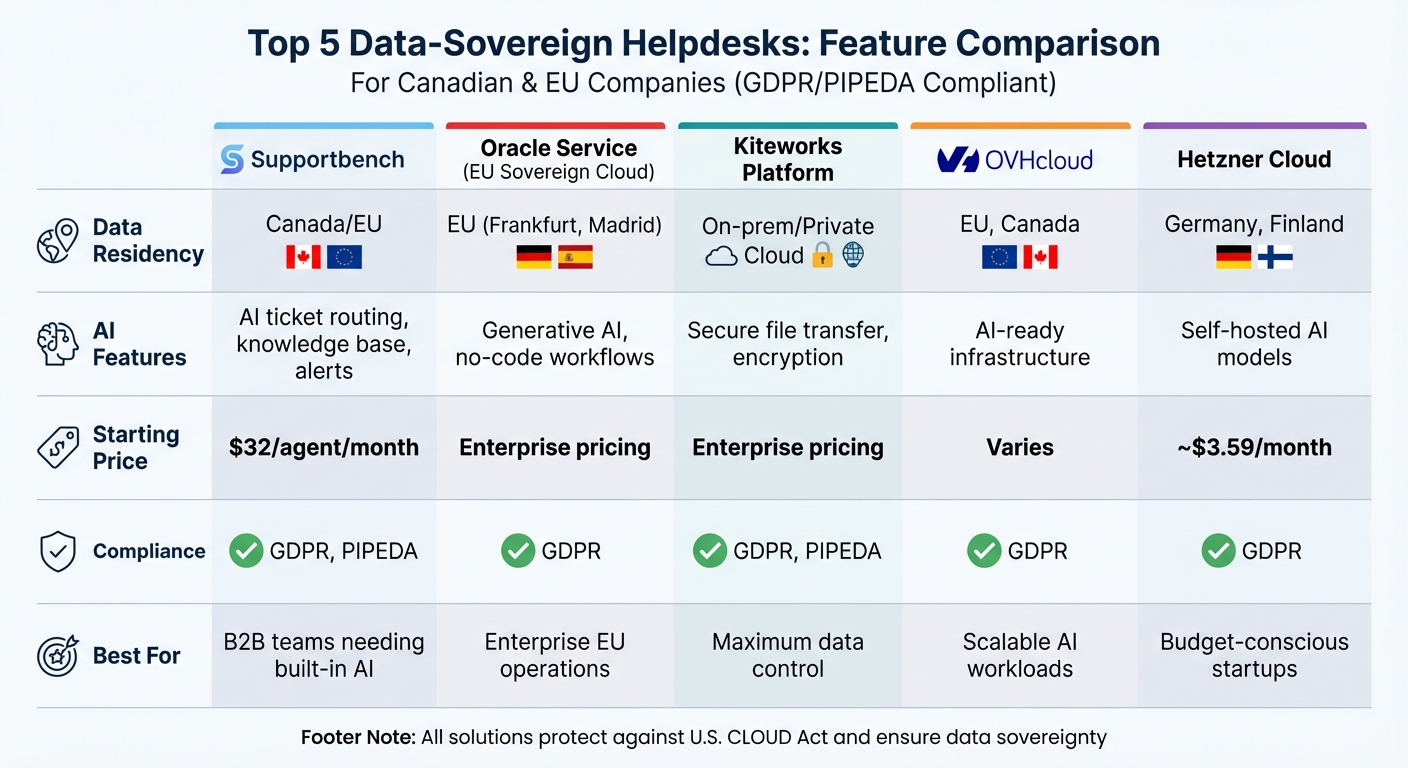
Data-Sovereign Helpdesk Solutions Comparison for GDPR and PIPEDA Compliance
Why Canadian and EU Companies Need Data-Sovereign Helpdesks
Data sovereignty is a critical concern for businesses operating in Canada and the EU, especially with regulations like GDPR and PIPEDA setting strict rules on how customer support data is handled. For instance, GDPR grants individuals the "right to be forgotten" and the right to data portability. This means helpdesks must be capable of deleting specific tickets, notes, or attachments upon request [4]. Similarly, PIPEDA requires Canadian businesses to be transparent about data processing and to delete data promptly when necessary.
Failing to comply with these regulations can lead to hefty fines. GDPR violations can result in penalties of up to €20 million or 4% of a company’s annual global revenue – whichever is higher. Additionally, organizations must report data breaches to both authorities and affected individuals [3]. For B2B companies managing sensitive client data across departments, even one compliance issue can erode trust significantly.
"A GDPR-compliant help desk must offer EU-based hosting or on-premise deployment, tools to export, delete, and edit personal data upon request, and security features like individual login credentials and permission groups." – HelpSpot [4]
Data-sovereign helpdesks tackle these challenges by offering regional data residency and privacy-focused tools. For example, platforms with infrastructure based in Frankfurt for EU companies or in specific Canadian regions ensure that ticket data stays within the appropriate jurisdiction [5]. Features like automatic redaction of sensitive information, such as credit card numbers and Social Security numbers, further support compliance with PCI standards and privacy regulations [5].
In collaborative B2B environments, additional safeguards like permission groups and collision detection are essential. Permission groups limit access to sensitive information based on user roles, while collision detection ensures multiple agents don’t send conflicting responses to the same client [5]. These features not only enhance security but also improve team efficiency – key factors in the data-sovereign helpdesks discussed below.
sbb-itb-e60d259
1. Supportbench
Data Residency and Sovereignty Compliance (GDPR/PIPEDA)
Supportbench ensures that Canadian data stays within the country by utilizing dedicated Canadian infrastructure. For EU accounts, the platform provides a formal Data Processing Addendum to meet GDPR and PIPEDA requirements [6][7][9]. It supports key GDPR provisions such as the Right to be Forgotten (data erasure), data portability, and Subject Access Requests [7].
"We maintain a comprehensive data protection program that includes technical and organizational measures designed to protect customer data against unauthorized access." – Supportbench [6]
On top of compliance, Supportbench integrates AI to streamline support ticket management.
AI-Driven Workflows and Automation
AI features in the platform handle tasks like ticket routing, categorization, SLA escalations, sentiment analysis, and predictive scoring. This allows agents to manage large ticket volumes more effectively, as highlighted by Wolseley in May 2025 [8]. The AI-driven knowledge management system also surfaces relevant internal and public articles based on ticket context, cutting down on research time. Additionally, AI helps detect first contact resolution and flags at-risk accounts before issues escalate.
These automated workflows pair seamlessly with Supportbench’s B2B collaboration tools, enabling smooth, multi-stakeholder support.
B2B Support Features (SLAs, Secure Ticketing, Collaboration)
Supportbench offers a essential B2B support tools with features like a 360-degree ticket view, organizational hierarchy management, dynamic SLAs, and event-driven escalations [10]. Its collaboration tools allow users to involve others by subscribing them for email and mobile notifications on specific tickets, ensuring everyone stays in the loop. Retention and "at risk" dashboards further help identify customers who require extra attention, contributing to claims of increasing revenue by 25% through reduced churn and operational costs [10].
Scalability and Pricing
Supportbench starts at $32 per agent per month, with enterprise features included from the beginning. By consolidating support, experience, and success tools, the platform can reduce tech stack expenses by up to 75%. Special pricing is available for startups and non-profits, making it an appealing choice for a range of businesses [9][10].
2. Oracle Service Helpdesk (EU Sovereign Cloud)
Data Residency and Sovereignty Compliance (GDPR/PIPEDA)
Oracle’s EU Sovereign Cloud is built on an isolated infrastructure, ensuring that all customer data stays within Frankfurt, Germany, and Madrid, Spain. Technical and contractual safeguards prevent any data transfers outside these regions unless explicitly authorized [11].
A standout feature of this service is its legal framework. Oracle has established dedicated EU legal entities designed to contest data access requests from non-EU authorities [12]. Additionally, all support activities and data center operations are handled exclusively by personnel residing in the EU [11].
This setup is particularly beneficial for businesses managing EU customer data, as it aligns with GDPR requirements and addresses Schrems II and NIS 2 regulations. Transitioning from Oracle’s European Union Restricted Access (EURA) to the Sovereign Cloud is a straightforward process, typically completed within 6 to 12 hours [12].
Oracle also leverages advanced AI-driven workflows to enhance its strict data control measures and streamline support services.
AI-Driven Workflows and Automation
In September 2025, Oracle introduced OCI Generative AI and AI agents specifically for the EU Sovereign Cloud [12]. These include specialized agents capable of automating tasks like ticket categorization and resolution. For more complex scenarios, these agents can work together in "Agentic Flows" to handle multi-step processes [13].
"With these new capabilities, Oracle is adding AI-powered insights, authoring, and recommendations across the service lifecycle to help organisations more efficiently deliver service that elevates the entire customer experience." – Jeff Wartgow, VP, Oracle Service [15]
The platform also features a no-code workflow automation tool, allowing business users to streamline help desk operations using simple, plain-English commands. Generative AI tools can transcribe and summarize customer interactions, while semantic search powered by Large Language Models helps technicians find answers using natural language queries [13][15]. Importantly, all AI prompts and data processing are confined within EU borders [16].
These AI capabilities enhance Oracle’s already robust support offerings, making it easier for businesses to deliver efficient and effective service.
B2B Support Features (SLAs, Secure Ticketing, Collaboration)
Oracle Service provides financially backed SLAs that align with its public cloud standards [14][11]. For companies with stringent security requirements, OCI External Key Management allows encryption keys to be stored in dedicated hardware security modules (HSMs) outside the cloud [11]. With dual-region operations in Frankfurt and Madrid, the system ensures localized disaster recovery and business continuity, keeping all data within EU borders [11].
Scalability and Pricing
Oracle’s EU Sovereign Cloud is priced the same as its commercial public cloud regions, with no added cost for sovereignty [14][11]. Businesses can choose between pay-as-you-go or annual commitment plans under the Universal Credit Model. They can also take advantage of Support Rewards and "Bring Your Own License" programs [12].
A new Cross-Realm Credit Sharing feature enables companies to apply unused commercial cloud credits toward the EU Sovereign Cloud, minimizing waste [12]. To meet growing demand for AI workloads, Oracle has expanded its infrastructure – powered by NVIDIA H200 GPUs – by more than 400% since launching in 2023 [16][12].
3. Kiteworks Platform
Data Residency and Sovereignty Compliance (GDPR/PIPEDA)
Kiteworks uses a "Private Data Network" architecture to ensure both physical data residency and cryptographic sovereignty. A standout feature is that customers have exclusive control over their encryption keys, which are securely stored in hardware security modules. These keys are inaccessible even to Kiteworks itself. This setup ensures that, even under legal pressure from foreign governments, decryption of customer data is not technically possible [18].
The platform offers flexible deployment options – on-premises, private cloud (IaaS), or Kiteworks-hosted environments – allowing Canadian and EU organizations to keep their data within specific jurisdictions [17]. To meet data portability requirements under GDPR and PIPEDA, Kiteworks provides a unified interface for secure data access and transfer [17].
"Data sovereignty is no longer just about geography; modern requirements demand verifiable control over data." – Dario Perfettibile, EMEA GM of GTM and Customer Operations, Kiteworks [18]
Kiteworks’ 2025 data reveals that 1 in 3 organizations faced a data sovereignty incident, with rates of 23% in Canada and 32% in Europe. Additionally, 21% of Canadian organizations view the U.S. CLOUD Act as a direct threat to their data sovereignty [18]. To address such concerns, Kiteworks provides automated compliance reporting with preconfigured templates for GDPR and PIPEDA. These templates consolidate logs into streamlined, one-click audit reports [19].
Beyond its rigorous data controls, Kiteworks enhances day-to-day operations with secure communication and collaboration tools, ensuring both efficiency and compliance.
B2B Support Features (SLAs, Secure Ticketing, Collaboration)
Once data sovereignty is secured, Kiteworks equips support teams with advanced tools for collaboration and compliance. The platform integrates secure file sharing, encrypted email, managed file transfer, and secure web forms into a single control plane [21]. Its SafeEDIT feature allows external partners or customers to view and edit documents without transferring files outside the organization’s secure environment, reducing risks of data leaks [20].
Kiteworks also integrates seamlessly with Microsoft 365 and Office applications, enabling support teams to maintain secure workflows within familiar tools [20]. A centralized CISO Dashboard provides real-time visibility into file activity with immutable audit trails, detailing who accessed or shared files, when, and where [17]. The platform helps organizations meet nearly 90% of CMMC 2.0 compliance requirements [19] and safeguards over 100 million users worldwide [18].
"The Kiteworks platform is a huge security and efficiency story for us. We have achieved the highest levels of data security and control and our employees are able to work smarter and faster with external agencies, vendors, and partners." – Brian Goshorn, Sr. IT Analyst, County of Sacramento [19]
Kiteworks simplifies compliance by consolidating logs from multiple systems into one-click audit reports, making regulatory adherence more efficient [19].
4. OVHcloud Helpdesk Solutions
Data Residency and Sovereignty Compliance (GDPR/PIPEDA)
OVHcloud’s global infrastructure gives you the flexibility to choose data centers that align with GDPR and PIPEDA regulations. This setup ensures local control over data, which is crucial for meeting Canadian and EU regulatory requirements.
The platform’s architecture is designed to block foreign government access, keeping data within compliant jurisdictions. OVHcloud has structured its operations so that U.S. entities have no technical access to data stored in European data centers [23]. To further protect European data, technical support is provided exclusively by entities within the EU or nations approved by the European Commission for data adequacy, such as Canada [23].
"At OVHcloud, we believe that the ability to exercise our digital sovereignty is key to ensuring our users’ freedom. This is to keep control over our future, maintain job security, and uphold our European values." – OVHcloud [23]
By vertically integrating its operations, OVHcloud minimizes reliance on third parties, reinforcing data sovereignty. It also holds certifications like the SecNumCloud Security Visa (validated by ANSSI), HDS for healthcare data, and ISO 27001/27701 [23]. Any access to customer data for support purposes requires explicit consent and is fully traceable [23].
These stringent compliance measures create a secure foundation for OVHcloud’s advanced AI offerings.
AI-Driven Workflows and Automation
OVHcloud builds on its compliance strengths to support cutting-edge AI workflows. The platform offers a secure environment for deploying generative AI and machine learning models, ensuring proprietary algorithms remain under your legal jurisdiction [24]. Importantly, OVHcloud pledges never to use customer data for training or enhancing its own AI models [22].
A great example of this is Swedish company Ebbot. In Q1 2024, Ebbot transitioned from a U.S.-based provider to OVHcloud’s European data centers to adhere to Schrems II and GDPR requirements. Leveraging OVHcloud’s Kubernetes clusters and NVIDIA Tensor Core H100 GPUs, Ebbot scaled its AI-powered conversational platform to serve clients in banking, insurance, and the public sector. The results were impressive: a twofold increase in platform interactions during Q1 2024, surpassing the total interactions recorded in 2023 [26].
"The platform is in high demand, with a twofold increase in interactions during the first quarter of 2024, exceeding the total number of interactions in 2023." – Mikael Eriksson, CTO of Ebbot [26]
Using open standards like OpenStack and Kubernetes, OVHcloud enables seamless workload migration without vendor lock-in [24]. Additionally, its Disaster-Recovery-as-a-Service ensures automated, secure backups and recovery within the same regional jurisdiction, safeguarding critical business operations [24].
B2B Support Features (SLAs, Secure Ticketing, Collaboration)
OVHcloud complements its compliance and AI capabilities with robust support tools tailored for business needs. Its infrastructure includes bare-metal servers, VPS, and Private Cloud solutions, all designed for high-resilience operations [22]. Integrated Veeam backup options and Anti-DDoS protection further enhance service reliability [22]. Managed Kubernetes clusters simplify the deployment, scalability, and resilience of support applications, removing the need for manual management.
For industries with stringent regulations, OVHcloud’s "Public Cloud Trusted Zones" ensure adherence to EU and Canadian data protection standards. High-performance GPU instances, such as NVIDIA Tesla V100 and Tensor Core H100, empower teams to run proprietary large language models for automated customer interactions while maintaining strict data privacy [22][26].
OVHcloud ensures complete data ownership for its clients. Its flexible pricing model allows businesses to scale efficiently while managing costs [25][26]. With 24/7 availability and the ability to select specific data center locations, OVHcloud supports global operations while maintaining local data control for sensitive interactions.
5. Hetzner Cloud Support Tools
Data Residency and Sovereignty Compliance (GDPR/PIPEDA)
Hetzner, a German company, operates under the German Federal Data Protection Act (BDSG) and the GDPR. This legal framework shields it from U.S. surveillance laws like the CLOUD Act and National Security Letters. For businesses prioritizing strict data sovereignty, this is a significant advantage. Users can store their data exclusively in EU-based data centers located in Nuremberg, Falkenstein (Germany), or Helsinki (Finland). For data stored in these locations, Hetzner only responds to requests and court orders from German or Finnish authorities. U.S. authorities, on the other hand, must rely on Mutual Legal Assistance Treaties (MLAT), which are subject to local court reviews [28].
"Hetzner is a German company subject to German privacy law and GDPR – not US surveillance laws, not the CLOUD Act, not National Security Letters." – State of Surveillance [27]
Hetzner offers a standard Data Processing Agreement (DPA) under Article 28 of the GDPR, with its technical and organizational security measures audited annually by TÜV Rheinland. To enhance security, Hetzner requires identity verification for account creation, reducing the risk of anonymous signups and aligning with German legal standards.
These strong safeguards provide a solid foundation for integrating modern, AI-driven support tools.
AI-Driven Workflows and Automation
Hetzner’s infrastructure supports AI-powered tools like Zammad 7.0 and OpenClaw, offering businesses a compliant and secure environment to leverage AI technology. Hosting Zammad on Hetzner enables features such as AI-driven ticket summaries, a writing assistant for drafting replies, and automated ticket categorization and routing [31]. Additionally, Hetzner supports running local Large Language Models (LLMs) via Ollama, including Llama and Mistral. This ensures that all AI processing stays within your infrastructure, adhering to stringent data sovereignty requirements [30]. This approach aligns with the EU AI Act, which emphasizes maintaining a "human in the loop" for AI operations [1].
"Companies should not be forced into an impossible choice between adopting AI technology and protecting their data." – Martin Edenhofer, Founder and CEO, Zammad [1]
OpenClaw can be deployed on Hetzner infrastructure in under five minutes, offering seamless integration with platforms like Slack, Discord, WhatsApp, and Telegram [30]. Hetzner’s cloud servers also deliver impressive cost efficiency, providing 2 to 3 times the compute performance per dollar compared to major U.S. providers [30].
Scalability and Pricing
Hetzner combines compliance and powerful AI capabilities with competitive pricing. Its entry-level cloud plan (CX11) offers 2 GB of RAM for just $3.59 per month (€3.29), which is approximately 143% cheaper than comparable U.S. plans [27]. Billing is flexible, allowing hourly or monthly options without requiring prepayments. Here’s a breakdown of key plans:
| Plan | RAM | CPU | Storage | Monthly Price |
|---|---|---|---|---|
| CX11 | 2GB | 1 vCPU | 20GB | ~$3.59 |
| CX21 | 4GB | 2 vCPU | 40GB | ~$5.88 |
| CX31 | 8GB | 2 vCPU | 80GB | ~$10.46 |
| CX41 | 16GB | 4 vCPU | 160GB | ~$19.63 |
Additional features include block storage at $0.048 per GB per month and snapshots for backups at $0.013 per GB per month [27]. For AI workloads, the CX33 instance (4 vCPUs, 8 GB RAM) starts at $5.44 per month, offering sufficient power for running AI models and managing high-volume support tasks [29][30].
B2B Support Features (SLAs, Secure Ticketing, Collaboration)
Hetzner complements its compliance, AI tools, and pricing with robust support features tailored for B2B operations. Customers benefit from 24/7 technical support for its German and Finnish data centers, with assistance available in English and German [32]. Support requests are handled through a ticketing system in the Hetzner Console, while telephone support for dedicated servers requires secure authentication via a telephone password or a one-time password (OTP).
Hetzner also provides extensive resources, including over 350 tutorials, a community forum for user discussions, and a real-time status page for maintenance and fault updates [32]. For businesses scaling their operations, resource limit increases can be requested via the "Limits" tab in the project overview. These requests are processed manually, and responding to existing tickets rather than calling is recommended to maintain a clear audit trail.
Customer master data remains local – even when using Hetzner’s U.S. or Singapore locations [29]. Additionally, Hetzner is certified under DIN ISO/IEC 27001:2022 and ensures 99.9% uptime for its German-engineered infrastructure [30].
Feature Comparison Table
The table below highlights key features of leading data-sovereign helpdesk solutions, focusing on compliance, AI capabilities, pricing, and operational features. This comparison is particularly useful for Canadian and EU companies navigating GDPR and PIPEDA requirements.
| Solution | Data Residency Options | AI Features | Starting Price (USD/month) | Compliance with GDPR/PIPEDA |
|---|---|---|---|---|
| Supportbench | Flexible deployment options to meet regional compliance needs | Built-in AI copilot, automated responses, case summaries, AI-powered knowledge base article creation, and predictive CSAT/CES | From $32 per agent | Meets GDPR and PIPEDA requirements |
| Oracle Service (EU Sovereign Cloud) | EU Sovereign Cloud (isolated from non-EU operations) | AI-assisted routing, automated case categorization, and knowledge recommendations | Custom enterprise pricing | Certified for GDPR compliance |
| Kiteworks Platform | On-premises or private cloud (customer-controlled) | Limited native AI with a focus on secure file transfer and robust data governance | Custom enterprise pricing | Designed for regulated industries and GDPR-compliant |
| OVHcloud Helpdesk Solutions | EU data centers (France, Germany); Canadian data centers available | Basic automation via integrated tools with limited native AI capabilities | Varies by integrated solution | GDPR-compliant under EU data protection laws |
| Hetzner Cloud Support Tools | Data centers in Germany (Nuremberg, Falkenstein) and Finland (Helsinki) | Supports self-hosted AI integrations (e.g., via Zammad v7.0) with options for open-source models like Meta Llama and Mistral | Varies (infrastructure pricing applies separately) | Adheres to German and EU data protection standards |
Supportbench stands out with its built-in AI features available right from the start and straightforward pricing that scales with team size. Each solution strikes a different balance between innovation and data sovereignty, offering companies flexibility in choosing the option that aligns with their operational and compliance needs.
Conclusion
Selecting a helpdesk with strong data sovereignty features does more than just keep you compliant – it protects your business from legal risks and improves how efficiently you operate. For businesses in Canada and the EU, storing data within specific borders is crucial to limit access by foreign governments under laws like the US Patriot Act [5]. This is especially important when handling customer data governed by regulations like GDPR or PIPEDA.
Look for a platform that offers deployment options tailored to meet regional compliance needs. Make sure your provider keeps all data, including backups, within the required borders and includes built-in tools to handle data subject requests. Features like data deletion, anonymization, and export can dramatically simplify audits, saving time and effort [2][5].
Once compliance is addressed, shift your focus to security. In today’s B2B environment, security and efficiency go hand in hand. Features such as SOC 2 certification, encryption (both at rest and in transit), automatic redaction of sensitive information like credit card numbers and SSNs, and two-factor authentication are non-negotiable [5]. If the platform uses AI, ensure capabilities like smart drafting, automated categorization, and summaries operate securely within the system , often utilizing AI-driven KB article creation, without requiring data to be sent to third-party processors.
Operational functionality is just as important for B2B teams managing complex customer accounts. Verify that the platform supports multi-brand management, live CRM lookups, and scalable workflow automation. Even implementing a self-service knowledge base can cut support requests by 20% or more, allowing your team to focus on more strategic customer interactions [5].
Start by confirming that the platform offers physical data residency in your required region. Then, evaluate its privacy tools for tasks like data deletion and anonymization. Check whether the vendor employs a dedicated Data Protection Officer and whether their infrastructure meets industry-specific certifications [2]. As previously mentioned, platforms that integrate AI workflows effectively can help you maintain compliance while also elevating customer support. Balancing these priorities ensures your support operations meet regulatory requirements and drive business growth.
FAQs
What is “data sovereignty” for a helpdesk?
Data sovereignty in the context of a helpdesk refers to the requirement that data is stored, processed, and managed in alignment with the laws of the country where it is collected. This is crucial for adhering to privacy regulations like GDPR in the European Union or PIPEDA in Canada. These laws often mandate that data remains within specific regions, such as within Canada or the EU, to ensure compliance.
How can I ensure AI features don’t send ticket data outside Canada or the EU?
When evaluating a platform, take a close look at how it manages hosting and data. Opt for solutions that offer regional data residency, such as data centers located in Canada or the EU, and ensure they provide local AI processing.
Find out where your data will be stored, the encryption methods in place, and the certifications they hold for compliance. It’s also essential to ask vendors whether AI processing happens locally or in external environments. Make sure they can guarantee that no data will be transferred outside your region without your explicit permission.
What helpdesk features make GDPR/PIPEDA deletion and export requests easier?
Helpdesk tools designed for GDPR and PIPEDA compliance make handling data deletion and export requests much simpler. Key features include:
- Compliant Data Management Tools: These help ensure that user data is handled and processed in line with legal requirements.
- Regional Data Center Storage: Storing data within specific regions aids in meeting jurisdictional regulations.
- Strong Encryption Standards: Robust encryption protects sensitive user information during storage and transfer.
- Transparent Data Handling Practices: Clear policies on how data is used and managed build trust and align with legal expectations.
These features streamline the process of securely managing user data requests while adhering to privacy laws.
Related Blog Posts
- Which helpdesk tools are built outside the United States (UK/EU/Canada/Australia)?
- How do Canadian data residency requirements affect helpdesk selection?
- Which helpdesks offer Canadian hosting – and what questions should you ask vendors?
- What’s the best helpdesk for Canadian B2B companies that need strict data location controls?