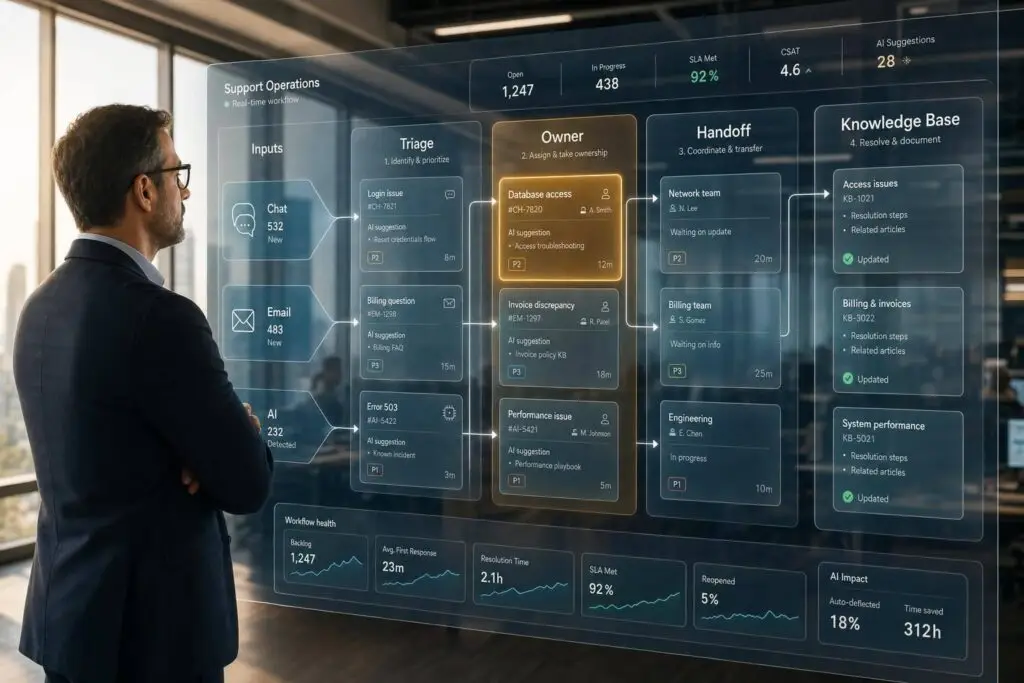
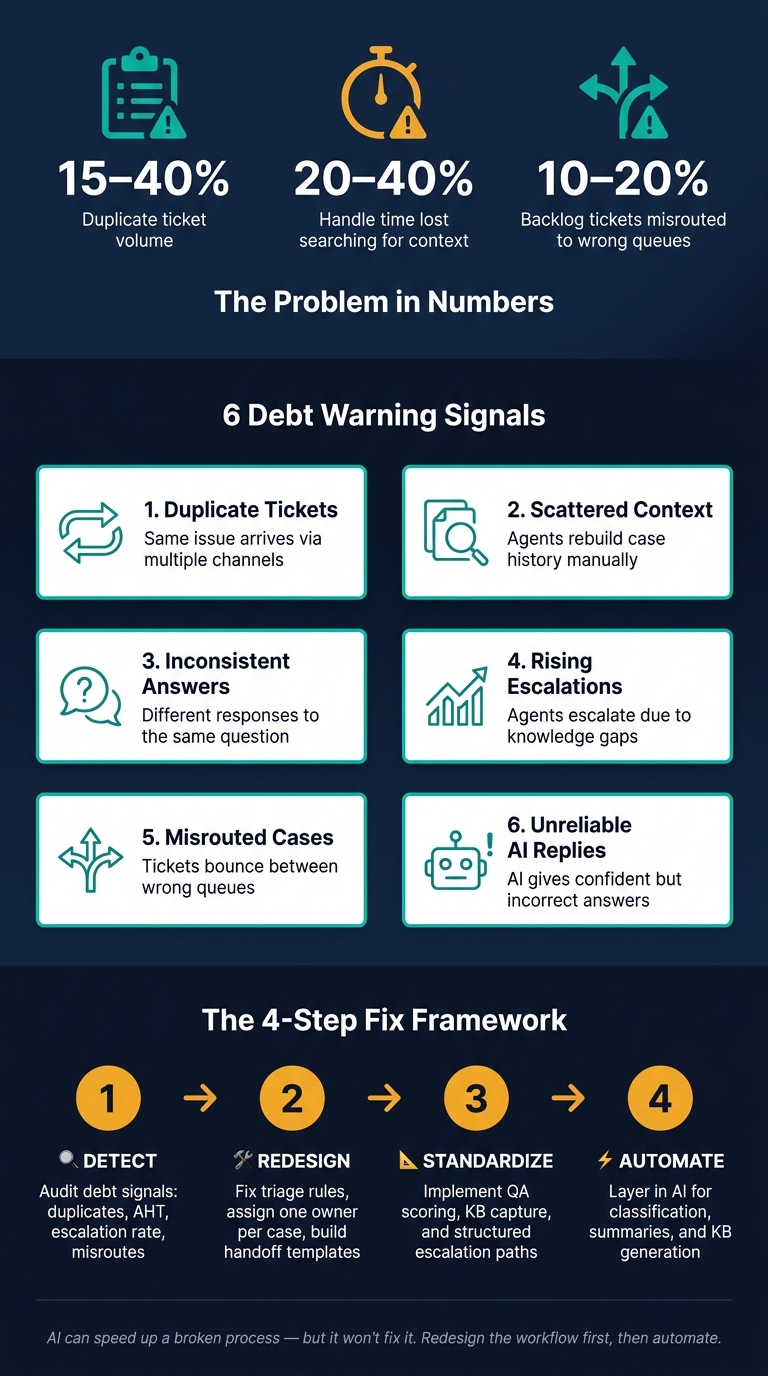
Support debt shows up when my team spends more time chasing context than solving issues. In B2B support, that can mean 15% to 40% duplicate tickets, 20% to 40% of handle time lost to searching for history, and 10% to 20% of backlog landing in the wrong queue.
Here’s the short version: if conversations live across chat, email, Slack, and AI tools with no clear owner, costs go up and answer quality drops. I’d fix that by tightening triage, assigning one owner per case, using structured handoffs, reviewing AI answers, and turning solved issues into KB articles and runbooks.
If I were auditing this today, I’d look for:
- Duplicate tickets from the same customer across channels
- Long handle time caused by searching Slack, old tickets, and inboxes
- More escalations because agents don’t trust the docs
- Cases bouncing between teams with no clear owner
- Mixed answers to the same question
- AI replies that sound sure, but are wrong
Channel sprawl also shows up on the invoice. If Slack has quietly become where your support actually happens, run the seat math before you scale headcount — the cost of per-user Slack pricing for scaling support teams shows where that model stops being the cheap option.
The article’s core point is simple: AI can speed up a bad support process, but it won’t fix it. The fix is to clean up the workflow first, then automate it.
A quick snapshot of the problem and fix:
| Problem | What it looks like | What I’d do |
|---|---|---|
| Duplicate work | Same issue arrives in chat and email | Match identities and unify case history |
| Scattered context | Agents rebuild the story by hand | Use one case timeline and AI summaries |
| Wrong routing | Tickets land in the wrong queue | Set rule-based triage with priority levels |
| Weak ownership | No one drives the case to closure | Assign one owner and set SLA alerts |
| Bad handoffs | Tier 2 restarts the investigation | Use a handoff template with steps, impact, and prior work |
| Stale knowledge | Agents and AI pull different answers | Turn solved cases into KB updates and review them |
So if support feels busy but not clean, that’s usually the signal. Tickets are moving, but the system is leaking time, money, and trust at every handoff.
How to Audit & Fix Conversational Support Debt: A 4-Step Workflow
Section 1: Warning signs that conversations are creating debt
Duplicate work, scattered context, and inconsistent answers
One of the first signs shows up in the ticket-to-customer ratio. Customers reopen the same issue in chat, then send it again by email[3]. That kind of duplicate work adds up fast.
Duplicates alone can make up 15% to 40% of total ticket volume[10]. In plain English, a big chunk of the team’s day goes to solving the same problem more than once across chat, email, and AI-assisted replies.
The cost doesn’t stop there. Once the same issue comes in twice, agents have to piece the story back together. They spend 20% to 40% of handle time digging through Slack, old tickets, and tribal knowledge instead of fixing the issue[10]. That’s not an agent problem. It’s a workflow problem.
When knowledge lives in stale KB articles, Slack DMs, and email threads, people pull answers from different places. The result is different answers to the same question. And that chips away at trust faster than slow response times.
Rising escalations and unresolved multi-stakeholder cases
The next red flag is escalation volume. When answers don’t line up, escalation pressure usually climbs right after. Rising escalations often point to a knowledge gap or an ownership gap[7]. Frontline agents can’t find internal documentation they trust, so they move cases up the chain rather than risk giving the wrong answer[1].
Weak or undocumented triage rules make the problem worse. In those setups, 10% to 20% of backlog tickets end up in the wrong queue and get bounced from team to team[10]. In multi-stakeholder B2B cases, that often means no single person owns the case from start to finish.
If reassignment rate is going up and triage lead time is getting longer, the issue isn’t agent effort. The routing and ownership model is broken.
Debt signals table: root causes, impact, and metrics
| Debt Signal | Root Cause in Conversational Workflows | Impact | Metric to Monitor |
|---|---|---|---|
| Duplicate work | Siloed channels; weak identity matching[3] | Paying twice for one resolution; agent frustration | Ticket-to-customer growth ratio[3] |
| Scattered context | Missing unified timeline; broken AI-to-human handoffs[3][6] | High customer effort; repeated explanations | Reassignment rate; Average Handle Time (AHT)[8] |
| Inconsistent answers | Unstructured knowledge; stale source articles[7] | Erosion of trust; high recontact rates | Repeat contact rate (>20% indicates resolution failure)[9] |
| Rising escalations | Knowledge failure; unclear ownership[7][1] | Specialist burnout; stalled resolutions | Escalation rate; triage lead time[8] |
| Misrouted tickets | Weak triage rules; undocumented escalation paths[10] | Resolution latency; cases bouncing between teams | Reassignment rate; misroute frequency[10] |
| Knowledge search time | Knowledge trapped in Slack, inboxes, and memory[7] | Longer resolution times; reduced throughput | Search time % of handle time[10] |
These signals usually point back to the same few cracks: routing, ownership, and knowledge gaps. The next section gets into where those failures begin.
sbb-itb-e60d259
Section 2: Where conversational debt comes from in support operations
Those warning signs usually come back to three core breakdowns: routing, ownership, and knowledge capture.
Weak routing, unclear ownership, and ad hoc handoffs
Conversation debt starts to build when routing and ownership fall behind channel growth. A lot of teams roll out chat or messaging with default routing rules, then never revisit them as the support setup shifts. Over time, rules stack on top of rules, nobody can explain how they work in plain English, and cases bounce from queue to queue because there was never a clear path to the right owner [4][6].
Ownership problems make that even worse. If nobody is clearly responsible for closing the loop, conversations get stuck at half-answers. And when a case moves from bot to human – or from one team to another – the owner has to stay clear the whole way through. If handoff notes are thin or missing, agents have to piece the case back together by hand before they can even start solving it [2].
Poor documentation, limited QA, and missing knowledge capture
Things also fall apart when answers stay buried in Slack threads or in one person’s memory. At that point, teams can’t reuse what they’ve learned, and they can’t check it later either [11][7]. New hires get slowed down. AI tools do too.
Add AI into a messy setup like that, and the mess tends to spread faster. Bad documentation leads to confident but wrong answers [7][4]. Many runbooks depend on shorthand that only seasoned agents understand. That may work in a hallway chat, but AI can’t fill in those blanks. It needs direct, grounded instructions [12].
Without structured QA, mixed answers spread quietly. No feedback loop steps in when AI invents a policy exception, or when two agents give different guidance for the exact same issue.
"Unstructured knowledge drives inconsistent resolutions at scale." – Drupad Modukuri [7]
Failure modes table: operational domains and governance fixes
These issues show up in different ways across support teams, but the fix is pretty simple: set clear controls for each step.
| Operational Domain | Typical Failure Mode | Governance Fix | Supporting AI Capability |
|---|---|---|---|
| Triage | No prioritization; all messages treated equally | Define thresholds by customer tier and intent | AI-driven intent classification and priority scoring |
| Routing | Layered, undocumented rules; unreviewed defaults | Assign ownership for rule audits; periodic revalidation | Intelligent routing by agent skill and case context |
| Ownership | No single person responsible for closure | Mandatory ownership fields and defined escalation paths | AI-generated case summaries to preserve context during transitions |
| Documentation | Tribal knowledge trapped in Slack and private threads | Executable runbooks with grounded tool calls; mandatory knowledge-centric support capture at resolution | Automated KB generation from resolved conversation threads |
| QA | Inconsistent answers; AI producing incorrect responses | Risk-based sampling; weekly calibration of AI-generated replies | AI-powered QA scoring and compliance auditing |
Section 3: How to redesign workflows to remove conversational debt
Those debt signals usually point to broken controls, not weak agent work. If you want to cut conversational debt, fix the workflow you already have in place: tighten triage, make ownership clear, clean up handoffs, improve QA, and turn solved cases into knowledge your team can use again. Start at intake. Then lock in ownership. Then make handoffs consistent.
Build structured triage, ownership, and escalation rules
The best place to stop debt is at intake. Instead of relying on agent-by-agent judgment, use documented triage rules. Set clear categories like billing, bugs, and integrations, then match them with severity levels such as Critical, High, Medium, and Low so each conversation follows the same path [5]. AI-assisted classification can handle intent detection and priority tagging automatically.
Each case should have one owner. That owner should carry the case through to closure, with SLA timing tied to priority and breach alerts fired before high-priority cases drift off track [5].
Escalations need structure too. Use handoff templates that include reproduction steps, business impact, and prior actions. That way, Tier 2 or Engineering can act right away instead of rebuilding the case from scratch before doing any actual work [5].
Use AI summaries, QA scoring, and KB capture to maintain quality
When a case moves from one person to another, a short summary matters a lot. It should cover what the customer reported, what the team already tried, and what still isn’t resolved. That keeps the case moving and cuts the all-too-common moment where the customer has to repeat the same story again [13].
AI-powered scoring can review 100% of tickets, flagging accuracy issues, tone problems, and policy deviations in real time [9]. Pair that with risk-based sampling that focuses on billing disputes, cancellation threats, and compliance-sensitive interactions, and QA can zero in on the cases with the most at stake [8].
Resolved cases shouldn’t just disappear into the queue. Turn them into reusable KB articles or internal runbooks. That cuts repeat work and helps stop the same issue from being investigated twice [10][7].
Use the workflow below as the operating standard.
Before-and-after workflow table
| Workflow Component | Legacy Workflow | Redesigned Workflow | Operational Debt Impact | Expected Outcome |
|---|---|---|---|---|
| Triage | Agent reads and tags each case by judgment. | AI classifies by intent and tags priority. | Inconsistent routing; slower first response. | Fewer misroutes; faster intake [5] |
| Ownership | No clear lead or accountability for closure. | Named owner with SLA tied to priority and breach alerts. | Follow-ups slip; customers repeat context to multiple agents. | Clear accountability; fewer dropped cases [5] |
| Escalation | Thin summaries; context lost at handoff. | Handoff templates with reproduction steps, impact, and prior actions. | Receiving agent reconstructs the case before acting. | Faster handoffs; lower rework on complex cases [5] |
| Knowledge | Articles in wikis agents can’t find quickly. | AI-generated KB articles and suggested answers from resolved cases. | Same issues investigated repeatedly; high handle time. | Less rework; lower cost per resolution [5] |
| Quality | Sampled review; reactive feedback. | 100% AI scoring for accuracy, tone, and policy compliance [9]. | Resolution inconsistency; answer drift goes undetected. | Consistent resolution quality across all tickets |
The next step is putting these controls in one system.
Section 4: Why Supportbench fits this operating model
Centralized case context, AI assistance, and governance in one system
Supportbench works well for teams where routing, ownership, handoffs, and knowledge capture start to crack under volume. It lines up with the controls that help cut conversational debt: routing, ownership, handoffs, documentation, and resolution quality.
The platform puts email-style case threads, case management, queues, role-based controls, escalation tracking, and a knowledge base in one system. Every case includes the full customer case history, and CRM synchronization keeps account data in view without tab-switching [3]. Built-in AI cuts down manual triage, summarization, and lookup work. AI case summaries are created automatically when a case is opened [3][2]. The agent copilot pulls up case history and KB answers inside the workflow [2][7]. Predictive CSAT, CES, and FCR risk scores help teams spot at-risk accounts earlier. That matters because teams can keep context intact and control quality without spreading work across separate tools.
How Supportbench reduces cost without adding complexity
Ops teams can set up support level management with dynamic SLAs, escalation rules, queue logic, and reporting dashboards without developer help. Keeping AI, routing, SLAs, and reporting in one place cuts tool sprawl and admin work.
Here’s how those controls help reduce debt in day-to-day support work.
Capability-to-debt-mitigation table
| Supportbench Capability | Debt Symptom Addressed | Operational Effect | Relevant Metric |
|---|---|---|---|
| AI Case & Activity Summaries | Scattered context during handoffs | Cuts manual catch-up time | Time to Resolution (TTR) |
| AI Auto-Tagging & Triage | Inconsistent routing; fragmented tracking | Prevents duplicate case records and parallel workflows | Ticket Duplication Rate |
| Escalation Management & Dynamic SLAs | Unclear ownership; missed follow-ups | Enforces accountability across multi-team cases | SLA Attainment / Escalation Rate |
| Agent Copilot & Auto-Responses | Repeated investigation of known issues | Surfaces case history and KB answers inside the workflow | Average Handle Time (AHT) |
| KB Article Creation from Case History | Knowledge debt; stale documentation | Turns resolved cases into reusable articles | KB Deflection Rate / FCR |
| Predictive CSAT / CES / FCR | Quiet erosion of customer trust | Flags at-risk accounts before issues show up in the data | CSAT / Retention Rate |
| CRM Synchronization | Weak identity resolution; siloed data | Provides full account context without tool-switching | First Contact Resolution (FCR) |
| KPI Scorecards & Reporting Automation | Missing workflow control; manual reporting overhead | Gives leaders real-time visibility without IT dependency | Operational Cost / Agent Utilization |
Conclusion: Audit the debt, fix the workflow, then scale
Conversational support turns into operational debt when routing, ownership, handoffs, documentation, and QA start slipping out of control. After you redesign the workflow, one question matters most: is context still leaking across the operation? When context breaks apart, agents can burn 20% to 40% of their handle time just hunting for answers instead of solving the issue [10].
AI can make a broken process move faster. It doesn’t repair the process itself.
Once you can see the debt, fix the workflow before you add more volume. Start by auditing debt signals. Then clean up triage, ownership, escalations, QA, KB capture, and reporting before you scale. The sequence is simple:
- Detect
- Redesign
- Standardize
- Automate
An AI-native platform like Supportbench can back that operating model without adding tool sprawl or forcing IT to maintain the setup.
Lower cost and better resolution quality come from clear ownership, structured handoffs, and context that stays intact from start to finish. Audit the debt, fix the workflow, then scale with control.
FAQs
How do I know if support debt is hurting my team?
Support debt hurts your team when support is stuck in constant firefighting instead of fixing the root causes.
Here’s what that usually looks like:
- Ticket growth is rising faster than customer growth
- Customers keep reporting the same issues across channels
- Repeat contact rates climb past 15% to 20%
- Routing rules are unclear, agent ramp time gets longer, and reporting is still manual
- Teams have to rebuild case history because context is scattered
- AI deflection is high, but CSAT is falling
What should I fix before adding more AI to support?
Before you add more AI, fix the base layer first. If you don’t, you risk scaling chaos instead of service.
Map your full workflow, including the unofficial workarounds people use to get things done. Those side paths matter. They often show where the process breaks, where data gets lost, and where teams patch the gap by hand.
Next, cut down fragmented data so AI can see the full conversation history and recognize the same customer across channels. If one system knows the email thread, another has the chat log, and a third stores the billing record, the AI is working half-blind. That’s when bad handoffs and mixed-up replies start to pile up.
You’ll also want to audit your knowledge sources. Old help docs, stale policy pages, and buried internal notes can feed the wrong answer into the system. And once that happens, the AI can repeat it at scale.
For each AI workflow, set clear guardrails:
- Human ownership: one person or team should be on the hook for the workflow
- Source of truth: define the trusted place the AI should pull from
- QA sampling: review a sample of outputs on a steady basis
- Rollback path: have a way to turn it off or route work back to people if results go sideways
That may sound basic, but it’s the difference between an AI setup that helps your team and one that creates a mess faster.
Which metrics matter most when auditing conversational support?
Focus on metrics that expose hidden operational debt, not just deflection.
Track ticket volume growth against customer growth, escalation rates, repeat contacts, and swings in CSAT and resolution quality across channels. Those numbers can tell you when support demand is growing faster than the customer base, or when one channel is giving people a much worse experience than another.
Also pay attention to agent ramp time, manual ticket merging, and knowledge base usage versus bypass. These are often the telltale signs of fragmented context, weak triage, inconsistent answers, and AI reasoning built on poor sources.
Related Blog Posts
- How to train agents on ownership vs collaboration expectations
- Intercom is not a helpdesk: how to keep Intercom for chat and run tickets elsewhere
- How to centralize Intercom conversations into a real helpdesk workflow
- How to avoid losing customer context when Intercom stays as the front door
Evaluating help desks for a B2B team?
Supportbench is all-inclusive from $32 per agent per month, with migration and onboarding included. See pricing or book a 20-minute demo.