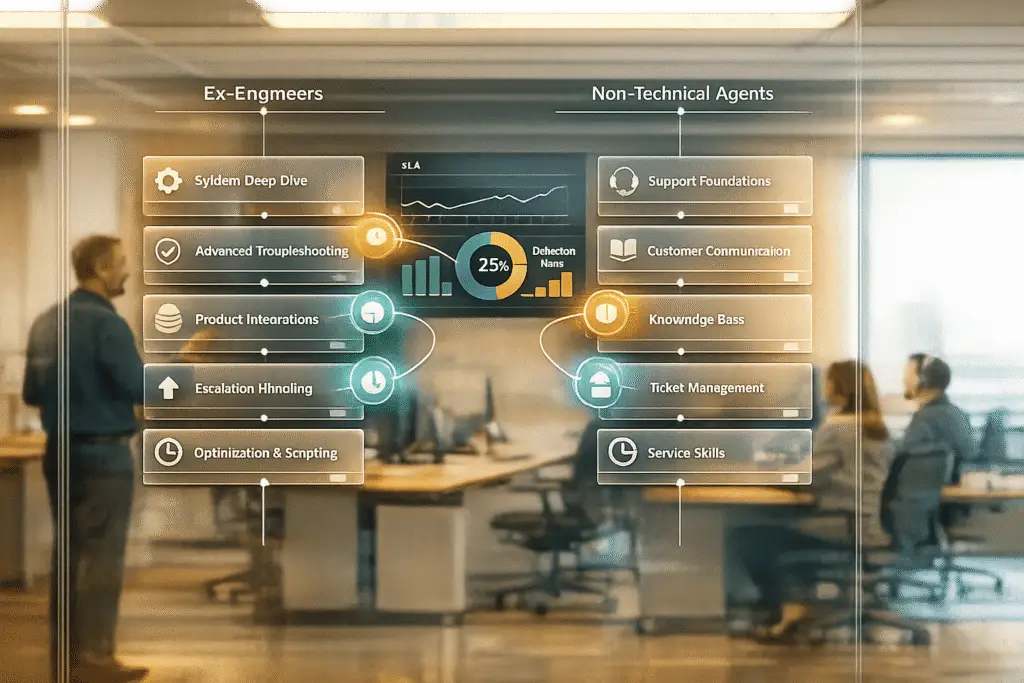
Onboarding new support hires? Treat ex-engineers and non-technical agents differently. Here’s why:
- Ex-engineers excel in technical problem-solving but often struggle with customer communication.
- Non-technical agents are great communicators but need help with technical skills.
- A one-size-fits-all onboarding wastes time and money – between $15,000–$25,000 per hire in training costs and lost productivity.
Instead, companies should use two tailored onboarding tracks:
- Ex-engineers: Focus on communication skills and customer empathy while refining technical execution.
- Non-technical agents: Emphasize technical training with tools like AI co-writers and mock environments.
Key benefits of this approach:
- Faster ramp-up times (2–3 months instead of 3–6).
- Reduced escalations and improved customer satisfaction.
- Cost savings of up to $15,000 per month, as seen with AI tools like RTR Vehicles‘ Digital Hire™.
Quick Comparison:
| Feature | Ex-Engineer Track | Non-Technical Agent Track |
|---|---|---|
| Focus | Communication and customer empathy | Technical skills and AI tool usage |
| Training Tools | Sandbox environments, shadowing, AI coaching | Mock tools, AI co-writers, knowledge bases |
| Ramp-Up Time | 60–90 days | 60–90 days |
| Challenges | Over-reliance on technical expertise | Struggles with product and system familiarity |
Tailored onboarding ensures hires reach full productivity faster while saving resources and improving team performance.
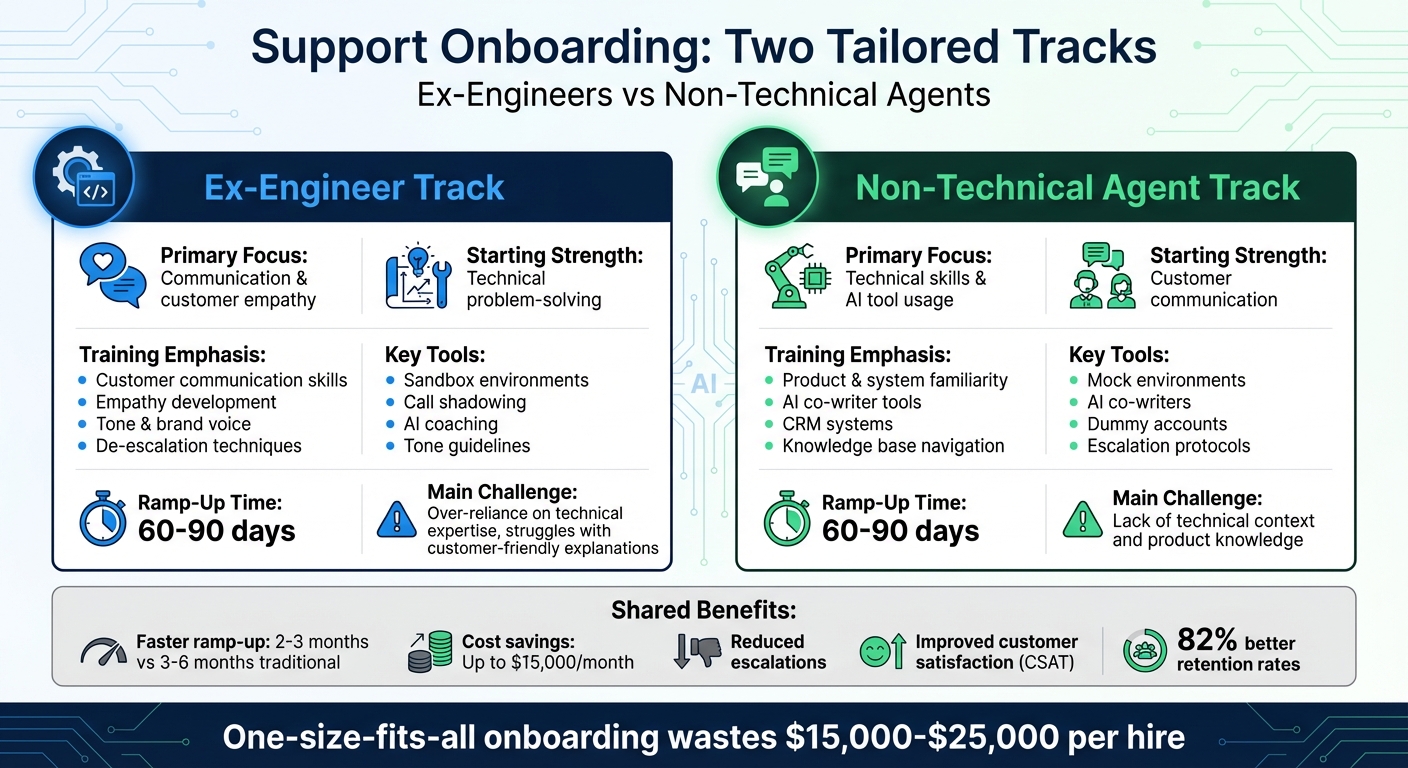
Ex-Engineer vs Non-Technical Agent Onboarding Tracks Comparison
Onboarding Track for Ex-Engineers
Ex-engineers bring strong technical expertise, but their challenge lies in explaining complex systems in a way that’s clear and accessible. It’s not about grasping integrations or fixing API issues – that’s their comfort zone. The real test is delivering solutions without overwhelming customers. As one Director of Support put it: "We gave them knowledge, but not competence" [7]. This gap between understanding and execution highlights the need for an onboarding process that combines technical training with communication skill-building.
Technical Training and Tool Setup
For ex-engineers, technical training should focus on real-world application rather than theoretical reviews. Instead of just reading manuals, they need hands-on practice in sandbox environments that mimic the challenges they’ll face – like handling API crashes, integration failures, or database connection issues [7].
Take Talantir, a DevOps platform with 310 employees, as an example. In January 2026, they revamped their onboarding process to include 15 realistic scenarios involving Kubernetes crashes and API failures. New support agents had to complete these exercises before tackling live tickets. The result? A 43% drop in escalations and a reduction in response times from over 8 hours to just 2.5 hours within 10 weeks [7].
Training should also cover the three-layer architecture of modern support:
- Knowledge layer: Understanding product details.
- Conversation layer: Navigating chat interfaces and maintaining a professional tone.
- Action layer: Managing APIs and automations.
While ex-engineers are typically strong in the action layer, they often need structured guidance to master the context-capturing process – like verifying workspace IDs, user roles, and integration states – before delivering specific answers [8].
Once technical skills are solid, the focus shifts to honing customer communication.
Developing Customer Communication Skills
Technical know-how alone doesn’t guarantee happy customers. Ex-engineers need to learn empathy and clear, customer-focused communication, which don’t always come naturally from a development background. AI tools can help bridge this gap.
For example, tools like Agent Co-writer suggest responses based on ticket context, helping new hires craft brand-aligned messages. These tools act as real-time communication coaches, guiding agents through the tricky balance of technical accuracy and customer-friendly language. However, as CX Leader Eryn Chesney points out: "AI tools like Agent Co-writer can help a new hire find the right words faster, but they can’t teach empathy or replace the judgment that comes with experience" [2].
Pairing these tools with shadowing opportunities allows new hires to observe experienced agents handling nuanced cases that aren’t covered in documentation. This approach also teaches them to critically evaluate AI-generated responses, ensuring they’re not only technically correct but also emotionally appropriate for the customer [2].
Strategies to Speed Up Ramp-Up Time
A structured 30/60/90-day roadmap can guide new hires from observation to guided practice and eventually to independent work, while AI tools take care of routine tasks [2].
Here are a few strategies to streamline the onboarding process:
- AI-generated case summaries: These provide a quick overview of customer history and context, saving time and allowing agents to focus on resolving the issue [2].
- Dedicated communication channels: Setting up a “safe space” on platforms like Slack or Teams encourages new hires to ask questions without fear of judgment. A target 15-minute response time from senior “buddies” ensures timely support for edge cases or communication challenges [2].
- Knowledge base audit: Before onboarding begins, ensure all SOPs and documentation are up-to-date and free of broken links. This creates a reliable resource for new hires to build confidence and independence [2].
sbb-itb-e60d259
Onboarding Track for Non-Technical Agents
Non-technical agents bring exceptional customer communication and relationship-building skills to the table – qualities that are distinctly human. The challenge lies in equipping them with enough technical know-how to confidently navigate AI-driven support platforms, without overwhelming them. While ex-engineers may need to simplify their technical jargon, non-technical hires focus on gaining familiarity with tools and systems, all while leveraging their natural empathy and communication strengths.
Basic Technical Training
For non-technical agents, the goal isn’t memorizing every product detail; instead, it’s about learning to effectively use support platforms and AI tools. Training should emphasize three main areas:
- Using AI co-writers to craft suggested responses
- Navigating the internal knowledge base, including SOPs and escalation paths
- Mastering help desk ticketing systems and collaboration tools like Slack or Microsoft Teams [2][9]
In AI-first environments, agents don’t need to know every product detail by heart. AI systems can handle 80–92% of routine inquiries, freeing human agents to focus on complex problem-solving and building customer relationships [1]. However, non-technical agents must develop the skill to critically evaluate AI-generated responses for accuracy and brand alignment before sharing them with customers [2].
To ease the learning curve, provide "dummy accounts" or mock tools populated with sample data. These allow agents to practice without risking live customer interactions [9]. Keeping the knowledge base updated is also crucial [2]. This technical foundation sets the stage for agents to refine their communication skills.
Customer Communication and Relationship Skills
With their technical foundation in place, non-technical agents can excel in customer communication – a skill set where they already shine. AI tools like Agent Co-writer can further enhance their abilities by offering real-time coaching on tone and context, helping them manage live cases more effectively [2].
"AI tools like Agent Co-writer can help a new hire find the right words faster, but they can’t teach empathy or replace the judgment that comes with experience."
- CX Leader Eryn Chesney [2]
A graduated shadowing approach works well for training: starting with observing experienced agents, moving to sample tickets, and finally progressing to live cases with real-time feedback from senior team members. Establishing dedicated communication channels – like a "no-judgment" Slack or Teams group – where experienced "buddies" respond within 15 minutes can be a game-changer. This type of support is critical, especially since about 70% of workplace skills are learned on the job, compared to just 30% through formal training [9].
Hands-On Training Sessions
Hands-on training should follow a structured 30/60/90-day plan:
- Days 1–30: Focus on orientation, shadowing live tickets, and practicing with mock scenarios [2].
- Days 31–60: Transition to guided independence, handling tickets with AI-assisted suggestions while receiving senior reviews and meeting initial volume targets [2].
- Days 61–90: Ramp up to full contribution, achieving performance metrics and providing feedback on the onboarding process [2].
Incorporating recordings of real scenarios can help illustrate effective communication and empathy [9]. AI-powered case simulations also offer a safe environment to practice de-escalation and tackle complex problems.
Typically, non-technical agents achieve full competency within 2–3 months. AI tools can speed up this timeline significantly, reducing training durations for complex products from 3–6 months to just a few weeks. This not only saves $8,000 to $15,000 in training costs per hire but also helps address high annual turnover rates of 30–45% [1].
Ex-Engineer vs. Non-Technical Agent Track Comparison
The onboarding process for ex-engineers and non-technical agents takes different approaches, reflecting the unique strengths and challenges of each group. Ex-engineers typically come with a solid technical background and a deep understanding of the product, while non-technical agents often excel in empathy and interpersonal skills but need more structured training to build their technical expertise. Understanding these distinctions allows leaders to allocate resources wisely and set realistic goals for their teams.
"Onboarding in tech roles requires a deeper focus on technical integration, which is often more complex and time-intensive than in non-technical roles."
- Anthony Taylor [3]
The table below highlights the main differences between the two onboarding tracks.
Comparison Table
| Feature | Ex-Engineer Track | Non-Technical Agent Track |
|---|---|---|
| Primary Focus | Building on technical expertise while improving customer communication [4] | Strengthening communication skills while learning technical tools [2] |
| Duration | 60–90 days to achieve full customer-readiness | 60–90 days to reach full productivity |
| Core Modules | Customer call shadowing and coaching on communication nuances [4] | Training in CRM systems, AI-driven summaries and KB creation tools, SOPs, and knowledge base navigation [2] |
| Tools Emphasized | Help desk platforms, communication tools (e.g., Slack/Teams), and tone guidelines [2] | AI Co-writers, ticketing systems, mock environments, and escalation protocols [2] |
| Success Metrics | Customer satisfaction, maintaining tone consistency, and effective issue de-escalation [2] | Ticket resolution volume, response time, and accuracy [2] |
| Common Mistakes | Relying too heavily on technical knowledge without adapting communication [4] | Lacking sufficient product context and technical grounding [5] |
| Learning Method | Shadowing calls with real-time tone coaching and feedback [4] | Gradual learning supported by AI-driven feedback [2] |
Both tracks aim to prepare team members for handling complex cases, leaving routine tasks to AI tools.
Common Onboarding Mistakes and How to Avoid Them
Even the most experienced support leaders can slip up when it comes to onboarding. In the AI-driven B2B support world, getting onboarding right isn’t just about efficiency – it’s about keeping costs under control and retaining talent. With 20.5% of organizations reporting that nearly half of their new hires leave within the first 90 days [14], there’s no room for error. Here are three common onboarding pitfalls and practical ways to avoid them.
Assuming Technical Skills Are Enough for Ex-Engineers
It’s easy to assume that ex-engineers, with their strong technical backgrounds, will naturally excel in support roles. But technical expertise alone doesn’t guarantee success. These individuals often focus narrowly on solving the technical issue – the “how” – while overlooking the broader business implications or the emotional needs of the customer [11].
"Hard work and intent do not equate to business impact."
- Elliot Graebert, Sr. Director of Engineering [11]
To address this, structured coaching is essential. Ex-engineers need guidance in areas like de-escalation, empathy, and brand voice consistency. Without this, they risk delivering technically accurate but emotionally disconnected responses that alienate customers. One tool to help is "V-Style" brainstorming exercises, which encourage engineers to dig into the root motivations behind a customer’s problem before jumping to solutions [11]. Pair this with call shadowing, where they can see seasoned agents balance technical precision with customer relationship management. And don’t stop at verbal feedback – document coaching sessions so expectations are crystal clear. Relying solely on verbal feedback can lead to misunderstandings, as it may be seen as mere suggestions rather than actionable requirements [11].
Providing Insufficient Technical Training for Non-Technical Agents
On the flip side, non-technical agents often struggle when product training is rushed. This can lead to repeated mistakes, frustrated customers, and an increased workload for senior staff. Worse still, 25% of customers are likely to leave after just one poor experience [12]. Every interaction with an unprepared agent becomes a potential revenue risk.
"You cannot support what you do not know. Rushing product training is a huge risk."
To bridge this gap, AI-assisted learning tools can act as real-time mentors. For instance, Supportbench’s AI Co-pilot scans past cases and knowledge base articles to suggest responses during live interactions. This allows new agents to learn on the job without requiring constant supervision from senior staff. Additionally, maintaining a "living" knowledge base is crucial. Automated tools can help ensure that links and standard operating procedures (SOPs) are accurate and up-to-date before new hires begin [2]. For non-technical agents, having reliable self-service resources makes all the difference.
Using One-Size-Fits-All Onboarding Programs
A cookie-cutter approach to onboarding often backfires, as it fails to address the specific needs of individuals with different backgrounds. When onboarding isn’t tailored, new hires experience confusion about their roles, leading to frustration and early turnover.
Organizations that invest in customized onboarding programs see 2.5x higher revenue growth compared to those that don’t [13]. Implementing tailored 30/60/90-day frameworks can make a huge difference. These programs should include weekly progress checks to ensure training stays on track. For ex-engineers, the first 30 days could focus on customer communication and tone coaching. For non-technical agents, hands-on practice with AI tools and sample tickets should take priority before they handle live interactions [2]. Tailored onboarding not only boosts confidence but also improves retention rates by 82% [14]. While it requires an upfront investment, the long-term benefits far outweigh the costs.
How to Implement Two Onboarding Tracks
Creating two onboarding tracks allows you to tailor training to address specific skill gaps for each hire, ensuring a more effective and focused onboarding process.
Step 1: Evaluate Team Backgrounds and Assign Tracks
Instead of labeling hires as "technical" or "non-technical", which can limit growth opportunities, take a more nuanced approach. Conduct detailed skill audits to identify each hire’s strengths and areas for improvement. For example, assess ex-engineers on their familiarity with tools like Docker or Kubernetes as implemented in your organization. For non-technical hires, evaluate their experience with CRM systems and escalation management systems [5][3].
"Instead of thinking of people in terms of ‘technical’ or ‘non-technical’, at Mem we’d like to think that everyone is a builder."
- Priscilla Mok, Designer, Mem [5]
Also, consider the hire’s background. Internal transfers may already understand company tools and culture but might need product-specific training. External hires, on the other hand, require a deeper dive into your tech stack, legacy codebases, and internal APIs [6]. Career changers or industry veterans may bring strong technical skills but lack the informal knowledge needed to navigate your organization effectively [4].
To streamline the process, use a structured milestone framework to measure progress through orientation, guided independence, and eventual full productivity. Assign a buddy who can address specific needs, such as technical troubleshooting for ex-engineers or workflow coaching for non-technical hires. This step sets the foundation for the AI-assisted training modules that follow [3][2].
Step 2: Use AI-Assisted Training Modules
AI tools can dramatically accelerate onboarding, cutting ramp-up times by up to 50% and improving new hire productivity by 70% compared to traditional methods [15]. For non-technical hires, AI co-writers can act as real-time assistants during live interactions, pulling insights from past cases and knowledge base articles to suggest responses in your brand’s tone [2].
In one example, James Wang (a VC and former Google[x] founder) onboarded a non-technical analyst by using Claude Code (Opus 4.6) to automate complex financial spreadsheets. Instead of teaching Python, the training focused on using AI to break spreadsheets into Model-View-Controller layers, allowing the hire to concentrate on applying domain-specific expertise [17].
For ex-engineers, the emphasis shifts to optimizing workflows. Rather than building code from scratch, they learn to manage AI agents effectively. Tools like Cursor or GitHub Copilot can help them master multi-file refactors and draft pull requests, boosting task completion speeds by 126% [16]. AI tools can also audit your knowledge base to ensure it stays accurate and up-to-date [2].
"AI doesn’t replace trainers. It makes them more strategic."
- Bernard Marr, Forbes [15]
Start with AI-assisted observation, progress to sample tasks with AI suggestions, and then move into live practice where AI acts as a safety net.
Step 3: Track Progress and Adjust Training
After rolling out tailored training modules, tracking progress is essential to ensure the onboarding tracks remain effective. Metrics like ramp-up time can help you measure efficiency. Traditional support training often takes 2–3 months for new hires to reach full competency [1], but AI-native platforms can significantly shorten this timeline.
For ex-engineers, focus on CSAT scores and tone evaluations to ensure they maintain both technical accuracy and empathy. For non-technical hires, track error rates and escalations to identify any gaps in technical knowledge early [1].
Set up a dedicated Slack or Teams channel with a 15-minute response window for onboarding queries [2]. Use AI-driven tools, like predictive CSAT and first contact resolution detection, to flag potential issues before they escalate. For example, Supportbench’s AI Co-pilot can alert managers when a hire’s responses might lead to customer dissatisfaction, enabling timely coaching.
Conduct weekly progress reviews during the first 90 days to monitor metrics such as shadowing volume, ticket quality, and performance parity [2]. These ongoing checks ensure continuous improvement, aligning with the broader AI-driven support strategy. Additionally, investing in strong onboarding practices can boost employee retention, with well-onboarded employees being 82% more likely to stay long-term [15].
Conclusion
Tailored onboarding tracks have become a must-have for modern B2B support teams, where balancing technical expertise with customer empathy is key. Former engineers bring deep product knowledge but often require guidance on communication and tone, while non-technical agents excel in relationship-building but need structured technical training to handle the complexities of troubleshooting and configurations. A generic, one-size-fits-all training plan not only wastes resources but can cost between $15,000–$25,000 per hire within the first 90 days [1]. AI-native tools offer a smarter solution to this challenge by automating routine tasks.
These tools completely change the training dynamic. Instead of spending months teaching agents how to handle routine product lookups or answer policy questions, AI can manage 80–92% of these standard inquiries from day one [1]. This frees up human training to focus on critical skills like judgment, empathy, and solving complex problems. The result? Ramp-up times shrink from three months to just a few weeks, while productivity jumps by 70% and retention rates improve by 82% [15][14].
"Every month you spend training a support rep on routine product lookups is a month wasted on work an AI already knows." – Gabe Campbell, AI Genesis [1]
This quote highlights the inefficiencies of traditional training methods.
The financial benefits of AI integration are equally compelling. For example, RTR Vehicles reduced their training timeline from 3–4 months to just weeks by implementing an AI Digital Hire™. This allowed their human team to concentrate on escalations and relationship management, rather than routine tasks [1].
For B2B teams managing complex accounts, adopting two AI-supported onboarding tracks – one for ex-engineers and another for non-technical agents – delivers faster productivity, lower training costs, and better team performance. By addressing the specific strengths and needs of each group, companies can shorten learning curves and unlock their full potential. There’s no time to wait – embrace this AI-powered dual-track approach now.
FAQs
How do I decide which onboarding track a new hire should follow?
When onboarding new hires, it’s crucial to align their training with their experience and technical background. For instance, former engineers might thrive with workflows and tools that tap into their technical expertise, such as AI-powered systems designed to manage complex tickets efficiently.
On the other hand, non-technical hires should concentrate on foundational training, which includes accessible resources like step-by-step guides and user-friendly customer support tools.
To streamline the onboarding process and minimize ramp-up time, assess each new hire’s skills and familiarity with existing workflows. This personalized approach ensures they’re equipped to succeed from the start.
What metrics show each track is effective within the first 90 days?
When evaluating the success of onboarding tracks within the first 90 days, two metrics stand out: time-to-productivity and retention rate at day 90.
A well-executed onboarding process often results in new hires reaching full productivity within 90 days or less. At the same time, strong retention rates by this milestone indicate that both technical and non-technical employees are settling into their roles effectively. These metrics provide valuable insight into how well new team members are adapting and contributing during this critical period.
How do we use AI in onboarding without risking wrong or off-brand replies?
AI can improve the onboarding process while keeping your brand’s voice consistent by implementing structured guidelines, verified knowledge sources, and real-time AI copilots. To make this work effectively, set up clear boundaries for the AI system, communicate transparently about areas where it may lack certainty, and ensure a seamless transition to human agents when necessary. Regularly reviewing and updating AI-generated content is key to staying aligned with your brand’s standards, reducing off-brand or inaccurate responses, and boosting overall precision.