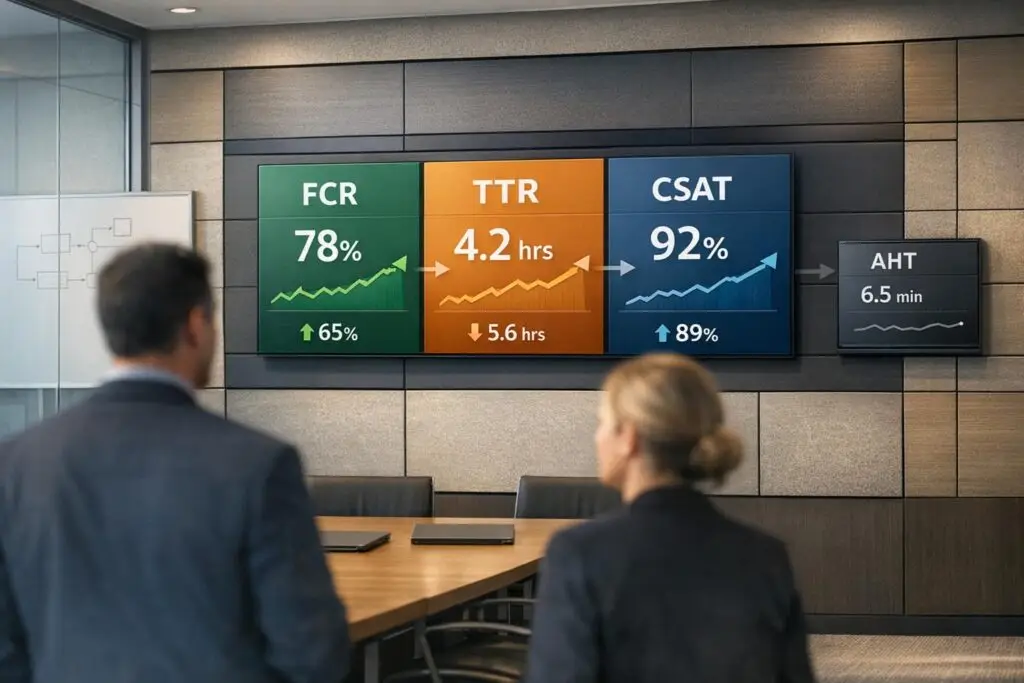
Focusing on speed over quality hurts B2B support. Average Handle Time (AHT) measures how quickly agents handle calls but ignores whether problems are solved effectively. This approach may save time on individual calls, but it often leads to repeat contacts, unresolved issues, and frustrated customers.
Instead, B2B support teams should prioritize metrics that reflect quality and outcomes, such as:
- First Contact Resolution (FCR): Measures if issues are resolved on the first try.
- Time to Resolution (TTR): Tracks the full lifecycle of problem-solving.
- Customer Satisfaction (CSAT): Gauges how satisfied customers are with the support they receive.
- Customer Effort Score (CES): Evaluates how easy it was for customers to resolve their issues.
A 90-day case study showed that removing AHT targets led to longer calls but improved FCR by 23%, reduced repeat contacts by 35%, and cut overall costs by 14%. In B2B, where issues are complex and relationships matter, speed isn’t the right goal. Solving problems thoroughly and building trust delivers better results for businesses and customers alike.
Why AHT Doesn’t Work in B2B Support
AHT Prioritizes Speed Over Quality
Focusing on Average Handle Time (AHT) often creates a misleading obsession with speed, forcing agents to rush through calls, skip critical clarifying questions, and, as Christopher Basile describes, rely on the "polite ejection seat" tactic to end conversations quickly [2].
A study of 5,000 calls found that the top 25% of high-performing agents took deliberate pauses during conversations to ensure they understood customer needs [1]. These moments of clarification, while essential for effective resolutions, directly clash with AHT targets. Ironically, prioritizing AHT can lead to more repeat calls. For instance, one tech support team consistently hit an 8-minute AHT goal, but the full resolution process averaged 23 minutes due to follow-ups [2]. The result? Faster calls didn’t actually mean faster problem-solving.
"Doing it right the first time is cheaper than doing it fast three times." – Christopher Basile, VP of Operations Transformation, Etech [2]
Another major flaw with AHT is that it often measures factors beyond an agent’s control. Call length depends on variables like the customer’s technical knowledge, the complexity of the issue, and even their communication style [4]. When AHT becomes a key performance metric, agents are unfairly judged on things they can’t influence.
This relentless focus on reducing time compromises quality and fails to account for the unique challenges of B2B support, which are far from straightforward.
B2B Issues Involve Multiple Stakeholders and Extended Timelines
B2B support rarely wraps up in a single phone call. Enterprise issues often require collaboration with IT teams, approval from procurement departments, input from legal, and updates to stakeholders across various time zones. Since AHT only measures the time spent on the phone, it completely overlooks the broader, more complex process of resolving these issues.
Effective B2B agents go beyond the call itself by conducting research, consulting internal experts, and preparing detailed work orders. None of this off-call effort factors into AHT metrics, which means agents who take the time to solve problems thoroughly may actually be penalized [2].
Strict AHT goals can also encourage harmful behaviors, like creating "transfer artists" – agents who pass complicated issues to other departments just to keep their call times low [2]. While this might improve their individual metrics, it increases overall customer effort and operational costs.
As simpler issues are increasingly handled by self-service tools and chatbots, human agents are left with the most complex, technical problems. These challenges require time and expertise, not speed. Even though the standard AHT benchmark for technical support is 8–10 minutes [4], this figure doesn’t reflect the reality of intricate B2B cases.
It’s no wonder that B2B customers value a collaborative, relationship-driven approach over transactional efficiency.
B2B Customers Expect Consultative, Relationship-Based Support
B2B customers expect more than quick fixes – they want support agents to act as strategic advisors who understand their industry, business objectives, and technical environment [6]. This consultative approach involves discovery, analysis, and tailored recommendations, none of which align with AHT’s narrow focus on speed.
Heidi Bailey, Director of Virtual Experience at Tucson Federal Credit Union, recognized this and shifted her team’s performance model away from call duration. Instead, her agents are evaluated based on their ability to ask meaningful questions and deliver solutions that strengthen the customer relationship [4].
"My focus has never been on reducing handle time. I just want our time spent with the member to be more consultative so we can better understand the relationship." – Heidi Bailey, Director of Virtual Experience, Tucson Federal Credit Union [4]
The stakes in B2B support are far higher than in consumer contexts. Losing a single enterprise customer could mean forfeiting hundreds of thousands or even millions of dollars in revenue. With 32% of customers switching providers due to poor service [7], rushing through interactions to meet AHT goals is a risky move that could jeopardize these high-value relationships.
Modern AI quality management systems are helping shift the focus. Unlike traditional QA, which samples just 1–2% of calls for AHT compliance, AI-driven platforms can analyze 100% of interactions, evaluating sentiment, compliance, and resolution quality [3]. The bottom line? Ensuring customers feel heard and their issues are resolved matters far more than shaving a few minutes off call times.
sbb-itb-e60d259
What AHT Measures and What It Ignores
AHT Focuses on Efficiency, Not Effectiveness
Average Handle Time (AHT) zeroes in on three key elements: talk time, hold time, and after-call work (like note-taking and CRM updates) [3]. The formula is simple: Total call time ÷ Number of calls. While this metric captures how quickly agents handle calls, it says nothing about whether the customer’s problem was actually solved. And that’s a big blind spot.
Imagine an agent hitting a 6-minute AHT target but leaving the customer with incomplete instructions or unresolved issues. The customer may have to call back, creating more work for everyone. This highlights a major flaw: AHT prioritizes speed over meaningful outcomes, as explained further below.
AHT Overlooks Customer Outcomes and Account Health
In B2B support, it’s not just about speed – it’s about results. Metrics like First Contact Resolution (FCR), Customer Satisfaction (CSAT), Customer Effort Score (CES), and Time to Resolution (TTR) provide a fuller picture of success by tracking the right KPIs. A 90-day pilot revealed what happens when agents ignore AHT and focus on resolution instead. The results? Average handle time went up by 2.3 minutes per contact, but FCR jumped from 61% to 84%, repeat contacts dropped by 35%, and CSAT scores climbed by 18 points. When factoring in overall costs like escalations and transfers, this "slower" approach turned out to be 14% more efficient [2].
| Metric | What It Measures | Overlooked Aspects |
|---|---|---|
| Average Handle Time (AHT) | Talk time, hold time, and after-call work. | Resolution quality, customer sentiment, long-term account health. |
| First Contact Resolution (FCR) | Percentage of issues resolved on the first attempt. | Time taken to achieve resolution. |
| Customer Effort Score (CES) | How much effort the customer exerted to resolve an issue. | Agent speed or operational costs. |
| Time to Resolution (TTR) | The full lifecycle of an issue from start to finish. | Length of individual interactions. |
Lower AHT Can Mean Lower Customer Satisfaction
When speed becomes the sole focus, customer experience often takes a hit. For example, Stevens Transport tackled this issue by using Brightmetrics to analyze queue congestion and routing instead of enforcing strict AHT goals. By cutting average wait times from 10 minutes to 1 minute, they reduced caller frustration right from the start. The result? Calmer conversations and better diagnostics, thanks to smoother operations [5].
In B2B settings, speed and satisfaction often pull in opposite directions. Complex issues – whether they involve technical troubleshooting, billing disputes, or multiple stakeholders – demand time and careful attention. Relying only on AHT creates what experts call "false efficiency." These calls may look quick on paper but often leave customers with unresolved problems and lower satisfaction [2].
Key metrics to track B2B SaaS customer service in 2023?
Better Metrics for B2B Support Performance
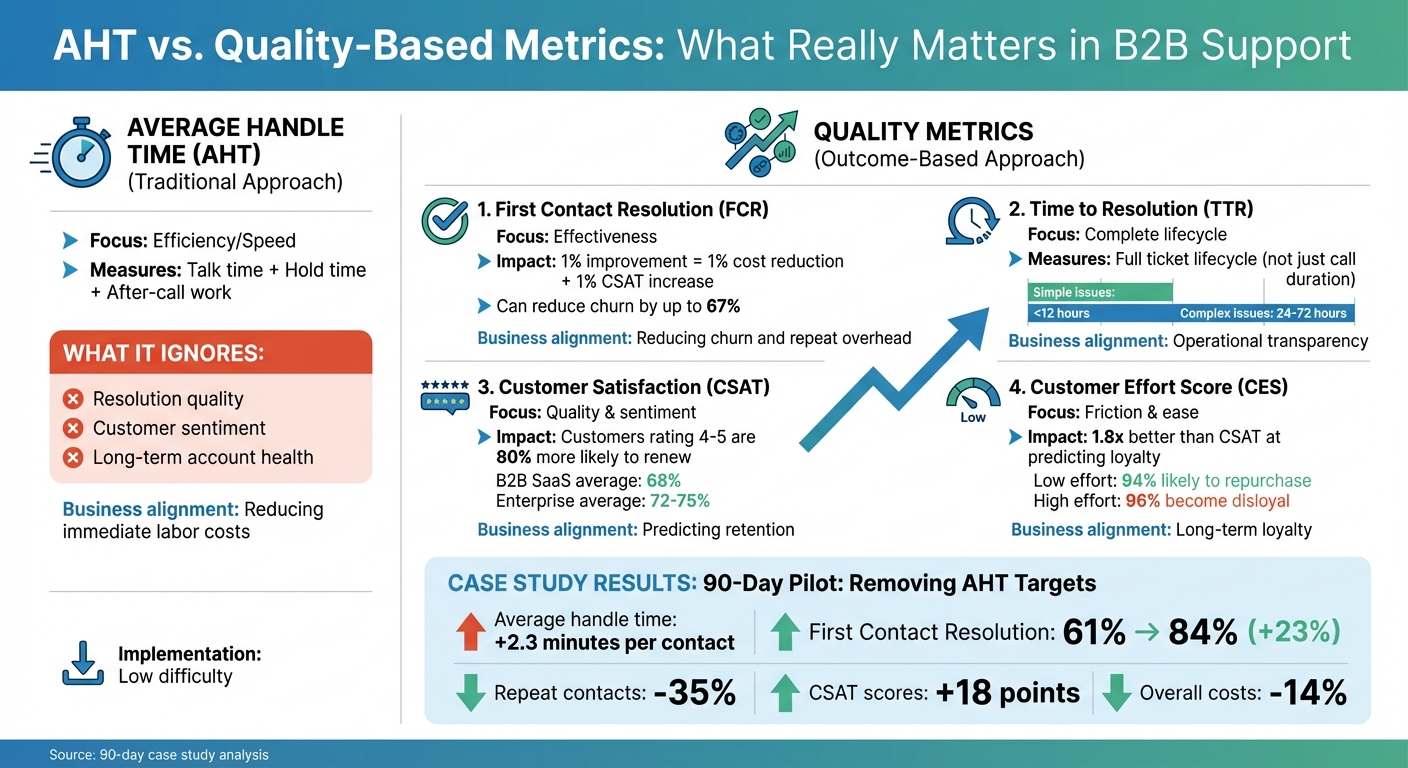
AHT vs Quality-Based B2B Support Metrics Comparison
First Contact Resolution (FCR): Resolving Issues on First Contact
First Contact Resolution (FCR) measures how often customer issues are fully resolved during the first interaction – no follow-ups, no callbacks, no extra tickets. It’s a powerful metric: improving FCR by just 1% can cut operating costs by 1% and boost customer satisfaction by the same amount. Even more striking, improving FCR can reduce customer churn by up to 67% [8].
Unlike metrics that focus solely on speed, FCR prioritizes resolution quality. To measure it effectively, you need to rely on actual interaction data rather than small survey samples. For example, if a customer revisits support for the same problem within seven days, the issue wasn’t truly resolved [2]. In B2B environments where accounts are often complex, FCR is closely tied to account health and renewal rates, making it a critical measure for long-term success.
Time to Resolution (TTR): Tracking the Complete Issue Lifecycle
While FCR focuses on immediate resolution, Time to Resolution (TTR) looks at the entire lifecycle of a support ticket. TTR starts when a ticket is created and ends when it’s fully resolved. Unlike Average Handle Time (AHT), which only measures the duration of individual calls, TTR captures the full scope of B2B support – research, collaboration across departments, follow-up communications, and interactions across multiple channels.
For simpler issues like feature questions, top-performing teams aim to resolve tickets in under 12 hours. For more complex technical problems, realistic resolution times can range from 24 to 72 hours [8]. To get meaningful insights, segment TTR by issue complexity. Comparing simple inquiries with multi-stakeholder technical challenges doesn’t provide an accurate picture.
TTR offers a level of operational clarity that AHT simply can’t, helping teams focus on effectiveness rather than just efficiency.
Customer Satisfaction (CSAT) and Net Promoter Score (NPS)
Beyond resolution metrics, understanding customer sentiment is crucial for maintaining strong B2B relationships. Customer Satisfaction (CSAT) measures how satisfied customers are with individual interactions, typically on a 5-point scale. Customers who rate their experiences as a 4 or 5 are 80% more likely to renew their contracts [8]. For B2B SaaS companies, the average CSAT score is 68%, while enterprise-level support teams often achieve higher scores of 72-75% due to their dedicated resources [8].
Net Promoter Score (NPS), on the other hand, evaluates the strength of long-term customer relationships. It asks a simple question: how likely are you to recommend this company? In the Technology/SaaS sector, the average NPS is 45, with top performers reaching 60 or higher [8]. While CSAT focuses on short-term satisfaction, NPS is a better predictor of loyalty and potential account growth.
Another important metric is Customer Effort Score (CES), which measures how easy it was for customers to resolve their issues. CES is 1.8 times better than CSAT at predicting customer loyalty [8]. A low-effort experience leads to increased loyalty (94% of customers are more likely to make repeat purchases), while a high-effort experience drives disloyalty (96% of customers become less likely to stay) [8].
Comparison: AHT vs. FCR, TTR, and CSAT
Here’s a quick breakdown of how AHT compares to more outcome-focused metrics:
| Metric | Focus Area | Alignment with Business Goals | Implementation Difficulty |
|---|---|---|---|
| Average Handle Time (AHT) | Efficiency/Speed | Reducing immediate labor costs | Low (Standard in most tools) |
| First Contact Resolution (FCR) | Effectiveness | Reducing churn and repeat overhead | Medium (Requires tracking re-contacts) |
| Time to Resolution (TTR) | Complete Lifecycle | Operational transparency and reliability | Medium (Requires clear ticket status tracking) |
| Customer Satisfaction (CSAT) | Quality/Sentiment | Predicting short-term retention | Low (Post-interaction surveys) |
| Customer Effort Score (CES) | Friction/Ease | Predicting long-term loyalty | Low (Post-interaction surveys) |
The transition from AHT to these outcome-based metrics isn’t just a mindset shift – it’s a practical improvement. Modern tools like Supportbench now feature AI-driven FCR detection, which reviews case histories to confirm if an issue was truly resolved on the first attempt. This eliminates the guesswork that previously made FCR hard to track. Additionally, AI can generate predictive CSAT and CES scores by analyzing interaction patterns, giving support teams real-time insights into customer sentiment without waiting for survey responses.
Moving to Outcome-Based Support Operations
Shifting from outdated metrics like Average Handle Time (AHT) to outcome-based operations is a game-changer for support teams. This approach balances efficiency with quality, ensuring better customer experiences. However, it requires rethinking how you structure SLAs, use technology, and train your team. Despite its benefits, about 60-65% of enterprises still rely on AHT as their primary metric [9], which means many B2B support teams are focusing on the wrong priorities.
The starting point for this transition? Redefining success. Instead of asking, "Could this have been faster?" managers should ask, "Did we solve this completely?" [2]. This simple shift impacts everything – from SLA design to agent performance evaluations – and sets the stage for deeper customer outcomes.
Building SLAs Around Quality and Resolution
Traditional SLAs often prioritize speed, such as "respond within 2 hours" or "resolve within 24 hours." But in B2B support, where issues can be complex and require collaboration, speed alone doesn’t cut it. Outcome-based SLAs focus on actionable results rather than just meeting time targets.
For example, instead of measuring how quickly a ticket is closed, consider Time to First Useful Response – the moment a customer receives actionable information and clear next steps [10]. This metric is especially relevant in technical B2B support, where customers care more about progress than just an acknowledgment. Similarly, Time to Resolution (TTR) should vary based on issue complexity. A password reset shouldn’t have the same SLA as a complicated multi-system integration.
Stevens Transport illustrates this shift well. By analyzing queue congestion and time-of-day patterns, they cut average wait times from 10 minutes to 1 minute. This not only calmed interactions but also improved diagnostics, stabilizing AHT without pressuring agents [5].
When designing SLAs, pair efficiency metrics with quality safeguards. For instance, if you’re tracking TTR, also monitor metrics like First Contact Resolution (FCR) and Customer Satisfaction (CSAT) to ensure speed doesn’t compromise quality [5]. This prevents scenarios where agents rush through calls to meet targets, leaving issues unresolved [2].
Using AI and Knowledge Management to Improve Efficiency
AI can transform how support teams handle repetitive tasks, especially during pre-interaction stages. In technical support, agents often spend 15 to 30 minutes gathering logs, matching IDs, and reviewing past cases before troubleshooting even begins [10]. This is where AI shines.
Platforms can automate the creation of context packets for escalations, bundling environment details, logs, and similar cases into a single document [10]. This eliminates the "scavenger hunt" that inflates handle times without adding value. For instance, United Heritage Credit Union implemented an AI-powered intranet in 2024, reducing search times from 13 seconds to just 1 second. Over eight months, this saved more than 300 hours of productivity [11].
AI also helps close the knowledge loop. When an agent resolves a complex issue, AI can analyze the case and draft a knowledge base article, complete with summaries and keywords [10]. This ensures future agents and customers can find solutions faster.
Supportbench takes this further with AI-driven FCR detection, analyzing case histories to confirm if issues were resolved on the first attempt. It also predicts CSAT and Customer Effort Scores (CES) by analyzing interaction patterns, offering real-time insights into customer sentiment without waiting for survey results.
AI-powered systems are also revolutionizing quality assurance. Instead of sampling just 2% of calls, these tools analyze 100% of interactions [1][3]. This allows managers to identify coaching opportunities based on actual performance rather than random samples.
Training Agents for Outcome-Focused Performance
As AI reduces administrative burdens, agent training must focus on delivering quality interactions and understanding customer needs. This means shifting from metrics like call duration to controllable behaviors: asking insightful questions, using empathetic language, setting clear expectations, and demonstrating product expertise [4].
"The focus on uncontrollable KPIs causes both management and agents to focus on not being last rather than being the best they can be." – Don Davey, Senior Director of Customer Success, Creovai [4]
Interestingly, research shows that top-performing agents pause more during calls – before responding or after delivering key information [1]. These pauses give agents time to process details, consult resources, and provide thoughtful responses. Yet, environments focused on AHT often penalize these behaviors. Training agents to embrace pauses can significantly improve resolution quality and customer satisfaction.
Tucson Federal Credit Union offers a great example. Under Heidi Bailey’s leadership, the organization moved away from call duration metrics entirely. Instead, agents are evaluated on consultative skills, like asking tailored questions to better understand customer needs.
"My focus has never been on reducing handle time. I just want our time spent with the member to be more consultative so we can better understand the relationship and offer applicable products and services." – Heidi Bailey, Director of Virtual Experience, Tucson Federal Credit Union [4]
To implement this shift, try a 90-day pilot program where AHT targets are removed for a specific team. Focus instead on resolution and quality metrics like FCR, CSAT, and repeat contact rates [2]. Use AI tools to analyze interactions for sentiment, hesitation, and resolution quality – insights that traditional metrics often miss [3].
Finally, tailor coaching to the complexity of the issue. Not all calls are the same. A billing inquiry requires different handling than a technical escalation. Setting AHT expectations based on call complexity allows agents to prioritize what truly matters: solving the customer’s problem [5].
Conclusion: Better Metrics for B2B Support
As discussed, prioritizing resolution quality over call speed is critical for tackling the challenges unique to B2B support. Metrics like Average Handle Time (AHT) fall short because they emphasize speed at the expense of meaningful solutions. And let’s be clear: speed doesn’t equal success. B2B customers often need in-depth guidance, coordination across multiple stakeholders, and solutions that actually stick. AHT encourages agents to wrap up calls quickly, which can lead to rushed troubleshooting, unresolved issues, and repeat calls – an expensive and frustrating cycle. Solving a problem right the first time is always more cost-effective than having to fix it repeatedly.
Results from a 90-day pilot program back this up. Removing AHT targets led to slightly longer calls but delivered significant improvements in First Contact Resolution, fewer repeat contacts, and lower overall costs [2]. This proves that focusing on effectiveness, rather than just efficiency, drives better outcomes for both businesses and their customers.
To truly measure success in B2B support, teams should lean on metrics like key customer service metrics like First Contact Resolution, Time to Resolution, and Customer Satisfaction. These reflect what really matters: fully solving complex problems, maintaining strong customer relationships, and fostering long-term partnerships. Unlike AHT, these metrics capture the entire lifecycle of an issue and show whether your support team is helping customers move forward, not just rushing through interactions.
Shifting to quality-driven metrics requires a commitment from leadership, updated coaching strategies, and AI tools designed to support problem-solving over speed. But the benefits are undeniable: reduced costs, happier customers, and empowered agents who can focus on doing their jobs well. With 60-65% of enterprises still relying heavily on AHT [9], there’s a huge opportunity for B2B teams willing to take a different path.
The takeaway is simple: stop measuring how fast your agents can work. Start measuring how effectively they solve problems. That’s the real key to success in B2B support.
FAQs
When is AHT still useful in B2B support?
In the world of B2B support, Average Handle Time (AHT) can be a useful metric when applied carefully to gauge operational efficiency. It’s particularly effective for spotting issues like call routing delays or lengthy after-call tasks that could be optimized without sacrificing service quality. That said, AHT works best when paired with other metrics like first call resolution (FCR) and customer satisfaction (CSAT). This ensures that efforts to improve efficiency don’t come at the expense of delivering personalized, high-quality support.
How can we measure FCR accurately across channels?
To get a clear picture of First Contact Resolution (FCR) across different channels, start by setting clear criteria for what counts as a resolution. Make sure your data collection methods are consistent to avoid gaps or inaccuracies. Use omnichannel tracking to monitor resolution status across all your communication platforms – this gives you a full understanding of how well you’re performing.
On top of that, bring in AI tools to spot trends and fine-tune how cases are routed. This not only sharpens your measurement accuracy but also helps improve overall operations.
What should replace AHT on agent scorecards?
Metrics such as First Call Resolution (FCR), Customer Satisfaction (CSAT), and interaction quality signals are better suited for assessing support in B2B settings. These metrics emphasize solving problems effectively and creating a positive customer experience, rather than sacrificing quality for the sake of speed.