Managing Tier 2 support through Slack threads is inefficient and creates avoidable challenges. While Slack works fine for quick, simple Tier 1 issues like password resets, it struggles with complex, long-term cases requiring collaboration across teams.
Key problems include:
- Fragmented communication: Updates get buried in threads, making it hard to track progress.
- Lack of structure: No clear ownership or escalation paths for tickets.
- Limited tools: Slack lacks features like automation, proper integration with engineering tools, and centralized case management.
The solution? Move away from Slack-based tools and adopt platforms designed for Tier 2 workflows. These platforms centralize data, automate ticket routing and prioritization, and integrate seamlessly with tools like Jira or Salesforce. This shift reduces inefficiencies, improves collaboration, and helps teams handle more cases without scaling headcount.
If your team struggles with missed updates, manual processes, or long resolution times, it’s time to rethink your tools.
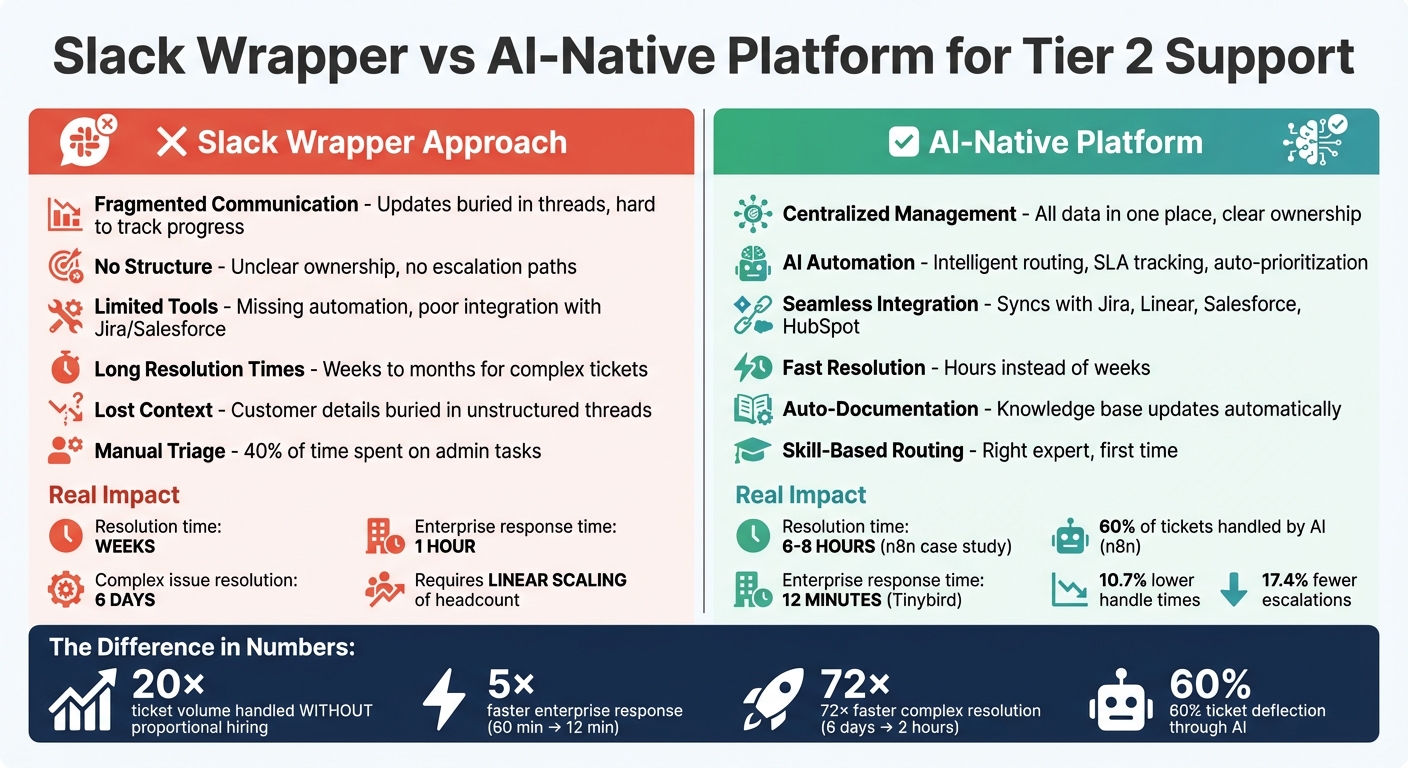
Slack Wrapper vs AI-Native Platform Comparison for Tier 2 Support
Why the ‘Slack Wrapper’ Fails at Tier 2 Support
Complex Issues Involving Multiple Teams
When a support ticket involves input from multiple teams – like engineering, product, and customer success – Slack’s fragmented nature can create chaos. Key updates often end up scattered across various channels, leaving no centralized view for teams to follow. Will Stewart, CEO of Northflank, described the problem:
"Before Plain, managing support across email and Slack was chaotic. We were constantly losing track of conversations, and it was hard to escalate issues to engineering." [2]
Tinybird faced similar struggles, noting how switching between tools created confusion:
"We had to jump between tools all the time. We’d lose track of what was active or urgent. Things were easy to miss." [2]
This fragmentation only amplifies as tickets grow more complex or stretch over long periods.
Tickets That Take Weeks or Months to Resolve
Slack’s conversational style isn’t built for handling long-running tickets. When threads drag on for weeks or months, crucial updates get buried, making it difficult for new team members to catch up on the case history. For example, n8n transitioned from Slack threads to an AI-powered platform, reducing resolution times from weeks to just 6–8 hours – even while managing a 20× surge in ticket volume. [2]
Adding to the challenge, Slack introduced stricter rate limits on March 3, 2026, for apps not listed on its Marketplace. These limits, targeting the conversations.history and conversations.replies methods, restrict access to full conversation histories. [3] For teams managing hundreds of long-running tickets, this can severely disrupt workflows when historical context is needed most.
The result? Prolonged ticket lifecycles that make escalation and tracking ownership a logistical headache.
Tracking Escalations and Ownership
One of the biggest flaws in the "Slack wrapper" approach is its lack of structured accountability. As tickets bounce between teams, it becomes difficult to track ownership or ensure that SLAs are consistently met. Instead of using defined workflows, teams rely on @mentions, which increases the risk of urgent issues slipping through the cracks. Raycast experienced this firsthand:
"We were treating every issue with the same priority, which wasn’t efficient or scalable." [2]
Without proper escalation tracking, support leaders face challenges in identifying bottlenecks, measuring resolution times, or planning for future capacity. As one team explained:
"The number of Slack Connect channels we have is unmanageable without something like Plain. Beyond speeding things up, it’s enabled us to actually give our customers really solid support." [2]
The lack of a structured system leaves teams scrambling to maintain oversight, often at the expense of efficiency and customer satisfaction.
sbb-itb-e60d259
Where Tier 2 Workflows Break Down
Tier 2 workflows often stumble not just because of their complexity or extended resolution times, but also due to lost customer context, limited automation, and poor integration with essential tools.
Lost Customer Context in Thread Conversations
Slack’s chat-based structure can bury critical customer details, making it difficult for Tier 2 engineers to pick up where others left off. When an engineer joins a conversation weeks later, they’re often faced with a long, unstructured thread. Key information – like what steps the customer has already taken, prior promises, or the root issue – gets lost in the noise. This forces engineers to sift through endless messages or ask for details that should already be accessible.
Slack’s API limitations make this worse. Rate limits and message size restrictions can prevent syncing comprehensive case data. During a critical escalation, these constraints can delay or block messages, leaving teams without the information they need. Sanity’s team shared their frustrations with an outdated integration:
"We were making six API calls just to do one thing. The integration was gnarly, the interface felt dated, and common actions, like editing messages in Slack, just weren’t possible." [2]
Missing Automation and AI Capabilities
Slack wrappers often lack advanced features like intelligent routing, conversation summaries, or automated SLA tracking. As a result, support teams spend more time on manual triage instead of resolving issues.
Companies using Slack-native tools see measurable improvements, including 10.7% lower handle times and 17.4% fewer escalations compared to those relying on basic integrations. [1] Without AI to manage repetitive tasks or identify urgent issues, teams waste valuable time. For example, n8n implemented an AI layer that handled 60% of tickets, allowing their team to focus on critical Tier 2 tasks, even as ticket volume surged 20×. [2]
When automation is lacking, inefficiencies snowball, especially when tools don’t integrate smoothly with Tier 2 workflows.
Weak Integration with Tier 2 Tools
The real challenge emerges when Tier 2 issues need to flow between support platforms, engineering tools like Jira or Linear, and CRMs like Salesforce or HubSpot. Basic Slack integrations force support agents to manually transfer information, creating friction at every step. Without automated syncing, agents must update case statuses manually, slowing down resolutions and complicating accountability.
Tinybird saw dramatic improvements after switching to a unified platform. Their first response time for enterprise clients dropped from 1 hour to 12 minutes, and complex issue resolution times fell from 6 days to just 2 hours – all by eliminating the need to jump between disconnected systems. [2] Will Stewart, CEO of Northflank, highlighted similar issues when managing support across Slack and email before integrating Linear:
"Before Plain, managing support across email and Slack was chaotic. We were constantly losing track of conversations, and it was hard to escalate issues to engineering." [2]
This integration halved response times and streamlined the connection between support requests and development workflows. [2]
Better Approaches for Tier 2 Support
Breaking away from the limitations of basic Slack integrations requires platforms designed specifically for AI-driven workflows. These platforms centralize case management, streamline processes, and use automation to tackle the unique challenges of Tier 2 support.
AI-Native Platforms for Tier 2 Workflows
AI-native platforms are a game changer for managing the complexities of Tier 2 support. Unlike simple Slack-based tools, they seamlessly integrate data from CRMs and billing systems, prioritizing tickets automatically to reduce delays. Advanced triage ensures tickets are routed efficiently, saving valuable time on every case. [4]
Another standout feature is their predictive capabilities. These platforms can forecast customer satisfaction scores and identify patterns in first contact resolution that traditional systems might completely overlook. When a Tier 2 agent resolves a particularly tricky issue, the system captures the resolution steps, automatically drafting knowledge base articles. This proactive approach minimizes the chances of similar problems escalating in the future. As Tina Grubisa, Value Consultant at Mosaic AI, explains:
"Escalations have a much more significant impact than they realize. It’s a bottleneck that can be removed rather easily." [5]
These predictive tools naturally integrate into centralized case management, ensuring all data remains in one place for better efficiency.
Centralized Case Management
Centralized case management eliminates the need for Tier 2 agents to switch between multiple tools. When Tier 1 escalates a case, the complete conversation history transfers seamlessly, giving Tier 2 agents all the context they need.
These platforms also enable internal collaboration, allowing support teams to work directly with engineering or product teams on complex issues. Importantly, this happens behind the scenes, so customers don’t see the internal back-and-forth. Every ticket is assigned a clear owner, status, and priority, ensuring accountability. Any updates made within the platform are synced automatically with customer-facing tools like Slack, keeping everyone on the same page without requiring manual updates.
Automation and Real-Time Reporting
With centralized data as a foundation, automation takes efficiency to the next level. Modern platforms eliminate manual sorting by predicting ticket complexity almost instantly. They also use time-triggered actions and anomaly detection to automate follow-ups and flag potential issues early, enabling teams to address problems before they escalate.
Skill-based routing ensures that complex issues are sent to the right expert immediately, cutting resolution times. Automation also captures knowledge from resolved cases, updating the knowledge base without requiring manual input. This prevents repeated escalations and protects Tier 2 and Tier 3 experts from being bogged down by repetitive tasks. Instead, these experts can focus on strategic improvements, avoiding the "expertise drain" that often hampers productivity. [5]
Conclusion: Moving Past the ‘Slack Wrapper’ Model
The ‘Slack wrapper’ model falls short when tackling Tier 2 support cases. These cases often span weeks or months, involve multiple teams, and demand meticulous tracking – something Slack’s chat-based structure just isn’t designed to handle. Messages slip through the cracks, accountability weakens, and critical details scatter across fragmented threads.
Relying on lightweight tools for Tier 2 workflows adds unnecessary complexity. Without formal ticket assignments, clear escalation paths, or effective SLA management, teams can waste as much as 40% of their time on admin tasks instead of resolving customer issues. This inefficiency forces a linear scaling model, where increased ticket volumes require proportional hiring – an approach that just doesn’t work for growing B2B operations.
To break this cycle, support teams need to shift toward systems designed specifically for Tier 2 challenges. AI-native platforms offer a better path forward. These systems keep all customer context in one place, automate ticket prioritization and routing, and ensure resolutions are documented automatically. By deflecting repetitive tasks and freeing up specialists for complex cases, they allow teams to handle far more tickets – without scaling headcount at the same rate.
Take a close look at your current workflows. If agents are still manually tracking case histories or struggling with unclear ownership, you’re likely encountering the recurring inefficiencies inherent in wrapper-based tools. Purpose-built platforms solve these issues by centralizing case management, ensuring no detail is overlooked.
For B2B teams managing intricate accounts and renewal-driven relationships, the solution is clear: move away from retrofitting chat apps into ticketing systems. Instead, adopt AI-native platforms tailored for Tier 2 support. This shift not only streamlines operations but also delivers better outcomes for both your team and your customers.
FAQs
What signals show Slack threads are failing for Tier 2 support?
Slack threads can fall short for Tier 2 support teams, especially when managing complex cases. Common challenges include disjointed account views, making it hard to see the full picture, and difficulty tracking long-running tickets, which can lead to confusion. The lack of audit trails also becomes a problem, as it hinders accountability and transparency.
Other pain points include misrouted tickets, which waste time, slower response times, and escalation issues that complicate meeting SLAs (service-level agreements). These challenges often escalate when teams rely on manual processes without automation, exposing Slack’s limitations in scaling workflows for advanced support needs.
How can we keep clear ticket ownership and SLAs without leaving Slack?
To keep ticket ownership and SLAs organized in Slack, structured workflows are key. Tools like Pylon can help by turning Slack conversations into trackable tickets. These tickets come with assigned owners, priorities, and SLA tracking, making it easier to manage support tasks.
Here are a few tips to streamline the process:
- Use dedicated support channels to centralize communication.
- Set up clear escalation protocols to handle complex issues.
- Automate ticket routing based on ownership rules or priority to save time.
This approach promotes transparency, enables real-time SLA tracking, and ensures your support operations within Slack run smoothly.
What should an AI-native Tier 2 support platform include?
An effective AI-driven Tier 2 support platform needs to excel at managing complex issues that often involve multiple stakeholders. Key features should include advanced ticket management tools – such as SLA tracking, task prioritization, and automation – to streamline workflows. Additionally, omnichannel communication is essential for smooth collaboration across teams and channels.
By incorporating AI-powered automation, the platform can minimize repetitive tasks and intelligently route tickets to the right teams or agents. Beyond that, AI-driven insights play a crucial role in monitoring customer health and offering predictive analytics. These capabilities allow businesses to adopt proactive strategies and scale their operations efficiently, especially in B2B settings.