When your customer support operations feel stretched, it might be time to move beyond Pylon. Here’s how to tell:
- Fragmented Account Views: Struggling to track multi-stakeholder relationships? If your team spends too much time piecing together context from Slack, email, and other tools, you’re likely missing key account insights and renewal opportunities.
- Weak AI Automation: Manual processes slowing you down? Pylon’s limited AI capabilities mean more ticket misrouting, slower resolutions, and higher operational costs.
- Scaling Challenges: As your team grows, hidden costs like implementation, IT resources, and manual processes can make Pylon unsustainable.
- Outdated Knowledge Management: If your knowledge base doesn’t keep up, ticket volumes rise, self-service fails, and customer trust erodes.
Key takeaway: If rising inefficiencies, poor account visibility, and limited automation are holding you back, it’s time to consider an AI-driven platform that can scale with your business and streamline operations.
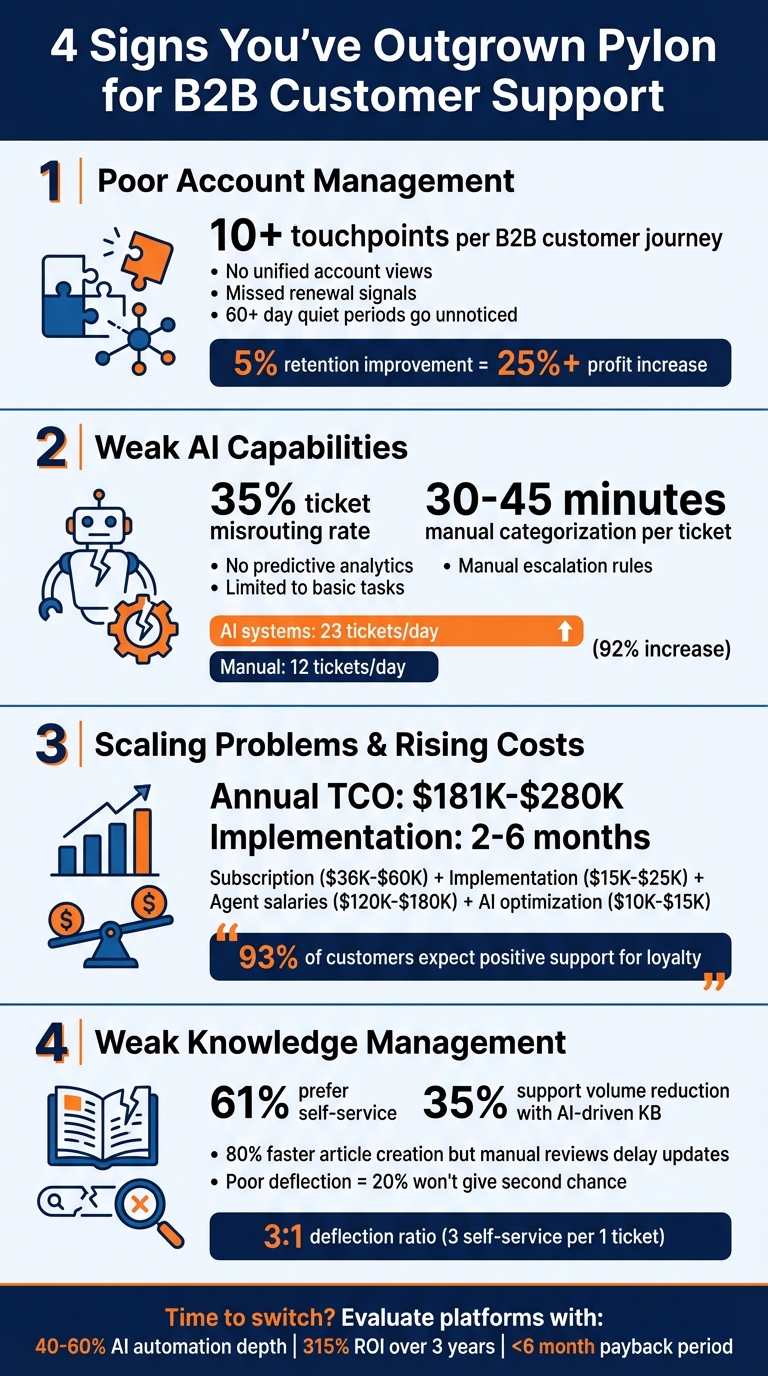
4 Signs You’ve Outgrown Pylon for B2B Customer Support
We Automated 80% of Customer Support With One AI Agent (No Code)
sbb-itb-e60d259
Sign 1: Poor Account Management for Multi-Stakeholder B2B Relationships
Managing B2B relationships is no small feat. Unlike B2C, where the focus is on individuals, B2B support involves entire organizations. That means keeping track of technical users, managers, procurement teams, and executives – all at the same time. If you’re relying on Pylon, its shortcomings become glaring as soon as you try to juggle these complex dynamics without proper visibility tools.
Missing Unified Account Views
When your system lacks a unified account view, your support team ends up working in silos. Different teams engage with various stakeholders but have no insight into each other’s activities. The result? Duplicated efforts, missed issues, and a lot of wasted time.
The inefficiencies stack up quickly. Your teams burn hours digging through Slack messages, email threads, and call recordings just to piece together context. And with modern B2B customers interacting across 10+ touchpoints during their support journey, this fragmented approach becomes a logistical nightmare. Metrics like first response time or resolution time become impossible to track at the account level – they’re only measurable per ticket. That leaves you flying blind on key account insights.
This lack of cohesion also makes it hard to spot early warning signs. For instance, you might miss when an account goes quiet for 60+ days or overlook a sudden surge in ticket volume that hints at deeper problems. Without centralized insights, taking proactive steps is nearly impossible. And here’s the kicker: improving retention by just 5% can increase profits by over 25%. An AI-native platform can solve these issues by seamlessly integrating data and automatically surfacing account-level patterns. Without these tools, even something as critical as renewal management takes a hit.
Weak Renewal Management Capabilities
The problem doesn’t stop at fragmented account views. Renewal management becomes a major challenge when critical data is scattered across multiple systems. Without a reliable account health scoring system, every ticket looks the same, making it hard to focus on high-value accounts that need extra care.
Key renewal blockers – like a champion leaving the company or changes to a customer’s tech stack – often get buried in unstructured data. And when support and success teams operate in disconnected systems, it’s nearly impossible to predict and spot churn signals until it’s too late. This lack of coordination can derail renewal discussions, especially when unresolved support issues creep into the conversation. For B2B companies, fragmented tools can cost 15–20% in potential revenue growth.
An AI-native platform can bridge this gap, automating renewal signals and unifying support and success data. Without a system like this, poor account visibility becomes a costly risk that no B2B company can afford.
Sign 2: Weak AI Capabilities for Automation and Insights
Building on the data fragmentation issues mentioned earlier, weak AI capabilities can make these problems even worse by stalling automation and limiting predictive insights. If your support platform isn’t leveraging AI effectively, you’re leaving efficiency on the table. For example, Pylon’s AI performance heavily depends on the quality of its documentation – outdated or incomplete articles restrict its potential. Even with solid documentation, the system mainly handles basic tasks, leaving complex troubleshooting to be done manually.
No Predictive Analytics
Predictive analytics can be a game-changer, but without it, B2B organizations are left relying on gut feelings rather than data-driven decisions. For instance, if your system doesn’t use predictive models for metrics like CSAT (Customer Satisfaction) or CES (Customer Effort Score), your team has to manually track sentiment trends to catch warning signs of churn. This manual process not only slows things down but also adds operational strain. In fact, systems that lack AI-powered triage misroute about 35% of tickets. This leads to slower resolutions, wasted resources on low-priority accounts, and the risk of neglecting high-value customers. Beyond these predictive gaps, the inability to automate and optimize your support workflows can make scaling up your operations a real challenge.
Missing AI-Powered Automation
Without strong AI-driven automation, support teams often resort to direct scaling, where costs and headcount increase alongside ticket volume. For example, manual ticket categorization can take anywhere from 30 to 45 minutes per ticket, while AI automation can handle the same task in seconds. AI-powered systems also significantly boost productivity – agents can handle up to 92% more tickets, increasing their daily workload from 12 to 23 tickets, while cutting the average cost per ticket from $22 to $11.
Some real-world examples highlight these gaps. In June 2025, AssemblyAI used Pylon’s AI Agent to cut their first response time by 97%, dropping from 15 minutes to just 23 seconds. They also improved their AI resolution rate from 25% to 50%. However, even with these gains, Pylon’s AI agents still rely on manual escalation rules and struggle with requests outside of business hours. For teams that require 24/7 coverage or fully autonomous case handling, these limitations can quickly become deal-breakers.
Sign 3: Scaling Problems and Rising Costs
As your support team expands, the real cost of your platform begins to reveal itself. A pricing structure that works for a small team of five agents can quickly become unsustainable when you scale to 20 or 50 agents. Platforms like Pylon, with their custom pricing models, often come with hidden costs beyond the monthly subscription. You’re also footing the bill for implementation, ongoing upkeep, technical support, and the human resources required to manage tasks that AI can’t handle.
Rising Total Cost of Ownership (TCO)
The subscription fee is just the tip of the iceberg. AI-powered platforms typically cost between $181,000 and $280,000 annually. This includes subscription fees ($36,000 to $60,000), implementation and setup ($15,000 to $25,000), salaries for human agents handling escalations ($120,000 to $180,000), and ongoing AI optimization ($10,000 to $15,000). For legacy platforms, "Premier Support" add-ons can add an extra 20% to 35% of your annual license fee.
And then there’s ticket misrouting – an issue that occurs in about 35% of cases with poorly configured platforms. Every misrouted ticket leads to unnecessary back-and-forth, wasting both time and money.
"The sticker price is just the beginning. Additional costs include implementation services, premier support add-ons, and essential integrations." – Pylon Team
"At a certain point, your customer base grows faster than your support budget. You can’t just keep hiring more people at the same rate – the math doesn’t work out." – Marty Kausas, CEO of Pylon
These quotes emphasize how scaling with manual processes and tools like Pylon becomes financially impractical. When 93% of customers expect a positive support experience to remain loyal, relying on headcount growth alone is an unsustainable strategy.
But rising costs aren’t the only issue. The technical demands of these platforms can also put a strain on your operations.
Heavy Dependence on IT Resources
Many platforms require constant IT involvement to keep things running smoothly. Integrating with CRMs, development tools, and communication systems often demands dedicated technical resources. This creates a bottleneck: every workflow adjustment, new integration, or troubleshooting session diverts your IT team from other critical tasks.
For enterprise platforms, implementation timelines can stretch from 2 to 6 months, assuming you have the technical staff to handle it. If your system requires custom-built connectors or workarounds to unify data across tools, these hidden costs only grow as your company scales. This "context-switching tax" slows down your team’s ability to respond efficiently, especially when agents have to juggle multiple tools to resolve a single ticket. The result? Reduced operational agility, lower customer satisfaction, and ultimately, higher churn.
These challenges underline the need to transition to an AI-native platform designed to support sustainable growth without overburdening your team or budget.
Sign 4: Weak Knowledge Management and Self-Service Tools
As your business scales, outdated knowledge management systems can make Pylon’s limitations even more apparent. When the knowledge base isn’t up to date, simple customer questions quickly turn into support tickets. Each unresolved query adds to your team’s workload, while outdated articles frustrate users. This means your support team spends more time putting out fires than solving the complex issues that are critical in a B2B environment.
Although Pylon’s AI can speed up article creation by up to 80%, the need for manual reviews to ensure accuracy and maintain brand standards causes delays. Weekly updates require constant reviews, which leaves your documentation perpetually behind. With 61% of customers preferring self-service for straightforward issues, falling behind on maintaining an accurate knowledge base directly increases ticket volumes.
Poor Knowledge Base Automation
The problem isn’t just about speed – it’s also about scalability and governance. AI-driven knowledge bases can reduce support volumes by 35%, compared to 23% for traditional systems, but only if the content stays up to date. Unfortunately, Pylon’s tightly integrated system connects its knowledge base to its support platform, limiting flexibility. For organizations that need advanced features like specialized Markdown editors or multi-level version control, this setup can fall short.
"Outdated articles erode trust faster than missing content." – Pylon Team
Without automated tools to audit and update content, your team misses opportunities to cut search times by up to 35%. This creates a frustrating cycle: customers search for answers, find outdated or irrelevant information, and submit tickets that could have been avoided. This lack of effective content management weakens self-service efforts and undermines customer trust.
Ineffective Self-Service Deflection
When self-service tools fail, ticket volumes rise, and operational costs grow alongside your customer base. Companies with strong deflection strategies report benefits like 45.8% headcount avoidance and 30% lower customer churn. Without effective deflection, businesses are forced to hire more agents, even though AI-driven B2B enterprise customer support systems can significantly improve productivity – boosting the number of tickets handled per agent from 12 to 23 daily, a 92% increase.
In B2B support, the stakes are high: nearly 20% of customers won’t give you a second chance after a poor service experience. If your knowledge base can’t address technical questions or your chatbot relies on outdated, rigid menus instead of conversational AI, you’re not just adding to your team’s workload – you’re damaging customer relationships. A solid self-service system should aim for a 3:1 deflection ratio, meaning three self-service resolutions for every ticket submitted. Falling short of this benchmark is a clear indicator that your current tools aren’t keeping up with your growth.
When to Move to an AI-Native B2B Platform
Deciding to switch from Pylon – or any similar platform – comes down to recognizing when your current system is holding you back. If you’re dealing with rising ticket costs, stagnant automation rates, or declining customer health scores, it’s a clear signal that sticking with the status quo might be costing more than making a change. To help pinpoint the right moment to transition, focus on the metrics below.
Key Evaluation Metrics
Start by identifying what drives success in B2B operations. A critical measure is AI automation depth. Platforms capable of autonomously managing 40% to 60% of tickets represent a major step up compared to basic chatbots, which often max out at 25% automation. For example, AssemblyAI achieved a 97% improvement in first response times – cutting them from 15 minutes to just 23 seconds – by implementing AI-powered runbook automation. This highlights the level of automation depth you should aim for during your evaluation.
"Our customers are developers who expect quick, actionable support. We needed a way to meet them where they work without slowing down." – Lee Vaughn, Manager of Support Engineering, AssemblyAI
Another critical factor is dynamic SLA management. Your platform should adapt response targets based on account tier, renewal timelines, and escalation history, rather than relying on rigid, one-size-fits-all rules. Efficiency also matters: modern platforms can boost agent productivity from 12 to 23 tickets per day (a 92% increase) while cutting average ticket costs in half – from $22 to $11. If your platform doesn’t deliver similar results, it’s a sign you’re paying more for less.
To calculate ROI, multiply the minutes saved per interaction by the total number of interactions, divide by 60, and then multiply by your agent’s hourly cost. Leading B2B platforms often deliver a 315% ROI over three years, with payback periods under six months. Considering that 57% of enterprise buyers expect ROI within three months, platforms that fail to show quick value creation should raise red flags. These metrics provide a clear framework for assessing when it’s time to move forward.
Priorities for Platform Transition
Once you’ve identified performance gaps, focus your evaluation on addressing core issues like automation and account-level intelligence. Prioritize platforms that emphasize account-centric intelligence rather than ticket-centric workflows. A strong platform should consolidate signals across entire accounts – not just individual users – to calculate health scores and flag churn risks ahead of renewal dates. Platforms designed specifically for B2B operations excel in this area, unlike consumer tools retrofitted for business use.
Look for predictive insights baked into the system rather than offered as pricey add-ons. The right platform should automatically detect accounts with negative communication trends, flag expansion opportunities based on product usage, and predict CSAT outcomes before surveys are even sent. These features help prevent problems instead of just documenting them after the fact.
Workflow automation should go beyond simple ticket routing. Advanced systems analyze message content, customer attributes, and sentiment to automatically categorize and prioritize requests, ensuring they’re routed to the right specialists without manual effort. Tools like agent copilots, which suggest real-time replies and summarize conversations, enable teams to handle complex issues faster while maintaining the personal touch that B2B relationships demand.
Finally, don’t overlook practical needs. Platforms should be easy to configure and maintain without heavy IT involvement. They should integrate natively with tools like Slack and Microsoft Teams (not just email) and meet enterprise security standards like SOC 2 Type II compliance. Before committing, test your top choices using real-world scenarios – like multi-stakeholder conversations or compliance-related escalations – to ensure the system performs under pressure. Demos alone won’t reveal how a platform handles the complexities of your business.
Conclusion
Fragmented account visibility, limited automation, rising costs, and ineffective self-service options are clear signs your current platform might be holding you back. When you can’t track multi-stakeholder relationships under one unified account view – or if predictive intelligence and native business messaging are missing – operational friction only increases as your business grows.
Switching to an AI-driven B2B platform can change the game. It breaks the traditional scaling model, enabling teams to manage higher volumes without the need for additional staff. With AI driving down costs and boosting productivity, the financial benefits are hard to overlook.
The advantages go beyond just cost savings. AI-powered platforms can turn customer support into a revenue generator. By integrating support signals with account health scoring, renewal tracking, and churn prediction, these platforms not only safeguard retention but also uncover growth opportunities. According to Salesforce, 91% of organizations now measure service-driven revenue, acknowledging the direct impact of support on profitability.
Take a closer look at your current setup using key metrics like cost per ticket, the extent of AI automation, and account-focused intelligence. If your platform needs constant IT support, lacks integrations with tools like Slack or Microsoft Teams, or can’t predict customer satisfaction scores before surveys, you’re likely spending too much for too little in return.
The platforms built for 2026 focus on efficiency, predictive insights, and straightforward pricing – without hidden costs. Whether you’re managing 50 customers or 5,000, the right platform should grow with your business, not against it. It’s time to choose a solution that scales seamlessly and supports your long-term growth.
FAQs
What are the benefits of using AI-driven platforms for B2B customer support?
AI-powered platforms are reshaping B2B customer support by making operations smoother and boosting productivity. Using natural language processing (NLP) and machine learning (ML), these tools take over repetitive tasks – like answering routine questions, directing tickets to the right agents, and drafting responses based on past interactions. This not only lightens the manual workload but also speeds up response times, allowing teams to manage more tickets without increasing headcount.
What’s more, these platforms enable personalized and proactive support by offering real-time customer insights and simplifying teamwork within multi-stakeholder accounts. With easy integration into tools like Slack or Teams, they help reduce hurdles and dramatically improve response times. By automating workflows, fine-tuning ticket management, and aiding smarter decision-making, AI-driven solutions empower B2B support teams to scale efficiently, cut costs, and deliver the fast, tailored service that today’s customers demand.
What are the cost considerations when switching from Pylon to an AI-driven support platform?
Switching to an AI-powered support platform comes with upfront costs, but the long-term financial benefits often make it worthwhile. Initial expenses usually include data migration, system integration, and staff training. However, these are often balanced out by the efficiency and automation the platform delivers.
AI-driven platforms can automate 40-60% of support tickets, significantly reducing the need for manual intervention. This not only cuts operational costs but also speeds up response times. Plus, these platforms are typically quick to implement – taking days instead of weeks or months – helping to keep onboarding expenses in check. Over time, businesses often experience improved customer satisfaction, faster ticket resolution, and even revenue growth. Many companies report seeing a return on their investment in as little as 3 to 6 months.
In short, adopting an AI-based solution is a smart move for scaling B2B support teams, offering a way to streamline operations, reduce costs, and deliver better service.
What metrics should you use to evaluate a new B2B customer support platform?
When evaluating a new B2B customer support platform, it’s essential to focus on metrics that highlight both efficiency and customer satisfaction. Start with indicators like response times (how quickly your team resolves issues), ticket volume capacity (how well the platform scales with demand), and automation effectiveness (the percentage of tickets resolved through AI or automated workflows). These metrics provide a clear picture of how the platform can handle growth while minimizing manual work.
Another key area to consider is cost efficiency. Metrics such as cost per ticket and overall support expenses can help you determine whether the platform delivers a solid return on investment. To measure customer satisfaction, keep an eye on CSAT (Customer Satisfaction Score) and NPS (Net Promoter Score). These scores reflect the quality of service and customer loyalty. For complex B2B setups, account-level metrics like retention rates and churn risk can give you deeper insights into how effectively the platform supports multi-stakeholder accounts.
Lastly, assess how seamlessly the platform integrates with tools like Slack or Teams and whether it simplifies omnichannel support. Look for improvements like faster response times and less context-switching, as these are strong indicators of enhanced agility and overall performance.
Related Blog Posts
- The 3 best help desk ticketing systems for 2026
- How do you build a support org chart that scales (roles, ratios, and when to hire ops)?
- What are common reasons teams leave Service Cloud for a dedicated support platform?
- Pylon alternatives for B2B support: what should you use as you scale?
Evaluating help desks for a B2B team?
Supportbench is all-inclusive from $32 per agent per month, with migration and onboarding included. See pricing or book a 20-minute demo.