Reducing Customer Effort Score (CES) in B2B support is critical to retaining customers and increasing loyalty. High-effort interactions lead to frustration and churn, while low-effort experiences improve retention and repurchase intent. Here’s how to simplify support processes without compromising quality:
- Centralize communication: Use a unified platform to consolidate customer interactions, ensuring seamless transitions across channels.
- Leverage AI for efficiency: Automate ticket routing, triage, and predictive escalation to reduce delays and miscommunication.
- Enhance self-service: Maintain an up-to-date, AI-driven knowledge base to help customers resolve issues independently.
- Monitor sentiment in real time: Use AI to track emotional shifts and intervene early to prevent escalations.
- Tailor support with dynamic SLAs: Adjust response times based on customer value and urgency for faster resolutions.
- Analyze CES with AI insights: Predict effort levels across all interactions, even when surveys are skipped, and address friction points proactively.
Customer Effort Score Impact on B2B Loyalty and Revenue
Customer Escalation Reduction Made Easy: Your Prescription to Efficiency
sbb-itb-e60d259
What Drives Customer Effort in B2B Support
Reducing friction is crucial for maintaining strong B2B support. The challenges often stem from more than just complex product features – they arise from broken information flows across systems, teams, and departments.
At the heart of the issue are siloed organizational structures. Customer journeys are frequently mapped to internal workflows, where Marketing hands off to Sales, and Sales passes the baton to Support. This setup forces customers to navigate confusing internal processes, leading to frustrating handoffs. Add to that disjointed third-party integrations, and customers are often left playing a blame game, with delayed resolutions as the outcome. In fact, 62% of workers report spending excessive time searching for information during their day, which not only slows down support teams but also leaves agents scrambling through CRMs, Slack threads, and knowledge bases to find answers.
Manual processes make things worse, introducing unnecessary handoffs and forcing customers to repeatedly explain their issues. For example, manual escalation analysis can take anywhere from 9 to 13 hours, turning support into a reactive firefight, often because your customer support ticketing system was not designed for B2B complexities. When agents lack context from previous interactions or are constrained by rigid policies, customers feel every extra step as a burden. These inefficiencies ripple through the entire support experience.
What High CES Looks Like in B2B
High-effort experiences tend to follow predictable patterns: repeated handoffs, missing context, and incomplete initial details. Imagine a customer submitting a support ticket without attaching critical information like purchase orders or error logs. Instead of resolving the issue, the agent’s first response is a request for more information. The ticket might then be misrouted to the wrong team, bouncing around before landing in the right place.
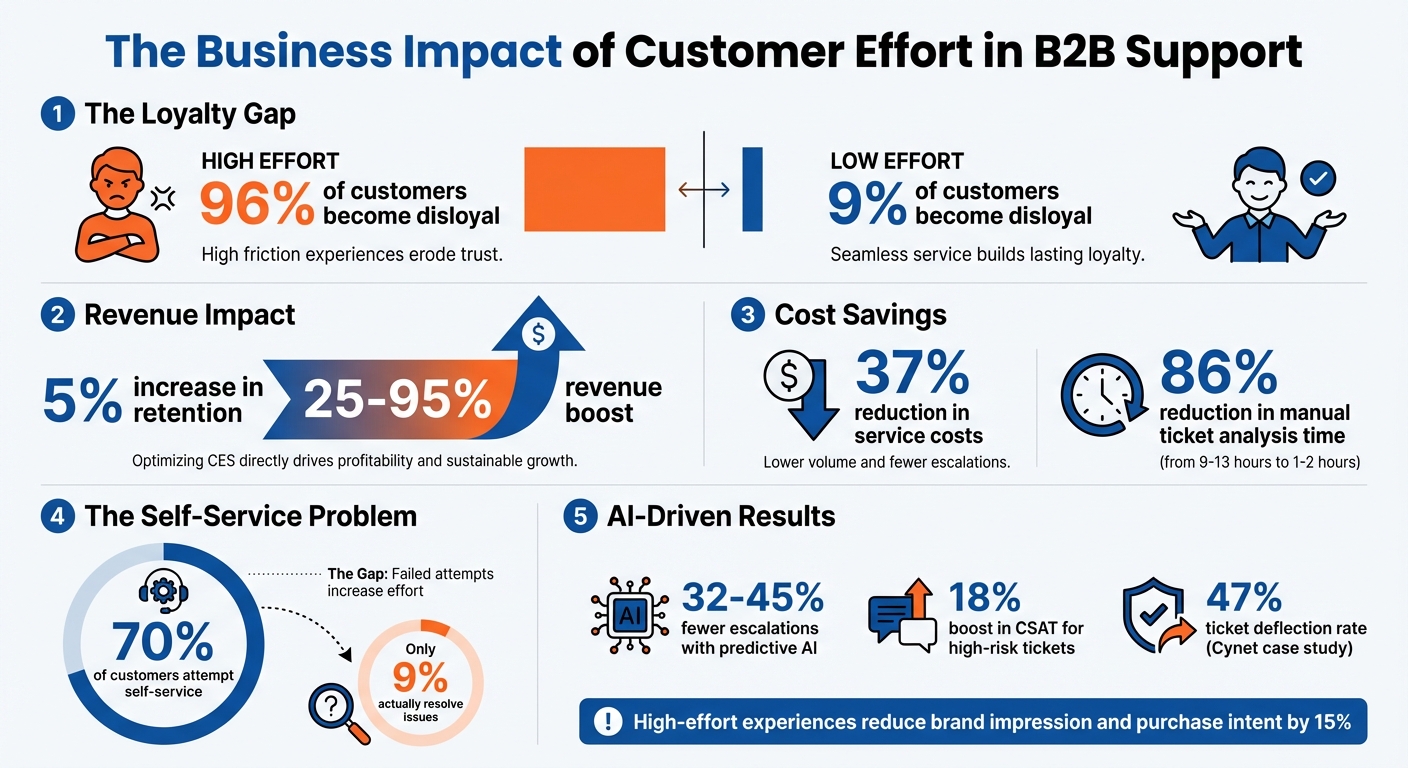
Channel switching adds even more complexity. A conversation might begin in Slack, shift to email, and escalate to a phone call – with no seamless transfer of conversation history. Research shows this kind of fragmentation reduces brand impression and purchase intent by 15%. While 70% of customers attempt self-service, only 9% actually resolve their issues through those channels. This often drives them back into the support queue, frustrated and with higher expectations.
"Customer effort isn’t about the effort to solve the problem. It’s about solving a problem in the first place".
These systemic issues not only make problem resolution harder but also erode long-term customer loyalty.
How CES Affects Retention and Renewals
In B2B relationships, which often hinge on renewals, high-effort support experiences can be a red flag for potential churn. Unlike quick, transactional B2C interactions, B2B partnerships thrive on trust and consistent value delivery over time. When customers face repeated struggles to resolve issues, their frustration doesn’t fade – it lingers. The stakes are high: even a 5% increase in customer retention can result in a revenue boost of 25–95%.
In complex B2B environments, where deals often involve multiple stakeholders, a single poor support experience can sour the relationship across an entire organization. With only 14% of large B2B companies considered genuinely customer-focused, there’s a clear opportunity for businesses to stand out by making customer effort a priority.
How to Reduce Customer Effort Without Lowering Standards
Reducing customer effort means creating smarter systems that remove obstacles at every step. The goal is to simplify processes, automate repetitive tasks, and use AI to direct issues efficiently – all while keeping service levels high for B2B customers.
Build a Unified Support System
Start by consolidating all customer interactions into one central platform. This setup ensures that communication across channels stays seamless and complete. A unified system eliminates the frustration caused by fragmented communication.
Integrating CRM data into this platform is key. It provides a clear view of account details like hierarchies, renewal dates, and past interactions. This way, customers won’t have to repeat basic information like "What product are you using?" or "When did this issue begin?". For instance, Payfirma, a payment processing company serving 10,000 customers, used this approach to handle 800–1,000 monthly requests with just four agents. By combining CRM data with smart workflows, they cut resolution times in half and improved first response times using real-time alerts.
AI-powered triage adds another layer of efficiency. By analyzing intent, language, and sentiment, AI can instantly route tickets to the most qualified agent. This eliminates the back-and-forth of cases bouncing between teams. For more complex issues, automated runbooks guide AI through step-by-step processes, such as diagnosing API errors, without needing human input. Together, unified platforms, CRM insights, and intelligent routing ensure that customers connect with the right person on the first try.
Improve Self-Service with AI-Driven Knowledge Bases
Self-service options only work when customers can easily find accurate answers. The problem with traditional knowledge bases is that they’re often outdated, poorly organized, and hard to search. AI solves this by automatically converting resolved tickets into updated knowledge base entries, keeping documentation current without adding extra work for your team.
To make this work, you’ll need to structure your content for AI. Start by auditing your existing documentation and reformat it into a Q&A style that AI can easily interpret and retrieve during interactions. Set up an approval process for AI-generated drafts to ensure technical accuracy, maintaining the quality standards B2B customers expect.
In June 2025, AssemblyAI adopted Pylon’s AI-powered support platform under Lee Vaughn, Manager of Support Engineering. This move reduced their first response time from 15 minutes to just 23 seconds, enabling 24/7 support without increasing headcount.
"Our customers are developers who expect quick, actionable support. We needed a way to meet them where they work without slowing down." – Lee Vaughn, Manager of Support Engineering, AssemblyAI
For more complex B2B issues, runbooks are invaluable. These step-by-step guides help AI handle edge cases that typically require human expertise, ensuring consistent quality. When AI isn’t confident, the system escalates the issue to a human, avoiding the risk of incorrect responses.
By combining intelligent routing with well-organized self-service tools, you can reduce customer effort without compromising on thoroughness.
Use AI for Predictive Routing and Prioritization
Traditional routing systems rely on rigid keywords and dropdown menus, which often fail when issues are mislabeled or more nuanced. AI, on the other hand, uses Natural Language Processing to understand the actual intent and urgency behind requests, routing them based on context instead of keywords.
AI evaluates multiple factors simultaneously, including sentiment (e.g., frustration or anger), urgency keywords like "outage" or "cannot log in", customer value from CRM data, and patterns such as frequent follow-ups. It then assigns tickets to the best-suited agent based on expertise and real-time availability.
Predictive escalation takes this a step further by analyzing historical data to anticipate when tickets are likely to escalate. This enables teams to intervene proactively, leading to a 32% drop in escalations and a 28% improvement in Mean Time to Resolution. High-risk tickets managed with AI see an 18% boost in CSAT, CES, and NPS scores.
"AI routes the ticket to the best-equipped available agent or queue the first time. This minimizes internal transfers (‘ticket tennis’), reduces delays, and ensures customers connect with someone who can actually solve their problem faster." – Nooshin Alibhai, Founder and CEO, Supportbench
AI can also request missing details – like logs or invoice numbers – before an agent gets involved. This reduces the back-and-forth exchanges that slow down resolutions, making the process smoother for customers while still being thorough. By combining predictive routing, proactive escalation, and intelligent triage, you can deliver faster, more efficient support at every touchpoint.
Use Real-Time Sentiment Analysis for Dynamic Support
Sentiment analysis tracks emotional shifts during customer interactions, allowing businesses to step in before frustration escalates into churn. AI evaluates tone across categories like Very Positive, Positive, Neutral, Negative, and Very Negative, updating these scores with every customer reply. This real-time tracking identifies "sentiment drift", where a customer may start neutral but grows increasingly frustrated with each interaction.
The stakes are high. Studies reveal that 76% of customers remain loyal to brands that make them feel appreciated. On the flip side, 80% of customers consider switching to competitors after just two negative experiences. For B2B companies, where relationships often involve years-long contracts worth six or seven figures, these emotional cues can signal churn risks that traditional metrics like CSAT might overlook. This emotional layer adds depth to AI’s role in streamlining customer support.
"Emotion is no longer a soft metric – it’s a hard business outcome driver." – Forrester
Sentiment analysis also pinpoints problem areas in the customer journey. For instance, in February 2025, Firstsource – a telecom giant – analyzed 70,000 customer chats using FirstCustomer Intelligence (FCI). They uncovered that 6% of calls stemmed from frustrations over specific issues, such as TV streaming and password resets. By automating resolutions for these problems, they cut call volume by 6% and raised satisfaction rates from 64% to 84%.
Prevent Escalations with Early Intervention
Using real-time sentiment insights, AI doesn’t just monitor emotions – it actively prevents issues from escalating. It flags warning signs like sharp negative language, frequent follow-ups in a short timeframe, or a shift from neutral to negative sentiment. When these patterns emerge, the system alerts a Customer Success Manager or escalates the issue to a senior specialist for immediate attention.
Salesforce demonstrated the effectiveness of this approach by using SupportLogic‘s real-time sentiment analysis. During spikes in negative sentiment, their team coordinated responses, leading to a 56% drop in escalation rates. The key was acting on sentiment trends rather than waiting for customers to explicitly request help.
"Whenever we witness a surge in negative sentiment, our team springs into coordinated action, and the outcomes we achieve are consistently on target." – Katherine Sullivan, SVP, Customer Success, Salesforce
Organizations that have adopted AI-driven escalation prediction report 32% to 45% fewer escalations and an 18% boost in CSAT for high-risk tickets that received proactive intervention. Additionally, manual ticket analysis time shrinks dramatically – falling from 9–13 hours to just 1–2 hours, an 86% reduction.
Adjust SLAs Based on Customer Context
Dynamic SLAs take early interventions a step further by tailoring response times to customer-specific contexts. These SLAs combine sentiment data with account details to adjust targets in real time. For example, if AI detects negative sentiment in a high-value account nearing renewal or one with premium support, response time thresholds are automatically tightened.
Databricks has successfully implemented this strategy using SupportLogic’s proactive support signals. By analyzing ticket language, SLA status, account details, and product usage, they generated timely alerts for intervention. This approach led to a 15% reduction in SLA misses.
"[SupportLogic can] look at the actual content, process it intelligently, and generate alerts and signals to intercept and intervene at the right time." – Matt Blair, SVP Support and Customer Success, Databricks
Measure and Optimize CES with AI-Driven Insights
Measuring Customer Effort Score (CES) with AI takes support operations to the next level. Traditional CES surveys often capture feedback from less than 20% of customers, which leaves a huge gap in understanding the experiences of the "silent majority". AI bridges this gap by analyzing 100% of customer interactions – from emails to chats and calls – delivering predictive effort scores for every customer, even those who skip surveys. This proactive approach shifts the focus from reactive feedback to predictive insights, helping B2B teams tackle friction points before they affect retention.
Track CES and First-Contact Resolution (FCR) with AI
AI tools can analyze the content of interactions, metadata, and agent actions to assess effort in real time. Platforms like Supportbench display Predicted CES and Predicted FCR scores right in the case list, making it easy for supervisors to identify high-effort cases without sifting through lengthy transcripts.
"Low predicted CSAT or high predicted CES scores act as early warning signals for potentially at-risk customers. Instead of waiting for a negative survey… you can proactively intervene." – Eric Klimuk, Founder and CTO of Supportbench
When a low predicted CES score pops up, AI-generated summaries provide instant clarity on the root causes of friction, such as repeated requests for the same information or long wait times. These summaries save managers hours by pinpointing issues in seconds.
AI also enables automated workflows to address problems immediately. For instance, if a high-value account shows a "Predicted High Effort" score, the system can automatically create a task in the CRM for a Customer Success Manager to reach out before the customer considers leaving. This proactive approach ensures that even issues missed by surveys are addressed, leading to quicker resolutions and continuous process improvements.
Use CES Data to Improve Long-Term Retention
CES insights play a direct role in shaping retention strategies. Customers who encounter high effort during problem resolution are 96% more likely to become disloyal, while reducing effort can boost repurchase intent by up to 94%.
Take Cynet, a B2B cybersecurity company, as an example. In 2024, they used generative AI to enhance support efficiency, achieving a 14-point CSAT increase (from 79 to 93). The AI-driven system also delivered a 47% ticket deflection rate, resolving nearly half of all tickets at Tier 1 without escalation.
Another example is Rapid7, which implemented AI to unify its knowledge base across platforms like Slack, Notion, and Zendesk. By equipping agents with real-time AI assistance, they sped up ticket handling and maintained a 95% CSAT score, all while managing higher ticket volumes without adding staff. These cases highlight how AI-driven CES improvements not only protect revenue but also keep operational costs in check.
"Reducing customer effort has a proven relationship to higher-level organizational goals, such as maintaining customer loyalty and minimizing service costs." – Gartner
To ensure accuracy, a human-in-the-loop calibration process is essential. Manually scoring a portion of interactions helps create a reliable dataset that refines AI predictive models over time. Feeding intervention outcomes – like whether a callback resolved the issue – back into the system further improves accuracy and reduces false positives. This continuous feedback loop keeps AI insights reliable as customer needs and support processes evolve. Reducing customer effort isn’t just about faster resolutions – it’s about securing loyalty that lasts.
Conclusion
Bringing together the strategies outlined earlier, it’s evident that simplifying customer effort can reshape the landscape of B2B support. This isn’t about cutting corners or lowering standards – it’s about working smarter. Tools like AI-driven knowledge bases, predictive routing, and real-time sentiment analysis ensure customers get the right answers quickly, preventing frustration from escalating into churn.
Here’s a telling statistic: 96% of customers who endure high-effort interactions become less loyal, compared to just 9% of those who have low-effort experiences. Plus, making support easier leads to a 37% drop in service costs, as fewer customers need to follow up or escalate issues. In short, simplifying support not only strengthens customer loyalty but also trims operational costs.
"Reducing customer effort is a stronger driver of loyalty than trying to exceed expectations." – Gartner
AI plays a key role in this transformation. By automating repetitive tasks and delivering predictive insights, it allows your team to focus on meaningful, high-value interactions – the kind that forge lasting relationships. The shift from reactive problem-solving to proactive experience management isn’t just a nice-to-have anymore; it’s essential.
FAQs
How can AI tools make self-service easier and more effective in B2B support?
AI tools make self-service in B2B support faster and more efficient by leveraging automation, natural language processing, and intelligent knowledge management. These tools allow customers to resolve issues quickly by providing tailored solutions through AI-driven chatbots, automated workflows, and smart recommendations. For example, AI can assess customer intent and direct them to relevant knowledge base articles or deliver instant answers, cutting down the need for agent involvement and speeding up problem resolution.
Over time, AI gets smarter by learning from customer interactions, which improves the precision and relevance of its suggested solutions. This not only boosts customer satisfaction but also minimizes support requests through effective ticket deflection. By enabling customers to find answers on their own, businesses can offer smooth, cost-effective support without sacrificing quality or the customer experience.
How does sentiment analysis help reduce customer effort in B2B support?
Sentiment analysis helps support teams gauge customer emotions in real time, making it easier to address issues efficiently. By analyzing the tone of a conversation – whether it’s frustration, dissatisfaction, or positivity – agents can quickly identify and prioritize pressing concerns. This allows them to adapt their responses and tackle problems proactively, sparing customers from having to repeatedly explain their situation. The result? A smoother, faster resolution process.
When paired with AI workflows, sentiment analysis can also automate key tasks like ticket routing and escalation management. For instance, tickets flagged with negative sentiment can be sent to seasoned agents or marked for immediate action. This approach not only speeds up resolutions but also reduces frustration, delivering a more tailored and effortless support experience while keeping service quality high.
How can dynamic SLAs improve customer support while maintaining high standards?
Dynamic SLAs adjust response times in real time by considering factors like case urgency, customer sentiment, and issue complexity. This approach prioritizes critical cases, ensuring they’re handled quickly while maintaining consistent quality across all interactions.
By aligning service levels with the unique demands of each situation, dynamic SLAs make it easier for customers to get help, simplify resolution processes, and improve overall satisfaction – all without compromising the quality your customers rely on.